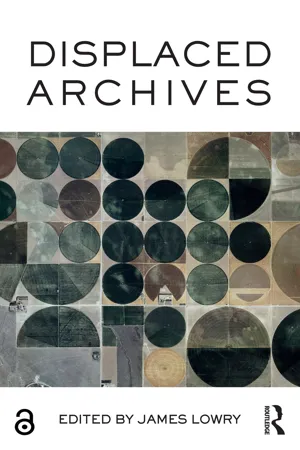
Displaced archives have long been a problem and their existence continues to trouble archivists, historians and government officials. Displaced Archives brings together leading international experts to comprehensively explore the current state of affairs for the first time. Drawing on case studies from around the world, the authors examine displaced archives as a consequence of conflict and colonialism, analysing their impact on government administration, nation building, human rights and justice. Renewed action is advocated through considerations of the legal approaches to repatriation, the role of the international archival community, 'shared heritage' approaches and other solutions. The volume offers new theoretical, technical and political insights and will be essential reading for practitioners, academics and students in the field of archives, cultural property and heritage management, as well as history, politics and international relations.
- 228 pages
- English
- ePUB (mobile friendly)
- Available on iOS & Android
eBook - ePub
Displaced Archives
About this book
Information
1 Archives Seizures
The Evolution of International Law1
Charles Kecskeméti
Historical Summary
Since the seventeenth century, the system of rules governing the relationships between states has been called the jus gentium (law of nations). We owe to Emer de Vattel, citizen of Neuchâtel and subject to the King of Prussia, the brilliant synthesis of this law, still used as a starting point for reflections on public international law.2 Vattel makes a distinction between customary law (tacitly established rules, in other words ‘custom’) and conventional law recorded in treaties; each treaty constitutes a unique case complying with customary law.
Customary and conventional laws concerning archives have existed since the Middle Ages. Studies undertaken under the umbrella of the United Nations Educational, Scientific and Cultural Organization (UNESCO) in the 1970s have identified 144 treaties between 1645 and the end of the Second World War, the former being the date of the Second Treaty of Brömsebro signed between Sweden and Denmark. While most of these treaties relate to the transfer of sovereignty and the records that should accompany the transfer, thirteen of them address the restitution of displaced archives.
All these treaties are governed by three principles of customary law:
1 The predecessor state gives to the successor state the documents necessary for exercising sovereignty and ensuring administrative continuity. The list of archives to be transferred or duplicated is established by agreement between the two parties.
2 The archives displaced during the period the state was dependent are returned when the state becomes independent again.
3 Archives seized and displaced during a war are returned at the end of hostilities to the power against whom the war was being waged.
A fourth principle was added during the twentieth century, according to which the provisional occupying military authorities’ archives would remain the property of the occupying power.
As summarised by R.-H. Bautier in 1961: ‘For centuries there has been, if not an “international law on archives”, at least an “archival issue in the international law”.’3 Neither systematic exposition nor critical studies have been conducted on the international law on archives. There is no handbook, no corpus of treaties and no collection of studies. Archivists have tended only to pay attention to the issue of displaced archives during negotiations to resolve bilateral disputes, and lawyers have seemingly had even less cause to consider the problem. The Institute of International Law, founded in 1873, which meets every two years and whose commissions work inter-sessionally, has considered during its 137-year history, a wide range of topics related to international law, but it has never addressed the issue of archives in international law.
In the archival field, compliance with customary law was respected until the Second World War. In a monarchic Europe, the issue was familial: if a state added a province to its territory, the reigning prince received from his ‘cousin’ the archives that would help him to govern his new province. The advent of the age of popular sovereignty created a new framework. In the Europe of nation states, the transfer of archives is no longer merely a technical operation; it now has a chauvinistic, emotional dimension.
The break with convention regarding transfers in the case of a succession of states occurred after the Second World War. A few agreements were signed just after the war, in particular by France, with newly independent colonies and protectorates. The distinction between sovereignty archives and governance archives as a principle upon which to decide what is owned by who (mainland and colony or protectorate), dates back to this time. These concepts were malleable and gave the negotiators a lot of flexibility, but had the merit of solving a few cases.
The application of customary law suddenly stopped with the great wave of decolonisation, and disputed claims proliferated within ten years. In the 1960s some fifty newly independent countries did not conclude the ordinary agreement to receive the records that would formerly automatically have been given to the new sovereign by his ‘cousin’. Some agreements were secured in 1975 between Portugal and its newly independent colonies, but these consisted solely of the issuance of authenticated copies on both sides, without mentioning the transfer of records in one direction or another. The evacuation of the archives from the former colonies to Europe was not handled uniformly, which led to extreme contrasts in practice. For example, the archives of French West Africa (Afrique Occidentale Française) remained in Dakar, while about 7.5 km of records were transferred from Algeria to France.
The United Nations (UN) and UNESCO, as well as the European Parliament and the Council of Europe, felt the need to put an end to the legal disorder resulting from the fall into abeyance of customary law with respect to archives. One of the conditions for success in such an endeavour is to associate archival expertise with legal expertise so as to ensure that the law reflects the archival issues.4 Studies conducted in the 1960s and 1970s under the aegis of the UN (via the International Law Commission) and UNESCO (via the International Council on Archives, or the ICA) resulted in, amongst other items that I will return to later, three theoretical outcomes:
1 they identified a wide range of topics for further research;
2 they explicated the difficult set of circumstances created by the non-compliance with customary law from 1939;
3 they revealed how significant the lack of theoretical and historical literature was in this field.
An Intellectual Framework for Approaching Resolutions
UNESCO and the ICA’s work began in 1974. The first task was to give the member states a tool in order to facilitate dispute settlements with a typology of disputes, a specific and unambiguous terminology, concepts able to offer a way out of impasses and a coherent set of principles based on practice – in other words, an intellectual framework in which the involved parties could find consensual solutions. UNESCO and ICA’s efforts aimed at initiating the codification of customary law on the basis of an analysis of the conventional law.5
This work found that most of the current and latent disputes fell under one of the four following types:
1 change of sovereignty over a territory, without the creation of a new state;
2 transfers carried out during wars or after a military occupation;
3 creation of new states as a result of break-ups of political entities;
4 impacts of colonisation and decolonisation.
Three principles, based on provenance, were developed to govern the settlement of disputes:
1 The retroactive sovereignty principle, which means that the archives produced by administrations and institutions in charge of managing the business of the territory that has become a newly independent state are devolved to the new state.
2 The territorial origin principle, according to which the archives produced by the territory before it became dependent, and then incorporated in the archives of the annexing or supervising state, are bound to the successor state. This principle also requires the restitution of the public and private archives seized by belligerents during hostilities or by the occupying authorities.
3 The functional pertinence principle, observed by most of the treaties signed after a change of sovereignty, means that the transfer of power and responsibilities must be accompanied by the transfer of archives that are necessary for administrative continuity to be ensured.
The implementation of these principles requires an international climate of détente and a full recognition of the right of every national community to its national heritage. In its effort to celebrate and ensure the continuity of its national heritage, every national community should be able to rely upon the assistance of other states owning sources related to its history. The same spirit of solidarity implies that countries holding information will forward that information to the citizens of other countries who need it to protect or assert their rights. In his presentation for the International Conference of the Round Table on Archives (CITRA) in Thessaloniki, Klaus Oldenhage of the Bundesarchiv, summarising the Federal Republic of Germany’s experience, underlined the crucial importance of professional cooperation for reconstituting the archival heritages dismembered during the Second World War and for getting on with the preservation and opening up of occupying military authorities’ archives.6
If archival holdings are produced by an administration whose succession is divided between several states, and therefore the archival holdings belong to several national heritages, the only responsible solution is to implement the concept of joint heritage. Applying this concept, the archival holdings are entirely preserved in one of the involved countries, ensuring their safety, and the other countries have equal access and moral property rights. This concept has proven to be practicable. It is a fundamental basis of the 1926 Baden–Baden convention between Austria and Hungary. Regarding the transfer of archives from Vienna to Budapest, the Baden–Baden convention, based on the principle of provenance, discarded the territorial pertinence principle, the application of which would have required the division of the archival holdings. The convention stated that the archives produced by the central authorities of the Habsburg Monarchy between 1526 and 1918 were the common, indivisible and inalienable property of Austria and Hungary. The archival holdings’ (held in the Haus-, Hof- und Staatsarchiv, Hofkammerarchiv and Kriegsarchiv) preservation and management were entrusted to Austria. Hungary, as a co-owner, was represented by permanent delegates located in the premises of the Austrian archives. Decisions on access and disposal rules were taken by mutual agreement between the archival authorities of both countries. The documents relat...
Table of contents
- Cover-Page
- Halftitle
- Title
- Copyright
- Contents
- List of Contributors
- Foreword by Eric Ketelaar
- Acknowledgements
- Introduction: Displaced Archives
- 1 Archives Seizures: The Evolution of International Law
- 2 Making Sovereignty and Affirming Modernity in the Archives of Decolonisation: The Algeria–France ‘Dispute’ between the Post-Decolonisation French and Algerian Republics, 1962–2015
- 3 Displaced Archives in The National Archives of the United Kingdom
- 4 Indonesian National Revolution Records in the National Archives of the Netherlands
- 5 Hiding the Colonial Past? A Comparison of European Archival Policies
- 6 Expatriate Archives Revisited
- 7 A Proposal for Action on African Archives in Europe
- 8 Displaced Archives in the Wake of Wars
- 9 Pan-European Displaced Archives in the Russian Federation: Still Prisoners of War on the 70th Anniversary of V-E Day
- 10 Iraq and Kuwait: The Seizure and Destruction of Historical Patrimony
- 11 Networking Records in their Diaspora: A Reconceptualisation of ‘Displaced Records’ in a Postnational World
- 12 Revisiting the Law and Politics of Compromise
- Index
Trusted by 375,005 students
Access to over 1.5 million titles for a fair monthly price.
Study more efficiently using our study tools.
Frequently asked questions
Yes, you can cancel anytime from the Subscription tab in your account settings on the Perlego website. Your subscription will stay active until the end of your current billing period. Learn how to cancel your subscription
No, books cannot be downloaded as external files, such as PDFs, for use outside of Perlego. However, you can download books within the Perlego app for offline reading on mobile or tablet. Learn how to download books offline
Perlego offers two plans: Essential and Complete
- Essential is ideal for learners and professionals who enjoy exploring a wide range of subjects. Access the Essential Library with 800,000+ trusted titles and best-sellers across business, personal growth, and the humanities. Includes unlimited reading time and Standard Read Aloud voice.
- Complete: Perfect for advanced learners and researchers needing full, unrestricted access. Unlock 1.5M+ books across hundreds of subjects, including academic and specialized titles. The Complete Plan also includes advanced features like Premium Read Aloud and Research Assistant.
We are an online textbook subscription service, where you can get access to an entire online library for less than the price of a single book per month. With over 1.5 million books across 990+ topics, we’ve got you covered! Learn about our mission
Look out for the read-aloud symbol on your next book to see if you can listen to it. The read-aloud tool reads text aloud for you, highlighting the text as it is being read. You can pause it, speed it up and slow it down. Learn more about Read Aloud
Yes! You can use the Perlego app on both iOS and Android devices to read anytime, anywhere — even offline. Perfect for commutes or when you’re on the go.
Please note we cannot support devices running on iOS 13 and Android 7 or earlier. Learn more about using the app
Please note we cannot support devices running on iOS 13 and Android 7 or earlier. Learn more about using the app
Yes, you can access Displaced Archives by James Lowry in PDF and/or ePUB format, as well as other popular books in Languages & Linguistics & Library & Information Science. We have over 1.5 million books available in our catalogue for you to explore.