eBook - ePub
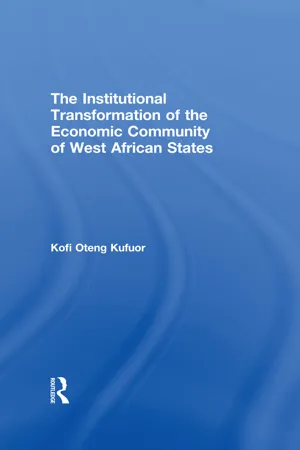
The Institutional Transformation of the Economic Community of West African States
- 190 pages
- English
- ePUB (mobile friendly)
- Available on iOS & Android
eBook - ePub
The Institutional Transformation of the Economic Community of West African States
About this book
This book examines regional economic integration in West Africa within the context of the institutional evolution of the Economic Community of West African States (ECOWAS). It uses the tools of the New Institutional Economics School (NIE) to explore the origins and development of the most recent ECOWAS Treaty. Particular attention is given to the interface between domestic legal arrangements and the success of open markets at the regional and international levels.
Chapter 1
Schools of Thought for the Study of ECOWAS: New Institutional Economics and Ordoliberalism
Two separate, yet at times interrelated scholarly perspectives, Ordoliberalism and New Institutional Economics (NIE), shape this inquiry into the institutional transformation of ECOWAS. Ordoliberalism as an intellectual endeavour emerged in the wake of the collapse of the world economy in the 1930s and disenchantment with international efforts to revive world trade. NIE is an attempt to incorporate a theory of institutions to explain policy success or failure. Ordoliberalism and NIE provide us with methods to explore the decision to adopt the 1993 Treaty and the persistent problems that still face ECOWAS.
A large body of work exists on the Ordoliberal and NIE Schools. However, there has been very little application (if any at all) of the basic premises of these Schools to the study of ECOWAS. For example, influential scholarship on ECOWAS can be found in Samuel Asante’s analysis.1 Asante’s work focuses on the rationale for ECOWAS, its organizational design, and its problems. Then there is the work of Ibrahim Gambari that approaches ECOWAS from a comparative perspective. Gambari contrasts developments, successes, and problems within ECOWAS, with other regional integration schemes and prescribes policy remedies for ECOWAS policy-makers.2 Asante’s and Gambari’s analysis are thought provoking in that they enrich our understanding of the obstacles ECOWAS has faced since its inception in 1975. However, none of them, and other leading studies,3 tries to apply in-depth the theoretical constructs developed by the Ordoliberal and NIE schools.
New Institutional Economics
First, we should note here that NIE scholars make a distinction between institutions and organizations. Institutions are defined as the constraints on human actions, those formal or informal rules that govern every day lives. Organizations are the collective of persons that create institutions, shape them and are shaped by them and can dissolve or reform institutions. Thus institutions defined as “the rules of the game” or the “humanly devised constraints that shape human interaction”,4 are the laws and organizations are the players that implement the laws.5
NIE is a transdisciplinary scholarly enterprise. Its primary aim is to interpret institutions; specifically it explores why institutions emerge, their roles, their dynamics, their persistence, and, assuming they are inefficient, how they should be reformed. To achieve this goal, NIE draws on insights from economics, law, organization theory, political science, sociology and anthropology.6 The difference between NIE and the numerous attempts to discredit neo-classical theory is that NIE discards the notion of instrumental rationality-the hypothesis of neo-classical economics that has made it an institution-free theory. Thus NIE seeks to build on neo-classical theory and so develop it further by incorporating a theory of institutions into it.7
The NIE School traces its roots to two influential papers written by Ronald Coase, the Nature of the Firm8 and the Problem of Social Cost.9 In the Nature of the Firm, Coase asks why, if the market is an optimal system for exchange, we have firms? Coase answers his own question by arguing that the market is not a cost-free mechanism. The cost of using markets such as the problem of ascertaining prices, the need for long-term contracting for the supply of goods and services, the risks associated with forecasting, and the difficulty of writing contracts to cover all details serve to explain why firms arise. The entrepreneur, the main decision-maker, seeks to reduce the cost of relying on the price mechanism by establishing a firm. What the entrepreneur seeks to do in this regard is to subsume all market activities needed for his entrepreneurial endeavour, under the firm’s umbrella. In effect, the firm as Coase sees it is not really a means for converting inputs into outputs. Rather the firm is a governance structure, created to temper, if not completely eliminate, the costs of transacting.10
Coase returned to the theme of transaction costs in his 1960 paper The Problem of Social Cost. Here, the crux of Coase’s analysis is on the resolution of conflicts between parties. Using disputes over resources as case studies, Coase argues that in a world without transaction costs, parties to a bargain would reach agreement on the most rational utilization of resources. In effect, there would be no need for third-party intervention in disputes, as the parties themselves would determine what was to be the most efficient, and thus acceptable, outcome. However, as he acknowledges, the world is not free of transaction costs and thus institutions are created to protect mutually agreed bargains by lessening incentives for post-bargain opportunism.11
Given the influence of Coase’s work12 it is puzzling that the crucial role of institutions in facilitating cross-border economic transactions has not always been acknowledged. Adam Smith and John Stuart Mill, in their work on the political economy of international trade, highlighted this role. However, when David Ricardo set out his principle of comparative advantage he assumed, in the “interests of rigour”, institutional homogeneity. The consequences of Ricardo’s model over time led to the view among “orthodox” trade theorists and economists that at best, institutions were passive and, hence, not really important variables in explaining the success or failure of international exchange.13 NIE scholars in their analysis of international economic relations have challenged this assumption on the supposed passivity of institutions. The NIE School insists that institutions are just as important for international trade (if not more so) as they as for intra-national economic transactions.
The argument in this regard is that relative to international trade, intra-national commerce is characterized by a considerably high degree of institutional certainty. Domestic laws and policies are more stable, and thus create situations where economic decision-makers can predict with considerable certainty the impact of national institutions on their trading activities. Furthermore, domestic business concerns are aware of the consequences of enforcement should they default on their obligations and, subsequently, be held liable in contractual disputes. This is not to assert that national commercial dealings occur in a transaction cost free setting. The point here is that when there is cross-border exchange, there is the likelihood of higher transaction costs through even greater institutional difference and/or uncertainty.
Thus, NIE scholars argue that any model or hypothesis that presupposes low transaction costs at the international level, and thus minimizes the significance of institutions, is seriously flawed. Rather, decision-makers stand to benefit from heightened international trade volumes when there are structures for inter-party bargaining, and dispute resolution because this will lower transaction costs.14 The role of institutions therefore is to assist decision-makers overcome collective action problems and so help yield socially beneficial outcomes. It is when there are no, or very weak institutions, that sub-optimal outcomes are likely to emerge as actors seek to maximize their preferences to the detriment of other actors.15 As we shall see in chapter 3, the role of the revised ECOWAS Treaty is to put in place institutions necessary for strengthening the ECOWAS’ system. The shift in institutional power from an intergovernmental ECOWAS to a supranational one as set out in the 1993 Treaty is, thus a patent attempt to reduce the costs of intra-state cooperation. By assigning greater authority to the Community’s organs, the thinking behind the 1993 Treaty is a manifestation of the need to craft institutions for low-cost collective action. In sum international institutions are extremely important.
A number of other lines of thought under the umbrella of the NIE School16 are relevant for our study of ECOWAS. First there is James Buchanan’s contribution to political economy, his public choice theory that is in essence, an attack on classical presumptions on the motivations of public decision-makers. Buchanan has challenged the generally accepted notion of the public-spirited official who takes decisions in the interests of society at large. Before Buchanan’s work began to shape thinking on the role of decision-makers, political economy assumed the existence of some supposedly “objective welfare function”17 and that legislators and bureaucrats sought to maximize this welfare function. Buchanan’s challenge is premised on the argument that it is impracticable to presume that national decision-makers can realistically aggregate society’s preferences. The size and complexity of the modern state make such a task virtually impossible. Thus, no “objective welfare function” is a myth, constructed to serve as a cover for manipulation of public decision-making processes to the advantage of an elite class of law-makers and their collaborators.
Even if we assume, for the purpose of argument, that it is possible to aggregate social preferences and therefore such a welfare function does exist, what supporters of the public-spirited decision-maker fail to acknowledge is that the aggregation of social preferences is not done by “society”. Instead, it is individuals that make society’s choices and these choices are shaped by their individual private assessment of costs and benefits.18 This is the crux of Buchanan’s public choice theory that has had such a marked impact on political economy.19 In his analysis of decision-making, Buchanan takes pains to point out that organizations do not make decisions – individuals do and thus any study of organizations and/or their institutions is really a study of individuals that constitute organizations and are constrained by institutions. As Buchanan has pointed out:
In my vision of social order, individual persons are the basic component units, and “government” is simply the complex of institutions through which individuals make collective decisions and through which they carry out collective as opposed to private activities. Politics is the activity of persons in the context of such institutions.20
The influence of Buchanan’s methodology is twofold: First, it has challenged scholars of political economy to question the traditional notion of the bureaucrat and/politician as a person who acts in the public interest and, second, it presents us with an alternative; what Buchanan argues is a much more realistic model of the public official. Buchanan’s public official is no different from a private “utility maximizer” notwithstanding that the public official operates in a different, supposedly public interest (non-profit making) setting. As a consequence of his analysis, Buchanan stresses the import of rules to constrain the behaviour of public officials. Without institutions government officials take decisions that tend to maximize their utility (normally but not exclusively, revenue) at the expense of the citizenry.21 For our task then we can claim here that decision-makers have preferences, and that through strategic calculations they act so as to exploit the realization of these preferences.
Buchanan’s public choice theory is not limited in its application to decision-making and institutions at the national level; it can also enlighten our study of international law and organizations. To comprehend public choice assumptions in international relations first necessitates an understanding of the underpinnings of regime theory.22 Regime theorists see regimes as global public goods23 that moderate international transaction costs and information asymmetries. Regimes are thus defined as “sets of implicit or explicit principles, norms, rules and decision-making procedures around which actors’ expectations converge in a given area of international relations.”24 Regime theory assumes rational self-interest but where it differs from public choice theory is that this self-interest is that of states. These interests are also not necessarily the same as the interests of the domestic lobbies and groups that formulate and drive policy in Buchanan’s public choice model.
In contrast, public choice theory’s model of state behaviour on the international level is that of a process determined by rival interest groups who seek to influence international policy to fit their own agendas.25 Thus the...
Table of contents
- Cover
- Half Title
- Dedication
- Title
- Copyright
- Contents
- Preface
- Introduction
- 1 Schools of Thought for the Study of ECOWAS: New Institutional Economics and Ordoliberalism
- 2 The Origins and Evolution of Regional Integration in West Africa
- 3 The Revised ECOWAS Treaty
- 4 The Exclusion of Domestic Interests from Decision-making within ECOWAS Constituent Units
- 5 The Utility of National Courts and Private Citizens in ECOWAS
- 6 Recent Centralizing Tendencies in the Community
- 7 Conclusion
- Appendix
- Index
Trusted by 375,005 students
Access to over 1.5 million titles for a fair monthly price.
Study more efficiently using our study tools.
Frequently asked questions
Yes, you can cancel anytime from the Subscription tab in your account settings on the Perlego website. Your subscription will stay active until the end of your current billing period. Learn how to cancel your subscription
No, books cannot be downloaded as external files, such as PDFs, for use outside of Perlego. However, you can download books within the Perlego app for offline reading on mobile or tablet. Learn how to download books offline
Perlego offers two plans: Essential and Complete
- Essential is ideal for learners and professionals who enjoy exploring a wide range of subjects. Access the Essential Library with 800,000+ trusted titles and best-sellers across business, personal growth, and the humanities. Includes unlimited reading time and Standard Read Aloud voice.
- Complete: Perfect for advanced learners and researchers needing full, unrestricted access. Unlock 1.5M+ books across hundreds of subjects, including academic and specialized titles. The Complete Plan also includes advanced features like Premium Read Aloud and Research Assistant.
We are an online textbook subscription service, where you can get access to an entire online library for less than the price of a single book per month. With over 1.5 million books across 990+ topics, we’ve got you covered! Learn about our mission
Look out for the read-aloud symbol on your next book to see if you can listen to it. The read-aloud tool reads text aloud for you, highlighting the text as it is being read. You can pause it, speed it up and slow it down. Learn more about Read Aloud
Yes! You can use the Perlego app on both iOS and Android devices to read anytime, anywhere — even offline. Perfect for commutes or when you’re on the go.
Please note we cannot support devices running on iOS 13 and Android 7 or earlier. Learn more about using the app
Please note we cannot support devices running on iOS 13 and Android 7 or earlier. Learn more about using the app
Yes, you can access The Institutional Transformation of the Economic Community of West African States by Kofi Oteng Kufuor in PDF and/or ePUB format, as well as other popular books in Law & Business General. We have over 1.5 million books available in our catalogue for you to explore.