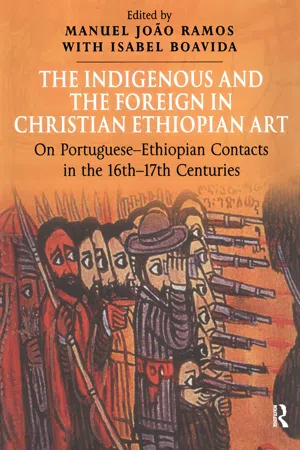
In the rural plateaux of northern Ethiopia, one can still find scattered ruins of monumental buildings that are evidently alien to the country's ancient architectural tradition. This little-known and rarely studied architectural heritage is a silent witness to a fascinating if equivocal cultural encounter that took place in the 16th-17th centuries between Catholic Europeans and Orthodox Ethiopians. The Indigenous and the Foreign in Christian Ethiopian Art presents a selection of papers derived from the 5th Conference on the History of Ethiopian Art, which for the first time systematically approached this heritage. The book explores the enduring impact of this encounter on the artistic, religious and political life of Ethiopia, an impact that has not been readily acknowledged, not least because the public conversion of the early 17th-century Emperor Susïnyus to Catholicism resulted in a bloody civil war shrouded in religious intolerance. Bringing together work by key researchers in the field, these studies open up a particularly rich period in the history of Ethiopia and cast new light on the complexities of cultural and religious (mis)encounters between Africa and Europe.
A Tale of Four Cities: Late-16th and Early-17th Century Ethiopian Capitals and their Turkish, Portuguese and Indian Connections
Richard Pankhurst
Introduction
After the death of Emperor Gälawdewos while fighting against the Muslim emirate of Adal in 1559, his brother, Emperor Minas (15 59-63), took the revolutionary step of abandoning Šäwa, then threatened by Oromo incursions, and established his royal capital at
mfraz, in the mountains overlooking Lake Tana. Minas’s move from the southeast of the empire (linked by long-established trade routes with the Gulf of Aden ports) to the Lake Tana area (linked with trade routes with both the Sudan and the Red Sea port of Massawa) opened a new era in Ethiopian history. This period, which coincided with the advent of the Ottoman Turks at Massawa, the arrival and later expulsion of the Jesuits, and the arrival of Indian and other foreign craftsmen, witnessed the establishment of a series of new camps and settlements in the Lake Tana area.
The towns which emerged in the vicinity of the lake in the late 16th and early 17th centuries differed from the military camps or ‘moving capitals’ of former times. They were protected by stone fortresses, and were the site of royal churches, also built of stone, erected largely with the assistance of foreign artisans including Turks, Indians, Portuguese, and possibly Egyptians. The coming of such craftsmen had no small influence on Ethiopian buildings in the capitals of this period, and led inter alia to the emergence of the so-called Gondarine style of architecture.
The object of the present study is to set the architectural developments of this time in historical context by focusing on the four most important and best documented settlements of the period –
mfraz, Gorgorä, Dänqäz and Gondär. We shall see how monumental architecture developed differently in each of these towns with the involvement of foreigners of different nationalities (albeit utilising Ethiopian labour), introducing differing building styles in the service of the indigenous rulers.
mfraz: Guba’e or Guzara
The earliest of the four capitals, and the first to be built in the north-west of the country, was at
mfraz, overlooking the north-eastern shore of Lake Tana. Emperor Minas apparently first visited the site in 1559, almost immediately after his withdrawal from Shäwa. The new settlement came to be known as Guba’e, literally ‘assembly’ or ‘reunion’, perhaps because it was there that the Emperor and his followers, and doubtless churchmen, foregathered.1 The
mfraz area subsequently attracted the attention of Minas’s son, the warlike monarch Emperor Särṣä D
ng
l (1563-97). His chronicle records that he established himself in a kätäma, or royal camp, at
mfraz in 1571, and installed himself in a makdar, likened in the text to a säqäla or square building. After spending several weeks there, with great feasting, he left to undertake various expeditions, and does not seem to have returned to
mfraz until 1578, when the settlement is described as ‘chosen among all the convents of
mfraz’, and was the site of the s
ra mäng
st or royal palace. A later passage in the chronicle indicates that a fine makfäd or fortress, with an ‘admirable exterior’, had been erected by 1586, as well as sundry dwellings for the Emperor’s soldiers.2
It is worth noting that this building activity took place in the immediate aftermath of Särṣä D
ng
l’s historic victory over the Turks at D
bärwa in T
gray in 1579.3 This triumph had two important consequences – the destruction of the Turkish-built D
bärwa fortress, described by an earlier Ethiopian chronicler as comprising ‘a long wall and a very high tower’,4 and the incorporation of the captured Turkish garrison into the Emperor’s army, which it taught the practice of firing ceremonial fusillades on important occasions.5
It would seem not unreasonable to wonder whether the Turks recently captured at D
bärwa may not have also been employed in the new construction work at
mfraz. If this is the case the recently-demolished Turkish fortress at D
bärwa, with its ‘very high tower’, might well have served as the model for Särṣä D
ng
l’s newly erected fort at
mfraz, with its ‘admirable exterior’.
Despite the existence of this new castle, Emperor Särṣä D
ng
l did not think fit to remain long at
mfraz, and soon abandoned it in favour of settlements further north. The urban development of
mfraz, which had just began, was thus arrested. The settlement did not disappear, however. It was subsequently visited for short periods by a series of later monarchs: Särṣä D
ng
l’s son Emperor Ya’qob, and in the 17th century by Emperors Susn
yos (1606-32), Fasilädäs (1632-67), Yohänn
s I (1667-81) and Iyasu I (1681-1706).6
The French physician Charles Poncet, who visited the town in 1700, provides important later information about
mfraz. He states that though ‘not as big’ as the then capital, Gondär,
mfraz stood in a ‘more pleasant situation’, and had ‘better built’ houses. The Emperor’s palace, he adds, was ‘seated upon an eminence’, and commanded ‘the whole town’. The latter according to the Frenchman was a major commercial settlement, ‘famous for its trade in slaves and civet’, and like other trading settlements had a considerable Muslim population. It was, moreover, ‘the only town in Aethiopia where the Mahometans have public exercise of their religion, and where their homes are mixed with those of the Christians’.7
Fig. 1.1 North-western view of the Guzara castle,
mfraz
mfraz was later visited by the Scottish ‘explorer’ James Bruce in 1770. He recalls that it was a ‘large village’ or ‘town’ of ‘about 300 houses’ situated on a ‘steep hill’, with ‘a very distinct and pleasant view’ of Lake Ṭana. The palace, he relates, was ‘a square tower’ then ‘going fast to ruin’.8
mfraz as we know it today is the site of a remarkable squarish two-storey ruined fortress (Fig. 1.1). It had a single rectangular tower, two domed angle-towers, doors and windows edged in red volcanic tuff, an outside staircase, and wooden balconies. This edifice stands on a hill above Lake Tana, in an area now known as Guzara. The name does not appear in the early literature, and may have come into existence as a result of a prophesy, current by the 19th century, that the rulers of Ethiopia would triumph over their enemies only if they had their capital in a place the name of which began with the letter G.9 Hence presumably the fo...
Table of contents
Cover Page
Title Page
Copyright Page
Table of Contents
List of Illustrations
List of Contributors
Acknowledgements
Introduction
PART ONE Architecture and Urbanism
PART TWO Icon and Mural Paintings
PART THREE Decorative Arts
Bibliography
Index
Trusted by 375,005 students
Access to over 1.5 million titles for a fair monthly price.
Study more efficiently using our study tools.
Frequently asked questions
Yes, you can cancel anytime from the Subscription tab in your account settings on the Perlego website. Your subscription will stay active until the end of your current billing period. Learn how to cancel your subscription
No, books cannot be downloaded as external files, such as PDFs, for use outside of Perlego. However, you can download books within the Perlego app for offline reading on mobile or tablet. Learn how to download books offline
Perlego offers two plans: Essential and Complete
Essential is ideal for learners and professionals who enjoy exploring a wide range of subjects. Access the Essential Library with 800,000+ trusted titles and best-sellers across business, personal growth, and the humanities. Includes unlimited reading time and Standard Read Aloud voice.
Complete: Perfect for advanced learners and researchers needing full, unrestricted access. Unlock 1.5M+ books across hundreds of subjects, including academic and specialized titles. The Complete Plan also includes advanced features like Premium Read Aloud and Research Assistant.
Both plans are available with monthly, semester, or annual billing cycles.
We are an online textbook subscription service, where you can get access to an entire online library for less than the price of a single book per month. With over 1.5 million books across 990+ topics, we’ve got you covered! Learn about our mission
Look out for the read-aloud symbol on your next book to see if you can listen to it. The read-aloud tool reads text aloud for you, highlighting the text as it is being read. You can pause it, speed it up and slow it down. Learn more about Read Aloud
Yes! You can use the Perlego app on both iOS and Android devices to read anytime, anywhere — even offline. Perfect for commutes or when you’re on the go. Please note we cannot support devices running on iOS 13 and Android 7 or earlier. Learn more about using the app
Yes, you can access The Indigenous and the Foreign in Christian Ethiopian Art by Isabel Boavida, Manuel João Ramos,Isabel Boavida, Manuel João Ramos in PDF and/or ePUB format, as well as other popular books in History & World History. We have over 1.5 million books available in our catalogue for you to explore.