- 404 pages
- English
- ePUB (mobile friendly)
- Available on iOS & Android
eBook - ePub
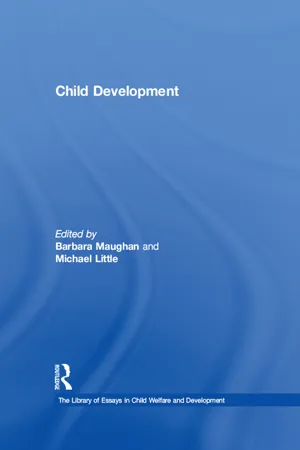
Child Development
About this book
This book provides a good foundation for understanding influences on children's health and development. The volume brings together in a single reference source the world's leading thinkers on children's health and development. It sets out the basic concepts that underpin the study of child development and response to impairments to development, including attachment, changes in brain structure, and resilience. The book explores the idea of life-course development, explaining how experiences at each stage in a person's life shapes his or her future. It goes on to example the relative contribution of societal, neighbourhood, school, family and individual influences to child well-being. This includes a look at the way these forces interact, such as when genes shape environments, and vice versa. The book summarises the evidence on the incidence and consequences of impairments to children's health and development, covering both the majority of typical children and the minority who experience significant problems.
Information
Key Concepts In Developmental Research
Attachment
[1]
An Ethological Approach to Personality Development
Editor’s note. Articles based on APA award addresses that appear in the American Psychologist are scholarly articles by distinguished contributors to the field. As such, they are given special consideration in the American Psychologist’s editorial selection process.
This article was originally presented as a Distinguished Scientific Contributions award address at the 98th Annual Convention of the American Psychological Association in Boston in August 1990.
Author’s note. John Bowlby’s death on September 2, 1990, at his summer home on the Isle of Skye in Scotland, prevented him from completing all that he intended to dp in preparing this article for publication. As his coauthor I am greatly saddened by his death, but am secure in the knowledge that he would have wished me to complete the task.
Correspondence concerning this article should be addressed to Mary D. Salter Ainsworth, 920 Rosser Lane, Charlottesville, VA 22903.
This is a historical account of the partnership in which Bowlby and Ainsworth participated to develop attachment theory and research. Beginning with their separate approaches to understanding personality development before Ainsworth joined Bowlby’s research team at the Tavistock Clinic in London for 4 years, it describes the origins of the ethological approach that they adopted. After Ainsworth left London, her research in Uganda and in Baltimore lent empirical support to Bowlby’s theoretical constructions. The article shows how their contributions to attachment theory and research interdigitated in a partnership that endured for 40 years across time and distance.
The distinguishing characteristic of the theory of attachment that we have jointly developed is that it is an ethological approach to personality development. We have had a long and happy partnership in pursuing this approach. In this article we wish to give a brief historical account of the initially separate but compatible approaches that eventually merged in the partnership, and how our contributions have intertwined in the course of developing an ethologically oriented theory of attachment and a body of research that has both stemmed from the theory and served to extend and elaborate it.
Before 1950
Even before beginning graduate training, each of us became keenly interested in personality development and the key role played in it by the early interaction between children and parents. In Bowlby’s case this was kindled by volunteer work in a residential school for maladjusted children, which followed his undergraduate studies in medicine at Cambridge University. Two children especially impressed him. One was an isolated, affectionless adolescent who had never experienced a stable relationship with a mother figure, and the other was an anxious child who followed Bowlby around like a shadow. Largely because of these two children, Bowlby resolved to continue his medical studies toward a specialty in child psychiatry and psychotherapy, and was accepted as a student for psychoanalytic training. From early in his training he believed that analysts, in their preoccupation with a child’s fantasy life, were paying too little attention to actual events in the child’s real life. His experience at the London Child Guidance Clinic convinced him of the significant role played by interaction with parents in the development of a child’s personality, and of the ways in which this interaction had been influenced by a parent’s early experiences with his or her own parents. His first systematic research was begun also at the London Child Guidance Clinic, where he compared 44 juvenile thieves with a matched control group and found that prolonged experiences of mother–child separation or deprivation of maternal care were much more common among the thieves than in the control group, and that such experiences were especially linked to children diagnosed as affectionless (Bowlby, 1944).
The outbreak of war in 1939 interrupted Bowlby’s career as a child psychiatrist but brought him useful research experience in connection with officer selection and with a new group of congenial associates, some of whom at the end of the war joined together to reorganize the Tavistock Clinic. Soon afterward the clinic became part of the National Health Service, and Bowlby served as full-time consultant psychiatrist and director of the Department for Children and Parents. There he also picked up the threads of his clinical and research interests.
Unfortunately, the Kleinian orientation of several members of the staff made it difficult to use clinic cases for the kind of research Bowlby wanted to undertake. He established a research unit of his own, which began operations in 1948. Convinced of the significance of real-life events on the course of child development, he chose to focus on the effects of early separation from the mother because separation was an event on record, unlike disturbed family interaction, of which, in those days, there were no adequate records.
Members of the research team began two research projects, one retrospective, the other prospective. The retrospective project was a follow-up study of 66 school-age children who had experienced separation from their families in a tuberculosis sanatorium at some time between the ages of one and four years, and who had subsequently returned home. The prospective project was undertaken single-handedly by James Robertson, then a social worker, who had had experience in Anna Freud’s wartime nursery. Robertson observed young children’s behavior as they underwent separation in three different institutional settings. Where possible, he observed the children’s behavior in interaction with parents at home, both prior to the separation and after they were reunited with them. Bowlby himself undertook a third project, in response to a request by the World Health Organization (WHO) to prepare a report on what was known of the fate of children without families. This request led him to read all the available literature on separation and maternal deprivation, and to travel widely to find out what was being done elsewhere about the care of motherless children. The report was published both by WHO as a monograph entitled Maternal Care and Mental Health (Bowlby, 1951) and subsequently in a popular Penguin edition with the title Child Care and the Growth of Love (Bowlby & Ainsworth, 1965).
Let us turn now to the beginnings of Ainsworth’s career. She entered the honor course in psychology as an undergraduate at the University of Toronto, hoping (as many do) to understand how she had come to be the person she was, and what her parents had to do with it. She was interested in the whole wide range of courses available to her, but in two particularly. One was run as a class experiment by S. N. F. Chant, in which she learned that research is a fascinating pursuit The other, taught by William E. Blatz, focused on Blatz’s newly formulated theory of security as an approach to understanding personality development. After graduation Ainsworth continued on at the University of Toronto as a graduate student, and was delighted when Blatz proposed that she base her dissertation research on his security theory.
Because she carried some highlights of security theory with her into attachment theory, it is appropriate here to say something about it (Blatz, 1966).1 Security, as its Latin root—sine cura—would suggest, means “without care” or “without anxiety.” According to Blatz, there are several kinds of security, of which the first to develop is what he called immature dependent security. Infants, and to a decreasing extent young children, can feel secure only if they can rely on parent figures to take care of them and take responsibility for the consequences of their behavior. Children’s appetite for change leads them to be curious about the world around them and to explore it and learn about it. But learning itself involves insecurity. If and when children become uneasy or frightened while exploring, they are nevertheless secure if they can retreat to a parent figure, confident that they will receive comfort and reassurance. Thus the parent’s availability provides the child with a secure base from which to explore and learn.
As children gradually gain knowledge about the world and learn skills to cope with it, they can increasingly rely on themselves and thus acquire a gradually increasing basis for independent security. By the time of reaching maturity, according to Blatz, a person should be fully emancipated from parents. Blatz viewed any substantial continuation of dependence on them to be undesirable. But one cannot be secure solely on the basis of one’s independent knowledge and skills. To be secure, a person needs to supplement with mature dependent security whatever degree of independent security he or she has managed to achieve. Blatz thought of this as occurring in a mutually contributing, give-and-take relationship with another of one’s own generation—a relationship in which each partner, on the basis of his or her knowledge and skills, can provide a secure base to the other. Blatz also acknowledged that defense mechanisms (he called them deputy agents) could provide a temporary kind of security, but did not themselves deal with the source of the insecurity—like treating a toothache with an analgesic.
For her dissertation, Ainsworth (then Salter, 1940) constructed two self-report, paper-pencil scales intended to assess the degree to which a person was secure rather than insecure. The first scale concerned relations with parents, and the second relations with friends. Together these scales were intended to indicate the extent to which the person’s security rested on immature dependence on parents, independence, mature dependent relations with age peers, or the pseudosecurity of defense mechanisms. Individual differences were identified in terms of patterns of scores—a classificatory type of assessment for which she found much later use. The subjects were third-year university students, for each of whom an autobiography was available as a validity check.
To anticipate her later evaluation in the light of further experience, Ainsworth came to believe that Blatz’s security theory did not deal adequately with defensive processes. Rejecting Freud’s theory of unconscious processes, Blatz held that only conscious processes were of any significance in personality development. This was one aspect of his theory that Ainsworth did not carry forward. Furthermore, it became clear to her that with the self-report paper–pencil method of appraisal it is well-nigh impossible to assess accurately how much defensive maneuvers have inflated security scores. However, the general trends in her dissertation findings gave support to security theory as formulated at the time, and sustained her enthusiasm for it.
Upon completing her degree in 1939, Ainsworth hoped to continue security research with Blatz, and sought and obtained an appointment to the faculty. Their research plan was interrupted by the outbreak of war three months later. Blatz and most of the other faculty of the department soon departed for war-related jobs, Ainsworth continued teaching until 1942, but then joined the newly established Canadian Women’s Army Corps, where she was assigned to personnel selection. After V-E Day, she spent a year as Superintendent of Women’s Rehabilitation in the Department of Veterans’ Affairs. In 1946 she happily returned to the University of Toronto as an assistant professor of psychology.
Through her war work she had developed an interest in clinical assessment, and she chose this as her area of academic specialization. She focused on projective techniques, especially the Rorschach, which she learned through workshops directed by Bruno Klopfer. This led to coauthorship of a book on the Rorschach technique (Klopfer, Ainsworth, Klopfer, & Holt, 1954). She gained practical experience in clinical assessment as a volunteer in a veterans’ hospital, and as planned earlier, she codirected research with Blatz into further assessments of security.
In 1950 she left the University of Toronto, having married Leonard Ainsworth, a member of the security research team who had been admitted for PhD training at the University of London. Jobless, she was guided by Edith Mercer, a friend she had met during the war years, to an advertisement in the Times Educational Supplement. This sought a developmental researcher, proficient in projective techniques, for a project at the Tavistock Clinic investigating the effect on personality development of separation from the mother in early childhood. She got the job—and it transformed her research career, while at the same time incorporating some of its earlier threads.
1950 to 1954
Bowlby had just completed his report for the WHO when Ainsworth joined his research team. She was put to work reading the literature h...
Table of contents
- Cover
- Half Title
- Title Page
- Copyright Page
- Table of Contents
- Acknowledgements
- Series Preface
- Introduction
- PART I KEY CONCEPTS IN DEVELOPMENTAL RESEARCH
- PART II INFLUENCES ON DEVELOPMENT
- PART III IMPAIRMENT AND DISORDER
- Index
Trusted by 375,005 students
Access to over 1.5 million titles for a fair monthly price.
Study more efficiently using our study tools.
Frequently asked questions
Yes, you can cancel anytime from the Subscription tab in your account settings on the Perlego website. Your subscription will stay active until the end of your current billing period. Learn how to cancel your subscription
No, books cannot be downloaded as external files, such as PDFs, for use outside of Perlego. However, you can download books within the Perlego app for offline reading on mobile or tablet. Learn how to download books offline
We are an online textbook subscription service, where you can get access to an entire online library for less than the price of a single book per month. With over 1.5 million books across 990+ topics, we’ve got you covered! Learn about our mission
Look out for the read-aloud symbol on your next book to see if you can listen to it. The read-aloud tool reads text aloud for you, highlighting the text as it is being read. You can pause it, speed it up and slow it down. Learn more about Read Aloud
Yes! You can use the Perlego app on both iOS and Android devices to read anytime, anywhere — even offline. Perfect for commutes or when you’re on the go.
Please note we cannot support devices running on iOS 13 and Android 7 or earlier. Learn more about using the app
Please note we cannot support devices running on iOS 13 and Android 7 or earlier. Learn more about using the app
Yes, you can access Child Development by Michael Little, Barbara Maughan in PDF and/or ePUB format, as well as other popular books in Social Sciences & Sociology. We have over 1.5 million books available in our catalogue for you to explore.