eBook - ePub
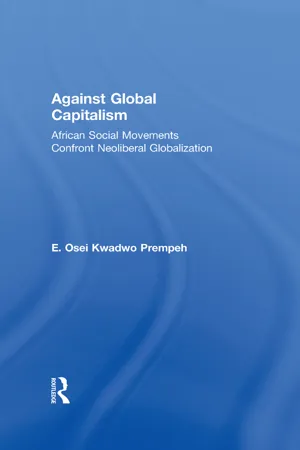
Against Global Capitalism
African Social Movements Confront Neoliberal Globalization
- 198 pages
- English
- ePUB (mobile friendly)
- Available on iOS & Android
eBook - ePub
Against Global Capitalism
African Social Movements Confront Neoliberal Globalization
About this book
The fundamental challenge of democratizing globalization by opening up spaces for democratic participation beyond the state is addressed in this study. The author captures both the democratic activities and voices of opposition to neoliberal globalization and investigates how this reinvention of democracy through resistance to neoliberal globalization has taken shape in the African context. In doing so, he reasserts the relevance of the de-globalization and anti-capitalism movements. With a careful selection of case studies, this volume is ideal for classroom use and library reference.
Information
PART 1
‘Conventional’ Views and Perspectives on Neoliberal Globalization: The No Alternative Discourse
Chapter 1
Understanding Globalization
Globalization – the term itself is hotly contested – is the modern or postmodern version of the proverbial elephant, described by its diverse observers in so many diverse ways. Yet one can still posit the existence of the elephant in the absence of a single, persuasive and dominant theory; nor are blinded questions the most unsatisfactory way to explore this kind of relational and multi-level phenomenon (Jameson, 1998, p. xi).
Introduction
Since the late 1980s, the world has witnessed the unleashing of historical forces which are restructuring and reshaping the socio-economic and political realities of contemporary life. This epoch-defining moment in the contemporary global economy has unfolded within the overarching structure of the processes of neoliberal globalization. As Jan Aart Scholte points out, ‘“globalization” stands out for a large public, spread across the world, as one of the defining terms of contemporary society’ (2000, p. 1). According to Hirst and Thompson, the term has become ‘a fashionable concept in the social sciences, a core dictum in the prescriptions of management gurus, and a catchphrase for journalists and politicians of every stripe’ (1996, p. 1). For Meric S. Gertler, ‘frequent pronouncements by academics, journalists, and policy makers alike continue to assert publicly the “fact” of globalization with numbing frequency. Bound up in such pronouncements are the ideas that globalization both is a reality and, as a process, constitutes an inevitable and inexorable development’ (1997, p. 45). Globalization thus understood, has become to borrow Petras and Veltmeyer’s words:
A key word in not only the dominant theoretical and political discourse, but also in everyday language. As both a description of wide-spread, epoch-defining developments and a prescription for action, it has achieved a virtual hegemony and so is presented with an air of inevitability that disarms the imagination and prevents thought of and action towards a systemic alternative – towards another, more just social and economic order (2001, p. 8).
Such pronouncements that attest to the configurations and transformations unleashed by globalization highlight not only the extent of globalization’s hegemony, extent and reach, but also the new challenges for global society and progressive forces. This chapter captures the various dynamics of neoliberal globalization, the understandings and meanings of the process from divergent perspectives as captured in the extant literature. It is therefore an attempt to come to terms with the various definitions for the term ‘globalization.’ Most importantly, what is the extent and significance of globalization and how should it be conceptualized?
Understanding Globalization
In order to come to terms with the realities of neoliberal globalization, the new international order consolidated in the late 1980s and early 1990s, one has to come to terms with the meanings of the processes underlying this phenomenon. Such an undertaking is a direct response and reaffirmation of Clive S. Kessler’s observation that:
… The globalization debate is itself a major global phenomenon, a key instance of the very issue it seeks to explore. To contribute further, to offer yet another small piece, to the already gross body of this scholarly monster is not hard; to make sense of the now monumental globalization literature is a problem. But addressing this problem, in a brief caricature perhaps, is a necessary preliminary to understanding what is humanly at stake in globalization and its discourses (2001, p. 18).
As a radical project to reshape and restructure the contemporary political, economic, cultural and social architecture of global order, globalization has acquired hegemonic status and an ability to impose the discipline of market forces on almost all segments of our lives. What then is globalization? For one, there is no agreed consensus as to globalization’s meaning or historical significance as expressed in Gary Teeple’s reminder that ‘despite the rapidly growing body of literature on the topic of globalization and its implications, there is disagreement about how to conceptualize what is happening. Although the term is widely used to characterize the profound changes unfolding in the world, the nature of these shifts and what they mean remain debated questions’ (2000, p. 9). Ian Clark (1999, p. 34) has remarked that ‘the concept of globalization is as contested as it is popular: as it still bears the birthmarks of its multi-disciplinary paternity; it is virtually impossible, amongst the myriad accounts and interpretations, for the would-be synthesizer to discern a simple meaning or referent for the term.’ Yet others have noted that the concept of globalization ‘lacks precise definition. Indeed, globalization is in danger of becoming, if it has not already become, the cliché of our times: the big idea which encompasses everything from global financial markets to the Internet but which delivers little substantive insight into the contemporary human condition’ (Held et al., 1999, p. 1). Its diversity and multi-dimensional nature has led many to argue that it is a ‘rubric for varied phenomena’ (Mittelman, 1996, p. 2), or ‘the most significant development and theme in contemporary life and social theory’ (Albrow, 1996, p. 89) or ‘the word of the decade’ (Axtmann, 1998, p. 1).
Notwithstanding these disagreements, there has developed over the years some general agreement about globalization’s dimension and meanings in contemporary times. The first line of definition and debates take place in the mainstream, conventional framework. Much of the earlier literature about globalization seemed to rest upon a conceptualization of the phenomenon as an economic project of enormous proportions. An attractive version of this literature on economic globalization rested on the proposition that production has gone global with the resultant alteration of the world economy. It is in this sense that Ian Clark (1999, pp. 2–3) is right to insist that:
Much writing on globalization draws attention to the role of transnational corporations in creating a global market and system of production; to capital markets in creating an integrated financial system; and to bodies such as the International Monetary Fund (IMF) in disseminating a particular view of the state’s role within the international economy… Globalization may also be conceived as an intensification of the conditions of interdependence, with all the supposedly transformational associations that flow from such a position.
This economism is predicated on markets and technology as the key driving forces of the process.
The issue underlying these economic globalization debates is whether the economic restructuring that is a feature of globalization is reconstituting national economies and markets through increased flows of transnational relations and the creation of a global market. Thus Stocker quotes the Organization for Economic Cooperation and Development (OECD) as defining globalization as a process ‘by which markets and production in different countries are becoming increasingly interdependent due to dynamics of trade in good and services and then flows of capital and technology’ (1998, p. 103). In a similar vein, Louis Pauly makes the point that when ‘pressed for examples of what the term [globalization] means, the mind now turns automatically to the image of more integrated financial markets, through which international capital flows ever more fluidly’ (1997, p. 1). Equally, Hans-Peter Martin and Harald Schumann view globalization in terms of the creation of a global market. For Martin and Schumann, new advances in communication, falling transportation costs and unrestricted and unfettered trade are leading to the creation of a single global market (1998, p. 5). It is precisely this claim which leads Hurrell and Woods to state the position that ‘states and governments are bystanders to globalization; the real driving forces are markets.’
Along these same lines, Gillian Hart examines the discursive power of globalization and concludes that ‘typically framed in terms of the impact of the ‘global’ on the ‘local,’ these discourses conjure up inexorable market and technological forces that take shape in the core of the global economy and radiate out from there’ (2002, pp. 12–13). Hart carries this argument further, calling attention to different images conjured by the market and technological forces that highlight the impact of the ‘global’ on the ‘local’ which is at the core of globalization’s project through what she calls the ‘impact model’ of globalization:
This model conjures up images of active forces – defined primarily in terms of new information technology and/or markets – that take shape at the core of the global economy and radiate from there. ‘Placeless power’ in the form of rapidly accelerating flows of information and capital ricochet around the world, bearing down upon and agglomerating in some ‘powerless places’ while bypassing others; hence the imperatives of conforming to orthodox neoliberalism. Claims about ‘deterritorialization,’ the disintegration of national borders, and the demise of the nation state often figure prominently in these discourses (2002, p. 49).
Held, McGrew, Goldblatt, and Perraton define globalization as ‘a process (or set of processes) which embodies a transformation in the spatial organization of social relations and transactions – assessed in terms of their extensity, intensity, velocity and impact – generating transcontinental or interregional flows and networks of activity, interaction and the exercise of power” (1999, p. 16). For Hurrel and Woods,
The term ‘globalization is often invoked to describe the process of increasing interdependence and global enmeshment which occurs as money, people, images, values, and ideas flow ever more swiftly and smoothly across national boundaries. It is assumed to be a process driven by technological advance which will lead to a more and more homogenous and interconnected world… The liberal orthodoxy posits a world economy in which a global increase in transactions is driven by technological advance and by self-maximizing decisions of private actors. On this view, states and governments are by standers to globalization: the real driving forces are markets. Furthermore, the emergence of global markets improves efficiency (1995, pp. 447–448).
According to Pippa Norris, “globalization’ is understood as a process that erodes national boundaries, integrating national economies, cultures, technologies, and governance, producing complex relations of mutual interdependence’ (2000, p. 155). Petras and Veltmeyer see globalization as referring ‘to the widening and deepening of the international flows of trade, capital, technology and information within a single integrated market’ (2001, p. 11) and Teeple makes the point that ‘globalization represents the shift of the main venue of capital accumulation from the national to the supranational or global level’ (2000, p. 9). The insights of McGrew are poignant in his assessment of globalization as ‘the process by which events, decisions, and activities in one part of the world can come to have significant consequences for individuals and communities in quiet distant parts of the globe’ (1992, p. 23). For Albrow (1990, p. 9) globalization is ‘all those processes by which the peoples of the world are incorporated into a single world society, the global society.” From Friedman’s vantage point, ‘globalization is that loose combination of free trade agreements, the Internet and the integration of financial markets that is erasing borders and uniting the world into a single, lucrative, but brutally competitive, marketplace’ (1996).
Implicit in the globalization thesis is a belief that it is a process that is reconstituting national economies and increasing interdependence and interconnectedness. One is struck not only by the extent and reach of the process and its impact on the socioeconomic, cultural and political spheres, but also by the resulting enmeshment of economies and societies in social, political and cultural terms. In short, globalization has resulted in the compression of distance and time, and the creation of a complex web of interconnections across societies. Thus, writing from a sociological perspective, Roland Robertson refers to globalization as ‘both a compression of the world and the intensification of the consciousness of the world’ (1992). For Anthony Giddens, globalization entails ‘the intensification of worldwide social relations which link distant localities in such a way that local happenings are shaped by events occurring many miles away and vice versa’ (1990, p. 64). The philosopher Martin Heidegger has mused about the advent of “‘distanceless’ and an abolition of every possibility of remoteness’ (1950, pp. 165–6) and Manuel Castells has proclaimed the emergence of a ‘“network society” in which a new “space of flows” exists alongside old “space of places’” (1989, p. 348, 1996). This conceptualization reflects the growing global interconnectedness that is a defining aspect of contemporary social reality and the unprecedented compression of time and space differences, hence Clark’s helpful intervention that ‘in all such cases, the very emphasis on the global highlights the integrative aspects of social life’ (1999, p. 2).
Globalization, in the sense of space-time compression and a shrinking of the world, unfolds within the context of a transcending of territorial boundaries and territorial distances. In this respect, globalization is eroding the divide between national and international boundaries, and linking the local to the global. This link between the local and the global occurs in a context whereby social relations can no longer be understood or conceived solely in local terms. Local social interactions are influenced and determined by global networks. To invoke David Harvey’s words, globalization has led to ‘an intense phase of time-space compression that has had a disorienting and disruptive impact upon political-economic practices, the balance of class power, as well as upon cultural and social life’ (1989, p. 284). Harvey calls attention to the flows and networks of globalization which have resulted in the shrinking of the world.
The view that globalization transcends time and space through global interconnectedness is echoed in Held et al’s claims that:
Accordingly, the concept of globalization implies, first and foremost a stretching of social, political and economic activities across frontiers such that events, decision and activities in one region of the world can come to have significance for individuals and communities in distant regions of the globe. In this sense, it embodies transregional interconnectedness, the widening reach of networks of social activity and power, and the possibility of action at a distance (1999, p. 15).
Held et al. contend that the spatial understandings and intricacies of globalization are worth pursuing in any attempt to come to terms with the concept and ideology behind the process. In other words, the spatial connections and the degree of integration and interdependence at the core of globalization require highlighting in any such endeavour. Central to their argument is the conclusion that:
Globalization can be located on a continuum with the local, national and regional. At the one end of the continuum lie social and economic relations and networks which are organized on a local and/or national basis, at the other end lie social and economic relations and networks which crystallize on the wider scale of regional and global interactions. Globalization can be taken to refer to those spatio-temporal processes of change which underpin a transformation in the organization of human affairs by linking together and expanding human activity across regions and continents. Without reference to such expansive spatial connections, there can be no clear or coherent formulation of this term (1999, p. 15).
David Held reinforces this position by suggesting that:
Globalization is best understood as a spatial phenomenon lying on a continuum with ‘the local’ at one end and ‘the global’ at the other. It denotes a shift in the spatial form of human organization and activity to transcontinental or interregional patterns of activity, interaction, and the exercise of power. It involves a stretching and deepening of social relations and institutions across space and time such that, on the one hand, day-to-day activities are increasingly influenced by events happening on the other side of the globe and, on the other, the practices and decisions of local groups or communities ...
Table of contents
- Cover
- Half Title
- Dedication
- Title Page
- Copyright Page
- Table of Contents
- Acknowledgements
- Introduction
- Part 1 ‘Conventional Views’ and Perspectives on Neoliberal Globalization: The No Alternative Discourse
- Part 2 Contestation and Resistance to Neoliberal Globalization: Radical Alternative Visions
- Part 3 Contemporary Applied Issues and the Reinvention of Democracy through Mass Mobilization and Resistance
- Index
Trusted by 375,005 students
Access to over 1.5 million titles for a fair monthly price.
Study more efficiently using our study tools.
Frequently asked questions
Yes, you can cancel anytime from the Subscription tab in your account settings on the Perlego website. Your subscription will stay active until the end of your current billing period. Learn how to cancel your subscription
No, books cannot be downloaded as external files, such as PDFs, for use outside of Perlego. However, you can download books within the Perlego app for offline reading on mobile or tablet. Learn how to download books offline
Perlego offers two plans: Essential and Complete
- Essential is ideal for learners and professionals who enjoy exploring a wide range of subjects. Access the Essential Library with 800,000+ trusted titles and best-sellers across business, personal growth, and the humanities. Includes unlimited reading time and Standard Read Aloud voice.
- Complete: Perfect for advanced learners and researchers needing full, unrestricted access. Unlock 1.5M+ books across hundreds of subjects, including academic and specialized titles. The Complete Plan also includes advanced features like Premium Read Aloud and Research Assistant.
We are an online textbook subscription service, where you can get access to an entire online library for less than the price of a single book per month. With over 1.5 million books across 990+ topics, we’ve got you covered! Learn about our mission
Look out for the read-aloud symbol on your next book to see if you can listen to it. The read-aloud tool reads text aloud for you, highlighting the text as it is being read. You can pause it, speed it up and slow it down. Learn more about Read Aloud
Yes! You can use the Perlego app on both iOS and Android devices to read anytime, anywhere — even offline. Perfect for commutes or when you’re on the go.
Please note we cannot support devices running on iOS 13 and Android 7 or earlier. Learn more about using the app
Please note we cannot support devices running on iOS 13 and Android 7 or earlier. Learn more about using the app
Yes, you can access Against Global Capitalism by E. Osei Kwadwo Prempeh in PDF and/or ePUB format, as well as other popular books in Politics & International Relations & Globalisation. We have over 1.5 million books available in our catalogue for you to explore.