eBook - ePub
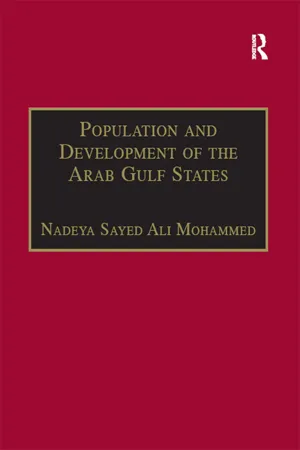
Population and Development of the Arab Gulf States
The Case of Bahrain, Oman and Kuwait
- 208 pages
- English
- ePUB (mobile friendly)
- Available on iOS & Android
eBook - ePub
Population and Development of the Arab Gulf States
The Case of Bahrain, Oman and Kuwait
About this book
This thought-provoking study measures and critically examines the effects that an average population growth rate of 2.8% could have on the development of the Arab Gulf States. It questions the ability of Gulf governments to continue providing relatively high standards of education, health and employment under conditions of rapid population growth, an undiversified economic base, and a tribal political framework. Within this context, population growth is identified as one important variable that hinders long-term development. The book will appeal to all those interested in the Middle East, demography, development and sociology.
PART I
DEMOGRAPHIC COMPONENTS OF GULF POPULATIONS
Chapter 1
Non-Nationals in the Gulf: Transient Migrants or Adopted Siblings?
General theories of migration tend to concentrate on the decision to migrate at the individual level, which is assumed to be based on a rational comparison of relative costs and benefits of migrating or remaining. Therefore, the causes for migration are sought in terms of ‘push’ and ‘pull’ factors. The existence of undesirable factors in the area of origin (for example, overcrowding, low incomes and living standards) compels people to leave, while the merits of the destination (for example, better economic opportunities, political freedom, higher living standards), beckons them to it. Such a framework is instrumental to the analysis of migration, but it does not encompass all the factors at work in the migratory process. It either totally disregards the role of the State and its policies, or treats it as an aberration, which, because it disrupts the functioning of the rational market, should be removed. Further, the push-pull model cannot explain why certain groups of migrants go to one country rather than another.
No single cause is ever sufficient to explain why people decide to leave their country and settle in another. Migration is a collective phenomenon and should be examined as a part of the global economic and political system. Migratory movements are the result of global interdependence: of interacting macro and micro structures: large scale institutional factors (the political economy of the world market, interstate relationships, laws, structures and practices established by the states) and informal networks (psychological adaptations, personal relationships, family and household patterns, friendship and community ties), practices and beliefs developed by the migrants themselves to cope with migration and settlement. To understand migratory movements, it is essential to consider all aspects of the process.
Within such a framework, this Chapter shall trace and explain the main characteristics of the migratory flows into and out of the Gulf States: the increase in the size of this population, the shifts in its ethnic composition, and the tendency towards ‘settling’ found in some States. It will also reflect on the official policies of the Gulf States with respect to their non-national populations, and tease out the potential future trends.
Tracing the Characteristics of the Non-Nationals
The non-national population in the Gulf has been increasing, in absolute numbers and percentage terms since the 1950s. Qatar’s total population increased from 12,000 (1940) to 190,000 (1976), of whom 6,000 were thought to be foreign.1 In the United Arab Emirates, non-nationals make up more than 70 percent of the 2.5 million inhabitants. Abu Dhabi’s population increased from 46,375 (1968) to 235,662 (1975) of whom an estimated 176747 were foreign.2 In 1993, non-nationals accounted for an average of 26 percent of the total population in Oman3 and in Saudi Arabia.
As Table 1.1 indicates, between 1957 and 1993, the proportion of non-nationals in Kuwait increased from 45 to 57 percent, and from 12 to 36 percent (1959–1991) in Bahrain. The increase was most rapid between 1970 and 1980 for Kuwait and, between 1960 and 1970 for Bahrain. Since 1990, the rate of increase has been slowing down in Bahrain, while that in Kuwait has been negative because of the Kuwait-Iraq War (1991).4
Table 1.1 Change in the Non-National Population’s Size

* Kuwaiti data refers to the Censuses of 1957, 1970, 1980, 1989, 1993.
Source: National Censuses and Statistical Abstracts, various years
National Origins of the Non-Nationals
The non-national population in the Gulf States has comprised specific nationalities at different times, not by coincidence. Initially, nationals from within the Arabian Peninsula, particularly Omanis, Bahrainis and Iranians constituted the bulk of the ‘non-national’ population in any State. The construction of the Saudi Arabian pipeline (Tapline) at Ras al Mishab in 1944 employed 450 Americans, two Britons, and 1200 ‘native labourers’ (mainly Bahrainis, and Saudi Arabians).5 In 1960, there were claims that the United Arab Emirates government, with help from the British, was trying to ‘Iranize’ the country, by granting too many naturalizations to the Iranians.6 Between 1959 and 1971, Gulf Arabs and Iranians accounted for an average of 55 percent of the non-national population in Bahrain (see Table 1.2).7 In Kuwait, this was 23 percent by 1965.8
Table 1.2 Nationality Distribution of Non-Nationals in Bahrain
Year | Iranians | Omanis | Saudis |
1941 | 47 | n/a | n/a |
1950 | 37 | 12 | n/a |
1959 | 17 | 30 | 10 |
Source: State of Bahrain, Fourth and Fifth Population Census, p. 3 and p. 166
By the early 1960s, the first shift in nationality occurred: the proportion of Arabs from the Fertile Crescent began increasing steadily. In Kuwait, it increased from 65 percent (1965) to 76 percent (1975).9 Between 1953 and 1963,10 the proportion of other Arabs working in the Kuwait Oil Company increased from 22 percent to 36 percent, while that of Asian workers declined from 37 to 31 percent.11 In Bahrain, the increase was less significant and never large, the total number of non-nationals increased from 15930 to 38389 between 1950 and 1965, and just under 50 percent of these were other Arabs.12 Between 1959 and its peak in 1965, the proportion of other Arabs increased by about 0.6 percent per annum to reach 11 percent of the non-national population.13 In 1957, Saudi Arabia’s ARAMCO’s foreign labour force was divided between ten percent Indians and Pakistanis and nine percent other Arabs.14
The second shift in nationality occurred by the late 1970s: this time towards Asians, initially Indians and Pakistanis, then including Far East Asians as well. Since 1977, the proportion of Asians in the non-national workforce in Bahrain has been increasing by three percent per annum, and accounting for 91 percent of non-nationals on the Island. In 1980, Asians accounted for 88 percent of all work permits issued, a proportion which increased to 92 percent by 1984. Indians comprised 51 percent of these Asians. The share of Asians in the Omani non-national workforce increased by two percent per annum between 1980 and 1983: from 88 percent to 93 percent.15 In Qatar, Asians represented 60 percent of total employment in the period 1980–1984.
The Non-National Population’s Sex and Dependency Structure
Overall, the non-national population across the Gulf States are largely workers, given the relatively high labour force participation rates: 60 percent in Kuwait, 80 percent in Bahrain, 55 percent in Qatar and an average of 47 percent in Saudi Arabia and the United Arab Emirates.16 Since the proportion of dependents amongst the non-national population is relatively small, it can be assumed that the non-national females are either migratory workers, or employed spouses, and are in the Gulf States for employment, rather than settlement purposes (Figure 1.1).17

Figure 1.1 Non-National Females and Dependants in Bahrain and Kuwait
Source: UNESCWA, 2001. Demographic and Related Socio-Economic Datasheets, and Statistical Abstracts, various years
Further evidence of this can be found in both Kuwait and Bahrain, where the rate of natural increase (per 1000 of the non-national population) has been declining. In Bahrain, the rate of natural increase declined from 18 in 1980 to 16 by 1991, while in Kuwait, it declined by two percent per annum between 1967 and 1976, and by six percent between 1988 and 1989.
Characteristics of the Non-National Workforce
On average, 62 percent of the workforce in the Gulf States is accounted for by non-nationals, a proportion which has been increasing, in absolute and percentage terms in every State, and has been most rapid in Saudi Arabia and least rapid in the UAE, as illustrated in Figure 1.2.

* the average % increase per annum between 1975-1990.
Figure 1.2 Participation of Non-Nationals in the Workforce (1975–1990)
Source: ILO estimates
Sex distribution Across the Gulf States, more non-national males than females are employed. However, while the proportion of non-national male workers has been declining in both Kuwait and Bahrain, that of female workers has been increasing. In Kuwait, between 1957 and 1993, the proportion of female non-national workers increased by 35 percent in two stages: a slow increase of 0.2 percent per annum between 1957 and 1975, followed by a rapid inc...
Table of contents
- Cover
- Half Title
- Title Page
- Copyright Page
- Table of Contents
- List of Figures
- List of Tables
- Introduction
- PART I: DEMOGRAPHIC COMPONENTS OF GULF POPULATIONS
- PART II: PUBLIC SERVICES AND EMPLOYMENT IN THE ARAB GULF STATES
- PART III: TOWARDS 2025: THE ALTERNATIVE SCENARIOS
- Bibliography
- Index
Trusted by 375,005 students
Access to over 1.5 million titles for a fair monthly price.
Study more efficiently using our study tools.
Frequently asked questions
Yes, you can cancel anytime from the Subscription tab in your account settings on the Perlego website. Your subscription will stay active until the end of your current billing period. Learn how to cancel your subscription
No, books cannot be downloaded as external files, such as PDFs, for use outside of Perlego. However, you can download books within the Perlego app for offline reading on mobile or tablet. Learn how to download books offline
Perlego offers two plans: Essential and Complete
- Essential is ideal for learners and professionals who enjoy exploring a wide range of subjects. Access the Essential Library with 800,000+ trusted titles and best-sellers across business, personal growth, and the humanities. Includes unlimited reading time and Standard Read Aloud voice.
- Complete: Perfect for advanced learners and researchers needing full, unrestricted access. Unlock 1.5M+ books across hundreds of subjects, including academic and specialized titles. The Complete Plan also includes advanced features like Premium Read Aloud and Research Assistant.
We are an online textbook subscription service, where you can get access to an entire online library for less than the price of a single book per month. With over 1.5 million books across 990+ topics, we’ve got you covered! Learn about our mission
Look out for the read-aloud symbol on your next book to see if you can listen to it. The read-aloud tool reads text aloud for you, highlighting the text as it is being read. You can pause it, speed it up and slow it down. Learn more about Read Aloud
Yes! You can use the Perlego app on both iOS and Android devices to read anytime, anywhere — even offline. Perfect for commutes or when you’re on the go.
Please note we cannot support devices running on iOS 13 and Android 7 or earlier. Learn more about using the app
Please note we cannot support devices running on iOS 13 and Android 7 or earlier. Learn more about using the app
Yes, you can access Population and Development of the Arab Gulf States by Nadeya Sayed Ali Mohammed in PDF and/or ePUB format, as well as other popular books in Economics & Development Economics. We have over 1.5 million books available in our catalogue for you to explore.