- 272 pages
- English
- ePUB (mobile friendly)
- Available on iOS & Android
eBook - ePub
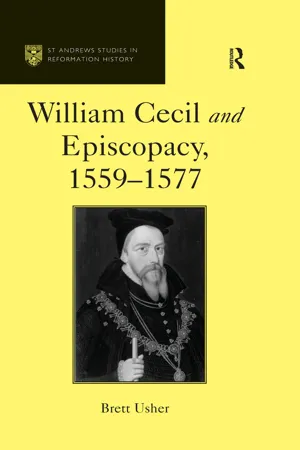
William Cecil and Episcopacy, 1559–1577
About this book
The figure of William Cecil dominates the court of Elizabeth I, and next to the queen herself, no one did more to shape the political, religious and economic landscape of late sixteenth century England. Nowhere is this influence more evident than in the ecclesiastical settlements that Elizabeth imposed on a country wracked by religious divisions and uncertainty. At the very heart of this settlement lay the question of the role of the bishops, and it is to this problem that Cecil was to devote much time and energy. Broadening our understanding of the Elizabethan Church, this study utilises a number of hitherto underused primary sources to re-examine the vexed issue of the role of bishops. It addresses the question of why certain men were appointed bishops whilst others, often seemingly better qualified, were passed over. Taking a broadly chronological approach, this book argues that Cecil, a committed protestant, hoped to remodel espiscopacy along 'reformed' continental lines. Rather than great princes of the church, Cecil envisaged 'superintendents' shorn of much of their traditional temporal power and wealth. Charting the first two decades of Elizabeth's reign it is shown how Cecil tried to convince the queen to abandon the established economic foundations of 'prelacy' in favour of a properly funded superintendency. In this he failed. Yet as long as Cecil remained a dominating voice at the council table the Church of England, through the mediation of a bench of conscientious and hard-working (if often hard-pressed) bishops, was assured of a broad base and an evangelical future. The remainder of Cecil's career, from 1577 to 1598, will be dealt with in a subsequent volume Lord Burghley and Episcopacy.
Chapter One
Introduction
Historiographical debates
Though one of the principal themes in English history, the Elizabethan religious settlement is shrouded in mystery.
(J.E. Neale, Elizabeth I and her Parliaments, 1559–1581, London, 1953, p. 51)
And so it remains. It was once a commonplace of Elizabethan studies that, despite the strange obliquity of the parliamentary settlement of 1559, the new queen had little alternative but to throw in her lot with the returning Protestant exiles, her own conservative inclinations notwithstanding. Yet by the time that Sir John Neale came to crown a lifetime’s distinguished research into Elizabethan politics by distilling it into a two-volume study of the parliaments which Elizabeth summoned with ever-increasing reluctance, he elected to throw that commonplace to the winds. Elizabeth was transformed from unwilling reformer into hardened reactionary: set on course for a disastrous collision with her chief advisers, clerical and lay, as her first parliament set about thrashing out a religious settlement acceptable to all parties, she was saved only at the eleventh hour by her own common sense and her consequent acceptance that a ‘Protestant’ polity, however loosely its terms might be construed, was an inevitable corollary of her own accession. Henceforth, however, she would exercise her Supremacy with extreme, even paranoid, vigilance in the maintenance of a conservative, Erastian status quo.1
Whilst there is a great deal of truth in the latter proposition, it is now in its turn a commonplace that the first part of Neale’s hypothesis has signally failed the test of time. By the end of the 1970s the whole of Sir John’s grand edifice had come under attack from a new generation of historians – most notably N.L. Jones and W.S. Hudson – and a reactionary queen began to give way to a variety of other Elizabeths. None, however, steps unequivocally from the shadows. Closest to Neale’s portrait stands Christopher Haigh’s cautious realist, Protestant by inclination but above all a politique anxious to placate Catholic sensibilities.2 Next in line comes Norman Jones’s judicious stateswoman, steadily determined to return England to the Protestant fold, if on her own idiosyncratic terms.3 Well to the left is W.S. Hudson’s forthright and convinced reformer, wedded to Protestantism through personal, emotional and educational ties and at one with her most trusted adviser, William Cecil, in choosing the personnel of her settlement from among his own particular friends, the survivors of an ‘Athenian’ circle stretching back to his undergraduate days in Henrician Cambridge.4
Despite later tensions and misunderstandings between the Supreme Governor and her leading churchmen it became widely accepted during the 1980s that a synthesis of the two latter portraits produced a scenario which fitted the known facts most satisfactorily. Jones argued that the stubborn resistance of the bishops in the House of Lords put both the queen and the Marian exiles on the defensive early in 1559 but, finding no evidence of Neale’s ‘puritan choir’ in the Commons, concluded that Elizabeth, having at last overcome the bishops, eventually obtained the settlement she had wanted from the first. By setting the Elizabethan legislation in the context of the Henrician and Edwardian settlements, Hudson at the same time demonstrated both how the latter led logically to the former and also placed Cecil and his Cambridge friends centre stage.
Thus, in Professor Cross’s words, ‘previous implausibilities fell into place’. A convinced Protestant who conformed under Mary, Cecil was in a position to act as intermediary between the politique queen and the Marian exiles, eager for further reform, and was amply justified in claiming that he had been ‘above all others in propagating religion in the beginning of the queen[’s reign]’. Thus:
it seems unlikely that so much concentration will be paid in the future to the independent actions of the Elizabethan House of Commons, and more stress laid instead upon the plans of Cecil and the queen. The simpler solution may well be preferred to the more complex one . . . Most of the Edwardian Protestant bishops . . . had perished in the Marian persecution; on the refusal, therefore, of the catholic bishops to remain in their sees the Crown had little choice but to appoint exiles to their offices . . . While in theory the queen chose the bishops, all the evidence suggests that at this early period the responsibilities for the appointments rested with Cecil and his closest associates.5
The combined wisdom of Jones, Hudson and Cross did not, however, succeed in sweeping all before it. By 1996 Professor Pettegree was expressing surprise that this should be so, given the authority with which Jones presented his case and a general recognition that the Neale hypothesis was discredited. That elements of Sir John’s interpretation survive in recent studies is perhaps due to:
a largely fortuitous congruity between Neale’s picture of a Queen with essentially conservative religious inclinations and recent revisionist writings on the English Reformation. Thus the view of the Elizabethan church as a via media lives on, even if the evidential base on which Neale constructed his original hypothesis looks increasingly threadbare.6
It finds its clearest expression, Pettegree suggests, in that ‘half-hearted Reformation’, hampered by its hesitant, ambiguous Book of Common Prayer, proposed by Christopher Haigh.7
In a brief but authoritative and convincing survey Pettegree proceeds to demolish the two principal planks in the lingering Neale/Haigh case for a theologically conservative queen and a reactionary liturgy. Examining the European developments which would naturally have prompted Elizabeth to express real, if vague and generalized, support for the Augsburg Confession, he concludes that such support ‘made her no more of a ‘‘Lutheran’’ than others who sought to exploit its symbolic potential, such as Theodore Beza or the Cardinal of Lorraine’.8 More arresting, and perhaps less controversial, is the contention that, far from being a liturgical compromise, the marrying of the 1552 words of institution (‘Take and eat this, in remembrance . . . ’) with those of 1549 (‘The body of our Lord Jesus Christ . . . ’) represents ‘a corrective adjustment rather than a weakening of the doctrine of 1552’.9
There can be few further nails left lying around with which to secure the lid of Sir John Neale’s coffin. Yet above the incessant hammering it might be wise to heed the voices of those who finally took responsibility for implementing the settlement. ‘The doctrine is every where most pure’, wrote John Jewel in November 1559, ‘but as to ceremonies and maskings, there is a little too much foolery’.10 Unreservedly Protestant the settlement may be construed as being in strictly doctrinal terms. A via media, however, it most assuredly was in the broader sense that Elizabeth held grimly and tenaciously to the early evangelical laissez-faire of cuius regio, eius religio. It was to transpire that King Harry’s daughter placed much more emphasis upon regio than upon religio.
The Elizabethan Settlement falls squarely within those momentous years during which Protestantism sloughed its ‘heretical’ skin and, a veritable snake in the grass from the point of view of secular princes, emerged as an alternative world-view, in a position to coil itself around many an ancient institution and squeeze the life out of it. Ultimately the Protestant conscience owed no allegiance to anything but the conviction that it and it alone was in possession of the truth. In the doctrines, practices and later refinements of Calvinism it achieved emotional and intellectual – though not, perhaps, spiritual – maturity: what reaches of the heart, mind and soul were left to be scoured after acceptance of the notion, so alien even to genuinely pious members of the Church of England today, of double predestination? Yet it was this emergent brand of Calvinism which many of the returning exiles brought back with them and Calvinism per se which was even then in the process of ‘harmonizing’ the many evangelical tendencies of the foregoing forty years.
The Calvinist tradition would come to dominate the thinking of the two or three generations of clerics who were to govern, or else attempt to subvert, the Elizabethan church. And what the Calvinist tradition proposed in its most extreme form was theocracy: ultimately there was no place in the mysteries of its internal organization even for the godliest of magistrates.
Much of this Elizabeth instinctively understood. Bossy herself, she instantaneously recognized bossiness in others. Her settlement of religion was thus unashamedly pragmatic. Authorizing no reshaping of the administrative structure of the church, she merely instructed her ecclesiastics to pour new wine into old bottles. They were expected to graft revived Protestant doctrines onto a ramshackle and irrational agglomeration of episcopal, decanal and peculiar jurisdictions which owed allegiance to a bewildering and often competing network of church courts. The officials who ran them were by training civil lawyers, administering as best they could such portions of the ancient canon law as remained valid in the wake of the Henrician break with Rome nearly thirty years earlier.
Above all Elizabeth’s church continued to be governed by bishops – men who at the stroke of her pen ceased to be private citizens and became instead members of the House of Lords, possessors for life of landed estates, and prominent leaders – moral, judicial, financial and military – of provincial society. This very obvious fact has been largely taken for granted by historians since bishops continue to be appointed to this day. But why should it have been so?
A rounded study of the Elizabethan Settlement must take into account, therefore, not only questions of doctrine and liturgy and the parliamentary legislation which made that doctrine, by means of that liturgy, the official religion of England. It requires also an attempt to understand the administrative and financial problems which faced Elizabeth’s first bench of bishops as they prepared to take up their duties and a recognition that in these two areas continuity and not change was the keynote.
Whilst the long process of burying Sir John Neale has encouraged a tendency to concentrate on the minutiae of doctrinal and parliamentary reform at the expense of broader issues, research into ecclesiastical administration and finance – topics almost impenetrably obscure as recently as the 1930s – has during the last half-century swelled from a trickle into a cataract. The records of many a church court have been dusted off and scrutinized: their procedures are now reasonably well understood and a consensus has emerged that they were moderately efficient. In the process it has become possible to assess the churchmanship and effectiveness of many a hard-pressed Elizabethan diocesan. Since 1956, moreover, when Christopher Hill publ...
Table of contents
- Cover
- Half Title
- Dedication
- Title
- Copyright
- Contents
- Preface and acknowledgements
- List of abbreviations
- 1. Introduction
- 2. 1559: Policies and personalities
- 3. The drive towards reform
- 4. Saving the settlement: July-December 1559
- 5. Cecil deflected: March 1560-March 1562
- 6. The bishops and the exchequer, 1560-62
- 7. Cecil revised: 1562-70
- 8. The aftermath of rebellion, 1569-73
- 9. Contrary winds, 1570-76
- 10. The bishop in his diocese, 1560-76
- 11. Interim conclusions
- Appendix I The bishops and the exchequer 1559-77
- Appendix II Revenues of the Crown sede vacante and from first-fruits November 1558-December 1578
- Select bibliography
- Index
Trusted by 375,005 students
Access to over 1.5 million titles for a fair monthly price.
Study more efficiently using our study tools.
Frequently asked questions
Yes, you can cancel anytime from the Subscription tab in your account settings on the Perlego website. Your subscription will stay active until the end of your current billing period. Learn how to cancel your subscription
No, books cannot be downloaded as external files, such as PDFs, for use outside of Perlego. However, you can download books within the Perlego app for offline reading on mobile or tablet. Learn how to download books offline
Perlego offers two plans: Essential and Complete
- Essential is ideal for learners and professionals who enjoy exploring a wide range of subjects. Access the Essential Library with 800,000+ trusted titles and best-sellers across business, personal growth, and the humanities. Includes unlimited reading time and Standard Read Aloud voice.
- Complete: Perfect for advanced learners and researchers needing full, unrestricted access. Unlock 1.5M+ books across hundreds of subjects, including academic and specialized titles. The Complete Plan also includes advanced features like Premium Read Aloud and Research Assistant.
We are an online textbook subscription service, where you can get access to an entire online library for less than the price of a single book per month. With over 1.5 million books across 990+ topics, we’ve got you covered! Learn about our mission
Look out for the read-aloud symbol on your next book to see if you can listen to it. The read-aloud tool reads text aloud for you, highlighting the text as it is being read. You can pause it, speed it up and slow it down. Learn more about Read Aloud
Yes! You can use the Perlego app on both iOS and Android devices to read anytime, anywhere — even offline. Perfect for commutes or when you’re on the go.
Please note we cannot support devices running on iOS 13 and Android 7 or earlier. Learn more about using the app
Please note we cannot support devices running on iOS 13 and Android 7 or earlier. Learn more about using the app
Yes, you can access William Cecil and Episcopacy, 1559–1577 by Brett Usher in PDF and/or ePUB format, as well as other popular books in History & World History. We have over 1.5 million books available in our catalogue for you to explore.