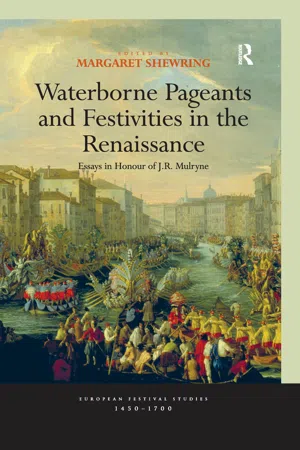
eBook - ePub
Waterborne Pageants and Festivities in the Renaissance
Essays in Honour of J.R. Mulryne
- 474 pages
- English
- ePUB (mobile friendly)
- Available on iOS & Android
eBook - ePub
Waterborne Pageants and Festivities in the Renaissance
Essays in Honour of J.R. Mulryne
About this book
As the first book-length study of waterborne festivities in Renaissance and early modern Europe, this collection of essays draws on a rich array of sources, many previously un-researched, to explore aspects of scenography, choreography, music, fashion, painting, sculpture, architecture, stage-and personnel-management and urban planning as evinced in spectacles staged on water. Bodies of water in all their variety are explored here: seas, rivers, fountains, lakes and canals and flooded improvised locations within or adjacent to great buildings all provided stages for elaborate and costly performances, utilising the particular qualities of water to reflect light and distort sound. The volume encompasses festivals marking a wide range of occasions from the election of civic officials, the welcome of a monarch, an investiture or coronation, to ambassadorial visits or the arrival of a royal or ducal bride or bridegroom. Often taking the form of re-enactments of naval battles or legendary seaborne quests, these festivals seek to buttress civic and national pride, make claims to mastery over the sea and landscape, and explore the imaginative as well as practical life of performance space which has been a hallmark of the research and publication of this volume's honorand, J.R. (Ronnie) Mulryne.
Information
Chapter 1
French Renaissance Waterborne Festivals in the Sixteenth Century
Richard Cooper
While Venice is famous for a profusion of waterborne festivals, not least those offered to an incoming Henri III, which are discussed in this volume of essays, and which were so elaborate that they were sent up in an amusing and fantastical pamphlet to which I will return at the end; while Portugal and even Spain has occasional waterborne festivals in Burgos,1 Valencia2 or Madrid,3 Tudela or Tortosa;4 France is less well known for its Renaissance aquatics. A number of chapters in this volume try to correct this, notably on Lyon, Paris, Fontainebleau and Bayonne, which allows me to focus on broader aspects of the subject.
Not that aqua is always essential for aquatics. Textbooks like that of Sabbatini,5 explain how to create a realistic impression of movement of sea and waves on the stage, anticipated in the Sirens and Tritons leaping about in the Balet comique de la royne.6 A good example is the performance in front of the château de Nantes in February 1596 of Nicolas de Montreux’s Arimène for the duc de Mercœur. Among the five intermèdes was one of the rape of Helen (II), followed by a naval battle:
une mer coula artificieusement sur le theatre où flottaient les navires de Pâris, qui rencontrent en leur route des nefs ennemis
[a sea flowed artfully across the theatre, bearing Paris’s ships, which encounter enemy ships on their route]
and another (III) showing Andromeda chained to a rock, and how a sea monster that fires out water is defeated by Perseus:7
Sur le theatre parut une mer agitée, et les pentagones changeant de face parurent portant des grotesques et rochers […]. A l’instant sortit le monstre de la mer, avec un haut bruit et jaillissement de flots.
[On the theatre a stormy sea appeared, and five-sided revolving flats appeared, depicting rocks and grotesques […]. Suddenly the monster rose from the sea, with loud noise and surging waves.]
The Antwerp Ommegangs, and François d’Anjou’s 1582 entry,8 made much of the ship on dry land, as did Brussels for the funeral of Charles V.9 The marriage ceremonies in the Pitti Palace for Francesco de’ Medici turn a courtyard into a lake, or have galleys or sea-creatures on wheels.10 In Lyon in 1533,11 the Arch at St Eloy sheltered a model ship in full sail, which lacked a helmsman, to the consternation of the sailors seeking guidance, until the arrival of the Virago Eleanor gave the answer to a sailor’s prayer.
Gifts made to French monarchs by hopeful cities have a marine flavour, whether a representation of Perseus liberating Andromeda,12 or the inevitable Neptune promising dominion of the seas, or a three-masted golden ship in full sail, filled with golden écus;13 or again a golden statue of Charles offered in Montpellier, standing on the shore of the Mediterranean, one foot on land, one on sea.14 Nantes developed a speciality of offering gilded silver ships, taken from the city’s coat of arms.15 In Paris too, much is regularly made in the iconography of the ship on the city’s shield,16 and the same will apply in Caen, a maritime town, which makes no use of the sea in its entries, but has symbols including hands on tillers, anchors, lighthouses, storm-tossed ships,17 or has seven virgins, representing the Virtues, pouring water into an ‘estang’ (‘pond’).18
But France in fact has, throughout the sixteenth century, a good tradition of water festivals, of considerable variety, stimulated by an itinerant court covering hundreds of miles per year in the biggest country in Europe, and by the tradition of the joyeuses entrées at the beginning of each reign. I stress itinerant court, because of the convenience of river transport, which these festivals turn into something less mundane. To welcome Eleanor and the Royal Children to Bordeaux in 1530, a special boat was sent to Langon upstream on the Garonne, allowing the party to
vaguer sur la marine entre Langon et Bordeaux, en batteaux propres et experts, vitrez, peints, et dorez si magnifiquement, que la maison de verre du Roy d’Angleterre, tant estimé à la venue et entreveuë d’Ardres leur cedoit le lieu, quant à l’excellence des richesses et beautez.19
[sail on the water between Langon and Bordeaux, in neat, manoeuvrable vessels, glazed, painted and gilded so magnificently that the King of England’s glass palace at the Field of Cloth of Gold at Ardres was inferior to them in outstanding wealth and beauty.]
As part of the crossing of France by Charles V in 1539, the ‘échevins’ (aldermen) of Orleans fitted out ten or twelve boats to meet François Ier at Gien on the Loire, and to fetch him to Orleans:
tous couverts de satin, où estoient galleries, cha[m]bres, cheminées, et cabarets en mode de navires; et y en avoit un special pour le Roy, où y avoit quatre chambres, galeries et jeux de paume.20
[all covered in satin, containing the kind of galleries, bedchambers, fireplaces and serveries found in ships; and there was a special one for the King, with four bedchambers, galleries and tennis courts.]
Nantes made a speciality of using expert local sailors to navigate the treacherous Loire to guide royal visitors safely.21 In 1500 the town constructed two ‘galliotes’ (‘galiots’) in which the ‘seigneurs de la justice et aultres bourgeois furent au devant du Roy et de la Royne’ (‘justices and other burghers went to meet the King and Queen’), Louis XII and Anne de Bretagne; one of the ‘galliotes’, used for the king, was fitted with a cabin ‘monté sur des arceaux’ (‘mounted on arches’), rowed by 18 oarsmen, and strewn with straw.22 The final part of the visit of François Ier and Claude on 8 August 1518 was made on the ‘galions’ (‘galleons’) fitted out by Nantes and manned by crews recruited from Nantes and Le Croisic.23 In 1532 Eleanor and the Dauphin were fetched from Ancenis in two ‘galliotes’, each decorated with ‘trente six grans pavoys armoyez et victrés’ (‘thirty-six large shields, glazed and painted with arms’) and topped with seven ‘guyrouectes de fer blanc’ (‘tin weather-vanes’) and with ‘ecussons’ (‘coats of arms’); they had been converted from sailing barges, and fitted with a deck and glazed cabin, waterproofed with tarpaulin, and arrayed with rich internal hangings. It took a crew of 23 to sail the smaller ‘galliote’ for the king and queen to Ancenis, and to navigate shallow waters in August, taking two days to cover the short distance and then, after the entry, needing a crew of 40 to take them back to Ancenis. The low water level, and the narrowness of the river in some places, meant that the craft had to be towed, and paddles provided to clear a path through the silt.24 Once the guests were in Nantes, however, there is no evidence of the river being used as part of the ceremonial.
In the Royal tour of 1564–66, Charles IX and his mother, Catherine de’ Medici, made use of ceremonial boats which had been fitted out for them by the municipalities,25 travelling from Chalon-sur-Saône and Mâcon to Lyon in a ‘basteau sumptueusement basty et maisonné’ (‘sumptuously constructed and fitted vessel’), decorated by the Lyon municipality;26 or up the Garonne to Agen27 and then on to Bordeaux, on a craft rigged out by Toulouse,28 before transferring to a boat provided by the Jurats of Bordeaux for the entry to that city,29 before going off towards Bayonne, and being picked up by two craft sent by the elders of that town:30
deux Bapteaulx qui seront assès propres, selon la portée des rivieres de ce païs; oultre ce, qu’ilz seront accompagnez de douze gallions, lesquelz...
Table of contents
- Cover Page
- Title Page
- Copyright Page
- Contents
- J. R. (Ronnie) Mulryne
- Acknowledgements
- List of Illustrations
- Notes on Contributors
- Introduction
- Chapter 1 French Renaissance Waterborne Festivals in the Sixteenth Century
- Chapter 2 Lyon: a Centre for Water Celebrations
- Chapter 3 Parisian Waterborne Festivals from Francis I to Henri III
- Chapter 4 Water Festivals of the Reign of Charles IX of France
- Chapter 5 Renaissance Venice and the Sacred-Political Connotations of Waterborne Pageants*
- Chapter 6 Rex Christianissimus Francorum: Themes and Contexts of Henry III’s Entry to Venice, 1574*
- Chapter 7 Water Policy and Water Festivals: the Case of Pisa Under Ferdinando de’ Medici (1588–1609)
- Chapter 8 Arbitrary Reality: Fact and Fantasy in the Florentine Naumachia, 15891
- Chapter 9 Lepanto Revisited: Water-fights and the Turkish Threat in Early Modern Europe (1571–1656)
- Chapter 10 Mary, Queen of Scots’ Aquatic Entertainments for the Wedding of John Fleming, Fifth Lord Fleming to Elizabeth Ross, May 1562
- Chapter 11 Looking Again at Elvetham: An Elizabethan Entertainment Revisited
- Chapter 12 The Ice Festival in Florence, 1604
- Chapter 13 The Thames en Fête
- Chapter 14 Royal River: The Watermen’s Company and Pageantry on the Thames
- Chapter 15 The Ambassador’s Reception: The Moroccan Embassy to London of 1637-1638 and the Pageantry of Maritime Politics
- Chapter 16 The Savoy Naumachia on the Lake Mont Cenis: A Site-specific Spectacle in the ‘Amphitheatre’ of the Alps
- Chapter 17 Naumachiae at the Buen Retiro in Madrid
- Chapter 18 Waterfront Entertainments in Saxony and Denmark from 1548–1709
- Chapter 19 Sea Spectacles on Dry Land: The 1580s to the 1690s
- Chapter 20 Sing Again, Sirena: Translating the Theatrical Virtuosa from Venice to London
- Chapter 21 Sailing Towards a Kingdom: Ernst August von Braunschweig-Lüneburg (1629-1698) in Venice in 1685 and 1686
- Index
Trusted by 375,005 students
Access to over 1.5 million titles for a fair monthly price.
Study more efficiently using our study tools.
Frequently asked questions
Yes, you can cancel anytime from the Subscription tab in your account settings on the Perlego website. Your subscription will stay active until the end of your current billing period. Learn how to cancel your subscription
No, books cannot be downloaded as external files, such as PDFs, for use outside of Perlego. However, you can download books within the Perlego app for offline reading on mobile or tablet. Learn how to download books offline
Perlego offers two plans: Essential and Complete
- Essential is ideal for learners and professionals who enjoy exploring a wide range of subjects. Access the Essential Library with 800,000+ trusted titles and best-sellers across business, personal growth, and the humanities. Includes unlimited reading time and Standard Read Aloud voice.
- Complete: Perfect for advanced learners and researchers needing full, unrestricted access. Unlock 1.5M+ books across hundreds of subjects, including academic and specialized titles. The Complete Plan also includes advanced features like Premium Read Aloud and Research Assistant.
We are an online textbook subscription service, where you can get access to an entire online library for less than the price of a single book per month. With over 1.5 million books across 990+ topics, we’ve got you covered! Learn about our mission
Look out for the read-aloud symbol on your next book to see if you can listen to it. The read-aloud tool reads text aloud for you, highlighting the text as it is being read. You can pause it, speed it up and slow it down. Learn more about Read Aloud
Yes! You can use the Perlego app on both iOS and Android devices to read anytime, anywhere — even offline. Perfect for commutes or when you’re on the go.
Please note we cannot support devices running on iOS 13 and Android 7 or earlier. Learn more about using the app
Please note we cannot support devices running on iOS 13 and Android 7 or earlier. Learn more about using the app
Yes, you can access Waterborne Pageants and Festivities in the Renaissance by Margaret Shewring in PDF and/or ePUB format, as well as other popular books in Media & Performing Arts & Early Modern History. We have over 1.5 million books available in our catalogue for you to explore.