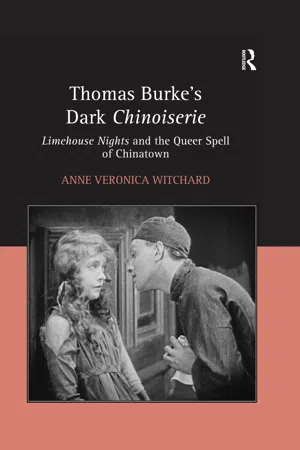
eBook - ePub
Thomas Burke's Dark Chinoiserie
Limehouse Nights and the Queer Spell of Chinatown
- 304 pages
- English
- ePUB (mobile friendly)
- Available on iOS & Android
eBook - ePub
Thomas Burke's Dark Chinoiserie
Limehouse Nights and the Queer Spell of Chinatown
About this book
Focusing on Thomas Burke's bestselling collection of short stories, Limehouse Nights (1916), this book contextualises the burgeoning cult of Chinatown in turn-of-the-century London. London's 'Chinese Quarter' owed its notoriety to the Yellow Perilism that circulated in Britain at the fin-de-siècle, a demonology of race and vice masked by outward concerns about degenerative metropolitan blight and imperial decline. Anne Witchard's interdisciplinary approach enables her to displace the boundaries that have marked Chinese studies, literary studies, critiques of Orientalism and empire, gender studies, and diasporic research, as she reassesses this critical moment in London's history. In doing so, she brings attention to Burke's hold on popular and critical audiences on both sides of the Atlantic. A much-admired and successful author in his time, Burke in his Chinatown stories destabilizes social orthodoxies in highly complex and contradictory ways. For example, his writing was formative in establishing the 'queer spell' that the very mention of Limehouse would exert on the public imagination, and circulating libraries responded to Burke's portrayal of a hybrid East End where young Cockney girls eat Chow Mein with chopsticks in the local cafés and blithely gamble their housekeeping money at Fan Tan by banning Limehouse Nights. Witchard's book forces us to rethink Burke's influence and shows that China and chinoiserie served as mirrors that reveal the cultural disquietudes of western art and culture.
Information
PART 1
Chinoiserie
Chapter 1
Enchantment
Historical focus on chinoiserie has tended to isolate it as a mid-eighteenth-century phenomenon, its aesthetic swansong being the Prince Regent's Chinese folly at Brighton, completed in 1822. This has resulted in the appropriation of the term to describe the taste in decorative arts of that period rather than a wide ranging phenomenon that began in the fourteenth century and which has continued in various manifestations ever since. From the very beginnings of the West's encounter with China, interpretations of the country and its people have resulted in a multiplicity of intellectual and emotional responses.1 These have altered according to cultural and political requirements over the centuries. The China described by Marco Polo for example, was a beguiling contrast to medieval Europe, a place of wise despotic government, elaborate manners, moral certainties and prodigious riches. Polo served Kublai Kahn in the Mongolian government from 1275–1292. His Description of the World or Travels of Marco Polo, published early in the fourteenth century, served to verify the legends and vague notions of the remote Orient which had been known to the Romans as the source of precious silks but had faded from the European mind during the course of the Dark Ages.2 Polo's book was to be the exemplar for centuries of romantic conjurings and speculations about the mythical land of Far Cathay while at the same time overseas exploration began to produce hard evidence of China. Throughout the fifteenth and sixteenth centuries, Portugal, Spain and Holland had the monopoly of trade with the Far East so products from the Orient reached Europe by way of their ships. English means of commerce were less than straightforward. Thanks to the official licence of Queen Elizabeth I, ‘many a stately Spanish carrack weighed down with eastern merchandise’ was diverted to English shores by pirates.3 The eventual establishment of a British trading post in Canton in 1637 increased evidence of China's legendary wonders, but Chinese export restrictions meant the merchandise was limited and therefore highly prized. It was because of this that the best of Europe's craftsmen were employed in creating decorative pieces à la façon de la Chine, initially for the French court at Versailles. They produced embroidered silks, blue-and-white porcelain, carved ivories and lacquered furniture, objets d'art which had the same associative value as the rare and exotic things imported by the trading companies. In 1670, Louis XIV presented his mistress, Madame de Montespan, with a Chinese pagoda constructed entirely of blue-and-white porcelain where they might disport themselves à la mode Chinoise in its Chambre des Amours. This lavish Parisian pagoda made manifest the fabled lotus life of China's mandarin elite, a particularly extravagant signifier of the Chinese Oriental as a realm of sensual indulgence. A passion for imitating aspects of Chineseness, from latticed teahouses in palace gardens to adaptations of Chinese plays for masques and entertainments, spread throughout the grand estates of Europe and would eventually be given the name chinoiseries.
The philosophical requirements of a utopian alternative would characterise the visions of China materialised by Western artefacts. Countless decorators of porcelain, silks and wallpapers depicted an enchanted place of topsy-turvydom where European values were turned on their heads, a place where men wore robes and women wore trousers, where belles-lettres were esteemed above commerce and the emperor himself was a philosopher. The inhabitants of Cathay waft to-and-fro in swings or dally by goldfish pools, everlastingly caught in a contemplative landscape of snow-capped mountains and flowering plum-blossom.4 The chinoiserie dreamscape of Samuel Taylor Coleridge's ‘Xanadu’ embodied a vision with which he and his circle were obsessed, the idea of discovering their own rural arcadia ‘in which they would live a life of communal harmony.’5 Even when the notion of Cathay as a culturally superior civilisation had been superseded by the late-nineteeenth-century picture of China as stagnant and uncivilised, there were visionaries such as Edward Carpenter who, repelled by England's factory culture, imagined China as a peasant paradise in Towards Democracy (1883) and England's Ideal (1887), and J.A. Hobson whose critique, Imperialism (1902) valorised Chinese religious tolerance and reverence for learning.
Western ideas about China have ever been representative of Western compulsions. Their historical permutations, ranging from delightful fantasy to downright phobia, have much to teach us about the ways in which, ‘through its articulation of a set of ideas named “China”, the West has envisioned itself.’6 As Edward Said has shown us, the Orient is never ‘merely imaginative’ but ‘an integral part of European material civilisation and culture.’7 For Said's scope the Orient was Islamic, the Oriental imaginary of England (and France) he writes, being derived from the closeness of their encounter with India and the Bible lands.8 But if nineteenth-century Orientalism was a discourse of managing and producing, objectifying the Oriental Other of Europe's colonies, the nineteenth-century ‘scramble’ for Chinese territories certainly adopted this modus operandum with regard to China.
The abrupt disfavour expressed by the literati of Georgian England following the craze for rococo chinoiserie can be ascribed to something more sinister than the inevitable vagaries of fashion. From the 1750s, consensual acceptance of the superiority of Chinese government, its art, classics and Confucian virtues, began to give way to derision. Admiration for an imagined China was supplanted by the ‘disdain’ of a developing imperialist culture ‘for the supposedly known China that was becoming an object for pressure and ultimately for the coercion of the opium wars.’9 Reactions ranging from the mildly satirical to ‘outright antagonistic backlash’, now condemned chinoiserie as the taste of the nouveaux riches and of women, neither capable of proper aesthetic judgment.10 The calm certitudes of neo-classicism directed educated attention to focus on the antiquities of Greece and Rome, and the dilettante collection of deviant rarities which had no foundation in morals or nature was regretted: ‘the barbarous gaudy goût of the Chinese … fat-headed Pagods and shaking Mandarins bear the prize from the greatest works of antiquity; and Apollo and Venus must give way to a fat idol with a sconse on his head.’11 The debilitating effect of the Chinese craze was widely lamented for having reduced the robust English gentleman to a tea-sipping fop, fit only to loll on his gilded Chippendale chaise, bedecked with dragons and lotus blooms.
Daniel Defoe was a very early exponent of the backlash. The Consolidator, or Memoirs of Sundry Transactions from the World in the Moon. Translated from the ‘Lunar Language by the Author of the True-Born Englishman’, in which a man travels from China to the moon in a flying machine, the ‘Consolidator’ (1705) was written in order to satirise European society, politics and letters by analogy with Chinese conditions. In Robinson Crusoe (1719) Defoe's hero expresses the following sentiment: ‘it seemed strange to me when I came home, and heard our people say such fine things of the power, glory, magnificence, and trade of the Chinese … as far as I saw, they appeared to be a contemptible herd or crowd of ignorant sordid slaves.’12 Robert Markley points out that the Chinese embody a contradiction which Defoe, a committed Protestant, cannot resolve: ‘a virtuous and prosperous “heathen” civilization that threatens Anglocentric fantasies of infinite profits, religious zeal, and a secure national identity.’13 By rejecting accounts that celebrated China's wealth, socioeconomic stability and good government, ‘Defoe … transforms the literature of diplomatic and tributary missions into mercantilist fantasies of outmanoeuvering a people he depicts as backward, dishonest and slow-witted.’14 Markley also draws our attention to just how ‘jarring an assertion this is’ in the context of early-eighteenth-century sinophilia.15 For other writers of this period, Qing China was still ‘a secure exterior vantage point from which to refute western hegemonic claims.’16
Thanks to the accommodationist precepts of the Jesuits and their translations, the reputation of Confucius was strong in Europe and the character of the sage as ‘Chinese observer’ emerged. Montesquieu's Lettres persanes (1721) in which two Persian gentlemen note the absurdities of Parisian life was imitated by the Marquis d'Argens’ Lettres chinoises (1739), and in...
Table of contents
- Cover Page
- Title Page
- Copyright Page
- Table of Contents
- List of Illustrations
- Acknowledgements
- Disclaimer
- PART 1 Chinoiserie
- PART 2 ‘The Lamp of Young Aladdin’: English Chineseness, 1780–1900
- PART 3 Inventing Chinatown
- PART 4 The Laureate of Limehouse
- PART 5 Nympholepsy
- Bibliography
- Index
Trusted by 375,005 students
Access to over 1.5 million titles for a fair monthly price.
Study more efficiently using our study tools.
Frequently asked questions
Yes, you can cancel anytime from the Subscription tab in your account settings on the Perlego website. Your subscription will stay active until the end of your current billing period. Learn how to cancel your subscription
No, books cannot be downloaded as external files, such as PDFs, for use outside of Perlego. However, you can download books within the Perlego app for offline reading on mobile or tablet. Learn how to download books offline
Perlego offers two plans: Essential and Complete
- Essential is ideal for learners and professionals who enjoy exploring a wide range of subjects. Access the Essential Library with 800,000+ trusted titles and best-sellers across business, personal growth, and the humanities. Includes unlimited reading time and Standard Read Aloud voice.
- Complete: Perfect for advanced learners and researchers needing full, unrestricted access. Unlock 1.5M+ books across hundreds of subjects, including academic and specialized titles. The Complete Plan also includes advanced features like Premium Read Aloud and Research Assistant.
We are an online textbook subscription service, where you can get access to an entire online library for less than the price of a single book per month. With over 1.5 million books across 990+ topics, we’ve got you covered! Learn about our mission
Look out for the read-aloud symbol on your next book to see if you can listen to it. The read-aloud tool reads text aloud for you, highlighting the text as it is being read. You can pause it, speed it up and slow it down. Learn more about Read Aloud
Yes! You can use the Perlego app on both iOS and Android devices to read anytime, anywhere — even offline. Perfect for commutes or when you’re on the go.
Please note we cannot support devices running on iOS 13 and Android 7 or earlier. Learn more about using the app
Please note we cannot support devices running on iOS 13 and Android 7 or earlier. Learn more about using the app
Yes, you can access Thomas Burke's Dark Chinoiserie by Anne Veronica Witchard in PDF and/or ePUB format, as well as other popular books in Literature & Literary Criticism. We have over 1.5 million books available in our catalogue for you to explore.