eBook - ePub
The Selborne Pioneer
Gilbert White as Naturalist and Scientist: A Re-Examination
- 272 pages
- English
- ePUB (mobile friendly)
- Available on iOS & Android
eBook - ePub
About this book
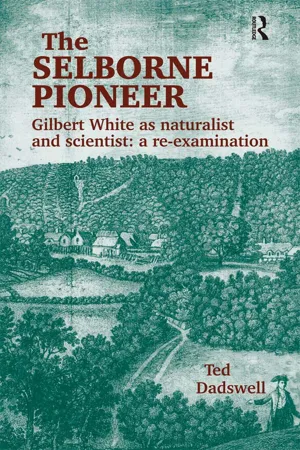
Gilbert White's name is known universally but, as Ted Dadswell insists in this book, important aspects of his work have frequently been overlooked even by scholarly editors. The Selborne naturalist (1720-1793) has been described as 'a prince of personal observers'; but a shrewd analytical questioning and comparing was also typical of his 'natural knowledge'. Exceptional even in his general aims, White studied the behaviour, the 'manners' and 'conversation', of his animals and plants. He saw, moreover, that an animal or plant and indeed a parish such as his own, was unitary in operation; again and again, a cause had numerous effects and an effect numerous causes. Observation could go forward in circumstances such as these, if one was both sharp-eyed and patient, but how could true investigation be managed? How could a particular cause or effect be isolated or tested? Here what Dadswell calls White's 'comparative habit' was put to good use. Gilbert White was a careful keeper of records, and using these comparatively he 'appealed to controls' while examining his living creatures. Questioning and testing even the 'entirely usual', White was brought back repeatedly to the notion of adaptability. His zoological findings often concerned 'changed or changing' animals (or birds) and their social and inter-personal relationships. Today, we can seem particularly well placed to appreciate his methods and factual claims; our 'ethologists' and ecologists have - seemingly - corroborated much of what he did. And yet just this corroboration renders him the more mysterious. To properly assess White as naturalist, we must be able to approach him not only scientifically but also historically. He hoped for the emergence of teams of behavioural workers but did not try to pre-empt what would be achieved only by such teams, and while he 'saw with his own eyes', as his friend John Mulso says, he was substantially affected by certain of his contemporaries and predecessors. His journals and notebooks show us the naturalist at work. When a perhaps unexpected combination of influences is allowed for, his 'unique' activities can be at least partially explained.
Chapter 1
The Heroic Gardener
1 Selborne and ‘Natural Knowledge’
White’s respect for small and ‘insignificant’ creatures – the hirundines and harvest mice, the field crickets and young frogs he studied – was both genuine and partisan. According to those who knew him, he was a small, neat man. His allegiance to the parish he immortalized, the ‘abrupt, uneven country, full of hills and woods and therefore full of birds’,1 was at one level an emotional allegiance. His description of his house and garden as a ‘sheltered, unobserved retreat’, in one of his rhetorical poems, is not to be taken quite literally; he made regular trips and journeys and regularly put up friends and relatives, he was sociable by nature and enjoyed musical parties; but his satisfaction at getting back to his home territory after any considerable absence is plain. He would travel if there was good reason for it even in the depths of winter, but he seems to have felt entirely secure only amidst ‘Selbornian scenes’.
The sympathy and loyalty played their parts in his natural history career; they helped keep him steadily directed towards a particular, restricted subject-matter; but they leave us unprepared for the originality, the independence of mind, which also typified him. He operated mainly within his own locality, and his career as a naturalist or committed naturalist began in the mid-1760s, but he was a methodical observer of the behaviour, or, as he puts it sometimes, the ‘life and conversation’, of animals and plants. On this evidence alone, he was out of step with his contemporaries:
It is fair to say that all the eighteenth century naturalists, with the exception of Gilbert White, concentrated on descriptions and names. They were so keen to get the recognition of animals cut and dried that they nearly all put studies and accounts of the creatures in the field into second place.2
But his ‘observing’ was not a matter merely of watching living things and writing reports. Exploiting his special relationship with the parish, and in a sense proceeding in spite of it, he probed and questioned the ‘lives’ of his parish members and, beyond this, the workings of the parish as a whole.
Classification and physiological research dominated the higher reaches of zoology and botany in the second half of the eighteenth century, and collecting in one field or another was the characteristic amateur naturalist’s activity. White was part of what can almost be called a British ‘natural history’ movement, but apart from the wild and foreign plants he gathered into his garden, he made no collections. He left no rows upon rows of mounted beetles or butterflies, no cases of stuffed birds or trays of neatly labelled birds’ eggs. During 1766, he catalogued the flowering plants of his district, covering more than four hundred species, but he left no books of pressed flowers. He lacked the competitive – emulative – quality of the true collector. He kept various of the fossil specimens found by himself or his neighbours: he gave these considerable thought and as we shall see left careful descriptions of them; but he made no serious attempt to amass ‘ores and fossils’.3
He was an assiduous recorder and note-taker, but he doubted the value of ‘posting from place to place’ in search of curiosities. His view was that of a more recent behavioural worker: ‘It is only by living with animals that one can attain a real understanding of their ways.’4 Seasonal record-keeping – the recording in particular of ‘first and last appearances’ – was a feature of the popular nature study, and more often than not, this recording was a sort of collecting. What recommended the Selborne district to Gilbert White as a naturalist, however, was its ‘outdoor’ diversity. The idea of an atomistic natural world was alien to him, but the parish, while it could be covered conveniently on foot or on horseback, included within it ‘chalks, clays, sands, sheep-walks and downs, bogs, heaths, woodlands, and champaign fields’.5 The weather of the locality might be similarly varied. The resident and longterm observer could note what happened to given animals and plants, and what they did, in the various seasonal conditions occurring during any year in Hampshire, and from time to time could add observations made during particularly hot summers or winters of ‘rugged’ snow, drought years (such as 1781) or years of persistent rain (such as 1782). Gilbert White’s openness, his availability to other people and things, was a distinguishing quality, but in White the natural historian an inquisitive scepticism complemented this openness. In the process of making discoveries he could doubt his own firsthand impressions; he could suspend judgement, in John Locke’s phrase, until he had made some relevant comparisons.
Inevitably, the advantages of his geographical situation notwithstanding, he met with obstacles as an observational naturalist at work in the eighteenth century. His occasional elementary mistakes are instructive two hundred years on. In 1767, for instance, he failed to identify a dead peregrine falcon which was brought him.6 The incident is documented in The Natural History of Selborne – the bird was ‘uncommon’ in White’s district but the carcass he examined was not seriously decomposed – although by the time the book was published he could also include a well-informed report on the peregrine; ‘candour’ was indispensable to the true naturalist.7 Again, he refers on a number of occasions to having seen ‘yellow wagtails’ in the Selborne parish in winter. This mistake, as we can assume it to have been, was never corrected.8 Presumably, he confused the yellow with the somewhat similar grey wagtail, or grey wagtail in winter plumage; the grey is a resident in Britain while the yellow is, and no doubt was, a summer visitor only. Even more strikingly for the present-day observer, towards the end of his life, when he was gathering materials for a paper on the nightjar, he mistook the eggs of a nightjar for those of a snipe.9 The shapes of the eggs alone should have put him on his guard, we tell him confidently: a snipe’s eggs are sharply pointed, whereas those of the nightjar are flattened ovals, virtually without large and small ends.10
The explanation of mistakes such as these is, of course, that when White began his researches the work of those concentrating on ‘names and descriptions’ was itself still at an early stage. Where the would-be naturalist of our own time can take accurate recognition guides almost for granted, the natural history books of White’s day were bulky, unreliable and relatively expensive. They suffered from the illustrators’ dependence on dead specimens, and if the illustrations were coloured, from a process of repeated copying from an original hand-coloured version.11 White built up a small library from among the available manuals, but for ornithological information he could rely on, clearly, he was often entirely dependent on his own field experience. Nightjars were frequently seen and heard on Selborne Down in the late evenings in summer (the Down was and is partly covered with scrub and beech woods), and a nightjar often hunted for chafers around the oak tree in White’s ‘great meadow’. But he had not watched these ‘wonderful and curious birds’ at the nest, or rather, at a nest containing eggs.12 The involved recognition problems he often had to deal with appear, in the same way, from the error over the yellow or grey wagtails. He did not know the yellow wagtail was a summer visitor only (in The Natural History of Selborne, it is listed with his resident birds), and depending on age and seasonal plumage, the grey wagtail can somewhat resemble the yellow. Because of these two causes combined, he sometimes ‘saw’ yellow wagtails about the parish during the winter months.
Remarkably few errors can be found in his work, in fact; and he has an assured place in the history of zoology as someone who in several instances distinguished between creatures which, until that time, had been universally confused. He added the noctule bat and the harvest mouse to the list of British mammals, or was among the ‘discoverers’ of both. He was the first to methodically sort out the three ‘leaf warblers’ which were and are widespread in Britain in summer: as they were eventually to be called, the chiff-chaff, the willow warbler and the wood warbler.13 These small, olive-coloured birds are difficult to tell apart even with the aid of the binoculars which, in principle, give present-day observers an enormous advantage over White. They are difficult to tell apart, this is to say, even with the aid of binoculars, and even though – thanks to the work of pioneers – we can be prepared in advance for the minute differences between them.
The different songs or calls of the three leaf warblers first alerted White to their separateness. A ‘good ornithologist’, he says, should be able to distinguish his birds or bird species ‘by their air as well as by their colours and shape, on the ground as well as on the wing, and in the bush as well as in the hand’.14 He dwells on the gaits and flight-styles of a number of species and genera; but recognition was only an initial stage, for White, a means to other work. (If only for this reason, the principle ‘shoot first and identify afterwards’ was generally quite unacceptable to him.) The ‘good ornithologist’ will be interested in the feeding and courtship, the hibernation or migration, the attitudes to offspring and the social habits of the creatures he deals with. In these more advanced inquiries too, exactitude will be the rule. In one of the Selborne ‘letters’, he refers to the behaviour of a pair of barn owls which had nested and hatched young ones in the roof of Selborne church:
About an hour before sunset (for then the mice begin to run) they sally forth in quest of prey, and hunt all round the hedges of meadows and small enclosures for them, which seem to be their only food. In this irregular country we can stand on an eminence and see them beat the fields over like a setting-dog, and often drop down in the grass or corn. I have minuted these birds with my watch for an hour together, and have found that they return to the nest, the one or the other of them, about once in five minutes.15
White seems to have watched birds and animals using only the naked eye, but from the quality of his detailed reports this inconvenienced him only rarely. In what was a secluded parish in his time and in winter even an inaccessible one, he usually worked alone: at least, and though he could and did call on helpers from within the village community, he was without a ‘companion’ in natural knowledge, an assistant who fully understood and shared his aims.16 This did constitute a handicap, he readily admitted.
He was a gardener as well as a naturalist, and a poet as well as an objective investigator; a romantic flourish was added to various of his activities. With his brothers, he built two ‘hermitages’ on Selborne Down, to be visited for tea parties and for the views they offered of the surrounding countryside, and he set up a large ‘figure of Hercules’ overlooking his outer garden. He copied the following lines from James Thomson on to the title pages of the early annual volumes of his Naturalist’s Journal:
I solitary court
The inspiring breeze; and meditate the book
Of NATURE ever open …17
But he recognized the limits of solitary research. A man trying to be sure of his facts but working only from ‘his own autopsia’ can seldom make steady progress, he says, and in his own case a local colleague would have ‘quickened his industry and sharpened his attention’.18 Beyond this, the behavioural nature study he wanted to be part of would have to be organized and co-operative for true advances to be possible; it would require a sharing and mutual monitoring on the part of widely – even internationally – scattered ‘observers’.19
White never despaired of seeing at least the early stages of this cooperation. He tried to lead by example. He was a gifted letter-writer, and he helped other naturalists generously. Without being responsible for the general character of that work, he contributed much more to the later editions of Thomas Pennant’s British Zoology than Pennant (1726–98) admitted in print.20 At the suggestion of the Hon. Daines Barrington (1727–1800), he submitted papers to the Royal Society, on the swallow, the house martin, the sand martin and the swift, which appeared in due course in the Philosophical Transactions.21 If we include his Garden Calendar, he kept detailed fieldbooks for a period of more than forty years; for twenty-six of those years, from January 1768 to June 1793, he kept a Naturalist’s Journal almost continuously, and where meteorological records were concerned, daily. (When he was away from home, Thomas Hoar, his loyal man of all work, ‘kept an account of the rain’.) These diary/notebooks give us insights into his protracted work on particular natural history problems, and the Naturalist’s Journal, at any rate, was intended for the use of others as well as himself. Finally, towards the end of his life, he published The Natural History of Selborne (1789), the collection of behavioural and, as we would term them, ecological reports based on his letters to Pennant and Barrington. He had revised these reports at intervals, using his journal records, and had added other papers to them, notably on geology and meteorology.
He could send requests for information to acquaintances scattered over much of the southern half of England, and he encouraged his friends and relatives to make natural history observations and keep records, especially if they travelled abroad. His brother John was to be a considerable asset during his years at Gibraltar with the garrison. Gilbert, however, remained always short of experienced co-workers. From time to time the ‘help’ he received proved a positive hindrance, as Selborne, for all its immortality, clearly shows. Only White’s side of the correspondence appears in those of the Selborne papers which are based on original letters, but clearly both Pennant and Barrington could pass on untested, hearsay information. White was often informing them, in the event; but in doing this he had to proceed diplomatically. Barrington was a magistrate and a dilettante writer and naturalist, whereas Pennant was an established zoological author, but both were fellows of the Royal Society. White and Barrington became friendly associates, but both of these, his principal correspondents, were of greater social standing than the Hampshire naturalist and curate.
On the positive side, he worked within an established methodological tradition (this will be considered in some detail in a later chapter); and though his remarks in the Natural History concerning his methods are sometimes misleading, we do not have to depend only on this source for our knowledge of these methods. For one thing, parts of the Antiquities, the lengthy appendix to Selborne as originally published, can still be read along with the more famous work. The publication of the papers generally associated with White did not take place until the winter of 1788–89, because of his ‘unassisted’ thoroughness and because he decided at a halfway stage to include the results of his research...
Table of contents
- Cover
- Half Title
- Dedication
- Title Page
- Copyright Page
- Table of Contents
- List of Illustrations
- Acknowledgements
- Preface
- 1 The Heroic Gardener
- 2 Nature as an ‘Economy’
- 3 The ‘Outdoor’ Method
- 4 The Disappearing ‘Swallows’
- 5 Behaviour: Birds and Other Animals
- 6 Instinct and Initiative
- 7 Behaviour: Plants and Insects
- 8 The Useful Naturalist
- 9 Science, Meteorology and Geology
- 10 The Problem of Adaptation
- 11 ‘Living Manners’
- 12 The Perennial Naturalist
- Appendixes: Some Relevant Papers and Extracts
- Notes and References
- Bibliography
- Index
Trusted by 375,005 students
Access to over 1.5 million titles for a fair monthly price.
Study more efficiently using our study tools.
Frequently asked questions
Yes, you can cancel anytime from the Subscription tab in your account settings on the Perlego website. Your subscription will stay active until the end of your current billing period. Learn how to cancel your subscription
No, books cannot be downloaded as external files, such as PDFs, for use outside of Perlego. However, you can download books within the Perlego app for offline reading on mobile or tablet. Learn how to download books offline
Perlego offers two plans: Essential and Complete
- Essential is ideal for learners and professionals who enjoy exploring a wide range of subjects. Access the Essential Library with 800,000+ trusted titles and best-sellers across business, personal growth, and the humanities. Includes unlimited reading time and Standard Read Aloud voice.
- Complete: Perfect for advanced learners and researchers needing full, unrestricted access. Unlock 1.5M+ books across hundreds of subjects, including academic and specialized titles. The Complete Plan also includes advanced features like Premium Read Aloud and Research Assistant.
We are an online textbook subscription service, where you can get access to an entire online library for less than the price of a single book per month. With over 1.5 million books across 990+ topics, we’ve got you covered! Learn about our mission
Look out for the read-aloud symbol on your next book to see if you can listen to it. The read-aloud tool reads text aloud for you, highlighting the text as it is being read. You can pause it, speed it up and slow it down. Learn more about Read Aloud
Yes! You can use the Perlego app on both iOS and Android devices to read anytime, anywhere — even offline. Perfect for commutes or when you’re on the go.
Please note we cannot support devices running on iOS 13 and Android 7 or earlier. Learn more about using the app
Please note we cannot support devices running on iOS 13 and Android 7 or earlier. Learn more about using the app
Yes, you can access The Selborne Pioneer by Ted Dadswell in PDF and/or ePUB format, as well as other popular books in History & World History. We have over 1.5 million books available in our catalogue for you to explore.