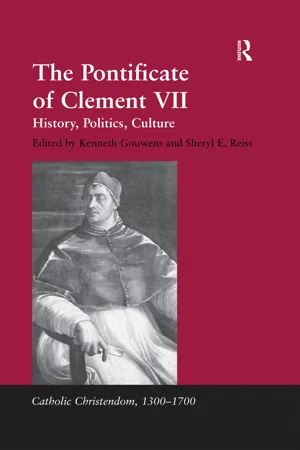
eBook - ePub
The Pontificate of Clement VII
History, Politics, Culture
- 520 pages
- English
- ePUB (mobile friendly)
- Available on iOS & Android
eBook - ePub
About this book
The pontificate of Clement VII (Giulio de' Medici) is usually regarded as amongst the most disastrous in history, and the pontiff characterized as timid, vacillating, and avaricious. It was during his years as pope (1523-34) that England broke away from the Catholic Church, and relations with the Holy Roman Emperor deteriorated to such a degree that in 1527 an Imperial army sacked Rome and imprisoned the pontiff. Given these spectacular political and military failures, it is perhaps unsurprising that Clement has often elicited the scorn of historians, rather than balanced and dispassionate analysis. This interdisciplinary volume, the first on the subject, constitutes a major step forward in our understanding of Clement VII's pontificate. Looking beyond Clement's well-known failures, and anachronistic comparisons with more 'successful' popes, it provides a fascinating insight into one of the most pivotal periods of papal and European history. Drawing on long-neglected sources, as rich as they are abundant, the contributors address a wide variety of important aspects of Clement's pontificate, re-assessing his character, familial and personal relations, political strategies, and cultural patronage, as well as exploring broader issues including the impact of the Sack of Rome, and religious renewal and reform in the pre-Tridentine period. Taken together, the essays collected here provide the most expansive and nuanced portrayal yet offered of Clement as pope, patron, and politician. In reconsidering the politics and emphasizing the cultural vitality of the period, the collection provides fresh and much-needed revision to our understanding of Clement VII's pontificate and its critical impact on the history of the papacy and Renaissance Europe.
PART 1
HISTORY, POLITICS, AND HUMANISM
Chapter 2
Guicciardini, Giovio, and the Character of Clement VII
Francesco Guicciardini's famous contrast of the natures of Clement VII and Leo X, introduced in the Storia d 'Italia during the account of the formation of the League of Cognac, is a rhetorical set piece worthy of Plutarch's parallel lives. Trenchant, incisive, persuasive, it epitomizes the second Medici pope as weak and vacillating, unable to hold to a decision or cope with its consequences:
And although he had a most capable intelligence and marvelous knowledge of world affairs, yet he lacked the corresponding resolution and execution. For he was impeded not only by his timidity of spirit, which was by no means small, and by a strong reluctance to spend, but also by a certain innate irresolution and perplexity, so that he remained almost always in suspension … whence … any slight impediment … was sufficient to make him fall back into that confusion wherein he languished before he had come to a decision; since it always seemed to him, once he had decided, that the counsel which he had rejected was the better one. For summoning up in his mind only those reasons that he had discounted, he did not recall those reasons that had motivated his choice. Thus as a result of his complicated nature and confused way of proceeding, he often permitted himself to be led by his ministers and seemed directed rather than counseled by them.1
Guicciardini's assessment of Clement's indecisiveness was shared by numerous contemporaries, including the datary Gian Matteo Giberti, Guicciardini's ally in the Curia and the minister most responsible for promoting the League of Cognac of 1526, a decisive link in the chain of events leading to the cataclysmic Sack of Rome in 1527.2 While protesting that the league had been the pope's own desire, Giberti nonetheless seemed to have been of the same opinion as Guicciardini when he lamented that the pope:
was of such a nature that I endured an extreme labor to put him on this road, but an even greater one to maintain him there, and it was impossible to put him on his feet again after so many slips—now the accord with the Colonna, now the treaty with Don Ugo Mon-cada, now the one with the viceroy—and so, with the many disasters bad fortune brought us, in the end we fell.3
Paolo Giovio's analysis of Clement's character, given principally in a retrospect following the pope's death, was similar to Guicciardini's, although with a different emphasis.4 In regard to Clement's good qualities—his intelligence, dignity, and self-control—the assessments of the two historians were much the same. So, too, with the roster of his defects—particularly his parsimony and indecisiveness, of which Giovio gave a vivid depiction in his narration of the weeks preceding the Sack of Rome.5 Giovio differed from Guicciardini, rather, in probing more deeply into the well-springs of these weaknesses, outlining a structure of personality whereby Clement's indecisiveness was grounded in avarice and, paradoxically, in ambition. As a fellow Florentine, Guicciardini was perhaps somewhat more forgiving of Clement's parsimony, although he commented emphatically in his Ricordi that success in war depended on large and timely expenditures, certainly a reflection of the disasters of 1527.6 But while Guicciardini acknowledged the pope's “eagerness to save” and alluded to his reputation for avarice, he subordinated avarice to indecisiveness, whereas Giovio saw it as a controlling character trait, a moral flaw. Lacking the liberality and vigor of mind of his cousin Leo X, Giovio charged, Clement VII “was of a nature to delight in parsimony and dissimulation.”7
He had the Medici talent for knowledge and singular judgment in almost everything, including the fine arts … but his nature was so bent to minor arts and to account books that he spent his time investigating the secrets of craftsmen and their works with excessive and almost depraved shrewdness. And certainly he was a person who was never deceived in small matters; whereas, not surprisingly, in great matters touching the welfare of everyone, he was very often deceived. For in affairs of moment the whole force of his great prudence was completely undermined by a fatal avarice, he being one of those persons who, when faced by the need for making an expenditure, dither and delay, tormented by compulsive indecision until the opportune moment for action is lost.8
Thus while acknowledging the play of both qualities in the pope, Giovio ultimately attributed to avarice what Guicciardini attributed to timidity: “in his actions Pope Clement was very grave, very circumspect, very much in control of himself, and with the greatest capacity if his timidity had not often corrupted his power of judgment.”9 Giovio knew of the pope's financial constraints in 1527 as well as Guicciardini did, but in the final analysis he weighted avarice over poverty or timidity.
And not only avarice. In the Life of the marquis of Pescara, Giovio linked the pontiffs wavering to a baleful desire for self-aggrandizement and to his hope that by favoring now one, now the other, he could keep the two most powerful monarchs in Christendom, Charles V and Francis I, in mutual check and hence dependent on his favor. That Clement VII should have been following the practice of countless popes, including his cousin Leo X, was not in itself exceptional. Leo had wavered long before breaking with Francis I in 1521 and allying with Charles V But Giovio's accusation went beyond policy and into the realm of character. He specifically rebutted the belief endorsed by Guicciardini that Clement was controlled by his ministers. His own policy was the source of the wavering, Giovio affirmed, not his falling under the influence of now one, now the other minister.10 Weak as he was, the pope retained final authority throughout the critical years leading up to the Sack, alternating between the recommendations of Nikolaus von Schönberg and Giberti as a means of balancing Charles V with Francis I to augment his own authority. And not only in 1526-27 but also two years later in the crisis of Henry VIII's divorce Giovio was far from describing the pope as caught between the English king and the Holy Roman Emperor. Rather, he accused Clement of actually “nourishing” the controversy in order to maintain a hold on the obedience of the two monarchs.11
Giovio thus gives us a portrait of a pope whose wavering stemmed from a variety of factors, some political, some personal; an individual who although weak was nonetheless ambitious; a leader who reserved to himself the decision-making power even though he did not wield it decisively and who attempted on occasion to profit from his very weakness; a statesman with insight, experience, and many admirable qualities, including moderation and self-control, one who was sincerely pious and sought to be moral in his actions and yet whose indecision coupled with ambition amounted at times to dishonesty. It is a more complex portrait than Guicciardini's and takes more account of the aspiring side of Giulio de' Medici's character, the side invoked ironically in Francesco Vettori's famous epigram, “He endured an enormous labor to become, from a great and respected cardinal, a small and little-esteemed pope.12
The differences between Guicciardini and Giovio with respect to the character of Clement VII broach interesting considerations relating on the one hand to personal bias, and on the other to methodology. Neither historian was an impartial observer. Both suffered the frustration of serving a weak master in turbulent times. Both blamed the pope for the disasters of 1527 from which each suffered personally and which each saw as the end of the libertas Italiae. The genesis of Guicciardini's great history, as Roberto Ridolfi showed some years ago, was the statesman's premura to justify his own role in the League of Cognac and the cataclysmic events it unleashed, a justification in which he demonstrated the degree to which he was prevented by the weakness and indecision of others from achieving goals in themselves realistic.13 But while Guicciardini relieved his frustrations by writing, Giovio took refuge in silence. His despair as an intimate but powerless observer was so great, he lamented, that he could not bring himself to narrate in his histories the entire decade 1517-27, leaving us to reconstruct his analyses of the events of these years from his biographies.14
Each of our two historians knew Giulio de' Medici well, although in different capacities, Guicciardini as a high-ranking official and at times an advisor, Giovio as a physician and constant attendant for over fifteen years, a companion rather than a counselor. Guicciardini's relationship was by way of official, Giovio's by way of personal service. To some extent this difference is detectable in their respective analyses. While Guicciardini expressed the frustration of the subordinate in matters of policy, Giovio added a courtier's disappointment at failing to receive the support he felt he deserved for writing his Histories. To men of letters, he complained, the pope “gave the blandishments of words to hold them in the appearance of grace, but in secret he hated them like his creditors.”15 In Giovio's vignette, the pope emerges as impartial, but inscrutable and cold. “Just as he plainly hated no one, so he never loved anyone, except those who were dear to him for some secret reason, and these he shamelessly and immoderately endowed with the highest honors, with positions of the greatest authority, and with enduring riches.”16 Giovio was probably Guicciardini's source for their mutual observation that of the more than thirty cardinals created by Clement (an aspiration of Giovio’s although not of Guicciardini's), almost none were chosen for the pope's own satisfaction; but whereas to Guicciardini this was a sign of the pope's control by others, to Giovio it was an indication of his innate parsimony, that he would not reward loyal service or merit.
Apart from personal perspective, however, the differences between Guicciardini and Giovio in their analyses of Clement VII yield interesting methodological insights into early modern historiography. Both historians were well aware of the conventions of classical and humanist historiography.17 For all his interest in motive, however, far exceeding classical historians in this regard, Guicciardini nonetheless confined his précis of Clement's character to clarifying his actions, whereas Giovio, although well-aware of the class...
Table of contents
- Cover Page
- Title Page
- Copyright Page
- Table of Contents
- Series Editor’s Preface
- List of Abbreviations
- List of Illustrations
- List of Contributors
- Acknowledgments
- Introduction
- PART 1 History, Politics, and Humanism
- PART 2 Patronage, Cultural Production, and Reform
- Index
Trusted by 375,005 students
Access to over 1.5 million titles for a fair monthly price.
Study more efficiently using our study tools.
Frequently asked questions
Yes, you can cancel anytime from the Subscription tab in your account settings on the Perlego website. Your subscription will stay active until the end of your current billing period. Learn how to cancel your subscription
No, books cannot be downloaded as external files, such as PDFs, for use outside of Perlego. However, you can download books within the Perlego app for offline reading on mobile or tablet. Learn how to download books offline
Perlego offers two plans: Essential and Complete
- Essential is ideal for learners and professionals who enjoy exploring a wide range of subjects. Access the Essential Library with 800,000+ trusted titles and best-sellers across business, personal growth, and the humanities. Includes unlimited reading time and Standard Read Aloud voice.
- Complete: Perfect for advanced learners and researchers needing full, unrestricted access. Unlock 1.5M+ books across hundreds of subjects, including academic and specialized titles. The Complete Plan also includes advanced features like Premium Read Aloud and Research Assistant.
We are an online textbook subscription service, where you can get access to an entire online library for less than the price of a single book per month. With over 1.5 million books across 990+ topics, we’ve got you covered! Learn about our mission
Look out for the read-aloud symbol on your next book to see if you can listen to it. The read-aloud tool reads text aloud for you, highlighting the text as it is being read. You can pause it, speed it up and slow it down. Learn more about Read Aloud
Yes! You can use the Perlego app on both iOS and Android devices to read anytime, anywhere — even offline. Perfect for commutes or when you’re on the go.
Please note we cannot support devices running on iOS 13 and Android 7 or earlier. Learn more about using the app
Please note we cannot support devices running on iOS 13 and Android 7 or earlier. Learn more about using the app
Yes, you can access The Pontificate of Clement VII by Sheryl E. Reiss, Kenneth Gouwens in PDF and/or ePUB format, as well as other popular books in History & World History. We have over 1.5 million books available in our catalogue for you to explore.