- 312 pages
- English
- ePUB (mobile friendly)
- Available on iOS & Android
eBook - ePub
About this book
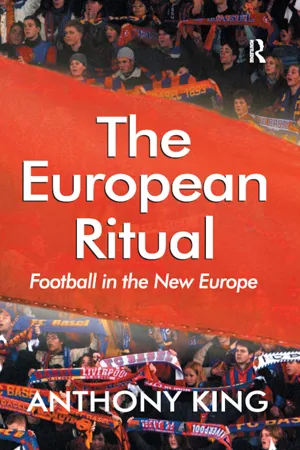
Football constitutes a vivid public ritual in contemporary European culture through which emergent social solidarities and new economic networks have come into being. This fascinating and unique volume traces the transformation of European football from the 1950s to the present, focusing in particular on the dramatic changes that have occurred in the last decade and linking them to the wider process of European integration. The examination of football illuminates how the growing dominance of the free market has changed European society from an international order in which the nation-state was dominant to a more complex transnational regime in which cities and regions are becoming more prominent than in the past. The study is supported by detailed ethnographic accounts emerging from the author's fieldwork at Manchester United and interview data with some of the most important figures in European football at clubs including Juventus, Milan, Bayern Munich, Schalke and Barcelona. It also includes a highly topical examination of racism in European football.
Information
PART I
THE TRANSFORMATION OF A RITUAL
Chapter l
From 1968 to 1999
It was, perhaps, one of the most dramatic moments in the history of European football. Since scoring in the sixth minute, it seemed certain that Bayern Munich would win the 1999 European Cup Final. They had dominated most of the game, scoring early and hitting Manchester United’s post and crossbar in the second half, while United had made few significant attacks. Halfway through the second half, Teddy Sheringham was brought on to replace United’s left-winger, Jesper Blomquist, bringing Ryan Giggs back into his favoured position on the left. With Giggs on the left and Beckham out wide on the right, Manchester United looked a more balanced side but the changes appeared to have been made too late. Later, in the eightieth minute, Ole Gunnar Solskjaer replaced Andy Cole but, despite Solskjaer’s record of late scoring, this substitution also seemed futile. In the ninetieth minute when the game seemed already lost, United won a corner and while David Beckham prepared to launch the team’s final effort, Peter Schmeichel, as he had done in other games, left his own net and joined the rest of his team in Bayern’s penalty area. As the ball swung over, Schmeichel, whose presence had drawn Bayern defenders out of position, jumped for the ball. It passed clear over the head of this mêlée, falling to Dwight Yorke on the far side of the goal. He headed the ball back and it eventually fell to Ryan Giggs who struck the ball weakly towards the Bayern goal. As the ball passed Teddy Sheringham he hooked it into Bayern’s net. Three minutes later, now deep into stoppage time, United won another corner. Again Beckham swung the ball in. Sheringham rose and deflected a header down towards the left-hand post where Ole Gunnar Solskjaer threw out his boot, driving the ball high into the net. Now familiar scenes of mayhem followed, while Sammy Kuffour, on all fours, pummelled the ground in despair.
1968: An International Match
Thirty-one years earlier, on 29 May 1968, Manchester United had beaten Benfica of Portugal 4–1 in the 13th European Cup Final at Wembley Stadium. Although the United players in 1999 lifted the same trophy as their forebears in 1968, any formal similarity between these two events is deceptive. In fact, historical transformations separate these dates decisively from one another though it is often difficult to recognise these wider changes. In the famous opening pages of Discipline and Punish, Foucault juxtaposes the brutal execution of the attempted regicide Damiens in 1757 with the penal regimen instituted in the following century in order to highlight the distinctiveness of European society (Foucault 1977). While the pitiful Damiens was ripped limb from limb, his various body parts displayed or burnt in a ferocious act of regal revenge, the criminal of the nineteenth century was subjected to a measured and private regime of mental and physical discipline. For Foucault, the two penal systems reflect the political regimes of the time; Damiens’ torture symbolised the personal revenge of the king, whose very self had been insulted by insurrection, while the new penal system denoted the imposition of abstract laws on deviant individuals. For Foucault, the peculiar cruelty of the familiar penal system can be recognised fully only when set against a sharply differing system of retribution. As Foucault demonstrated, that juxtaposition allows the familiar to be illuminated in dramatically new ways, providing dulled perceptions with new insights (see Baert 1998). Similarly, in order to recognise the current transformation of football, it is useful to juxtapose contemporary practices against those of the past. To this end, the comparison of 1999 with 1968 serves a useful heuristic purpose of illuminating the direction and extent of present changes, just as the execution of Damiens in 1757 and the prison regulations of 1828 economically highlight an important historical transformation in the penal system.
A brief examination of the main newspaper coverage in the respective years of Manchester United’s European victories is instructive. Throughout the 1968 season, the English newspapers had covered each of United’s games with previews and reports and there was an understandable expansion of reports for the final. Not only was this the first final that an English team had ever reached but it was also particularly significant because of the death of the Manchester United team, the so-called ‘Busby Babes’, in an aircrash ten years earlier in Munich.1 The English newspapers interpreted Manchester United’s matches in a historically distinctive fashion; they were international games and the club itself was the unproblematic representative of England and Britain. The line adopted by The Times’ correspondent, Geoffrey Green, was typical.2 For instance, after Manchester United had eliminated Real Madrid in the 1968 semi-final, Green commented: ‘Manchester United now stand as the heroes of England’ (Geoffrey Green 1968a: 16). He highlighted the qualities which brought these English heroes victory: ‘In the end it was English temperament, fibre and morale that won through’ (ibid.). Contrasting with the English national character, Green invoked a stereotypical account of Latin temperament of which he saw evidence both in the Real Madrid team and the crowd itself. ‘This was siesta time for the hot-blooded crowd whose wrath flamed out as Stiles stabbed at fleeting Amancio … All day the sun had beaten down like a hammer and the night, exquisitely still, was humid. It should have favoured the Spaniards …’ (ibid.). Contrasting with the phlegmatic English, Green implies that the Spanish players were ‘hot-blooded’, reflecting the climate in which they lived. This nationalistic paradigm was evident elsewhere in Green’s writing. Discussing the prospect of the 1968 final on the day of the game itself, Green similarly drew upon the concept of an English character. ‘There will be no question where the hopes of the 100,000 crowd and of the nation as a whole will lie … if there is any valid explanation it probably rests in their moral fibre, temperament and unquenchable spirit that lifted them off the floor recently’ (Geoffrey Green 1968b). Once again, Green emphasised the ‘English’ virtues of the Manchester United team.
Although Green assumed that Manchester United represented England, the team, in fact, included players from the other home nations of Britain. Indeed, the team even fielded two Republic of Irish internationals (Tony Dunne and Shay Brennan).3 For Green, England and Britain were synonymous; Scottish, Welsh, Northern Irish and even Republic of Ireland players were viewed by him as English when playing for English clubs. It was significant that during this period the term ‘Europe’ or ‘Europeans’ was rarely used in English newspapers. Rather, the preferred term for Europeans in these early years was ‘Continental’ or the ‘Continentals’ (for example, The Times 1962a; The Times 1963b), emphasising Britain’s distinctive maritime isolation. British teams were seen as the embodiment of the common national virtues of manliness, perseverance and strength against the effete (though skilful) showiness of ‘Continental’ teams. Thus, in describing Tottenham’s 4–2 defeat by the Polish team Gornik Zabrze, The Times drew on stereotypical accounts of English temperament (which saved Tottenham from an even heavier defeat) but were surprised that the Polish team did not demonstrate these typically ‘Continental’ characteristics: ‘In the end it was fitness, temperament and luck (or ill luck) of that injury to the Polish left-half that saved them from disaster. Most Continental sides in a similar position would have faded like a smoke ring’ (The Times 1961b). This reading was repeated when Tottenham played Benfica later in the same season; ‘In terms of pure football technique these Portuguese were the greater artists. But technique is not everything at times, and last night they found themselves in a man’s game where spirit and fibre and courage and the last drop of breath counted’ (The Times 1962e). While the newspapers recognised the skill of the ‘Continentals’, they were invariably portrayed as temperamentally suspect. After their controversial defeat by Internazionale in 1965,4 Liverpool ‘walked off the pitch at a hot, hysterical San Siro stadium’ (Horridge 1965) while in 1967, a Naples player, Sivori, ‘showing his quick South American temperament, jabbed his opponent, lashed out at Morgan, then kicked O’Neil’ (Green 1967b). Similarly, in his description of Manchester United’s game against Sarajevo in 1967, David Meek drew on this same motif which figured heavily in Green’s work of the disciplined English and the hot-blooded foreigner. He noted that the ‘Yugoslavs are a tough, passionate people’ (Meek 1967), concluding that the outcome of the game ‘was a matter of temperament’. While Manchester United ‘though often flattened [by fouls] got straight up again to play football’, the Yugoslavs ‘lost their heads’ (ibid.). This contrast between the English and British and the ‘Continentals’ culminated with assertions about the inherent disposition of different races towards certain kinds of behaviour. For instance, Benfica’s defeat by Sunderland in 1963 was explained in significant fashion: ‘Certainly last night was not the sort of weather to excite their Latin and Negroid blood’ (The Times 1963a).
It followed from his assumption that Manchester United represented England and its national virtues that Green interpreted the final as an international match between two nations. Club and nation were interchangeable for Green: ‘For this is a national occasion make no mistake. It is seen as revenge for Portugal’s World Cup defeat and Benfica’s humiliating 5–1 defeat by Manchester United … two years ago’ (Green 1968b). This assumption that clubs represented their nations was long-standing. After Manchester United’s drubbing of Anderlecht in 1956, The Times reported that, ‘They stayed to roar their heads off and to dream dreams of English football showing its true stamp once more’ (The Times 1956). Similar language was employed to describe Manchester United’s game against Real Madrid later in that year’s competition: ‘But now [having gone 2–0 down] United, remembering what they stand for in Britain, seemed suddenly inspired by the danger’ (Green 1957). This close connection between Manchester United and the nation was emphasised by other journalists. In his coverage of the 1968 Cup Final, David Meek, the Manchester Evening News football correspondent, similarly drew a connection between Manchester United and Britain when describing fans gathered in London before the game. ‘A group of youngsters in Trafalgar Square decided to back Britain as well as United. Over their sober suits, they had draped large Union Jacks’ (Meek 1968b).
Reflecting this nationalistic interpretation of European competition, club games were often conceived of in military terms; an analogy was drawn between the games and war. Thus, the opposition was regularly described as the ‘enemy’ (The Times 1962b) and metaphors of ‘arrows’ (The Times 1962d; The Times 1961a), ‘shafts’, ‘grape-shot’ (The Times 1963b), ‘spearheads’, ‘ripostes’ (The Times 1962f) or ‘barrages’ (Green 1967a) were often used to describe attacks or shots at goal. Milan made ‘a sneak raid’ against Ipswich in 1962 (The Times 1962c) while in a game against Internazionale, Everton were criticised for their unsubtle tactics; ‘It was physical exertion and the old frontal attack with no ideas of subtle infiltration’ (The Times 1963c). Similarly, to describe defensive play, martial metaphors were liberally employed. Thus, while Real Madrid were excellent in attack, ‘their shield could be dented’ (McGhee 1957) and against Ipswich, Milan’s sneak raid was mounted from a ‘chainmail defence’ (The Times 1962c). These military metaphors could reach the lyrical heights as a description of the semi-final between Real Madrid and Manchester United at Old Trafford in 1957 reveals: ‘The field had all the appearance of a battlefield. Smoke from the stone-fingers of surrounding chimneys drifted over the lividly-lit pitch’ (McGhee 1957). Similarly, Meek also drew on florid military references to frame his reports: ‘Having seen their mountains and watched their football, I can fully understand how the Germans found it impossible to beat Marshal Tito and the partisans into submission’ (Meek 1967). The most elaborate use of military metaphor was saved for matches against German opposition such as Manchester United’s match against Borussia Dortmund in 1956:
The Borussian forwards in their eagerness fell repeatedly into United’s off-side trap, much to the satisfaction of the British Tommies who were present in large numbers … Two superbly judged sorties by Wood held the ravening Germans at bay … Here was history repeating itself: the Thin Red Line against the German hosts. [The Guardian 21 November 1956, cited in Meek 1988, p. 21]5
In the 1950s, the Second World War was still a vivid memory. Consequently, the military metaphor was apt, denoting the status of European football as an international competition between the representatives of different nations.
The reports of the 1968 Final itself traversed the same nationalist line which was typical of the era. Thus, The Times carried a front-page piece which emphasised the national satisfaction that could be taken from this game: ‘How fitting too, that this memorable triumph should go now to a club which has done so much for the game England first gave to the world’ (Ecclestone 1968). On the sports pages, Geoffrey Green continued this theme.
At last Manchester United have climbed their Everest and after 11 years of trial and effort their dreams have come true. So the crown sits on the first English club to enter this competition … They have helped to beat back the Latin domination that for so long had taken Continental football by the throat … they [United] fell back on their morale and unconquerable spirit. Again it made giants of men who seemed to have given their last ounce of strength as they searched for the final yard to the summit. [Green 1968c]
Significantly, not only were United’s virtues of morale and spirit emphasised but the dubious character of foreigners was also highlighted. The Mirror’s reporter was critical of the game: ‘It was not a great match. Indeed at times it was an ugly one … In defeat Benfica do not retain the label of sportmanship that the Portuguese acquired during the World Cup. They showed their true colours last night. It was difficult to admire anything they attempted’ (Jones 1968). In fact, Eusebio was fouled many more times than Best. United were much more petulant than Benfica, and there were a couple of examples of outstanding sportsmanship from Eusebio. Yet, once Benfica had been interpreted as foreigners, unfounded attributions concerning their temperament followed.
The 1968 Final was seen as an international match between the representatives of two discrete nations. This interpretation was all but universal in papers such as The Times, The Manchester Evening News and The Mirror. However, although the nationalist paradigm was dominant in this period, it is worth noting that the final could occasionally be interpreted in a different way. In his report on the 1968 Final, Green noted with relish that in the following season both Manchester City, which had just won the league title, and Manchester United would be ‘treading the paths of Europe’. He added: ‘What rivalry that will engender in the years to come’ (Green 1968c). Here Green begins to recognise that European competition could be understood not in nationalistic but in localistic terms. European competition could stimulate local rivalry between the fans of different clubs. However, given the brevity of this comment especially in relation to the volume of Green’s reporting on European football and the positive tone of the sentence, it cannot be invested with too much significance. For Green, European competition was still understood in internationalist terms. On the same theme, the Manchester Evening News published a single letter which called for a ‘Truce time’ between United and City fans, noting that ‘there has always been the keenest rivalry between Manchester City and United fans’, but insisting ‘that on this night of nights … a United fan living in London calls for a truce and a linking of Reds and Blues in the name of Manchester, “home of champions”’ (Frame 1968). Frame’s letter is interesting in that it calls for unity between the fans on a local rather than a national basis. These brief comments by Frame and Green suggest that a localistic interpretation of European football was theoretically possible even in the 1960s. Yet, examples of a localistic interpretation were so rare that they were all but irrelevant in comparison with the hegemonic nationalist account of European football.
The nationalist account of the Final was not a mere construction, any other interpretation of these games providing an equally accurate account of the game. One of the reasons for the dominance of this interpretation is that it did accord broadly with the realities of European football at the time. At this time, national federations were sovereign, with the clubs subordinate to them. The federations administered both domestic and European competition with the aid of their international representative, UEFA (The Union of European Football Associations). These federations defended the sovereignty of their leagues carefully. In particular, in the 1960s, and indeed in the 1950s in all countries except Spain and Italy, foreign player restrictions were enforced. These restrictions ensured that European club teams were drawn from the nation in which the club was situated and were intended to protect the development of native talent for the national team.6 Thus, Benfica fielded only Portuguese nationals including former colonies so that Eusebio and Coluna, both from Mozambique, were qualified to play. Similarly, in England, although there was no restriction on home nation players from Scotland, Wales, Northern Ireland and Eire, no foreigners were allowed to play in English club teams. Consequently, the connection between the club and nation which journalists like Green and Meek drew, and the metaphor of war which hyperbolically suggested an international struggle, were valid accounts of European football at the time. A reading which emphasised the priority of the city or region was certainly not a priori impossible in 1968, but given the structure of European football, a nationalistic reading reflected contemporary realities most accurately. The Final in which Manchester United played some 31 years later was a very different occasion and was interpreted in significantly different ways.
1999: A Transnational Event
In 1968, the nationalist interpretation of European football was supported by the national composition of the teams. The players were natives of the countries in which the clubs were located and consequently, in European competition, the matches could be straightforwardly interpreted as international games. By the late 1990s, by contrast, the composition of the teams was far more cosmopolitan. For instance, in the 1999 European Cup Final, although both Manchester United and Bayern Munich had unusually few foreign players in comparison with their European peers, their squads were much more diverse. Manchester United’s 1999 team included seven foreign players (Blomqvist, Johnsen, Schmeichel, Yorke, Van der Gouw, Solskjaer, Stam) while Bayern’s team included two (Kuffour and Salihamidzic). The increasingly transnational composition of the teams in 1999 was reflected in public discussions of the event.
The nationalist interpretation remained very important in 1999. As in 1968, most of the reportage framed the Final as a match between England and Germany where Manchester United represented England and Bayern Munich, Germany. A typical example of this nationalistic reading was provided by ex-Liverpool player and European Cup winner, Tommy Smith: ‘I wore England’s three lions over my heart with pride and I would back any English side in Europe – we all should. It’s all about regaining ground in Europe’ (Smith 1999). The leader in The Mirror affirmed Smith’s stance insisting that ‘it is the night our football nation sets aside lifelong rivalries and stands United. The red of Old Trafford, Manchester, will be everyone’s colour’ (The Mirror 1999). It was notable that the other major tabloid, The Sun, also adopted an unproblematically nationalist line in its coverage to the point of xenophobia. The paper delighted in the fact that Manchester United had in the course of the season ‘brought the Italians down in Milan and Turin and on Wednesday they put the Germans on their knees’ (Greaves 1999). The Times sometimes traversed a similar line. On the day before the game, in a humorous article which listed ten reasons to support United (The Times 1999b), it was argued that a Manchester United victory would assist English football by providing more places for clubs in European competitions in the next season. In a piece of crude nationalism, the article asked: ‘A football match between an English and a German team? What other reason do you want?’ (ibid.). Similarly, although The Manchester Evening News recognised that many in the city did not support United (Everett 1999) and appeals to urban pride also featured in their coverage (for example, Everett 1999; Hince 1999), the regional paper generally adopted a simplistic nationalistic line delighting in the defeat of t...
Table of contents
- Cover
- Half Title
- Title Page
- Copyright Page
- Table of Contents
- Acknowledgements
- Preface
- PART I: THE TRANSFORMATION OF A RITUAL
- PART II: FOOTBALL IN THE OLD EUROPE
- PART III: FOOTBALL IN THE NEW EUROPE
- PART IV: FOOTBALL FANS IN THE NEW EUROPE
- Bibliography
- Index
Trusted by 375,005 students
Access to over 1.5 million titles for a fair monthly price.
Study more efficiently using our study tools.
Frequently asked questions
Yes, you can cancel anytime from the Subscription tab in your account settings on the Perlego website. Your subscription will stay active until the end of your current billing period. Learn how to cancel your subscription
No, books cannot be downloaded as external files, such as PDFs, for use outside of Perlego. However, you can download books within the Perlego app for offline reading on mobile or tablet. Learn how to download books offline
Perlego offers two plans: Essential and Complete
- Essential is ideal for learners and professionals who enjoy exploring a wide range of subjects. Access the Essential Library with 800,000+ trusted titles and best-sellers across business, personal growth, and the humanities. Includes unlimited reading time and Standard Read Aloud voice.
- Complete: Perfect for advanced learners and researchers needing full, unrestricted access. Unlock 1.5M+ books across hundreds of subjects, including academic and specialized titles. The Complete Plan also includes advanced features like Premium Read Aloud and Research Assistant.
We are an online textbook subscription service, where you can get access to an entire online library for less than the price of a single book per month. With over 1.5 million books across 990+ topics, we’ve got you covered! Learn about our mission
Look out for the read-aloud symbol on your next book to see if you can listen to it. The read-aloud tool reads text aloud for you, highlighting the text as it is being read. You can pause it, speed it up and slow it down. Learn more about Read Aloud
Yes! You can use the Perlego app on both iOS and Android devices to read anytime, anywhere — even offline. Perfect for commutes or when you’re on the go.
Please note we cannot support devices running on iOS 13 and Android 7 or earlier. Learn more about using the app
Please note we cannot support devices running on iOS 13 and Android 7 or earlier. Learn more about using the app
Yes, you can access The European Ritual by Anthony King in PDF and/or ePUB format, as well as other popular books in Social Sciences & Sociology. We have over 1.5 million books available in our catalogue for you to explore.