- 350 pages
- English
- ePUB (mobile friendly)
- Available on iOS & Android
eBook - ePub
About this book
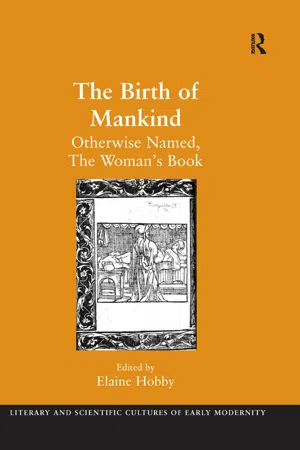
Between 1540 and 1654, The Byrth of Mankynde was a huge commercial success. Offering information on fertility, pregnancy, birth, and infant care, and written in a chatty, colloquial style, it influenced most other literary works of the period bearing on sex, reproduction, and childcare. Until now, this important text has been unavailable except for a microfilm of the 1654 edition. For this new annotated edition of the 1560 version, Elaine Hobby has modernized the spelling and included informative notes. In her critical introduction, she not only traces the development of the book from its German origins, but also shows how early-modern ideas about the reproductive process combined ancient, medieval, and contemporary conceptions. Combining editorial rigour with a concern for the needs of the informed non-specialist, Hobby has made available a text that will be useful to scholars and students in a range of academic disciplines, including literature, history, and women's studies.
Information
In this First Chapter Is Briefly Declared the Contents of the First Book
Although that many things entreated of1 in this first book shall seem unto some not very necessary to the understanding of the second book, yet then contrary do I ensure2 and certify (as I have sufficiently said in the Prologue) that the ignorant in the first, shall be full blind in the second; to the which, the first is as a key, opening and clearing the matters to be intreated of in the second.
The utility of the first book
In this first book, then, shall be declared the form, manner, and situation of the inward3 parts of a woman; such as are in them, by nature dedicate4 and assigned to the propagation, conception, and bearing of mankind; in whom, truly, is the receptacle, and, as ye would say, the camp or field5 of mankind to be engendered therein. And although that man be as principal mover and cause of the generation, yet (no displeasure to men), the woman doth confer and contribute much more, what to the increasement of the child in her womb, and what6 to the nourishment thereof after the birth, than doth the man.7 And doubtless, if a man would demand to whom the child oweth most his generation, ye may worthily make answer that, to the mother; whether ye regard the pains in bearing, other else8 the conference9 of most matter in begetting.
The contents of this book
The woman confereth more to the generation than man
Furthermore, in this book ye shall read certain things which in times past have been corruptly, negligently, yea, and very falsely written of; and of the which, both men, yea, and women themselves, have conceived very erroneous and misopinions,10 as ye shall farther perceive in the process.11
Many things falsely written of in times past
Now therefore that we come to the declaration of the organs generative1 in woman, it shall be necessary to the better understanding thereof, first to show the description of certain things without whose knowledge this treatise would be many times the more obscure and dark.
1 entreated of: handled.
2 ensure: guarantee.
3 inward: inner.
4 dedicate: dedicated.
5 camp or field: temporary quarters, or battlefield (both meanings current).
6 what … what: both … and.
7 And although … man: in stressing the importance of women’s role in conception, Raynalde is modifying a Hippocratic and Galenic position (see, for instance, Galen, On Semen 1.7; Galen, Usefulness, 14.6), and implicitly rejecting the Arisotelian assertion of women’s subsidiary role. See Introduction, pp. xx–xxi.
8 other else: or else.
9 conference: contribution.
10 misopinions: incorrect opinions.
11 process: treatise.
1 organs generative: reproductive organs.
In How Many Coats the Body Is Lapped or Involved1
The body of man or woman is involved or compassed universally with three principal coats; of the which, the first and uttermost3 is called the skin, in Latin, cutis, with whom generally every part of the body is clad and enclosed; the which yet in some part is more soft, delicate, and thin, than in some other,4 and in some one person more stour5 and stiff, than in some other again, for causes needless here to be rehearsed.6
The principal coats of the body
And ye shall note, that upon the outward face and superficie7 of this skin, there is yet another thinner skin,8 in Latin commonly named cuticula, and of some efflorescentia cutis. This thin skin is it the which ye see rise like a bladder when any part of the body is blistered with fire or hot water, so that between this thin skin and the very skin9 is contained the water which resorteth10 to the place by the violence of the fire or heat, the which thin skin also we use to11 prick to let the water issue forth; also, the same that scaleth or pilleth off12 on the ha...
Table of contents
- Cover Page
- The Birth of Mankind: Otherwise Named, The Woman’s Book
- Copyright Page
- Contents
- List of Illustrations
- Acknowledgments
- List of Abbreviations
- Introduction
- The Birth of Mankind: Otherwise Named, the Woman’s Book
- 1 The First Book
- 2 The Second Book
- 3 The Third Book
- 4 The Fourth Book
- 1 Richard Jonas’s Titlepage, 1540
- 2 Richard Jonas’s Preface to his 1540 Edition
- 3 Richard Jonas’s Dedication of the 1540 Edition to Queen Katherine Howard
- 4 Richard Jonas’s Table of Weights and Measures, 1540
- 5 Richard Jonas’s Chapter 1, 1540
- 6 Richard Jonas’s Infant Remedies, 1540
- 7 Richard Jonas’s Fertility Remedies, 1540
- 8 Thomas Raynalde’s Latin Preface, 1545, 1552
- 9 Thomas Raynalde’s Anatomical Table, 1545
- 10 Titlepage, 1654
- 11 Chapter Added 1654
- 12 Changes Introduced into The Birth of Mankind between 1540 and 1560
- 13 Changes Introduced into the Anatomical Table of The Birth of Mankind between 1545 and 1552
- 14 Changes Introduced into The Birth of Mankind after 1560
- Medical Glossary
- Bibliography
- Index
Trusted by 375,005 students
Access to over 1.5 million titles for a fair monthly price.
Study more efficiently using our study tools.
Frequently asked questions
Yes, you can cancel anytime from the Subscription tab in your account settings on the Perlego website. Your subscription will stay active until the end of your current billing period. Learn how to cancel your subscription
No, books cannot be downloaded as external files, such as PDFs, for use outside of Perlego. However, you can download books within the Perlego app for offline reading on mobile or tablet. Learn how to download books offline
Perlego offers two plans: Essential and Complete
- Essential is ideal for learners and professionals who enjoy exploring a wide range of subjects. Access the Essential Library with 800,000+ trusted titles and best-sellers across business, personal growth, and the humanities. Includes unlimited reading time and Standard Read Aloud voice.
- Complete: Perfect for advanced learners and researchers needing full, unrestricted access. Unlock 1.5M+ books across hundreds of subjects, including academic and specialized titles. The Complete Plan also includes advanced features like Premium Read Aloud and Research Assistant.
We are an online textbook subscription service, where you can get access to an entire online library for less than the price of a single book per month. With over 1.5 million books across 990+ topics, we’ve got you covered! Learn about our mission
Look out for the read-aloud symbol on your next book to see if you can listen to it. The read-aloud tool reads text aloud for you, highlighting the text as it is being read. You can pause it, speed it up and slow it down. Learn more about Read Aloud
Yes! You can use the Perlego app on both iOS and Android devices to read anytime, anywhere — even offline. Perfect for commutes or when you’re on the go.
Please note we cannot support devices running on iOS 13 and Android 7 or earlier. Learn more about using the app
Please note we cannot support devices running on iOS 13 and Android 7 or earlier. Learn more about using the app
Yes, you can access The Birth of Mankind by Elaine Hobby in PDF and/or ePUB format, as well as other popular books in Literature & Literary Criticism. We have over 1.5 million books available in our catalogue for you to explore.