- 300 pages
- English
- ePUB (mobile friendly)
- Available on iOS & Android
eBook - ePub
About this book
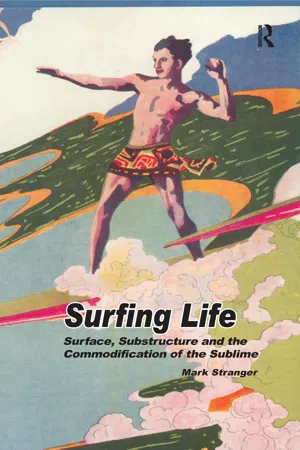
Surfing Life is a study of surfing and social change that also provides insights into other experience-based contemporary subcultures and the nature of the self and social formations in contemporary society. Making use of extensive empirical material to support innovative theoretical approaches to social change, this book offers an analysis of the relationship between embodied experience, culture and the economy. With its ground breaking theoretical contributions, and its foundation in an ethnographic study of surfing culture in locations across Australia, this volume will appeal not only to those interested in the social and cultural phenomenon of surfing, but also to anyone interested in the sociology of sport and leisure, the sociology of culture and consumption, risk-taking, subcultures and theories of contemporary social change.
Information
Chapter 1
This Study of Surfing
Surfing the oceans’ waves has inspired an aesthetically oriented (even hedonistic) lifestyle in dedicated practitioners since its renaissance at the turn of the twentieth century. It is not the only leisure activity to elicit this kind of response, but there is clearly something about surfing and its subculture that is emblematic of the dialectics at work/play in contemporary social change. In Future Shock Alvin Toffler described the surfing subculture as ‘… a signpost pointing to the future’ (1970: 263) and in more recent times surfing has become a metaphor for dealing with the uncertainties, opportunities and dangers of a postmodernizing society (Beck et al 2003).
This book examines surfing subculture1 and its relationship with the dominant culture; the risk-taking orientation of its bodily practices and its significance for the self, the construction of individual and group identity and social formations; and the multi-dimensional relationships between the surfing culture industry, surfing's sports bureaucracy, embodied experience, social configurations and subcultural integrity. The study looks at the surfing subculture as a fundamentally postmodern configuration, but one that displays a level of stability not accounted for in prominent theories of social change. The model I propose to explain this phenomenon is an inversion of Marx's ‘base’ and ‘superstructure’. In the postmodern world of surfing, the economy (which constituted the base in modernity) is substantially dedifferentiated within a hypercommodified subculture, contributing to what is referred to from the perspective of a collapsing modern superstructure as the ‘flat surface’ of postmodernity. What this study shows is that the nature of this postmodern surface is often misrepresented in neo-modern and postmodern theory. It is not that the surface of surfing culture disguises the lack of any real substance (following Baudrillard 1988b), rather, like the surface of the ocean, it provides a hint of something beneath; something that can only be glimpsed by ‘outsiders’; a substructure based upon shared ecstatic experience that constitutes a collective consciousness (Durkheim 1933) on a global scale; a postmodern surface and substructure rather than a modern base and superstructure.
I suggest that there is a link between the postmodern condition and the significance of risk-taking and ecstatic experience, which has consequences for the way the self is experienced and the nature of group identity. The study looks at how the commodification of surfing culture and the development of surfing as a professional sport influence and are influenced by the embodied experience of surfing and its importance within the culture. I suggest that the ecstatic experience inherent in the activity of surfing remains as the foundation of the culture – even in its commodified and bureaucratized form.
The surfing culture industry is a multi-billion-dollar concern, and surfing has been incorporated into the mainstream through the use of its style and image, and as a sport, with popular media coverage of professional surfing and involvement with the International Olympic Committee (IOC). But while the culture embodies so much of what it means to be postmodern, it has not been reduced to its commodified surface. Nor has it followed a modern trajectory and become purely a mainstream sport. Based on my own experience of the subculture, I knew that an identity as an insider was not something that could be purchased along with the surf label clothing; to be a surfer you have to surf. Learning to surf requires a considerable commitment of time and effort. Further, surfing's social configurations are relatively stable formations within a subculture that has maintained a discernible identity since the 1960s, with many surfers from that era still active insiders.
I also knew from experience that the culture varied considerably across different locations and that internal conflicts and mainstreaming influences needed to be accounted for beyond the competition oriented urban surfing scene (so often presented as the surfing subculture). The role of the surfing culture industry and competition surfing were crucial elements in this study since many social theorists emphasize the impact that commodification and bureaucratization can have on experience-based social configurations.
Previous analyses of surfing had been based upon studies of limited scope; either restricted to one (usually urban) general location for fieldwork or focusing on one particular sector or subgroup – such as the surf fashion industry, the surf media or university students. The breadth of this study involved an extensive coverage of sectors, geographic types, and forms of surfing subculture. Along with the USA, Australia has been a dominant source of surfing culture for what is now a global phenomenon. While this study focuses on data from the extensive research conducted in Australia, it also draws on visits to surfing locations in France, Indonesia, Japan, Portugal, UK and USA, and on the international literature and subcultural media on surfing and related activities (e.g. other ‘boardsports’ and extreme/lifestyle/alternative sports). While there are differences between the surfing culture in Australia and other countries (just as there are differences between different locations within countries), this study presents insights into the nature of surfing that are universal. Further, it provides a theoretical framework through which all surfing and similar lifestyles can be examined and a basis for the study of many other contemporary social formations that emerge around shared experience.
It is not my intention to enter into the debates between those who want to give the current era a neo-modern label, or call it postmodern. Rather, I provide an ethnographically based case study, which is both informed by and provides data for a discussion of such theories and related issues concerning the nature of the risk experience, the embodied self, individual and group identity, and the nature of community and solidarity in the contemporary world. What follows is a brief outline of the theoretical debates that have informed this work.
This postmodern framework
My approach to this study of social and cultural change is best described as a discourse in which a range of social theories are engaged, in order to provide the best possible understanding of contemporary surfing and the processes which create and are created by it.
The different theoretical approaches that aim to explain the current upheaval in contemporary society can be roughly divided into modern (including neo-modern) and postmodern camps. Broadly speaking the distinction is that modernity emphasizes continuity with the past while postmodernity emphasizes discontinuity. However Kumar (1995: 178) warns against drawing a hard line between the two; ‘For many thinkers on both sides of the divide the difference is mainly one of emphasis, when it is not simply terminological’. For example Giddens (1994: 197) declares that he prefers the terms ‘late’ or ‘high’ modernity rather than postmodernity, thus ‘… avoiding at least one of the ‘posts’ which otherwise tend to tramp across our pages …’. Bauman (1992: 187) says that postmodernity can be described as ‘modernity conscious of its true nature’ (see also Welsch 1997, Rojek 1995, Featherstone 1995). Harvey (1990) makes the point that early commentators of modernity like Baudelaire and Simmel recognized many of the fundamental characteristics attributed to postmodernity as inherent in modernity (see also Bauman 1992, Welsch 1997). Berman (1992) on the other hand suggests that our ability to deal with the fragmentation and uncertainty described as indicative of postmodernity is what makes us modern (see also Beck et al 2003, Malpas 2005, Adams 2007).
Neo-modernist approaches, like the ‘late capitalism’ of Jameson (1991) and Lash and Urry (1994), and the ‘reflexive modernity’ of Beck, Giddens and Lash (Beck et al 1994, 2003, Adams 2007), differ only slightly from postmodernists. Kumar (1995: 137–148) points out that prominent theorists like Jameson and Lash, while rejecting the idea of a postmodern society, acknowledge postmodern culture as the ‘dominant logic’ of our time. Giddens (1994: 197) however, dismisses the relevance of cultural postmodern phenomena (which he calls postmodern ism) in favour of what he declares to be the more interesting social ‘institutional transitions’ of postmodern ity.
Malpas (2005: 9) says that postmodern ism is about style and forms of representation while postmodern ity is used to describe cultural context or historical periods. Rojek (1995: 129) distinguishes between postmodern ity and postmodern ism by defining the former as a change in social conditions while the latter refers to a change in social consciousness; ‘… a sensibility born between the gradual collapse of one era and the slow, uneven crystallization of another’. Sometimes this ‘sensibility’ is expressed as a belief that the dominant model of modernity always was inadequate and only distorted our vision of the ‘truth’ (Bauman 1992); other times it presents as a postmodern ist ideology, a belief that the world should become postmodern (Rorty 1979); other times it appears as a perspective which recognizes the current upheavals in society as part of an ongoing process of postmodern ization (Crook et al 1992).
While commentators argue over whether we are entering a new era beyond modernity or whether we are simply in some late stage of modernity or for that matter whether we have ever really been modern at all (Latour 1993, Wynne 1996), most agree that we are in a time of significant cultural and social change. As imperfect as postmodernism might be, Jameson (1991: 418) concludes that no other theoretical framework provides the same insights into the current situation in quite so ‘effective and economical’ a fashion. For Kumar (1995: 195) postmodernity is a significant if not central feature of our contemporary world ‘… and an important way of thinking about it’. And while the popularity of postmodern theory waxes and wanes (postmodernists should expect nothing less) its insights are no less pertinent:
In recent years the postmodern has seemed less omnipresent, and yet the concepts, ideas and categories deployed by its exponents are still crucial to many of the key debates in contemporary culture. … [I]t has vital things to tell us about how we engage with and are shaped by our cultural milieu today (Malpas 2005: 6).
Postmodern approaches to the analysis of contemporary society range from the dystopian, such as Baudrillard's (1988b) vision of society as ‘pure simulacra’ – a world in which the influence of the mass media is such that we are all eternally lost in an unbreakable cycle of simulating simulations of things that no longer exist (see also MacCannell 1992, Crook et al 1992, Friedman 1992) – to more utopian visions, like that of Anderson (1996) who argues that postmodernity has its own enlightenment project (see also Rorty 1979, Maffesoli 1996, Berking 1996). Not only do these approaches vary across a broad spectrum from the dystopian to the utopian – and very often as potentialities within the one account – but each can be ‘outrageously eclectic’, contradictory and circular; and unashamedly so (Kumar 1995: 103):
[W]hen confronted with some sort of social renewal – a new society – it becomes important to put into practice a certain theoretical ‘laxness’ … (Maffesoli 1996: 4).
Kumar (1995) says that elements of traditional, modern and postmodern society are all present in contemporary society, and the defining features of postmodernity were recognized as inherent in modernity at the beginning of the last century. Welsch (1997: 38) says that we began our journey into postmodernity with Nietzsche, and both Simmel and Baudelaire are considered to be at least protopostmodernists (Rojek 1995, Kumar 1995). Bauman (1992: 31) in fact claims that Simmel was ‘… the sole “postmodern” thinker among the founding fathers of sociology’. As Rojek (1995: 146) explains, it is logically impossible to provide a complete picture of postmodernity given its flexible, protean and emerging nature. It is also impractical and counterproductive to restrict the range of theorists that contribute to a discussion of postmodern theory to self-declared postmodernists, since very few have taken this step and most remain what Kumar (1995) describes as ‘closet postmodernists’. Kumar (1995: 140) includes among these such prominent contributors to postmodern theory as Frederic Jameson and Scott Lash. ‘There are in fact a good number of closet post-modernists. … They are fellowtravelers of post-modernity, if not full party members’.
Those with one foot out of the closet so-to-speak, like Zygmunt Bauman and Andreas Huyssen, generally deny that postmodernity represents a new era, rather they describe it as a point in the history of modernity where we are able to review the modernist project and reject some elements – in particular the teleological view of progress and history – and retain others. This approach to postmodernity is very close to the reflexive modernity of Beck, Giddens and Lash (Beck et al 1994, 2003, Kumar 1995, Adams 2007). While rejecting the idea of postmodernity they claim that modernity has reached a point where reflexivity has become the dominant characteristic:
[B]oth share the view that the long-standing patterns of development of modern societies have now thrown up such fundamental problems and dilemmas that they call into question any further movement along those lines (Kumar 1995: 142).
Beck et al (2003: 2) describe the changes underway as ‘revolutionary’, a ‘metachange’ with ‘boundary-shattering’ impact: ‘… in short, the process that Marx once celebrated as that by which “everything solid melts into air”’. They say that the difference between their theory of ‘re-modernization’ (reflexive modernity) and theories of postmodernity is that theirs focuses on ‘re-structuration’ and ‘reconceptualization’, calling for social scientists to discover the new ‘coordinates’ of modernity. I am not sure that the role of social science should be to go in search of a lost modernity (except anthropology perhaps!), but rather to chart the new and changing terrain. Being distracted by debates about whether the end of the voyage is a ‘new’ or ‘post’ modern world seems a bit premature if we are so lost.
Following the counsel of theorists like Bauman (1992), Maffesoli (1996) and Featherstone (1995), who advise that in this time of change we need to mobilize whatever explanatory tools provide insights, this study takes account of work from a range of relevant disciplines; including psychology, psychiatry, philosophy, social psychology, biology and other social and physical sciences. While this is not an exclusively postmodern method – Elias's (1978, 1986) figurational sociology2 for example advocates the same approach, and Giddens (1991) and other neo-modernists employ it as well – it is demonstrative of the dedifferentiation of boundaries between specializations which postmodernists both recognize as inherently postmodern, and advocate:
It is this more widely conceived transdisciplinary sociology which would seem to be best suited to attempt to answer the vital questions of our time … (Featherstone 1995: 51).
This eclectic and pragmatic approach involves allowing theoretical understandings to provide insights into one area of study without forcing other areas uncomfortably into the same framework. For example, Bauman's (1992) work on identity construction provided a valuable way of looking at commodification and group identity but his concept of transient and motile postmodern communities was inconsistent with my findings. In order to develop a model which represented the particular forms of sociation I found in surfing culture, I drew on the works of people like Max Weber, Helmuth Berking, Victor Turner, Michel Maffesoli, and Herman Schmalenbach; and I adapted ideas from the literature on risk, sport and leisure, commodification and the mass media, and from a range of disciplines including psychology, geography, cultural studies, philosophy and semiotics.
The protean flexibility of postmodernism allows the researcher to come to an understanding of the object of study in the process of constructing a theoretical framework, rather than employing a prefabricated and homogenous theoretical framework designed in advance to fit a clearly defined social structure. The end result is a cluster of theoretical elements brought together in order to address a specific problem. This cluster of elements constitute a hermeneutic approach which recognizes that they all bring something of value to a discourse, rather than an epistemological approach that would attempt to unite them in some theoretical matrix (Rorty 1979: 315–356). The overarching postmodern framework established for this study is best understood as that discourse and not a theoretical structure that subsumes its various diverse elements. Neo-modernists (and closet postmodernists) are included within this broad postmodern um...
Table of contents
- Cover Page
- Title Page
- Copyright Page
- Contents
- List of Illustrations
- List of Figures
- Acknowledgements
- 1 This Study of Surfing
- 2 Pleasure and Discipline: A Surfing History
- 3 Resistance and Incorporation: Contemporary Surfing Life
- 4 Risk, Self and Social Configurations
- 5 Fear, Desire and a Postmodern Sublime
- 6 Commodification, Reflexivity and Trust: The Surfing Culture Industry1
- 7 Aestheticization and Sportization: Towards Synthesis
- 8 Conclusions
- Appendix I: Base Locations and their Characteristics
- Appendix II: Intensive Interviews: Interviewees and their Characteristics
- References
- Index
Trusted by 375,005 students
Access to over 1.5 million titles for a fair monthly price.
Study more efficiently using our study tools.
Frequently asked questions
Yes, you can cancel anytime from the Subscription tab in your account settings on the Perlego website. Your subscription will stay active until the end of your current billing period. Learn how to cancel your subscription
No, books cannot be downloaded as external files, such as PDFs, for use outside of Perlego. However, you can download books within the Perlego app for offline reading on mobile or tablet. Learn how to download books offline
Perlego offers two plans: Essential and Complete
- Essential is ideal for learners and professionals who enjoy exploring a wide range of subjects. Access the Essential Library with 800,000+ trusted titles and best-sellers across business, personal growth, and the humanities. Includes unlimited reading time and Standard Read Aloud voice.
- Complete: Perfect for advanced learners and researchers needing full, unrestricted access. Unlock 1.5M+ books across hundreds of subjects, including academic and specialized titles. The Complete Plan also includes advanced features like Premium Read Aloud and Research Assistant.
We are an online textbook subscription service, where you can get access to an entire online library for less than the price of a single book per month. With over 1.5 million books across 990+ topics, we’ve got you covered! Learn about our mission
Look out for the read-aloud symbol on your next book to see if you can listen to it. The read-aloud tool reads text aloud for you, highlighting the text as it is being read. You can pause it, speed it up and slow it down. Learn more about Read Aloud
Yes! You can use the Perlego app on both iOS and Android devices to read anytime, anywhere — even offline. Perfect for commutes or when you’re on the go.
Please note we cannot support devices running on iOS 13 and Android 7 or earlier. Learn more about using the app
Please note we cannot support devices running on iOS 13 and Android 7 or earlier. Learn more about using the app
Yes, you can access Surfing Life by Mark Stranger in PDF and/or ePUB format, as well as other popular books in Scienze sociali & Sociologia. We have over 1.5 million books available in our catalogue for you to explore.