- 280 pages
- English
- ePUB (mobile friendly)
- Available on iOS & Android
eBook - ePub
About this book
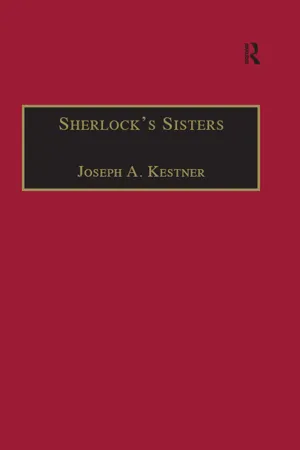
Sherlock's Sisters: The British Female Detective, 1864-1913 examines the fictional female detective in Victorian and Edwardian literature. This character, originating in the 1860s, configures a new representation of women in narratives of the nineteenth and twentieth centuries. This analysis explores female empowerment through professional unofficial or official detection, especially as this surveillance illuminates legal, moral, gendered, institutional, criminal, punitive, judicial, political, and familial practices. This book considers a range of literary texts by both female and male writers which concentrate on detection by women, particularly those which followed the creation of Sherlock Holmes by Arthur Conan Doyle in 1887. Cultural movements, such as the emergence of the New Woman, property law or suffragism, are stressed in the exploits of these resourceful investigators. These daring women deal with a range of crimes, including murder, blackmail, terrorism, forgery, theft, sexual harassment, embezzlement, fraud, impersonation and domestic violence. Privileging the exercise of reason rather than intuition, these women detectives are proto-feminist in their demonstration of women's independence. Instead of being under the law, these women transform it. Their investigations are given particular edge because many of the perpetrators of these crimes are women. Sherlock's Sisters probes many texts which, because of their rarity, have been under-researched. Writers such as Beatrice Heron-Maxwell, Emmuska Orczy, L.T. Meade, Catherine Pirkis, Fergus Hume, Grant Allen, Leonard Merrick, Marie Belloc Lowndes, George Sims, McDonnell Bodkin and Richard Marsh are here incorporated into the canon of Victorian and Edwardian literature, many for the first time. A writer such as Mary Elizabeth Braddon is reassessed through a neglected novel. The book includes works by Irish and Australian writers to present an inclusive array of British texts. Sherlock's Sisters enlarges the perception of emerging female empowerment during the nineteenth century, filling an important gap in the fields of Gender Studies, Law/Literature and Popular Culture.
Information
1 The Female Detective in Britain
The appearance of the female detective in English fiction during the nineteenth century was a result of a complex intersection of legal, social, moral, institutional and gendered practises. This study, Sherlock’s Sisters, concentrates on the emergence of the woman detective during the period from 1888 to 1913, but the origins of the female detective in fiction are actually in the 1860s. In 2000, Birgitta Berglund observed:
The traditional pattern of representing women in fiction as objects and men as subjects has in general posed great difficulties for those (presumably female) writers who have wished to create strong and positive women protagonists. Because of the specific demands of the genre, this is even more true of detective fiction. Thus, in spite of the great number of women writers in this genre, it is a fact that the overwhelming majority of detectives in fiction have until quite recently been men. (138)
While in the aggregate it is certainly true that there are more male than female detectives, this project explores the manifestation of a number of fictional female detectives in the late nineteenth and early twentieth centuries, although one woman from 1856 and two from the early 1860s indicate that even then detection was becoming part of the activity of female protagonists.
In the tradition examined in this book, these female detectives may be private or official. Some, contrary to all historical actuality during this era, are detectives at Scotland Yard. Others are employed by private enquiry agencies, while some work independently of either an official or private institution, being self-employed. Berglund continues in her appraisal:
Women in detective stories have been victims, or they have been perpetrators, but they have not, on the whole, been detectives – that is, they have not been given the most important part to play. In novels written by men, women detectives are very few indeed (although they do exist) but even in books written by women, male detectives dominate. (138)
Yet, in the period under consideration here, both male and female writers dared to create female detectives. It was daring, as Berglund remarks about the proclivities of readers: ‘Writers who want to reach large groups of readers tend to choose a male protagonist rather than a female one, as women are on the whole much more willing to read about men than the other way round’ (138).
Still, it is the case that some writers, for example Grant Allen, presented their women detectives in periodicals such as the Strand Magazine, which had a predominantly male readership, as Stephen Knight (1994) notes: The audience of the Strand was predominantly male; they bought the magazine, in shops, at bookstalls, especially on stations. They did take it home – there were sections for women and children, but they are just sections’ (374). Nevertheless, the Strand published the serial short story exploits of Lois Cayley and of Hilda Wade in, respectively, 1898 and 1899. From 1911 to 1912, Richard Marsh created his unusual female detective Judith Lee in the pages of the Strand.
This interest in the female detective was evident in other periodicals as well. Catherine Louisa Pirkis’s Loveday Brooke appeared in 1893 in the Ludgate Monthly before the book version in 1894. Beatrice Heron-Maxwell created her protagonist Mollie Delamere of The Adventures of a Lady Pearl-Broker in the pages of the Harmsworth Magazine in 1899, a magazine which had already published at least one famous tale involving a female detective, The Stir Outside the Café Royal by Clarence Rook, in September 1898.
The challenge facing creators of the female detective is summarized by Berglund:
The real difficulty in creating a woman detective has more to do with literary patterns and expectations than it has to do with real life. The problem is the fact that the detective in the classic detective story is the typical hero: strong, intelligent, resourceful, a latter-day knight who fights and defeats evil. According to the pattern established by Conan Doyle with Sherlock Holmes, he is also an almost superhuman mastermind who is allowed a great degree of eccentricity and egocentricity because of his extraordinary powers. With such forefathers, what can a woman writer do? Or, to put it more precisely, what could the early women writers of detective fiction do? How could they unite this ideal with a traditional feminine ideal and come up with a credible woman detective? (139)
This is the dilemma faced by those creating ‘Sherlock’s sisters’ at the end of the nineteenth century.
The central point, however, is that there were models of female independence and daring in numerous texts, even if these were not detectival, which could serve writers, both male and female, in creating their intrepid female investigators. One can think of a range of proto-models, women both good and bad, such as the protagonists of George Eliot’s The Mill on the Floss (1860), Mary Elizabeth Braddon’s Lady Audley’s Secret (1862) and Aurora Floyd (1863), Rhoda Broughton’s Not Wisely, But Too Well (1867), or Thomas Hardy’s Far from the Madding Crowd (1874) or The Return of the Native (1878). Critics such as Elaine Showalter and Winifred Hughes have demonstrated that the female protagonist in the sensation novel displayed a deft intelligence in confronting circumstances, provoking in readers fantasies of empowerment.
Novels such as those by Braddon or Hardy create protagonists who defy the patriarchal constraints imposed upon them. As Hughes stresses: Whatever their value as escapism, the higher forms of the sensation novel … are also in the business of propaganda, of crusading for social or political reform’ (34). As will be discussed below, the female detectives of Revelations of a Lady Detective (c. 1864) attributed to W. S. Hayward and of The Female Detective (1864) by Andrew Forrester Jr manifest the intelligence, daring and resourcefulness which could be linked with traits drawn from protagonists of non-detectival fiction to establish the fictional female detective in the late 1880s after the appearance of Sherlock Holmes in 1887 in A Study in Scarlet.
Intelligence, self-assertion, daring and defiance marked a range of female protagonists in English fiction before the creation of Sherlock Holmes. These traits, by the way, distinguish Holmes’s adversary Irene Adler in the first Holmes short story, A Scandal in Bohemia, published in the Strand in July 1891. The fact that Holmes is not ‘superhuman’ but is rather defeated by Irene Adler gave the opening to create the female detectives who became his ‘sisters’ in the detectival tradition.
A number of key facts deserve immediate assessment. The origin of modern policing can be dated to 1829, with the establishment of the civilian police in London by the Metropolitan Police Act, which was the result of the appointment of Sir Robert Peel as Home Secretary in 1822. Peel established the principle of uniformed patrols, that is constables, for the purpose of visible surveillance. Each man carried a ‘bull’s-eye’ lantern and a rattle, the latter soon replaced by a truncheon. Peelers wore a top hat until it was replaced by the ‘Roman’ helmet in 1864. These men were the famous Peelers or Bobbies.
In 1835, the Municipal Corporations Act established Borough police officers in other parts of the country, for example in Wigan in 1836, Manchester in 1839, Salford in 1844 and Oldham in 1849. The Metropolitan Police Act of 1839 declared that official police personnel could be hired by private firms or individuals. The institution of a civilian police service assumed national prominence in 1856 when legislation established the Home Office Inspector of Constabulary to improve uniform standards of police efficiency throughout the country.
The Detective Branch of the police was formed in 1842 in response to two specific crimes, as Peter Haining notes in his introduction to his anthology of Charles Dickens’s detective narratives:
It was in 1842, after two exceptionally brutal murders in London, that a Detective Branch of the police was formed at Scotland Yard. It consisted of two inspectors, six sergeants and the first chief, Nicholas Pearce, who was a former member of the Bow Street Runners. These men were detailed for exclusive plainclothes detective work and thereby created the embryo C.I.D. that would eventually be formalised in 1876. (13)
The O.E.D. records the first use of the word ‘detective’ in 1843. The first mention of ‘the detective force’ was in 1845 in the criminal case in Hampstead of the murderer Hocker. As Haining (Hunted Down 1996) notes, Dickens was ‘the first writer to recognise the importance of this revolutionary step in law enforcement’ (13).
Dickens used the existence of the detective police to great effect. His first officer, Sergeant Witchem of the Detectives, made his appearance in The Modern Science of Thief-Taking’ in Household Words on 13 July 1850. Dickens went on to write narratives about the detective police for Household Words, including ‘A Detective Police Party’ (27 July and 10 August) and Three Detective Anecdotes’ (14 September). In the latter, in particular, the three small narratives contain elements which will be key for subsequent detective literature: the significant object, the patience of the detective, the use of disguise and impersonation, the emphasis on surveillance and observation, hiding and concealment, and knowledge of criminal signals.
Dickens based these anecdotes on the experience of actual Inspector Charles Frederick Field, who becomes Inspector Wield in the first anecdote, The Pair of Gloves.’ Field appeared in ‘On Duty with Inspector Field’ in the issue of 14 June 1851, and Field served as the model for Inspector Bucket in Bleak House of 1853. Dickens’s important amateur detective, Meltham, appears in his brilliant tale Hunted Down of 1859, in which an evil uncle tries to destroy his nieces, a clear anticipation of Conan Doyle’s The Speckled Band in 1892.
Dickens had used details of actual murders in his fiction. For Bleak House, he drew on the case of Frederick and Maria Manning, who had murdered a money-lender, Patrick O’Connor. Dickens watched their execution in 1849. For Hunted Down, Dickens drew on the case of Thomas Griffiths Wainewright ‘who in 1830 had poisoned his sister-in-law for her £18,000 insurance money’ (Haining 18). In the tradition of the woman investigator in fiction, female detectives, such as Orczy’s Lady Molly of Scotland Yard in 1910, do pursue killers, often female killers. It is likely that the depiction of female killers owed some elements to the notorious cases of Victorian murderesses (studied by Altick and Hartman) such as Constance Kent (1860), Florence Bravo (1876), Adelaide Bartlett (1886), and Florence Maybrick (1889).
As Michelle Slung observes in her introduction to her anthology Crime on Her Mind, ‘there were no women actually attached to the Metropolitan Police in London until 1883, when two women were appointed to oversee female prisoners’ (15). In her introduction to Twelve Women Detective Stories, Laura Marcus notes that ‘in the 1880s women began to be employed as guards to female prisoners, but they were not given full police status by the Metropolitan Police until 1918’ (viii). ‘In 1916 an Act of Parliament expressly allowed Government grants for police purposes to include money spent on women police’ (Ivimey 154). The uniformed Women’s Police Service was founded in 1914. Metropolitan Women Police Patrols were approved in 1918 under the supervision of Mrs Sofia Stanley when Sir Nevil Macready was Commissioner. Joan Lock (1979) notes that ‘the first public appearance of the uniformed women police patrols was in May 1919 at a memorial service in Westminster Abbey for Metropolitan Police officers who had fallen in the war’ (94). Twenty-five women [were] recruited early in 1919 and a further 50 later in the year’ as Martin Fido and Keith Skinner observe (289).
As early as 1905, Miss Eilidh MacDougall was appointed to the Criminal Investigation Department to take statements involving sex cases, but she was not a police officer. Potter comments: ‘She had no police powers but took statements for the London C.I.D. from girls who had been the victims of assaults’ (35). Rawlings specifies: ‘A uniformed sergeant was transferred to the C.I.D. in December 1922 and became the first detective sergeant. This was Lilian Wyles, who was later to be the first woman detective inspector’ (151). However, as William Rawlings continues:
No detective work was allotted to [Lilian Wyles]; it was to a woman police constable, Louisa Pelling, who was appointed to Special Branch at about the same time, that the honour of being the first woman detective went. (151)
Rawlings comments about their reception:
By the end of 1922, … there were rumours that women might be brought in. As can be imagined, there was a good deal of debate on the subject, most of us men ranging ourselves pretty solidly against the invasion of what we thought of as a purely masculine preserve … It didn’t make any difference, naturally. The women of those days, full of the pioneering spirit, were determined and to oppose them at all was merely to fight a rearguard action. (150)
Clara Walkden became the first policewoman for Oldham Borough in 1921. No other women were appointed to the C.I.D. until 1932. There was no direct entry into the C.I.D. All were recruited from the uniformed constables in the force’ as Rawlings discusses (151). Writing in 1965, Ronald Howe observed: ‘During the last twenty years policewomen have acted in a detective capacity, and brought many notorious criminals to justice. They have proved that their work calls for as much quick wittedness and courage as does that of a policeman’ (143). In her introduction to Catherine Louisa Pirkis’s Loveday Brooke, Michelle Slung notes that ‘in the early 1860s [in the United States] a woman named Kate Warne was a celebrated operative of the detective bureau founded by Allan Pinkerton’ (x). The first female detective in the United States was Isabella Goodwin, appointed Acting Detective Sergeant in 1912; she had been a police matron since 1896.
The fact that women did not become involved in the Metropolitan Police until 1883 is especially startling considering the advent of the first female detectives in fiction. In the 1860s, two works appeared featuring female detectives, the first attributed to W. S. Hayward, Revelations of a Lady Detective, and the second by Andrew Forrester Jr, The Female Detective, published in May 1864 (see Bleiler, ed. 1978, x). The dating of Revelations of a Lady Detective is variously put at 1861 or 1864 (see Craig/Cadogan 15, Marcus 230, Slung, ed. [1977] 14–15, Bleiler [1975]). Craig/Cadogan summarize the significance of these two creations:
It would … be wrong to suggest that their creation represented a serious expression of feminism; the stories that featured these two women were firmly escapist … As well as forming the basis of a genre, however, they anticipated historical fact by having professional associations with the police some twenty years before the force actually began to employ women in any capacity … Both these female sleuths possessed sufficient histrionic ability to pose when necessary as tradeswomen in order to gain access to evidence that might be concealed in the digs or salons of their suspects. These were untrained amateurs at the acting business; but the theatre soon proved a fertile breeding ground for the female sleuths and spies of English fiction, and the ability to assume different roles was to become an even more important tool of the trade for women detectives than for men. (15–16)
Both Mrs Paschal, the detective in Revelations, and Mrs G in The Female Detective demonstrate qualities which become important to the flourishing of the female detective beginning in the 1880s.
W. S. Hayward (fl. 1861–80): Revelations of a Lady Detective (1861/1864)
The Revelations of a Lady Detective consists of ten episodes, the first of which, The Mysterious Countess, presents a fairly accurate summation of dimensions of the female detectives to follow subsequently. Mrs Paschal begins with a description of Colonel Warner, ‘at the time of which I am writing, head of the Detective Department of the Metropolitan Police. It was through his instigation that women were first of all employed as detectives’ (2). Mrs Paschal then details the circumstances which brought her to her profession:
I was particularly desirous at all times of conciliating Colonel Warner, because I had not long been employed as a female detective, and now having given up my time and attention to what I may call a new profession, I was anxious to acquit myself as well and favourably as I could … It is hardly necessary to refer to the circumstances which led me to embark in a career at once strange, exciting and mysterious, but I may say that my husband died suddenly, leaving me badly off. An offer was made me through a peculiar channel. I accepted it without hesitation, and became one of the much-dreaded, but little-known people called Female Detectives, at the time I was verging upon forty. (2–3)
The returning of the male gaze is startlingly stressed in this first episode:
I met the glance of Colonel Warner and returned it unflinchingly; he liked people to stare back again at him, because it betokened confidence in themselves, and evidence that they would not shrink in the hour of peril. (3)
It would appear that Hayward, the attributed author, grasps the parameters of the dynamics of the gaze well over a century before its enunciation by Laura Mulvey. It is vital for women to return the male gaze to establish their own subjectivity and to re-balance the power r...
Table of contents
- Cover
- Half Title
- Title Page
- Copyright Page
- Dedication
- Table of Contents
- The Nineteenth Century Series General Editors’ Preface
- Acknowledgements
- 1 The Female Detective in Britain
- 2 The Victorian Female Detective, 1888–1894
- 3 The Victorian Female Detective, 1897–1900
- 4 The Edwardian Female Detective to 1913
- Conclusion
- Select Bibliography
- Index
Trusted by 375,005 students
Access to over 1.5 million titles for a fair monthly price.
Study more efficiently using our study tools.
Frequently asked questions
Yes, you can cancel anytime from the Subscription tab in your account settings on the Perlego website. Your subscription will stay active until the end of your current billing period. Learn how to cancel your subscription
No, books cannot be downloaded as external files, such as PDFs, for use outside of Perlego. However, you can download books within the Perlego app for offline reading on mobile or tablet. Learn how to download books offline
Perlego offers two plans: Essential and Complete
- Essential is ideal for learners and professionals who enjoy exploring a wide range of subjects. Access the Essential Library with 800,000+ trusted titles and best-sellers across business, personal growth, and the humanities. Includes unlimited reading time and Standard Read Aloud voice.
- Complete: Perfect for advanced learners and researchers needing full, unrestricted access. Unlock 1.5M+ books across hundreds of subjects, including academic and specialized titles. The Complete Plan also includes advanced features like Premium Read Aloud and Research Assistant.
We are an online textbook subscription service, where you can get access to an entire online library for less than the price of a single book per month. With over 1.5 million books across 990+ topics, we’ve got you covered! Learn about our mission
Look out for the read-aloud symbol on your next book to see if you can listen to it. The read-aloud tool reads text aloud for you, highlighting the text as it is being read. You can pause it, speed it up and slow it down. Learn more about Read Aloud
Yes! You can use the Perlego app on both iOS and Android devices to read anytime, anywhere — even offline. Perfect for commutes or when you’re on the go.
Please note we cannot support devices running on iOS 13 and Android 7 or earlier. Learn more about using the app
Please note we cannot support devices running on iOS 13 and Android 7 or earlier. Learn more about using the app
Yes, you can access Sherlock's Sisters by Joseph A. Kestner in PDF and/or ePUB format, as well as other popular books in Literature & Literary Criticism. We have over 1.5 million books available in our catalogue for you to explore.