- 200 pages
- English
- ePUB (mobile friendly)
- Available on iOS & Android
eBook - ePub
About this book
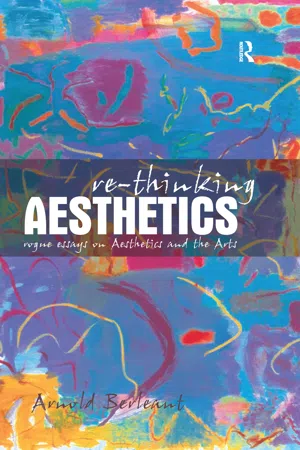
The essays, collected by Berleant in this volume all express the impulse to reject the received wisdom of modern aesthetics: that art demands a mode of experience sharply different from others and unique to the aesthetic situation, and that the identity of the aesthetic lies in keeping it distinct from other kinds of human experience, such as the moral, the practical, and the social. Berleant shows, on the contrary, that the value, the insight, the force of art and the aesthetic are all enhanced and enlarged by recognizing their social and human role, and that this recognition contributes both to the significance of art and to its humanizing influence on what we like to call civilization.
Information
PART I
The Focus of Aesthetics
Chapter 1
Re-thinking Aesthetics1
Re-thinking the Foundations of Aesthetics
Aesthetics is often thought of as one branch of philosophy, sometimes, indeed, a secondary branch of little significance for the broad reaches of philosophic thought. This is somewhat odd, since Kant, who is generally regarded as a founding figure in modern philosophy, put the aesthetic in his epistemological foundation and then developed a theory of the aesthetic as the systematic unifier of knowledge and morality. Because of Kant’s enormous historical importance, however, it may be more difficult to reconsider his dominant influence on the discipline of aesthetics. Yet that is precisely what I should like to propose here. For what could be more in keeping with both the critical tradition of philosophical thought and the openness of aesthetic perception than to re-think the foundations of the discipline.
In this chapter, then, I want to propose a radical re-examination of the foundations of modern aesthetics. This kind of exploration is at the same time a profoundly philosophical act, for philosophical premises lie at the base of modern aesthetics. Exploring these premises, indeed challenging them, can lead us to a new basis for aesthetics derived from aesthetic inquiry itself and not as the afterthought of a philosophical tradition whose origins were quite independent of the aesthetic domain. Conversely, re-thinking aesthetics may suggest new ways of doing philosophy.
The Radical Critique of Aesthetics
In recent years aesthetics has had something of a revival and is slowly emerging from its philosophical eclipse. At the same time, it has been the subject of serious criticism and fundamental reconsideration. Let me mention here two very different examples.
In The Ideology of the Aesthetic, Terry Eagleton develops a politico-social critique of aesthetics, placing it ‘at the heart of the middle class’s struggle for political hegemony’.2 Despite its protestations of autonomy, Eagleton regards the aesthetic in its historical complexity as a window into cultural and political changes. From this perspective, the very autonomy claimed for the aesthetic serves a larger political purpose as a model for bourgeois individualism, that is, of its own claims to autonomy. Thus the aesthetic is two-edged: it represents the political aspirations to self-determination of the middle class and provides an unconstrained locus for sensibility and imagination. At the same time, however, the aesthetic serves to internalize social power, rendering it, through its transformation into subjectivity, all the more effective a repressive force.3 In a larger sense, then, aesthetic autonomy is specious, for the aesthetic is not autonomous at all but is harnessed to a larger, political, purpose. Perhaps this might be called, with apologies to Kant, purpose without purposiveness – a utilitarian goal masquerading under the guise of being self-contained.
Unlike Eagleton’s subsumption of aesthetics under historical and political ends, Wolfgang Welsch centres his critique on the aesthetic, itself. He finds that the aesthetic not only pervades the whole of modern life but lies at the heart of philosophical thought. The aesthetic concerns not just art but human culture en tout, and it spreads out to inform the very fabric of meaning, truth, and reality. Thus aestheticization processes cover the surface of our world and reach beyond to shape social as well as material reality, affecting the form of individuals’ existence, the forms of social interaction, the very shape of culture, itself.4 More provocative still is Welsch’s argument for epistemological aestheticization, in which ‘truth, knowledge, and reality have increasingly assumed aesthetic contours’.5 All this leads him to an ‘aesthetics beyond aesthetics’, which takes three principal directions: expanding aesthetic perception to the full range of aisthēsis, enlarging the range of art to include both the multiplicity of its inner aspects and the many ways in which art pervades the whole of culture, and finally, extending aesthetics beyond art to society and the life-world.6
I find these critiques of aesthetics both important and convincing. They herald a new stage in philosophical development, one that recognizes the fundamental place of aesthetics in both the construction and the critique of contemporary culture and of our very grasp of reality. Yet for all their broad thrust, I believe that they do not go quite deep enough. Eagleton encloses aesthetics in its political and historical context, while Welsch expands the aesthetic into a powerful cultural force. Neither centres his critique on the aesthetic itself.
Yet the aesthetic theory they work with stands square in the centre of the very philosophic tradition they question. Until the defects in this tradition are exposed and replaced, any critique of aesthetics merely snaps at the heels of a sluggish though still powerful beast. Moreover, the domain of aesthetics needs to be invaded by a Trojan horse, by a critique from within the theory. In the pluralistic spirit of postmodernism, then, I believe that still more can be said here, and this from the standpoint not of culture or of history but of the aesthetic itself. There are artistic grounds for a critique of aesthetics, and philosophical grounds, as well. Above all, there are experiential grounds. None of these is independent of historical and cultural forces, but at the same time they cannot be reduced to these forces. The critique of aesthetics must take place on many levels and in many forms.
Difficulties in Traditional Aesthetics
Western aesthetics has been formed through two major influences – first classical Greek and then Enlightenment thought, particularly as it was formulated by Kant.
Of course, these are closely related. Yet new strands of thought emerging since the eighteenth century suggest sharply different ways of conceiving aesthetic theory. If I can characterize the dominant tradition in aesthetics as Kantian, what we need to explore are the possibilities of a non-Kantian aesthetics or, better yet, a post-Kantian aesthetics, and to consider the characteristics such a radically different aesthetics might display. I would like to examine some of these possibilities and to suggest a new and different course that aesthetics might follow.
The beginnings of movement away from Kant can be traced back to the middle of the last century. With his penetrating eye and directness of expression, Nietzsche recognized the fundamental difficulty with traditional aesthetics: ‘Kant had thought he was doing an honor to art when, among the predicates of beauty, he gave prominence to those which flatter the intellect, i.e., impersonality and universality ... Kant, like all philosophers, instead of viewing the esthetic issue from the side of the artist, envisaged art and beauty solely from the “spectator’s” point of view, and so, without himself realizing it, smuggled the “spectator” into the concept of beauty ... [W]e have got from these philosophers of beauty definitions which, like Kant’s famous definition of beauty, are marred by a complete lack of esthetic sensibility. “That is beautiful”, Kant proclaims, “which gives us disinterested pleasure.” Disinterested!’7
But it is not only the artist for whom disinterestedness is not appropriate. If the appreciator abandons the objectifying, analytic stance of the scholar or critic, the kind of personal participation that he or she engages in is closer to that of the artist than to the ‘philosopher of beauty’ of whom Nietzsche spoke so disparagingly. I like to call this active appreciative participation ‘aesthetic engagement’, for it best characterizes the kind of powerful personal involvement that we have in our most fulfilled aesthetic experience. There are other reasons for wanting to discard the notion of disinterestedness. The attitude it enjoins leads to distancing the art object and to circumscribing it with clear boundaries that isolate it from the rest of the human world. In the eighteenth century when the fine arts were being identified, separated from the other arts, and given a distinctive status, an aesthetics that institutionalized this process and conferred a special prominence on those arts had its value. At the present time, with widespread acceptance of the identity and importance of the arts, such a need no longer exists. To eternalize an idea whose significance is now largely historical both exaggerates its place and hinders aesthetic inquiry. And it also misdirects and obstructs appreciative experience.8
Disinterestedness is not the only one of Kant’s bequests that can be challenged. Eighteenth-century aesthetics is very much a product of the thinking of the times. It places in full view both its reliance on faculty psychology and the essentializing and universalizing philosophy of the Enlightenment. Furthermore, it imposes a scientific model on aesthetic understanding, a model that proceeds by objectification, dissection, and analysis. Thus the conceptual structure that we have inherited from Kant identifies distinct and separate modalities of perception and conception, beginning with that famous distinction itself. To separate percept and concept produces a problem some aestheticians continue to grapple with: the place of knowledge in the perceptual experience of art. There are other problematic oppositions in the eighteenth-century aesthetic, such as those between sense and reason, interest and disinterest, and illusion or imagination and reality. In the context of Enlightenment rationalism, these distinctions were illuminating and liberating. Today they provide a false clarity and a deceptive order, and they enthral both understanding and experience. Serious questions can be raised about whether we can speak either of reason or of sense without the one including the other, questions supported both by psychological research and later philosophical developments. Similarly, the purity of disinterestedness is difficult to defend, especially as both the motivation and the consumption of art have been absorbed into the commodification of culture.9 Then there is the implicit Lockean ontology of substance and qualities, whose present-day form of objects with aesthetic qualities preoccupies many scholars. The theoretical force of existential phenomenology, hermeneutics, deconstruction, postmodernism, and philosophical pragmatism have undermined claims to objectivity, the reduction of complex wholes to simple constituents, and the hegemony of scientific objectivity.
We need different theoretical tools for capturing the special character of aesthetic appreciation, special even though it need not be unique or unconnected with other domains of human culture. Furthermore, what is especially striking about both the intellectual and technological developments of our own time is the extent to which the notion of reality has been enlarged and multiplied. Hermeneutics and deconstruction have provided grounds for coexistent interpretations, and these have generated a plurality of truths. From a different direction, philosophical pragmatism and related approaches, such as Buchler’s principle of ontological parity, have laid the theoretical grounds for a metaphysics of multiple realities.10 The very objectivity of both history and science has been undermined by our recognition of the constitutive influence of social, cultural, and historical forces, and this has begun to be codified in the social sciences. Finally, contemporary industrial societies inhabit the virtual worlds of film, television, and cyberspace, ‘media-reality’, as Welsch calls it,11 a reality we have created that strangely resembles the African Bushmen’s belief in creation as a dream dreaming us.12
One of the lessons of postmodernism, a lesson postmodernism did not invent, is that cultural traditions and social influences shape our perceptual experience so thoroughly that there is no such thing as pure perception, and that to discuss it, even as a theoretical category, is greatly misleading. But Kantian aesthetics is built upon the conceptual structure of eighteenth-century psychology that considers reason, sense, imagination, and feeling as faculties of the mind. Formed in the interest of rationalizing and universalizing knowledge, these vastly simplify the complex contextual character of human experience. To take them separately and treat them as distinct and independent faculties or capacities creates divisions that we then are faced with reconciling. Think of the vast amount of attention devoted to defending imagination against reason, isolating unique aesthetic qualities, and reconciling expression with form.
The conclusion to which all this leads, whether or not it is comfortable or desirable, is inescapable. The idea of a rational universe, of an objective, systematic order, must be relegated to a display case in a museum of the history of ideas. Philosophy has constructed opposing forces that it is then faced with reconciling, a contrived process that is rarely successful. We need to re-think these ideas, not with the intent of clarifying them by sharpening their differences, but exactly the opposite – by showing their interpenetration, their continuity, and at times even their fusion, perhaps with the hope of achieving a kind of Spinozistic unity that sees them as aspects of a common substance.
A New Direction for Aesthetics
What is left of aesthetics if we turn away from the Kantian tradition? What would a new aesthetics, a post-Kantian aesthetics, look like? If we discard the categories of faculty psychology – sense, imagination, feeling, memory, reason, taste; if we forego the classical thrust of philosophy to universalize and dismiss the puzzles over emotion, expression, representation, and the like that arise from the fragmentation of the world of art into spectator, artist, and work of art; what then is left? If we literally re-think aesthetics, what kind of intellectual creation will emerge, what kind of creature will be born?
Let me suggest a programme for the different sort of thinking that I believe must guide our inquiry in aesthetics in a new and different direction:
- Relinquish the substantive categories we have inherited from eighteenth century psychology and replace them with adjectival and adverbial forms of such phenomena. ‘Sensation’ then becomes ‘sensory’, ‘perception’ becomes ‘perceptual’, ‘cognit...
Table of contents
- Cover Page
- Title Page
- Copyright Page
- Table of Contents
- Preface
- PART I The Focus of Aesthetics
- PART II Iconoclastic Implications
- PART III Re-Thinking the Arts
- Index
Trusted by 375,005 students
Access to over 1.5 million titles for a fair monthly price.
Study more efficiently using our study tools.
Frequently asked questions
Yes, you can cancel anytime from the Subscription tab in your account settings on the Perlego website. Your subscription will stay active until the end of your current billing period. Learn how to cancel your subscription
No, books cannot be downloaded as external files, such as PDFs, for use outside of Perlego. However, you can download books within the Perlego app for offline reading on mobile or tablet. Learn how to download books offline
Perlego offers two plans: Essential and Complete
- Essential is ideal for learners and professionals who enjoy exploring a wide range of subjects. Access the Essential Library with 800,000+ trusted titles and best-sellers across business, personal growth, and the humanities. Includes unlimited reading time and Standard Read Aloud voice.
- Complete: Perfect for advanced learners and researchers needing full, unrestricted access. Unlock 1.5M+ books across hundreds of subjects, including academic and specialized titles. The Complete Plan also includes advanced features like Premium Read Aloud and Research Assistant.
We are an online textbook subscription service, where you can get access to an entire online library for less than the price of a single book per month. With over 1.5 million books across 990+ topics, we’ve got you covered! Learn about our mission
Look out for the read-aloud symbol on your next book to see if you can listen to it. The read-aloud tool reads text aloud for you, highlighting the text as it is being read. You can pause it, speed it up and slow it down. Learn more about Read Aloud
Yes! You can use the Perlego app on both iOS and Android devices to read anytime, anywhere — even offline. Perfect for commutes or when you’re on the go.
Please note we cannot support devices running on iOS 13 and Android 7 or earlier. Learn more about using the app
Please note we cannot support devices running on iOS 13 and Android 7 or earlier. Learn more about using the app
Yes, you can access Re-thinking Aesthetics by Arnold Berleant in PDF and/or ePUB format, as well as other popular books in Philosophy & Philosophy History & Theory. We have over 1.5 million books available in our catalogue for you to explore.