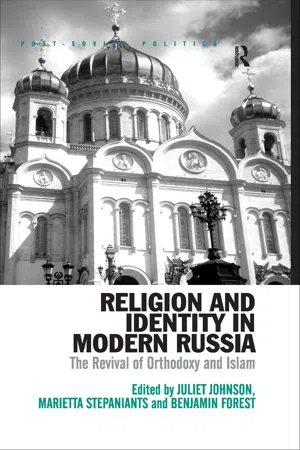
eBook - ePub
Religion and Identity in Modern Russia
The Revival of Orthodoxy and Islam
- 176 pages
- English
- ePUB (mobile friendly)
- Available on iOS & Android
eBook - ePub
Religion and Identity in Modern Russia
The Revival of Orthodoxy and Islam
About this book
Focusing on the roles of Russian Orthodoxy and Islam in constituting, challenging and changing national and ethnic identities in Russia, this study takes Tsarist and Soviet legacies into account, paying special attention to the evolution of the relationship between religious teachings and political institutions through the late 19th and 20th centuries. The volume explicitly discusses and compares the role of Russia's two major religions, Orthodoxy and Islam, in forging identity in the modern era and brings an innovative blend of sociological, historical, linguistic and geographic scholarship to the problem of post-Soviet Russian identity. This comprehensive volume is suitable for courses on post-Soviet politics, Russian studies, religion and political culture.
Information
Chapter 1
Religion after Communism: Belief, Identity, and the Soviet Legacy in Russia
And how believest thou, if thou believest anything at all?
- Ivan, in Dostoevsky’s The Brothers Karamazov
Many foreigners imagined post-Soviet Russia to be a religious wasteland in 1992, picturing it as a country full of “godless communists” yearning for salvation. I vividly remember a telling scene from that summer. During lunchtime one day, an eager group of young American missionaries, dressed all alike in (ironically) red t-shirts silkscreened with crosses, massed together in front of the Izvestiia building on Pushkin Square in central Moscow. As a curious crowd gathered, they began to act out in pantomime the story of the death and resurrection of Christ. Afterwards, they passed out pamphlets proclaiming the “Good News”. The Russian bystanders reacted mostly with amusement, although some took offense. Did these young people not know that Christianity had been introduced to Russia over a thousand years earlier, and that Christian imagery permeated Russian literature, painting, and culture? Moreover, did they not realize that the recent revitalization of religion in Russia had begun not with the Soviet collapse, but with Gorbachev’s introduction of glasnost and perestroika in 1986?
In fact, by 1992 Russia’s religious revival seemed firmly underway, with churches, mosques, and synagogues being built, rebuilt, and reopened all across the Russian Federation, and with more and more people publicly proclaiming themselves as religious believers every year. What Agadjanian (2001) has called an “energy of particularism” emerged as the universalistic Soviet identity was openly challenged, and a society-wide search for alternative ethnic and religious identities became both real and necessary. Moreover, the disorder, confusion, and creation of new states with old boundaries after 1991 forced people to rethink who they were and to which groups they belonged. Russian citizens actively sought stability, looking for symbols and identities around which to unite. In this atmosphere, religious belief flourished once again.
Russian Orthodoxy and Islam, historically the two predominant confessions in Russia, were at the forefront of this process. Not only had 70 years of state-sponsored atheism failed to uproot religion, but the Soviet state had not even consistently tried to do so. Despite the state’s Marxist-Leninist doctrine that officially considered religion to be the “opiate of the people”, the extent of religious repression in practice had been varied, nuanced, and highly dependent upon broader political circumstances. In turn, religious belief, religious practice, and religious institutions had both defied and adapted to the ever-changing state policies.
As James Scott (2003) reminds us, multiple, overlapping, and even contradictory aspects of identity coexist in each individual, with some felt more strongly than others at any given time. So when we observe what appears to be a change in an individual’s fundamental identity (for example, from atheist to believer, or Soviet to Russian), we may in fact be seeing a shift in emphasis among that person’s varied identities in reaction to a change in context. Scott ties this explicitly to state policies: “If, say, the presence of the state and its officials becomes progressively more intense over time, the identity appropriate to interaction with the state will be observed more frequently; actors will deploy it more frequently”. From this point of view, for many Soviet citizens a latent religious affiliation may have existed in their “identity kits”, but not been activated until religion became more politically and socially acceptable in the Gorbachev era and after the Soviet collapse.
The broader point, however, is that state policies and individual identities are mutually constituted. The state tries to constrain and mold individual and group identities, but alternative conceptions will slip the bounds of what state actors find permissible and comfortable. While reacting to these challenges, state policies (and sometimes ideologies) will undergo change, just as the identities of citizens simultaneously adapt to state pressures and persuasion.1 Similarly, state actors use carefully chosen mélanges of powerful, previously existing symbols of group identity both for self-legitimation and to promote particular conceptions of the nation.
To understand the nature of the post-Soviet religious revival, therefore, we need to examine the fate of religion in the Soviet period, looking at how the state’s policies molded and reacted to vernacular practice and vice versa…2 Although the Soviet state did not succeed in eradicating religion, policies during the Soviet period did affect the specific ways in which religious identity re-emerged in post-Soviet Russia. This brief review of religious policy in the Soviet period will aid us in answering three key questions about the revival of Orthodoxy and Islam in the Russian Federation. First, why do a significant majority of Russian citizens now characterize themselves as believers? Second, why is there a substantial gap between people’s strongly stated religious beliefs and their often anemic religious knowledge and practice (for example, attending services)? Finally, why is this gap in belief and practice far narrower among certain traditionally Muslim groups such as the Dagestanis and Chechens? In each case, examining the interaction of Soviet-era policy legacies with historical conceptions of group identity sheds light on post-Soviet patterns of religiosity in the Russian Federation.
Religion in the Soviet Era
According to Marxist-Leninist doctrine, national and religious identities were merely a divisive manifestation of false consciousness that prevented the working classes from joining together to overthrow their oppressors. As such, it was the avowed long-term expectation of the Soviet state that ethnic and religious attachments would eventually be superceded by the atheist, supra-national Homo sovieticus. The Soviet state’s identity politics, however, ebbed and flowed with historical circumstances, leadership and elite struggles, and modernization and globalization. Religion was never completely forbidden, and Soviet policies often served to strengthen and reinforce ethnic identities. While state action strongly restricted religious activity, particularly in the early Stalin era and under Khrushchev’s leadership, the persistence of belief and the regime’s need for legitimacy also led to occasional easing in policy, and finally to the tidal wave of particularism that swept the Soviet Union in the late 1980s following Gorbachev’s reforms.
The slogan “Autocracy, Orthodoxy, Nationality” encapsulated the official ideology of Tsarist Russia, and represented everything that the Bolsheviks hoped to destroy with their revolution. All three were thus major targets of the revolutionary authorities immediately after October 1917. However, the Bolsheviks dealt with each aspect in strikingly different ways. Autocracy as embodied in the Tsarist monarchy had already been struck a near-fatal blow by the February Revolution and the subsequent decision of Tsar Nicholas II to abdicate his throne. In July 1918 the Bolsheviks put the final nail in the coffin of the monarchy by murdering the entire royal family in the Urals city of Ekaterinburg, eliminating the potential for future blood claimants to the throne.3
Orthodoxy could not be so easily destroyed, but the Bolsheviks did their best to repress and subvert it. As Walters (1993) has observed, the Bolsheviks had “a genuine hostility towards religion, particularly as institutionalized in the Russian Orthodox Church … in the immediate post-revolutionary years, it was indeed the conscious policy of the Bolsheviks to direct their anti-religious activity virtually exclusively against the Orthodox Church” (5). At first the Bolshevik government was actually welcoming towards Islam, in great part because the new regime did not gain firm control over many traditionally Muslim areas until the end of the civil war. In November 1917 Lenin and Stalin issued their “Appeal to All Muslim Toilers of Russia and the East”, calling for imperial overthrow and promising to end imperial exploitation. While this appealed to some Muslim groups and drew adherents to the Bolshevik side, far more actively fought the Bolshevik efforts to incorporate their territories into a state reconstituted along the previous imperial borders (Yemelianova 2000).
In contrast, the new regime quickly introduced measures to dispossess the Orthodox Church of its property, terrorize priests, and bombard the population with anti-religious propaganda. The Bolsheviks also facilitated the creation of the alternative Renovationist Church, a nominally Orthodox church under state control. The Renovationist Church was run by breakaway Orthodox clergy and given jurisdiction over most Orthodox parishes (Ramet 1998). The Bolsheviks viewed undermining the country’s most powerful religious institution and promoting a tamer, fully co-opted alternative as a first step towards the eventual dissipation of religious belief.
Repression against Orthodox believers eased slightly during the New Economic Policy (NEP) period in the 1920s, as the Bolsheviks felt the need to placate the peasantry upon whom the success of their economic program depended (Walters 1993). However,the campaignagainst religionbecame more institutionalized during this time as well. In 1922 the “Antireligious Commission” (under Emel’ian Yaroslavskii) was founded, which later became the League of Militant Atheists operating under the aegis of the Central Committee’s Agitation and Propaganda Department. The Ministry for Cult Matters, founded in 1924, coordinated the religious policies of various state agencies (Luchterhandt 1993). Moreover, in 1923 the Soviet regime successfully co-opted the incarcerated Patriarch Tikhon into renouncing his previous anti-Soviet statements. This spelled the end of support for the Renovationist Church and forged a new pattern in state relations with the Russian Orthodox Church, a pattern which continued with Tikhon’sregime-approvedsuccessor Metropolitan Sergei (Stragorodskii). Metropolitan Sergei issued a “Declaration of Loyalty” to the USSR on behalf of the Church, a decision that gave birth to the breakaway underground True OrthodoxChurch movement(Davies 2003).Sergei maintained his public pro-regime stance even through the repression that followed in the early Stalin years.
The Bolsheviks were most cautious with their nationality policies. Indeed, the ideologically anti-national Bolsheviks vigorously embraced the slogan of national self-determination as a pragmatic way to undermine Russian nationalism and gain the support of the non-Russian peoples of the former empire during the revolution and subsequent civil war. The “Declaration of the Rights of the Peoples of Russia”, signed by both Lenin and Stalin (then Commissar of Nationality Affairs) in November 1917, promised that the government would allow “the free development of national minorities and ethnographic groups inhabiting the territory of Russia”. Soviet nationalities policy during this era evolved into what Terry Martin (2001) has called an “affirmative-action empire”. He characterizes Soviet nationalities policy in the pre-Stalin years as a strategy to “disarm nationalism” by giving peoples the “forms of nationhood” (3). These forms included the so-called korenizatsiia (indigen...
Table of contents
- Cover Page
- Title Page
- Copyright Page
- Table of Contents
- Preface
- 1 Religion after Communism: Belief, Identity, and the Soviet Legacy in Russia
- 2 Ethno-Religious Identity in Modem Russia: Orthodoxy and Islam Compared
- 3 Orthodoxy, Ethnicity, and Mass Ethnophobias in the Late Tsarist Era
- 4 In Search of the “Russian Idea”: A View from Inside the Russian Orthodox Church
- 5 Tolerance and Extremism: Russian Ethnicity in the Orthodox Discourse of the 1990s
- 6 Islam and the Emergence of Tatar National Identity
- 7 Islam and the Construction of Tatar Sociolinguistic Identity
- 8 The Politicization of Ethnic and Religious Identity in Dagestan
- 9 Modem Identities in Russia: A New Struggle for the Soul?
- Index
Trusted by 375,005 students
Access to over 1.5 million titles for a fair monthly price.
Study more efficiently using our study tools.
Frequently asked questions
Yes, you can cancel anytime from the Subscription tab in your account settings on the Perlego website. Your subscription will stay active until the end of your current billing period. Learn how to cancel your subscription
No, books cannot be downloaded as external files, such as PDFs, for use outside of Perlego. However, you can download books within the Perlego app for offline reading on mobile or tablet. Learn how to download books offline
Perlego offers two plans: Essential and Complete
- Essential is ideal for learners and professionals who enjoy exploring a wide range of subjects. Access the Essential Library with 800,000+ trusted titles and best-sellers across business, personal growth, and the humanities. Includes unlimited reading time and Standard Read Aloud voice.
- Complete: Perfect for advanced learners and researchers needing full, unrestricted access. Unlock 1.5M+ books across hundreds of subjects, including academic and specialized titles. The Complete Plan also includes advanced features like Premium Read Aloud and Research Assistant.
We are an online textbook subscription service, where you can get access to an entire online library for less than the price of a single book per month. With over 1.5 million books across 990+ topics, we’ve got you covered! Learn about our mission
Look out for the read-aloud symbol on your next book to see if you can listen to it. The read-aloud tool reads text aloud for you, highlighting the text as it is being read. You can pause it, speed it up and slow it down. Learn more about Read Aloud
Yes! You can use the Perlego app on both iOS and Android devices to read anytime, anywhere — even offline. Perfect for commutes or when you’re on the go.
Please note we cannot support devices running on iOS 13 and Android 7 or earlier. Learn more about using the app
Please note we cannot support devices running on iOS 13 and Android 7 or earlier. Learn more about using the app
Yes, you can access Religion and Identity in Modern Russia by Juliet Johnson,Marietta Stepaniants,Benjamin Forest, Juliet Johnson in PDF and/or ePUB format, as well as other popular books in Theology & Religion & Politics. We have over 1.5 million books available in our catalogue for you to explore.