eBook - ePub
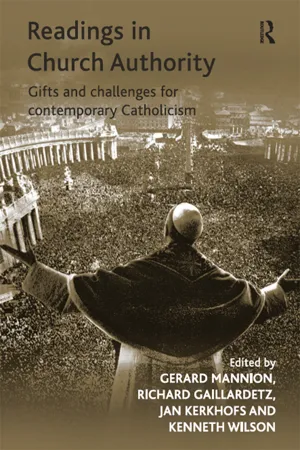
Readings in Church Authority
Gifts and Challenges for Contemporary Catholicism
- 592 pages
- English
- ePUB (mobile friendly)
- Available on iOS & Android
eBook - ePub
Readings in Church Authority
Gifts and Challenges for Contemporary Catholicism
About this book
The issues of Authority and Governance in the Roman Catholic Church permeate each and every aspect of the Church's identity, teaching, influence, organisation, moral values and pastoral provision. They have left their mark, in turn, upon its diverse theological and philosophical traditions. The trends of postmodernity, advances in communication, the advent of new ecclesial movements and theologies, and a perceived policy towards increasing institutional centralisation on the part of the Curial authorities of the Church in Rome, have all facilitated a continuous and lively stream of dialogue and disagreement on authority and governance in relation to the place of the Church in our age and the new Millennium. This comprehensive Reader uniquely gathers together in one volume key writings and documents from the wealth of published literature that has emerged on the issues of authority and governance in the Roman Catholic Church. With guided introductions to each section and to each reading, and end of chapter further reading lists, this Reader offers a balanced range of perspectives, themes, international writings, ecumenical dimensions, and formal church documents and Papal pronouncements on core areas of contemporary study and debate. Focusing on the modern/post-modern period in the Roman Catholic Church, but grounded in the historical contexts, Readings in Church Authority presents an accessible source book and introduction for all those exploring current debates and studying central themes in church authority.
Information
Part 1:
Ecclesiology – Envisaging the Church
Any study of questions concerning the nature and scope of church authority presupposes at least some tentative understanding of what the church actually is. Further related considerations follow concerning what constitutes church, what it means to be church, what the essence, nature and function of the church are, how the church is to be governed, shaped and facilitated, and how the church is renewed and enhanced from time to time. Then there are further questions about the nature of the church universal, whether in Roman Catholic terms or in relation to Christianity itself, and in relation to particular, regional and local churches.
Questions concerning the church embrace many considerations concerning the ways and forms of being community in relation to the love and will of God. For Christians, this was given definitive expression by Jesus of Nazareth and developed by his immediate followers. Through its many centuries, for various historical, political and cultural reasons, the church has grown, changed and taken on various new forms and styles of trying to remain faithful to the original mission given by Christ to his disciples.
Even at the highest level of the ‘official’ Roman Catholic church itself, history demonstrates that there have been a variety of ways in which those within the church, especially those in positions of authority, have developed a self-understanding of the church itself. So, too, at the grass-roots level, from the communities of the New Testament, to the churches of the fathers, from the radical groups of renewal and reformation, to the rural and far-flung parishes and missions oblivious to the political machinations of the medieval church; from the many denominations and their offspring, to the uniform Roman Catholic identity promoted post-Council of Trent and throughout the nineteenth century onwards. So, too, from the groups of Catholic Action to the base communities of Latin America, from the movement for woman-church, to the local groups of revolutionary and reactionary commitment (in radical, counter-cultural or conservative fashion). And, again, from the indigenous churches who have embraced inculturation, to the parishes of the developed world uncertain of their future, and a legion of other instances, besides. The quest for a vital, energizing and sustainable way of being the community called church has preoccupied, perplexed and fulfilled groups of Christians – those people committed to living the gospel of Jesus Christ, from the time of his own earthly ministry itself.
Hence, whilst ‘church’ must obviously be understood as one of the central concepts for Christianity, there is no set answer, applicable to all ages and to all places, to the question ‘what is church?’. Instead, there is a myriad of attempts to convey and to live some sort of response to a question which is fundamentally, for Christians, a calling long before it can be construed as a sociological, historical or theological exercise.
Thus the self-understanding of the church goes through many transformations, across time and throughout space. Some of the most wonderful images, metaphors and analogies have been employed in an attempt to try and elucidate the nature of church, and many profound theoretical and spiritual treatments have come forth as a result of the efforts of the followers of Christ to understand their lives and discipleship more fully.
Fundamental to the attempts of any part of the Roman Catholic church to understand and direct itself, are a consideration of the church’s institutional aspects in relation to its communitarian aspects, as are questions of relations between the hierarchy and the wider church, between clergy and laity, and between universal and local churches. Indeed the dynamics of the relation between ‘the church’ and ‘the churches’ reaches far beyond the broad confines of Roman Catholicism itself.
Hence many typologies, images, pictures and templates of what the church is, is about and should/might be have emerged throughout the Christian centuries. Many have become sufficiently influential, successful or even confrontational enough to be labelled ‘models’ of the church – i.e. as explanatory and exploratory devices for understanding and developing the church alike. The more wide-reaching models, particularly those employed and adapted by elements of the institutional church, can be said to have become sufficiently disseminated, sometimes even imposed, throughout the wider church to warrant the title of ‘paradigms’.1 This is because they both help to shape and to capture the essence of a particular selfunderstanding of the church for a particular era. Some models and paradigms have been restrictive and stifling, some parochial and hierarchical, whilst others have been progressive and dynamic, with some being flexible and egalitarian. Whatever, as the sociologist Max Weber stressed that we must bear in mind when employing typologies, there are no ‘ideal types’ which exist in reality. Our ventures to understand and direct the church – our ecclesiologies – will always be ‘grasping attempts’ at trying to capture and shape the fundamental aspects of the Christian community/ies.
But when an understanding of the church, whether it involves spiritual considerations, metaphors, models, paradigms and the like or not, becomes empowering, enabling and results in the enhancement and building up of the community, it can be said to be visionary. Here, ecclesiology enters a further dimension, more fully in tune, it might be said (in accordance with the New Testament), with the aims and intentions of Christ and the immediate successors he charged with the building of the kingdom of justice and righteousness.
All Roman Catholic ecclesiology will always be confronted by the twin poles of unity and diversity in its endeavours. Furthermore, it must never shy away from consideration of contextual and cultural considerations. The epistles of the New Testament demonstrate that this has always been the case. So, too, must the ‘signs of the times’ be given due attention (as John XXIII and Vatican II emphasized). Differing theologies, philosophies and social scientific schools, along with differing priorities across the church and the varied manner in which certain groups and individuals connect with often rich and diverse traditions (even just within Roman Catholicism), will give birth to differing themes and perspectives in ecclesiology. Nonetheless, given the considerations outlined, but only touched upon in this introduction, that is often no bad thing.
The church’s business is as a sacramental presence in the world, striving by its service to bring the message and reality of God’s salvific love to humanity, building community and furthering justice and righteousness. These goals help bring us closer both to one another and to God.
Our collection of readings touch upon many of the issues mentioned here, from official church paradigms, to fundamental shifts in the ecclesiological thinking of the hierarchy; from the struggle to articulate and develop a church of the poor and marginalized, to the attempt to theorize a fitting ecclesial ‘open-space’ for women; from attempts to clarify and/or reverse earlier ‘official’ ecclesiologies, to pleas that a more diverse, positive and practical vision of the church be cultivated. Alas, the collection is but a small sample of the ecclesiological riches of Roman Catholicism in recent times.
Many of the issues in this part naturally overlap with those which concern other parts, for all of the major themes with which this book is concerned are bound up with the selfunderstanding and vision of the institutional church, and the understanding of the church held by those in its local settings and at its margins.
1.1 MYSTICI CORPORIS CHRISTI – 1943
This encyclical,2 from the pontificate of Pius XII, sets down a re-newed understanding of the church, emphasizing elements of the self-understanding of the community found in the New Testament and the early church. It marks a shift from the ‘political society’ model of the church, which had prevailed since the seventeenth century. It purports to balance the charismatic and institutional understandings of the church. The encyclical identifies the visible community, i.e., the Roman Catholic church, with the invisible communion as one. Hence being part of the mystical body is seen as conditional upon being a member of and in good standing with the Roman Catholic church authorities. The document contains much symbolic language, (ontological analogies and images, biblical images, communitarian and sacramental language) and does recognize the importance of a diverse range of gifts and roles within the church. However, it clearly emphasizes an institutional and hierarchical model of the church. Thus much of the potential of the symbolic language it employs is thwarted. Many theologians were disappointed by its hierarchical understanding of the church, as well as its exclusivistic tone.

The doctrine of the Mystical Body of Christ, which is the Church,3 was first taught us by the Redeemer Himself … [1] … If we would define and describe this true Church of Jesus Christ – which is the One, Holy, Catholic, Apostolic and Roman Church – we shall find nothing more noble, more sublime, or more divine than the expression ‘the Mystical Body of Christ’ – an expression which springs from and is, as it were, the fair flowering of the repeated teaching of the Sacred Scriptures and the Holy Fathers.
That the Church is a body is frequently asserted in the Sacred Scriptures. ‘Christ’, says the Apostle, ‘is the Head of the Body of the Church’.4 If the Church is a body, it must be an unbroken unity, according to those words of Paul: ‘Though many we are one body in Christ.’5 But it is not enough that the Body of the Church should be an unbroken unity; it must also be something definite and perceptible to the senses… . Hence they err in a matter of divine truth, who imagine the Church to be invisible, intangible, a something merely ‘pneumatological’ as they say, by which many Christian communities, though they differ from each other in their profession of faith, are united by an invisible bond [14] … .
One must not think, however, that this ordered or ‘organic’ structure of the body of the Church contains only hierarchical elements and with them is complete; or, as an opposite opinion holds, that it is composed only of those who enjoy charismatic gifts – though members gifted with miraculous powers will never be lacking in the Church. That those who exercise sacred power in this Body are its chief members must be maintained uncompromisingly. It is through them, by commission of the Divine Redeemer Himself, that Christ’s apostolate as Teacher, King and Priest is to endure. At the same time, when the Fathers of the Church sing the praises of this Mystical Body of Christ, with its ministries, its variety of ranks, its officers, its conditions, its orders, its duties, they are thinking not only of those who have received Holy Orders, but of all those too, who, following the evangelical counsels, pass their lives either actively among men, or hidden in the silence of the cloister, or who aim at combining the active and contemplative life according to their Institute; as also of those who, though living in the world, consecrate themselves wholeheartedly to spiritual or corporal works of mercy, and of those in the state of holy matrimony. Indeed, let this be clearly understood, especially in our days, fathers and mothers of families, those who are godparents through Baptism, and in particular those members of the laity who collaborate with the ecclesiastical hierarchy in spreading the Kingdom of the Divine Redeemer occupy an honorable, if often a lowly, place in the Christian community, and even they under the impulse of God and with His help, can reach the heights of supreme holiness, which, Jesus Christ has promised, will never be wanting to the Church [17] … .
Actually only those are to be included as members of the Church who have been baptized and profess the true faith, and who have not been so unfortunate as to separate themselves from the unity of the Body, or been excluded by legitimate authority for grave faults committed. ‘For in one spirit’ says the Apostle, ‘were we all baptized into one Body, whether Jews or Gentiles, whether bond or free’.6 As therefore in the true Christian community there is only one Body, one Spirit, one Lord, and one Baptism, so there can be only one faith.7 And therefore, if a man refuses to hear the Church, let him be considered – so the Lord commands – as a heathen and a publican.8 It follows that those who are divided in faith or government cannot be living in the unity of such a Body, nor can they be living the life of its one Divine Spirit [22].
Nor must one imagine that the Body of the Church, just because it bears the name of Christ, is made up during the days of its earthly pilgrimage only of members conspicuous for their holiness, or that it consists only of those whom God has predestined to eternal happiness. It is owing to the Savior’s infinite mercy that place is allowed in His Mystical Body here below for those whom, of old, He did not exclude from the banquet9 … [23]. Let every one then abhor sin, which defiles the mystical members of our Redeemer; but if anyone unhappily falls and his obstinacy has not made him unworthy of communion with the faithful, let him be received with great love, and let eager charity see in him a weak member of Jesus Christ … [24] … .
Because Christ is so exalted, He alone by every right rules and governs the Church; and herein is yet another reason why He must be likened to a head. As the head is the ‘royal citadel’ of the body10 – to use the words of Ambrose – and all the members over whom it is placed for their good11 are naturally guided by it as being endowed with superior powers, so the Divine Redeemer holds the helm of the universal Christian community and directs its course. And as to govern human society signifies to lead men to the end proposed by means that are expedient, just and helpful,12 it is easy to see how our Savior, model and ideal of good Shepherds, performs all these functions in a most striking way [37].
While still on earth, He instructed us by precept, counsel and warning in words that shall never pass away, and will be spirit and life to all men of all times. Moreover He conferred a triple power on His Apostles and their successors, to teach, to govern, to lead men to holiness, making this power, defined by special ordinances, rights and obligations, the fundamental law of the whole Church [38] … .
But we must not think that He rules only in a hidden or extraordinary manner. On the contrary, our Redeemer also governs His Mystical Body in a visible and normal way through His Vicar on earth. You know, Venerable Brethren, that after He had ruled the ‘little flock’13 Himself during His mortal pilgrimage, Christ our Lord, when about to leave this world and return to the Father, entrusted to the Chief of the Apostles the visible government of the entire community He had founded. Since He was all wise He could not leave the body of the Church He had founded as a human s...
Table of contents
- Cover
- Half Title
- Title Page
- Copyright Page
- Dedication
- Table of Contents
- Acknowledgements
- List of Abbreviations
- The Editors
- Volume Format and Advice to Readers
- INTRODUCTION: GIFTS AND CHALLENGES FOR THE ROMAN CATHOLIC CHURCH TODAY
- PART 1: ECCLESIOLOGY – ENVISAGING THE CHURCH
- PART 2: THE MAGISTERIUM – THE CHURCH AND ITS TEACHING
- PART 3: SYNODALITY AND COLLEGIALITY – THE DYNAMICS OF AUTHORITY
- PART 4: THE PAPACY – SUPREME AUTHORITY?
- PART 5: THE SENSUS FIDELIUM AND RECEPTION OF TEACHING
- PART 6: THE ROLE OF THE THEOLOGIAN – SAINTS AND SCHOLARS
- PART 7: DOCTRINE AND DEVELOPMENT – THE DYNAMICS OF TRADITION AND TRUTH
- PART 8: REFORM AND RENEWAL IN THE CHURCH
- Biographies
- Index of Names
Trusted by 375,005 students
Access to over 1.5 million titles for a fair monthly price.
Study more efficiently using our study tools.
Frequently asked questions
Yes, you can cancel anytime from the Subscription tab in your account settings on the Perlego website. Your subscription will stay active until the end of your current billing period. Learn how to cancel your subscription
No, books cannot be downloaded as external files, such as PDFs, for use outside of Perlego. However, you can download books within the Perlego app for offline reading on mobile or tablet. Learn how to download books offline
Perlego offers two plans: Essential and Complete
- Essential is ideal for learners and professionals who enjoy exploring a wide range of subjects. Access the Essential Library with 800,000+ trusted titles and best-sellers across business, personal growth, and the humanities. Includes unlimited reading time and Standard Read Aloud voice.
- Complete: Perfect for advanced learners and researchers needing full, unrestricted access. Unlock 1.5M+ books across hundreds of subjects, including academic and specialized titles. The Complete Plan also includes advanced features like Premium Read Aloud and Research Assistant.
We are an online textbook subscription service, where you can get access to an entire online library for less than the price of a single book per month. With over 1.5 million books across 990+ topics, we’ve got you covered! Learn about our mission
Look out for the read-aloud symbol on your next book to see if you can listen to it. The read-aloud tool reads text aloud for you, highlighting the text as it is being read. You can pause it, speed it up and slow it down. Learn more about Read Aloud
Yes! You can use the Perlego app on both iOS and Android devices to read anytime, anywhere — even offline. Perfect for commutes or when you’re on the go.
Please note we cannot support devices running on iOS 13 and Android 7 or earlier. Learn more about using the app
Please note we cannot support devices running on iOS 13 and Android 7 or earlier. Learn more about using the app
Yes, you can access Readings in Church Authority by Richard Gaillardetz,Kenneth Wilson, Gerard Mannion in PDF and/or ePUB format, as well as other popular books in Teologia e religione & Canone biblico e diritto ecclesiastico. We have over 1.5 million books available in our catalogue for you to explore.