- 216 pages
- English
- ePUB (mobile friendly)
- Available on iOS & Android
eBook - ePub
About this book
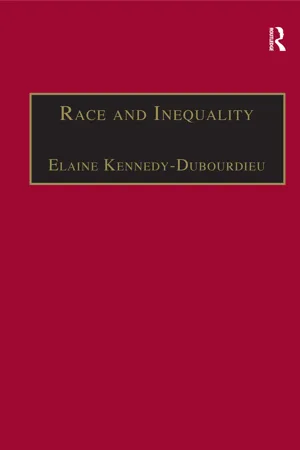
How do societies achieve cohesion in countries where the population is formed of different racial and ethnic groups? Although the debate continues, one constant is the agreement on the need for equality for all citizens of such societies. These egalitarian principles are believed by many to underpin a stable and just society. The question then arises of how best to achieve this equality? This book looks at the policy of affirmative action as it has evolved in different parts of the world: Australia, Canada, Great Britain, India, Northern Ireland, South Africa and the United States. The detailed juxtaposition of country case-studies allows readers to make comparisons and highlight disparities. Although affirmative action has operated in favour of various segments of the population, this book concentrates on the policy with regard to racial/ethnic groups. It explores the origin of the concept: where and how the policy emerged and what form it has taken, in order to open up the debate on this highly sensitive area of social policy.
Information
Chapter 1
Affirmative Action in the United States
Jo Ann Ooiman Robinson
Affirmative action is one instrument by which African Americans, as a ‘class’, have sought to secure citizenship rights and to erase the stamp of inferiority with which they were branded historically. Finding racial inequality to be embedded in the political, economic and social institutions of the nation, affirmative action advocates insist that it cannot be extirpated by laws and policies that simply promise fair and equal treatment from a given time forward. They argue that some redistribution of political power, social standing, and/or economic resources is necessary to attain what the 36th President of the United States, Lyndon Baines Johnson, identified as the ultimate goal: ‘not just equality as a right and a theory but equality as a fact and equality as a result’. The specific means by which these ends are sought include a wide range of race conscious initiatives and reforms, in both the public and the private sectors, and in such areas as school admissions, industrial apprenticeship and training programs, and hiring and promotion practices in the areas of business and manufacturing. It has also been argued that affirmative action should take the form of ‘a kind of open-ended reparations’.1
Opponents of race conscious initiatives and policies (including some African Americans and members of other disadvantaged groups) decry them as violations of an allegedly ‘color blind’ Constitution, as ‘reverse discrimination’ against whites, and as demeaning to the individuals they are intended to elevate.
1.
In the contradiction between United States’ claims of ‘freedom and justice for all’ and historical records of slavery, exploitation and brutal death for untold numbers lie the roots of the struggle for affirmative action. Following their war of independence against Britain, the new states, in 1787, formed a federal government that sanctioned slavery and assumed that the status of ‘citizen’ was synonymous with ‘white male’.2 Nearly three quarters of a century later, and at the conclusion of a bloody and bitter Civil War, the United States Congress – briefly controlled by a coalition of white and black reformers – amended the federal constitution, outlawing involuntary servitude (Thirteenth Amendment, 1865); establishing citizenship and guaranteeing ‘equal protection of the laws’ for ‘all persons born or naturalized in the United States’ (Fourteenth Amendment, 1866); and extending voting rights to men of color (Fifthteenth Amendment, 1869).3
In addition to the constitutional amendments, Congress enacted other laws that could be called prototypes for civil rights and affirmative action legislation a century later, including two civil rights acts (1866 and 1875) and laws that created and maintained a Bureau of Refugees, Freedmen and Abandoned Lands, better known as the Freedmen’s Bureau. It was this institution that most prefigured the race conscious remedies enacted in the 1960s and after.
In its earliest history (beginning in 1865) the bureau aided both newly freed slaves and white war refugees. Assistance with housing, employment, food, legal aid and education were among its services.4 When the bureau came up for renewal in 1866, whites were no longer included within its purview. This prompted opponents of the law to complain that it was ‘class legislation – legislation for a particular class of the blacks to the exclusion of all whites’. Concurring with this view and insisting that ‘the idea on which the slaves were assisted to freedom was that on becoming free they would be a self-sustaining population’, President Andrew Johnson vetoed the second bill.5
That bureau supporters were successful in fighting to override Johnson’s veto and to pass the Fourteenth Amendment simultaneously has led some scholars to conclude that the amendment was intended ‘to provide a constitutional basis for the Freedmen’s Bureau Act’. On these grounds of historical context they argue that a sanction for race conscious legislation is inherent in the Fourteenth Amendment. Foes of affirmative action reject this interpretation. For them the ‘equal’ in ‘equal protection’ cannot mean special consideration based on race or any other factor.6 In any case, for a few brief years national policy with regard to race was geared toward providing civil rights for all.7
Ultimately, however, Reconstruction failed. A new generation of political leaders was not concerned with racial justice. With a tremendous surge of industrialization occurring throughout the nation they sought compromises and coalitions that would reap the maximum benefit for themselves and their constituents. Reconstruction’s collapse was completed in the contested presidential election of 1876. The price paid by the Republican Party for retaining the White House included ordering federal troops that were stationed in the South to stand down, thereby removing the last vestiges of protection for black civil rights.8
Calling themselves ‘Redeemers’, and with the acquiescence of the federal government, the former slave-holding class of southerners returned to power in the South. They replaced Reconstruction laws and institutions with a system of rigid segregation and inequality.9 Reinforcing this ‘redemption’ the United States Supreme Court ruled in 1883 that Congress had exceeded its authority in passing the Civil Rights Act of 1875. Presenting the decision of the court majority, Justice Joseph Bradley asserted that it was time for blacks to cease ‘to be the special favorite of the laws’.10
In 1896 the Court completed its evisceration of the laws intended to protect African Americans by establishing in the case of Plessy v. Ferguson that ‘separate but equal’ public accommodations were constitutional. Justice John Marshall Harlan dissented. One phrase in that dissent would be cited repeatedly over the years – his assertion regarding a ‘color blind’ Constitution. Advocates of affirmative action have attacked it as historically untrue, while for their opponents the phrase is a touchstone for every argument against any remedy for discrimination that includes preferential treatment of one group over another.11
The period designated the Nadir by historian Rayford Logan (ca.1876–1914) was a time when whites solidified and openly celebrated legalized segregation in the South and de facto segregation in many other parts of the country.12 Additionally, many academics and social commentators formulated and broadcast ‘Social Darwinism’, an ideology predicated on the assumption that equality among human beings is impossible, for there will always be some who are strong and ‘fit’ and some who are weak and inferior. From such dogma would follow the concepts of ‘merit’ and ‘meritocracy’. (Lauded by opponents of affirmative action in later years, these concepts were invoked to associate race-conscious methods of admissions in education, or hiring and promotion in industry and business, with ‘lowering standards’ that, presumably, only whites or white males could maintain).13
Lynchings and riots served as enforcers of segregation. One of the characteristics of the Nadir that is most salient for the history of affirmative action is the concerted effort by organized labor to exclude black workers and rally around white privilege.14 The tradition of white supremacy that took root within the ranks of organized labor in the post-Reconstruction era (especially the American Federation of Labor) remained entrenched well into the 1960s.
Throughout the Nadir African Americans continued to resist. By the end of World War I academics and journalists were writing of a ‘New Negro’ who ‘was not content to move along the line of least resistance…’.15 In the following period, encompassing a world-wide depression, the New Deal response thereto by the administration of Franklin Roosevelt, and the Second World War, blacks laid significant ground work for the later emergence of affirmative action.
2.
The upsurge of black consciousness and racial pride indicated by the New Negro included the rise of a new generation of activist black leaders.16 A number of these leaders mounted campaigns against employers in their communities who followed white-only hiring practices. Some of these campaigns went beyond promoting the philosophy of ‘Don’t Buy Where You Can’t Work’ to demanding that white-owned establishments hire African Americans in proportion to their numbers in the community.
Legal challenges to such demands for affirmative action-like proportional hiring made their way to the United States Supreme Court on two occasions. In 1938 that court granted the New Negro Alliance of Washington, D.C. the right to picket the Sanitary Grocery Store chain on behalf of proportional hiring, but left the concept itself open to debate. In 1950, the court ruled against the black Progressive Citizens of America (PAC). The PAC had demanded proportional hiring by the Lucky Grocery Store chain in Richmond, California. Lawyers for the organization rebutted charges that proportional hiring was discriminatory. They maintained that ‘special consideration does not become “discrimination” where its beneficiaries are a uniquely oppressed and exploited social group’. The Supreme Court opined that if the PAC had its way ‘Hungarians in Cleveland,…Poles in Buffalo…, Germans in Milwaukee,…Portuguese in New Bedford,…Mexicans in San Antonio…and the numerous minority groups in New York, and so on…’ would all soon be ‘picketing to secure proportional employment on ancestral grounds…’.17
In the midst of the Great Depression, with a third of the US labor force unemployed, securing employment of any type became more difficult than ever for minority workers. In 1932 Franklin D. Roosevelt won the presidential election and proclaimed a ‘New Deal’ for the nation. Roosevelt’s New Deal was Janus-faced, putting out a few forward-looking programs that overrode entrenched white privilege while establishing many others that faced backwards toward traditional practices of discrimination.18
Impetus for the forward-looking initiatives came from African American political leaders such as Robert Weaver, race relations advisor to Harold Ickes in the Public Works Administration (PWA). Weaver was instrumental in persuading Ickes to require for all PWA construction that contractors employ at least the same percentage of African American workers as recorded in the 1930 census for each city. In a similar vein, hiring and training quotas for black workers were mandated for the extensive construction undertaken by the Tennessee Valley Authority, one of the most ambitious New Deal projects.19
The term ‘affirmative action’ appeared for the first time in federal law in the Roosevelt administration’s landmark labor reform, the National Labor Relations Act (NLRA) of 1935. The law empowered workers to negotiate and bargain collectively. It also created a N ational L abor Relations B oard (NLRB ) authorized to investigate unfair labor practices and ‘take such affirmative action…as will effectuate the policies of this Act’. Later laws were modeled on this measure.
Ironically, the measure itself became an instrument of discrimination against black and other minority workers by identifying organized labor as workers’ sole collective bargaining agent. Because the dominant unions were affiliates of the AFL, which regularly excluded blacks, the new law enhanced opportunities for white workers and reinforced their racism. Even the more progressive Congress of Industrial Organizations (CIO) that emerged in the 1930s to challenge the AFL had within a decade become ‘part of the white labor establishment in privileging whiteness’.20
As the likelihood of US involvement in Wor...
Table of contents
- Cover
- Half Title
- Title
- Copyright
- Contents
- Notes on Contributors
- Foreword
- Acknowledgements
- Introduction
- 1 Affirmative Action in the United States
- 2 Challenging Systemic Racism in Canada
- 3 Affirmative Action in India
- 4 From Periphery to Mainstream: Affirmative Action in Britain
- 5 Affirmative Action in Northern Ireland
- 6 Australian Multicultural Equity and Fair Go
- 7 Affirmative Action in South Africa: The Limits of History
- Conclusion
- Bibliography
- Index
Trusted by 375,005 students
Access to over 1.5 million titles for a fair monthly price.
Study more efficiently using our study tools.
Frequently asked questions
Yes, you can cancel anytime from the Subscription tab in your account settings on the Perlego website. Your subscription will stay active until the end of your current billing period. Learn how to cancel your subscription
No, books cannot be downloaded as external files, such as PDFs, for use outside of Perlego. However, you can download books within the Perlego app for offline reading on mobile or tablet. Learn how to download books offline
Perlego offers two plans: Essential and Complete
- Essential is ideal for learners and professionals who enjoy exploring a wide range of subjects. Access the Essential Library with 800,000+ trusted titles and best-sellers across business, personal growth, and the humanities. Includes unlimited reading time and Standard Read Aloud voice.
- Complete: Perfect for advanced learners and researchers needing full, unrestricted access. Unlock 1.5M+ books across hundreds of subjects, including academic and specialized titles. The Complete Plan also includes advanced features like Premium Read Aloud and Research Assistant.
We are an online textbook subscription service, where you can get access to an entire online library for less than the price of a single book per month. With over 1.5 million books across 990+ topics, we’ve got you covered! Learn about our mission
Look out for the read-aloud symbol on your next book to see if you can listen to it. The read-aloud tool reads text aloud for you, highlighting the text as it is being read. You can pause it, speed it up and slow it down. Learn more about Read Aloud
Yes! You can use the Perlego app on both iOS and Android devices to read anytime, anywhere — even offline. Perfect for commutes or when you’re on the go.
Please note we cannot support devices running on iOS 13 and Android 7 or earlier. Learn more about using the app
Please note we cannot support devices running on iOS 13 and Android 7 or earlier. Learn more about using the app
Yes, you can access Race and Inequality by Elaine Kennedy-Dubourdieu in PDF and/or ePUB format, as well as other popular books in Social Sciences & Sociology. We have over 1.5 million books available in our catalogue for you to explore.