- 240 pages
- English
- ePUB (mobile friendly)
- Available on iOS & Android
eBook - ePub
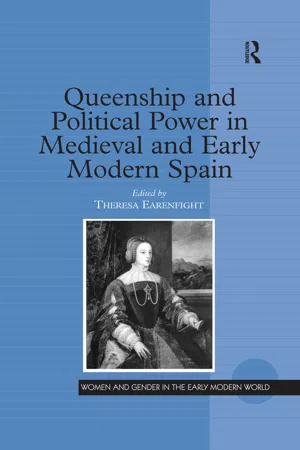
Queenship and Political Power in Medieval and Early Modern Spain
About this book
Unlike empresses in Germany and queens in England and France, the lives and political careers of most Iberian queens remain largely unknown to non-specialists. In this collection, Theresa Earenfight brings together new research on medieval and early modern Spanish queens that highlights the distinctive political culture that resulted in forms of queenship similar to, yet also substantially different from, that of northern Europe. The essays consider three aspects of queenship and politics: the institutional foundations and practice of politics, the politics of religion and religious devotion, and the literary and artistic representations of queenship and power. Late medieval queens, because they often occupied prominent and powerful offices such as the regency in Castile and Portugal and the Lieutenancy in the Crown of Aragon, exemplify a unique form of queenship that can best be described as a political partnership. Habsburg queens and empresses, often excluded from such official political roles, were less publicly visible but their power as partner to the king, although shrouded, remains potent. Their political careers were the result of two forces: first, military circumstances brought about by territorial expansion, conquest, and second, a political culture that did not explicitly prohibit queens from active participation in the governance of the realm. The essays in this collection-by both newer and well established scholars-demonstrate the range and depth of current research on Iberian queenship, and prompt a re-examination of long-held assumptions about women and the exercise of power in pre-modern Spain.
PART I
THE PRACTICAL LIMITS OF PARTNERSHIP
CHAPTER ONE
Unwilling Partners: Conflict and Ambition in the Marriage of Peter II of Aragon and Marie de Montpellier
The ideal feudal marriage in the period before the Albigensian crusades in Languedoc, and, it appears, in the Crown of Aragon as well, created a partnership. Examples abound of couples working together to promote the interests of their house or dynasty, build wealth, and administer the lands held by the family. The marriage might remain fundamentally unequal, with the wife exercising largely private authority, but sometimes both partners shared highly visible public duties. Happiness is not easily measured in feudal documents, but it is clear that the majority of medieval marriages in the area were successful. Unfortunately, most is never all, and there are plenty of counter-examples in which marriages were rent by greed or ambition. The marriage of Peter II of Aragon and Marie de Montpellier falls into this second category.
The union of Peter II and Marie de Montpellier is possibly the best-documented marriage from the entire area from the late twelfth and early thirteenth centuries. Strife began early and lasted until Marie’s death ended the marriage. This marriage has been examined before, once as a well-illustrated example of the process of canonical divorce, and, later, as an example of the deteriorating position of Catalan countesses.1 In some ways, their unhappy marriage was little different from the unhappy marriages of other regional magnates. However, it differed in two important respects. First, as king, Peter did not enjoy the same latitude as his vassals. In spite of a concerted effort spanning more than six years, he failed to dismiss Marie. Less highly placed men could and did divorce their wives with few repercussions and little clerical interference.2 Second, and most importantly from the perspective of this study, because they were reigning monarchs the domestic discord of Peter and Marie inevitably overlapped into the political sphere. For Peter this meant a kingdom. However, Marie’s interest and influence does not appear to have extended beyond the seigneury she had inherited from her father.
Superficially, the marriage of a king to the heiress of a seigneury appears incongruous, but at the time it did not. To understand how this union came about, it is useful to consider the place of the early count-kings and the lord of Montpellier in Occitania—a region stretching south from the Loire to the Rhone to the PyrEnees. The bond between this region and the county of Barcelona extended beyond a near-common language and similar culture, and almost all the most powerful families in Occitania were linked to the counts of Barcelona by blood as well. Two great counties had dominated the region since the eleventh century—the county of Barcelona and the county of Toulouse. There is not space here to fully explore the delicate and shifting balance of powers in the region, but the lords of Montpellier had been steadfast allies of the counts of Barcelona and later of the crown of Aragon from the early twelfth century. Beyond their own lands, the lords of Montpellier were regarded as counts from at least the beginning of the twelfth century, wielding something very like comital power. It spite of this, they never styled themselves as counts or viscounts, but bore the title, ‘Lord of Montpellier’ with pride. For most of the twelfth century Barcelona and Toulouse vied for hegemony over the region.3 The apogee of influence in Occitania came for the counts of Toulouse in the late twelfth century; it was to arrive for the crown of Aragon, briefly, under James I (1213-76).4 The marriage of Peter to Marie represented a logical step in the extension of Aragonese power north of the Pyrenees. For Marie, Montpellier was both home and inheritance, but her grasp on both was tenuous in 1204. It must be supposed that she hoped her powerful husband would protect her claim against all rivals.5
Examination of the short years between their marriage in 1204 and their deaths in 1213 reveals conflicting ambitions and a troubled relationship. Marie’s own story, which sets the stage for their unfortunate union, is usually characterized as tragic from beginning to end. This interpretation should perhaps be revised to at least grant her the status of a tragic heroine, for she realized the two goals arguably most important to her. She died in legal possession of the seigneury of Montpellier with her right to her patrimony vindicated, and with the expectation that one day her son would govern the family’s lands, as indeed, he did.
By the time Marie and Peter celebrated their nuptial mass in June 1204, Marie had already been married twice. Marie was the only child born to the ill-fated marriage of her father, Guillem VIII, lord of Montpellier and the great niece of Byzantine Emperor Manuel Comnenus, Eudocia Comnena. When Guillem VIII set Eudocia aside in 1187, he had every reason to believe that the absence of a male heir would be sufficient to secure clerical approval of the divorce.6 In this case the issue remained unresolved, and in 1191, Guillem VIII began his efforts to eliminate Marie as a potential heir to the seigneury. That year he married his eleven-year-old daughter to the aging viscount of Marseilles, Barral. The viscount did not survive a single year of marriage and Marie returned to her familial home in 1192.7 Five years later, Guillem VIII negotiated a second alliance for Marie, and again with a man more nearly his contemporary than hers—Count Bernard IV of Comminges. Her father presented her to Bernard as a matrimonial prize, but Marie also has a voice in the charter ‘I give to you, Bernard... myself, and all that I have or ought to have ... ‘8 Next, Guillem VIII wanted Marie to renounce her interest in the seigneury, and, although it is likely the words preserved in the charter are those of her father, for the first time, Marie acted as an adult, forever foregoing any claim to Montpellier.9 It is possible that Marie did this willingly. She may have regarded her legal interest in the property as insubstantial at best. Although her brother was not yet recognized by the papacy as the heir, magnates and townspeople alike considered her young half-brother Guillem VIII’s future successor— and he had several brothers. An impressive collection of ecclesiastical and lay authorities witnessed both wedding and renunciation.
Bernard tired of Marie swiftly, and by December of 1201 Marie had once again returned to her family in Montpellier.10 Guillem VIII enlisted the aid of a number of local ecclesiastics to reunite the couple, but Bernard promptly returned to one of his previous wives, and Marie was once again a threat to the uncontested inheritance of the seigneury by her half-brother. The question of the legitimacy of her father’s second family had not been settled, and papal approval of Guillem VIII’s marriage to Agnes of Castile remained elusive. The years between his marriage in 1187 and his final illness in 1202 were apparently dotted with an increasingly impatient series of letters asking the papacy to recognize his second marriage.11 In late 1202 Guillem VIII died, leaving the seigneury to his young son, Guillem IX. However, around Easter of 1204, the consuls led a revolt against the young lord, and Marie assumed her place as Guillem VIII’s only legal heir.12
The marriage of the young widow and Peter II must have been negotiated not long after. The wedding took place on June 15, 1204. Marie surrendered her dowry to Peter at that time, a common and not ordinarily hazardous convention. This rich inheritance included the seigneuries of Montpellier and Aumelas, the port of Lattes and much of the surrounding countryside. In return, Peter II endowed Marie with the county of Roussillon.13 It soon became evident that Peter, perennially in search of funds to fuel his military goals, was far more interested in acquiring control of a rich commercial center than in the woman who had inherited it. Bernard Desclot first made the observation in the thirteenth century, remarking that Peter wanted Montpellier more than he wanted Marie.14 Peter never welcomed her as a partner, perhaps remembering too vividly his mother’s influence early in his reign, and Marie’s role as queen was to be permanently circumscribed. Marie, however, had goals of her own, all involving her seigneury.
The marriage was never a happy one, but several periods of crisis are particularly evident. Four of these ruptures coincided with Peter’s most reckless accumulation of debt: 1204, 1205, 1206, and 1212.15 The first crisis stemmed not from a conflict between king and queen, but from the ambitions of the developing commune of Montpellier. In the fall of 1205 a profound rift developed between king and queen. A third upheaval followed a year later, when Peter began to court Marie de Montferrat, and the seigneury rebelled within a few months. It seems likely that other periods of discord surrounded Peter’s betrothals of their toddler son. A sixth time consuming disruption began with the arrival of the papal legate and endured for many months while the representatives of the pope tried to determine whether or not the marriage was valid. The final breech occurred in 1212 when Peter first refused to readmit Marie into his good graces and recognize their son as his heir, and then added insult to injury by awarding the seigneury to her half-brother, Guillem IX, in early 1213.
The rebellion of 1204 that furnished Marie with the seigneurial title has been investigated elsewhere.16 Actual record of the event is sparse, and much must be reconstructed from oblique references. The Chronique romane—which briefly recorded the most important events of the early seignuery of Montpellier and only later became a more elaborate record of the history of the commune—made no mention of the event.17 A bit more may be gleaned from the agreement between Peter and Marie and the consuls of Montpellier. Peter and Marie specifically excluded those exiled from Montpellier from the privileges and agreement—perhaps as a result of the revolt.18 It appears that several council members were to be replaced for their part in the uprising. In these first charters, Marie and Peter appear to be acting in concert, both as lord and lady of Montpellier, and as king and queen. Peter’s portion of the confirmation is rather general, whereas Marie’s is highly personal—the curia of Montpellier becomes ‘my curia’ and Montpellier and its appurtenances become ‘my lands’. With her conscious use of the first person possessive, Marie began to assert her position as lady of Montpellier.
Montpellier wanted Marie as their lady—why is not entirely clear. The council of fifteen may have wanted to free themselves from the male line of the Guillem family. However, there is little to suggest that Guillem VIII or his predecessors had thwarted the commune since the abortive revolt of 1141.19 Perhaps the community disapproved of the fiscal policies of Guillem IX.20 In any case, the council appears to have approved of the royal marriage, but it is possible that their support was linked to the formal approval of the carefully crafted redaction of 122 customs the consuls of Montpellier ...
Table of contents
- Cover Page
- Title Page
- Copyright Page
- Table of Contents
- Acknowledgements
- Women and Gender in the Early Modern World
- Dedication
- List of Illustrations
- List of Contributors
- PREFACE: Partners in Politics
- Note on Proper Names
- PART 1 The Practical Limits of Partnership
- PART 2 Child Abuse and State Intervention
- PART 3 Representing the Politics of Queenship
- Bibliography
- Index
Trusted by 375,005 students
Access to over 1.5 million titles for a fair monthly price.
Study more efficiently using our study tools.
Frequently asked questions
Yes, you can cancel anytime from the Subscription tab in your account settings on the Perlego website. Your subscription will stay active until the end of your current billing period. Learn how to cancel your subscription
No, books cannot be downloaded as external files, such as PDFs, for use outside of Perlego. However, you can download books within the Perlego app for offline reading on mobile or tablet. Learn how to download books offline
Perlego offers two plans: Essential and Complete
- Essential is ideal for learners and professionals who enjoy exploring a wide range of subjects. Access the Essential Library with 800,000+ trusted titles and best-sellers across business, personal growth, and the humanities. Includes unlimited reading time and Standard Read Aloud voice.
- Complete: Perfect for advanced learners and researchers needing full, unrestricted access. Unlock 1.5M+ books across hundreds of subjects, including academic and specialized titles. The Complete Plan also includes advanced features like Premium Read Aloud and Research Assistant.
We are an online textbook subscription service, where you can get access to an entire online library for less than the price of a single book per month. With over 1.5 million books across 990+ topics, we’ve got you covered! Learn about our mission
Look out for the read-aloud symbol on your next book to see if you can listen to it. The read-aloud tool reads text aloud for you, highlighting the text as it is being read. You can pause it, speed it up and slow it down. Learn more about Read Aloud
Yes! You can use the Perlego app on both iOS and Android devices to read anytime, anywhere — even offline. Perfect for commutes or when you’re on the go.
Please note we cannot support devices running on iOS 13 and Android 7 or earlier. Learn more about using the app
Please note we cannot support devices running on iOS 13 and Android 7 or earlier. Learn more about using the app
Yes, you can access Queenship and Political Power in Medieval and Early Modern Spain by Theresa Earenfight in PDF and/or ePUB format, as well as other popular books in History & World History. We have over 1.5 million books available in our catalogue for you to explore.