eBook - ePub
Publishing Women's Life Stories in France, 1647-1720
From Voice to Print
- 184 pages
- English
- ePUB (mobile friendly)
- Available on iOS & Android
eBook - ePub
About this book
In this new study, Elizabeth Goldsmith continues her pursuit of issues treated in her earlier books on conversation, epistolary writing, and the female voice in literature. She examines how French women in the seventeenth and early eighteenth centuries first came to publish their private life stories; in doing so, she explores what the writers have to say about why they decide to write about themselves, what they choose to write, how they get their stories circulated and printed, and what they do to defend themselves against the threat to personal reputation and credibility that was implied by such public self-exposure. Goldsmith scrutinizes the autobiographical writing of six women, all of whom were, for different reasons, the objects of fairly intense publicity during their lifetime, at the historical moment when the idea of "publicity" via the printed word was still a new concept. Three of the women-Jeanne des Anges, Marie de l'Incarnation, and Jeanne Guyon-were charismatic religious figures whose writings were widely circulated. The other three writers-the sisters Hortense and Marie Mancini, and Madame de Villedieu-are more worldly, but like their spiritual counterparts, they undertook self-publication as a form of conversation with the world, and a way of participating in other forms of public discourse. Publishing Women's Life Stories in France, 1647-1720 considers the different forms that the life writing of these three women took: autobiographies; letter correspondences (which in four of the six cases have never before been published); trial transcripts; testimonials published as part of other authors' works; and written self-portraits that were circulated among friends. Drawing on the work of Michel de Certeau on voice and communities of readers in the 17th century, as well as the work of Roger Chartier and other historians of the book and print culture, Goldsmith retraces the complicated networks of human interaction that underlie these early a
Information
CHAPTER ONE
Discovering New Worlds: Marie de l’Incarnation and the Process of Autobiography
The initial expression of the spiritual is nothing but the decision to leave.Michel de Certeau
mon coeur dans un cloître et mon corps dans le monde.Marie de l’Incarnation
The disparate writings that make up the work of Marie de l’Incarnation are all in some way inspired by the author’s desire to narrate the story of her life’s renewal that began with her departure for the unknown world of Canada in 1639. Most of what she wrote can be said to be autobiographical in that she wrote either to relate her own life and inner development (as in the memoir she titled her Relation and in her correspondence), or to document a specific occasion in which she had been involved (as in her notes from retreats, readings, and teachings). By the time of her death in 1672 her place in French history was secure. Her narratives of life in the newly established missions of Canada were widely read in France in the letters she regularly sent home for circulation and in her contributions to the regular accounts produced collectively by missionaries and sent to France, the Jesuit Relations. As the first female member of a religious order to become a missionary in New France, Marie was a well-known spiritual leader in her lifetime. After her death her life story was presented to generations of Catholic schoolgirls as an exemplary tale of feminine virtue and religious devotion.
The text that Marie de l’Incarnation produced in 1634 and revised in 1654 in the form of a memoir is in part a conversion narrative that traces the spiritual itinerary of an ordinary woman whose life was transformed by a series of mystical revelations leading her to shed her worldly ties and embrace monastic life. It was edited and published in revised form immediately after her death, in 1672, by her son Claude Martin, who titled the work La Vie de la vénérable mère Marie de l’Incarnation. In this form her life story was read by a public grown familiar with the genre of spiritual autobiography, a genre that eventually came under heavy criticism at the end of the century when Bossuet produced a condemnation of mysticism that included an attack on the practice of spiritual life-writing. Marie de l’Incarnation, though, was the only woman autobiographer (except for the sainted Teresa of Avila) who escaped Bossuet’s disapproval. Indeed, he held her up as an exemplary writer, despite the fact that on matters of doctrine and theology her concept of mysticism and spiritual growth through prayer is indistinguishable from that of many religious writers who were condemned by the church during the Quietist controversies. Thus, while most of the other early modern women who wrote spiritual memoirs were condemned by the Gallican church as “false mystics”, Marie de l’Incarnation was never charged with heterodoxy, or even the sin of vanity, for her decision to write and circulate her life. Literary and religious historians have been inclined to explain Marie’s special status by suggesting, as Henri Brémond does, that she was simply a superior writer, better able than her contemporaries to convince her examiners that mysticism posed no threat to the progressively more rationalized Catholic institutions.1 But Marie’s successful evasion of censorship was not only due to the arguments she presented in defense of mysticism. Her position as an officially approved writer of spiritual autobiography seems to be explainable for reasons due in part to her manner of writing, the personal voice that comes out in her life writing, and even more to the conditions under which her writing was circulated, edited, and printed.
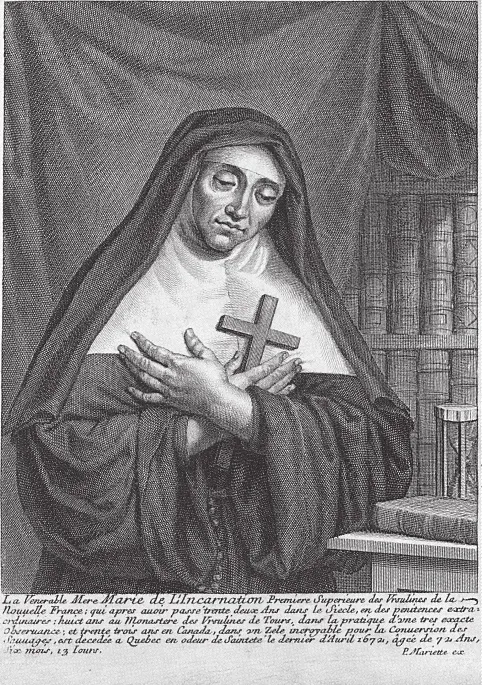
Moreover, when we read her autobiographical Relation de 1654 with her epistolary writing, which both she and her son treated as a single work, we can appreciate how she was able to satisfy the narrow definition of spiritual memoirs as authorized by the Church, and at the same time serve as a model to other women of her time who undertook a less orthodox approach to publishing their lives. Marie’s autobiographical voice, and the way in which it was edited by her son and interwoven with his own commentary, which he called “the filial echo” of her voice, would serve as a guide to other women who made the decision to write their life stories and who hoped to receive an approval from readers comparable to the response that Marie’s story had enjoyed.
The trajectory of Marie Guyart’s life that would lead her to a position of prominence in the history of Canada and of Catholic spirituality would have been difficult to predict when, in 1616, at the age of 17, she married the silk merchant Claude Martin in the provincial city of Tours. At 19 she was widowed and left alone with her infant son to help manage her brother’s family business. But an intense period of spiritual self-questioning followed, and within two years of her abrupt initiation into the world of trade Marie was secretly yearning for the refuge of a convent. Finally, at the age of 30, she managed to see her dream realized, and over the strenuous objections of her family (including her young son’s poignant pleas) she entered the Ursuline convent as a novice. Barely two years later she was professed as a nun.
Marie’s initial “departure” from the world into the circumscribed space of conventual life was the first in a series of leavetakings that she would come to see as patterning her life. The urge to quit her worldly life and focus on what she calls the “interior” life was also what precipitated, or facilitated, Marie de l’Incarnation’s entry into the world of writing. For Marie the act of writing seems always to have been fraught with an attendant anxiety about the vanity of any kind of verbal self-expression. But paradoxically, by moving out of the secular world and committing herself to religious life, in which the rule of modesty and silence would presumably be most strong, Marie found a freedom to write “from the heart” that she had not known before. This paradoxical “inner freedom” provided to women by cloistered life has been explored in recent years by scholars studying the writings of nuns from the middle ages to the eighteenth century.2 Established in France in the early seventeenth century, the Ursuline order promoted an approach to apostolic faith that was particularly congenial to a blending of the active and the contemplative life. Many Ursuline communities favored the taking of a special vow to promote Christianity through the teaching of young girls.3 Ursuline spirituality and the manifestations of mystical experience as described by Ursuline nuns were to incorporate the apostolic mandate of the order, just as that outward mission was to give heavy weight to the teachings of spirituality or the “inner way” to God.4
Writing and spiritual direction
In truth, Marie’s “coming to writing” may be traced to earlier influences in her life, and specifically to encounters with religious directors who encouraged her in her practice of mental prayer and reflection. Like many women of her generation, Marie was first exposed to the new practices of private devotion through reading François de Sales’s Introduction à la vie dévote. As a young woman she had listened raptly to the sermons of visiting prédicateurs, and been overwhelmed with the urge to speak about what she heard with others in her household.5 But describing her early religious education, Marie states that although her family was pious, she received no guidance in the “vie intérieure” until reading François de Sales (R 192). Then, in 1620, an incident occurred whose importance for her future development is marked in Marie’s Relation by its precise dating. The date would also become the inspiration for her choice of name in religion:
Après tous les mouvements intérieurs que la bonté de Dieu m’avait donnés pour m’attirer à la vraie pureté intérieure, en laquelle je ne pouvais entrer de moimême, n’ayant eu jusqu’alors aucun directeur, … sa divine Majesté voulut enfin elle-même me faire ce coup de grâce: me tirer de mes ignorances et me mettre en la voie où elle me voulait et par où elle me voulait faire miséricorde: ce qui arriva la veille de l’Incarnation de Notre-Seigneur, l’an 1620, le 24e de mars. (R 181)(After all the inner promptings which the goodness of God had granted me to draw me to true purity of soul, which I could not reach through my own efforts, not having had any director until then, his divine Majesty himself wanted to deliver the coup de grâce. He pulled me from my ignorance and placed me on his chosen path, taking pity on me: this happened on the eve of the Incarnation of Our Father, in the year 1620, on the 24th of March.)
Walking in the street she is overwhelmed by a sense of her own culpability, and she wanders as though in a trance, until she finds herself in front of the chapel of the Feuillant Fathers, where she enters and pours out her soul to a startled priest:
Après que j’eus tout dit, je vis que ce bon Père avait été grandement surpris de la façon de m’annoncer et de lui dire ainsi tous mes péchés, et de ma façon, qu’il connut n’être pas naturelle mais extraordinaire. Il me dit avec une grande douceur: “Allez-vous-en, et demain me venez trouver dans mon confessional.” (R 184–5)(When I had finished I saw that the priest was astonished by the way I had introduced myself and poured out my sins in this unusual way, and by my manner which he knew was not normal but out of the ordinary. He spoke to me very gently, saying, “Go home now and come back to see me tomorrow in my confessional.”)
Thus Dom François de Saint-Bernard became Marie’s first religious director, and his “regulation” of her confessions gave form to her inner explorations, convincing her most importantly of the necessity of dialogue as a means of spiritual advancement. This account is paradigmatic for the historian, dramatizing as it does one individual’s discovery of the power of private confession, at a moment in French history when this practice was just beginning to be widespread.6 Marie situates the point of origin of her religious conversion and spiritual identity in this initial turning to a private space for intimate confession (beginning with Dom François’s directing her to the confessional). The space of the confession-box was in fact a new configuration in Catholic ritual practices at the beginning of the seventeenth century, and Marie took to the new practice of the guided examen de conscience with a zeal that was remarkable to her religious directors.7
Marie’s spiritual directors quickly expanded their demands on her substantial talents for self-expression. After Dom François, she was assigned to another Feuillant monk, “homme grandement spirituel,” she writes, “et experimenté en la conduite des âmes … Il m’interrogea sur ma façon de vie, et généralement il me voulut connaître à fond” (R 193). Versed in new methods of spiritual direction, it was Dom Raymond who first asked Marie to account for herself in writing, in the form of regular letters addressed to him.8 Like her account of discovering the attraction and relief of private confession, Marie’s account of her initiation to the practice of the written examination of conscience provides a valuable historical example. Many pious women were similarly drawn to reflect on their lives in writing during the first part of the seventeenth century, to a point that was alarming to certain clerics who would later publish arguments against the circulation of confessional and spiritual writings by women.9
Marie was at times a more enthusiastic apprentice than her director would have wished. At one point Dom Raymond had to dissuade her from a determination to sharpen her humiliation by posting a signed, confessional letter on the door of the church, “à ce que tout le monde sache qu’elle [mon âme] a été si déloyale à son Dieu” (R 212). And though Dom Raymond had commanded her to “tell him everything” (R 193), it appears that he sometimes got more than he bargained for. Some of her letters respond to his criticism of what he saw as Marie’s excessive desire to tell all:
… un désir comme le mien ne peut long-temps garder le silence; il se réitère sans cesse et j’ai toujours de nouvelles choses à dire …Mortifiez-moi donc tant qu’il vous plaira, je ne cesserai point de vous déclarer les sentimens que Dieu me donne, ni de les exposer à votre jugement …10(… a desire such as mine cannot long remain silent; it repeats itself endlessly and I always have new things to say … Mortify me then, as long as you like, I will not stop telling you of the feelings God gives me, nor will I stop exposing them to your judgment …)
But at times, too, in a move that was not unusual in relations between directors and their protégées, it was Dom Raymond who seemed to be the follower and Marie the giver of spiritual advice.11 Dialogues with her directors seem to have given Marie an outlet for her urge to proselytize as well as her desire to be guided. When in 1631 she entered the Ursuline convent, she was given the responsibility of teaching the younger novices. In her life story she notes the facility with which she was able to do this, and the pleasure that it gave her to express herself in teaching. Her director told her to write down her thoughts on religious instruction (later, these were published by her son under the title L’Ecole sainte). In these encounters early in her career, the role played by her directors was in no way limited to an instructional one, with Marie as pupil. Marie quickly assumed an active role in forming and shaping these connections that she saw as so crucial for her spiritual advancement. When Dom Raymond was called away from Tours in 1638, she decided that she wanted a Jesuit for her next director, and upon hearing the sermons of the Jesuit priest Georges de la Haye, she asked her superior for an introduction. Their first conversation had an immediate effect:
Lorsqu’il m’eut entendue, il m’obligea de lui écrire la conduite de Dieu sur moi dès mon enfance et enfin tout ce qui s’était passé dans le cours des grâces qu’il avait plu à la divine Majesté de me faire. J’eus permission de ma supérieure; mais il me vint une répugnance de le faire, si je n’écrivais aussi tous mes péchés et imperfections de toute ma vie … à ce que, par ce moyen, il jugeât mieux de ma disposition. J’eus permission et le fis avec [la] plus grande fidélité qu’il fût possible, puis je mis le tout entre les mains dudit R.P., lequel ensuite m’assura que ç’avait été le Saint-Esprit qui m’avait conduite … (R 298)(When he had heard me, he asked me to write to him about God’s direction of me since childhood, and about all that had occurred during the series of blessings that it pleased his Divine Majesty to bestow on me. I had the permission of my superior; but it repelled me to do it if I did not at the same time write of all my sins and imperfections during my life … so that in this way he would be better able to judge my state. I received permission and did ...
Table of contents
- Cover
- Half Title
- Title Page
- Copyright Page
- Table of Contents
- Acknowledgements
- List of Figures
- Introduction
- 1 Discovering New Worlds: Marie de l’Incarnation and the Process of Autobiography
- 2 Public Sanctity and Private Writing: The Autobiography of Jeanne des Anges
- 3 Silent Communications: The Life and Letters of Jeanne Guyon
- 4 Scripting Errant Lives: The Memoirs of Hortense and Marie Mancini
- 5 Overheard Conversations: Madame de Villedieu’s Autobiographical Fictions
- Conclusion
- Bibliography
- Index
Trusted by 375,005 students
Access to over 1.5 million titles for a fair monthly price.
Study more efficiently using our study tools.
Frequently asked questions
Yes, you can cancel anytime from the Subscription tab in your account settings on the Perlego website. Your subscription will stay active until the end of your current billing period. Learn how to cancel your subscription
No, books cannot be downloaded as external files, such as PDFs, for use outside of Perlego. However, you can download books within the Perlego app for offline reading on mobile or tablet. Learn how to download books offline
Perlego offers two plans: Essential and Complete
- Essential is ideal for learners and professionals who enjoy exploring a wide range of subjects. Access the Essential Library with 800,000+ trusted titles and best-sellers across business, personal growth, and the humanities. Includes unlimited reading time and Standard Read Aloud voice.
- Complete: Perfect for advanced learners and researchers needing full, unrestricted access. Unlock 1.5M+ books across hundreds of subjects, including academic and specialized titles. The Complete Plan also includes advanced features like Premium Read Aloud and Research Assistant.
We are an online textbook subscription service, where you can get access to an entire online library for less than the price of a single book per month. With over 1.5 million books across 990+ topics, we’ve got you covered! Learn about our mission
Look out for the read-aloud symbol on your next book to see if you can listen to it. The read-aloud tool reads text aloud for you, highlighting the text as it is being read. You can pause it, speed it up and slow it down. Learn more about Read Aloud
Yes! You can use the Perlego app on both iOS and Android devices to read anytime, anywhere — even offline. Perfect for commutes or when you’re on the go.
Please note we cannot support devices running on iOS 13 and Android 7 or earlier. Learn more about using the app
Please note we cannot support devices running on iOS 13 and Android 7 or earlier. Learn more about using the app
Yes, you can access Publishing Women's Life Stories in France, 1647-1720 by Elizabeth C. Goldsmith in PDF and/or ePUB format, as well as other popular books in Letteratura & Critica letteraria. We have over 1.5 million books available in our catalogue for you to explore.