eBook - ePub
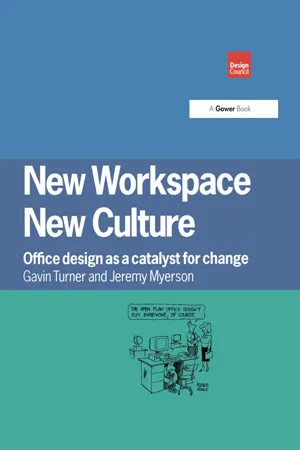
New Workspace, New Culture
Office Design as a Catalyst for Change
- 144 pages
- English
- ePUB (mobile friendly)
- Available on iOS & Android
eBook - ePub
About this book
The physical structure and appearance of the workplace determine how we function, how we communicate and collaborate, our motivation levels and company performance, but we often fail to recognize the vital connection between organizational culture and the work environment. Based on the authors' first-hand experience of major change programmes, on studies of offices around the world, and on design management research at De Montfort University, Leicester, this book explains the underlying principles of office design and its effects on cultural change and performance. Part 1 analyses the context and environment of working life, the drivers of change and the barriers - organizational, psychological and structural - to better working practices. Part 2 explores how traditional structures can be rethought and adapted through the reorganization of the workplace and the removal of physical barriers to change. It identifies four typical and disturbingly familiar work environments - Monolith, Makeshift, Modernizer and Mould-Breaker - to help companies understand their current problems and how to solve them. Part 3 introduces six proven workplace layouts: Town Square, Village Neighbourhood, City in Miniature, Space-time Machine, The Campaign Room and the Club; and explains their relative benefits for companies' different needs. These are brought to life with international case studies from the public and private sector which describe how leading organizations have benefited from improved working environments. New Workspace, New Culture is illustrated by the Financial Times cartoonist, Roger Beale. It also includes line drawings of office layouts, and photographs of some of the most productive working environments in the world. This book will help senior management and human resource specialists develop the way people work by changing the working environment. Also, designers, architects, and facility and property managers will find it a perceptive and logical guide to wha
Part One
Reviewing the context
’There is nothing more difficult to arrange, more doubtful of success and more dangerous to carry through than initiating changes.’
Machiavelli, The Prince
1
The change we face
Technological and attitudinal shifts leave no organization unscathed
At the turn of the twentieth century, the world of work in general but of office work in particular is in a state of enormous change and uncertainty. This change is driven directly or indirectly by technology, which has transformed basic office functions, cutting a swathe through clerical ranks and eliminating the role of many middle managers. Technology also enables people to work at home or in other places remote from their colleagues. In Britain there are already one million employed and self-employed teleworkers who would have occupied 11 million square metres (almost 120 million square feet) of commercial offices - representing a saving in rent and business rates of £1.2 billion. Today’s 20 million teleworkers worldwide are expected to increase to 200 million within the next 20 years. This has enormous implications for the design of the environments in which office workers once congregated during set hours to work.
Technology is crucial to productivity in factories and offices alike. Productivity has intensified international competition, as have modern communications with their impact on the globalization of markets. The Internet is further changing the nature of competition, and within a relatively short time will probably totally transform many businesses - for example, the delivery of recorded music through the Internet may kill off the substantial retail record business.
The pressure of competition has led many businesses to focus on administrative costs - especially those related to property - which had been more or less unquestioned in the past. Cost-cutting has had alarming effects within once stable organizational structures, and has largely destroyed traditional job security. For some years now we have lived with sensationalist magazine headlines and book titles proclaiming The Death of the Job’ or The End of Work’.
The unemployment of qualified staff has driven them into new forms of consultancy and contracting, often selling back to their former bosses services which they once performed in-house. Economies of scale are now achieved through networks of service alliances rather than through the vertical integration of once highly centralized corporations.
A new social order at work
Enthusiasm for and facility with new technologies among younger people have undermined the value of seniority and experience at work. There is also less automatic deference to authority generally - which has its roots in changes in the family background and the educational process. As a generalization, young people are much less obsessed with status and security than their parents’ generation, and much more focused on the interest of the work and its financial rewards.

The immense earning power of some young salespeople and financial service dealers has played havoc with traditional salary scales and notions of career progression. Loyalty and stability have been undermined both by draconian shake-outs and by the much more flexible job market in which young people are skilled in a range of new disciplines. A more fluid social and cultural mix, more heterogeneous political beliefs, and a questioning of established gender roles and sexual attitudes (with the increase in the proportion of women at work) have created new freedoms, but also new social tensions within organizations.
A generational catalyst
The greater freedom, the high earning power, and the job interchangeability enjoyed by skilled young people are beginning to have a wider impact on the shape of traditional organizations than is yet fully apparent. In many of the newer industries which are most attractive to young people - such as entertainment, advertising, design, public relations, IT, management consulting, and the new financial services - the creative work is done by and the agendas are often set by the youngest people in the organization.
Where skill in new technologies, enthusiasm, intuition, and risk-taking are pitted against an experience which is often out of date in this world transformed by technology, mere experience is often found wanting. Young people are less and less willing to work in the more traditional organizations where their voice is not heard and where managers are more interested in playing internal power games within the surviving hierarchies than in genuine lateral thinking to face external market challenges.
Large, inflexible, hierarchical organizations are especially vulnerable to change, can no longer guarantee any real job security, and have been among the most ruthless in ‘downsizing’ people and property to stay in business. So what can they offer the best young brains coming on to the job market? Clearly, either traditional management structures (and traditional working environments with them) must change, or it will be increasingly difficult to recruit the most able ‘knowledge workers’. These people will opt for self-employment or small start-up ventures where their contribution will be more highly valued. Already 50 per cent of men under 45 would prefer to be self-employed.
Finding the right solutions
Faced with this bewildering array of technological and attitudinal change, many managers attempt to resist whenever possible; but an increasing number of others run after any new trend and management fad, merely adding to the sense of dislocation and confusion amongst their staff. Meanwhile, management gurus make millions out of stating the obvious: that it is fairly chaotic out there, and that the old rules no longer apply. The change we face today will not slacken its pace over the next 20 years. Indeed it is most likely to accelerate at the nexus between technology push and consumer pull. To manage change successfully, businesses will need to pull every lever of influence available to them: the physical office setting is an obvious lever for change, but an overlooked one.
Some of the difficulties outlined may be unique to our age and its new technologies, but many are old problems in a new context. Poor communication and strained working relationships were contained or even obscured by the ponderous but predictable mechanisms of the traditional bureaucracy; but in the de-layered and thinned-down corporations of today, they are often cruelly exposed.
Like all other professional consultants who have serviced the mutating commercial organizations of the 1990s, workplace designers and space-planners have struggled to find solutions which adequately reflect the nature of the changes taking place. Too often, radically evolving companies have been forced into traditional buildings and office floor layouts which no longer match their new and different, technologically driven work processes. Too rarely have senior managers standing on the foothills of a major change programme recognized that the design of the office environment is an essential part of the landscape of business change - and that by ignoring the physical surroundings, they are missing a vital trick. But, as we shall see, perhaps some of the barriers are physical and can be knocked down and replanned. The key problems may not be as complex as they seem, and we may find the solutions to be simpler and less technical than some of those that management gurus would foist upon us.
2
Adapting to survive
Finding the right culture to cope with the future
Organizations have always had to face change of one sort or another - the difference today is the speed of transformation. In this context, how individuals within companies react to shifting conditions is essential to the ability of those organizations to cope. Much management behaviour has always been either intuitive and based on very fundamental personal characteristics, or imitative and modelled on a powerful individual colleague or mentor early in one’s career. Developmental psychologists believe that most children have their value systems firmly in place by the age of ten. Genetic givens, early environment and our interaction with early models (parents, teachers, childhood friends) shape our personality and social behaviour in later life.
Though we enter the organizations where we work well past the age of ten, similar patterning processes probably determine our instinctive behaviour within the world of the organization as well. Yet organizational theorists often seem to assume a rationality in the way we behave at work which has little to do with that conditioning. There have been a number of pseudo-scientific change management theories in business - like Total Quality Management and Business Process Re-Engineering - which focus on process improvement. These can be dangerously mechanistic when applied to organizations - where success depends significantly on the quality of human relationships.
Power and control
The formal study of management and organizational behaviour is largely a twentieth-century discipline, closely related to Modernism and the application of industrial design and industrial process analysis to the wider world of work (see Chapter 4). But as far back as the Renaissance, with Machiavelli’s The Prince, and certainly in the nineteenth-century literature of Dickens and his peers, we can see that earlier generations were also fascinated by the means through which individuals exercise and often misuse power over others within organizations.
Nor are many of the current trends all that new. The medieval church controlled one of the largest multinational corporations the world has ever known, with the flattest of hierarchies. The workshops of medieval guilds probably displayed many of those qualities of leadership, mentoring and teamwork that we are now struggling to recover. Even now there are still organizations in which top management rules by fear and line managers are terrorized by senior executives or corporate service managers in tightly controlled structures that offer little individual freedom. Other successful businesses operate with a very relaxed and self-deprecating style of management, with extreme delegation and much encouragement of individual initiative.
The human element
The point is that theorists frequently underestimate the extent to which personal factors affect both our behaviour at work and our views about how work should be structured and managed. W. Edwards Deming, the champion of the quality movement, believed that human factors accounted for only about 15 per cent of organizational problems, and that managers should concentrate on the 85 per cent of process problems. Yet as long ago as Roethlisberger and Dickson’s Hawthorne studies in 1932, American research showed that the quality of interpersonal relationships was a key factor affecting morale and productivity. Now that sophisticated information technology is increasingly resolving many of the process problems, a new focus needs to be brought to bear on the problems of human relations.
Another celebrated American, the jurist Oliver Wendell Holmes, used to speak of digestive jurisprudence - by which he meant that our personal moods and professional behaviour are inextricably linked, and are significantly affected by relatively trivial issues of day-to-day well-being and comfort - never mind more serious personal crises. If a judge or jury had a good breakfast, they were more likely to dispense justice with impartiality and equity.
The recent revitalization of the British truck-maker Ley land, once the lame duck of a highly competitive European industry, gives an insight into looking afresh at the human dimension of work. The company was all but written off by analysts when a management buy-out rescued it from receivership from its parent company DAF NV in the early 1990s. From the early 1970s onwards, Leyland had been through something like 25 different change management programmes, according to chief executive John Oliver, one of the buy-out team, and nothing had reversed its decline. But the turning-point came when Oliver and his colleagues recognized that it wasn’t systems or structures that needed changing at Leyland, but the attitudes of people. A new programme called Lean Enterprise (later renamed Team Enterprise) was instigated with the slogan ‘empowered people working towards mutually beneficial objectives’. The results were dramatic. A modest first-year investment of just £30,000 in this new programme, for example, yielded savings in operating costs of £10 million.
With a focus on autonomous work groups, more horizontal management and ideas generation, the workforce became more motivated and the organization more responsive. Leyland the loss-maker turned into a profitable, leading-edge manufacturer. Oliver recently told a London conference: ‘With Business Process Engineering, Total Quality Management and so on, we found they only work to a degree, they cost a fortune and they take too long to deliver. Changing systems and structures is elegant, intellectually challenging and they don’t answer back. But people are the real obstacles.’ (Elmwood Advantivity Conference, 21 May 1997)
Practising managers will recognize this simple truth. They know all too well how personal moods and characteristics can become disruptive and frequently provide a focus for undue management time and attention. We are naive if we believe that technology can solve these traditional problems - indeed, with its encouragement of remote communication rather than the direct reading of body language, it is even creating some new ones. It is also increasing the scope for destructive as well as constructive communication: individuals who used to circulate snide minutes and reports belittling the work of colleagues now have an even more potent weapon in the e-mail system - a new toy for corporate bullies.
At home at the office
While Leyland Trucks and other organizations show how the human dynamics of organizational life are ignored at your peril, it is undeniable that the old, fixed ‘social contracts’ of office life are breaking down. Technological and attitudinal change at work have begun to blur the distinctions between office and home. More and more people will probably work exclusively or partly at home - as corporate administrative and real estate costs rise, and as the cost and inconvenience of commuting and changing patterns of family life make it more advantageous.
A recent advertising campaign for AT&T captured the paradox of these intertwining worlds. It featured a greying executive, titanium spectacle frames glinting in the sun, observing that: ‘When I’m in the office, I think about the family. When I’m at home, I think about work. This can’t be right.’ Perhaps it can be. The strict separation between work and home lives is largely a creation of the industrial, commercial and transport revolutions of the late nineteenth century. Today we find the redundant offices, warehouses and dock buildings of that era being converted into loft apartments, or increasingly into combined living and working spaces for young professionals, artisans and artists, their families and associates.
New fashions in interior design are starting to suggest that the distinctions between the office and domestic domains - in furniture, lighting, materials, technology and so on - may no longer be meaningful. But whilst new styles of home working and new furnishing agendas may be raising questions about office design, there are also, as we have seen, huge changes in the social mechanics of organizations which provide rather more fundamental reasons for rethinking the office environment.
Looking for the right models
It is, of course, impossible to generalize about organizational structures, which are so diverse. One of the problems for traditional organizations is that much self-improvement management literature is dense and unreadable, written in the impenetrable jargon of the American business school. Other solutions are so off-the-wall that it is virtually impossible to relate their examples and case studies to the experience of administrators in the more conventional office. Managers in the more traditional companies who want to get where Tom Peters is, for example, may feel that the cultural gap is just too large for their organization, and may actually be put off by his words of intended encouragement.
Our own analysis and those of others suggests that many of the structural and attitudinal barriers to change start right at the top of the management tree. The main reason why organizational transformation is so difficult, when some of the solutions are obvious enough and relatively easy to achieve, is that some of those with the levers of power actually enjoy power, its privileges and outward trappings, and appear to have little incentive to initiate change. In fact, if they could only see it, their companies would perform better, and their bonuses and share options would be even more valuable, if they created a much more open and flexib...
Table of contents
- Cover
- Half Title
- Title
- Copyright
- Contents
- Acknowledgements
- Introduction
- Part One Reviewing the context
- Part Two Rethinking the culture
- Part Three Redesigning the environment
- References and bibliography
- Index
Trusted by 375,005 students
Access to over 1.5 million titles for a fair monthly price.
Study more efficiently using our study tools.
Frequently asked questions
Yes, you can cancel anytime from the Subscription tab in your account settings on the Perlego website. Your subscription will stay active until the end of your current billing period. Learn how to cancel your subscription
No, books cannot be downloaded as external files, such as PDFs, for use outside of Perlego. However, you can download books within the Perlego app for offline reading on mobile or tablet. Learn how to download books offline
Perlego offers two plans: Essential and Complete
- Essential is ideal for learners and professionals who enjoy exploring a wide range of subjects. Access the Essential Library with 800,000+ trusted titles and best-sellers across business, personal growth, and the humanities. Includes unlimited reading time and Standard Read Aloud voice.
- Complete: Perfect for advanced learners and researchers needing full, unrestricted access. Unlock 1.5M+ books across hundreds of subjects, including academic and specialized titles. The Complete Plan also includes advanced features like Premium Read Aloud and Research Assistant.
We are an online textbook subscription service, where you can get access to an entire online library for less than the price of a single book per month. With over 1.5 million books across 990+ topics, we’ve got you covered! Learn about our mission
Look out for the read-aloud symbol on your next book to see if you can listen to it. The read-aloud tool reads text aloud for you, highlighting the text as it is being read. You can pause it, speed it up and slow it down. Learn more about Read Aloud
Yes! You can use the Perlego app on both iOS and Android devices to read anytime, anywhere — even offline. Perfect for commutes or when you’re on the go.
Please note we cannot support devices running on iOS 13 and Android 7 or earlier. Learn more about using the app
Please note we cannot support devices running on iOS 13 and Android 7 or earlier. Learn more about using the app
Yes, you can access New Workspace, New Culture by Gavin Turner,Jeremy Myerson in PDF and/or ePUB format, as well as other popular books in Business & Business General. We have over 1.5 million books available in our catalogue for you to explore.