- 248 pages
- English
- ePUB (mobile friendly)
- Available on iOS & Android
eBook - ePub
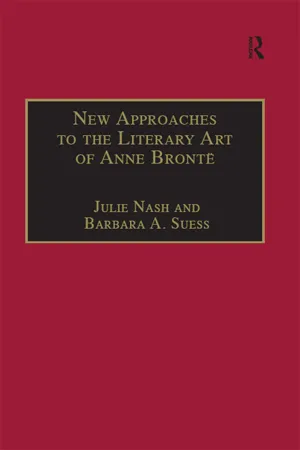
New Approaches to the Literary Art of Anne Bronte
About this book
This new essay collection brings together some of the top Brontë scholars working today, as well as new critical voices, to examine the many layers of Anne Brontë's fiction and other writings and to restore Brontë to her rightful place in literary history. Until very recently, Brontë's literary fate has been to live in the critical shadow of her older sisters, Charlotte and Emily, in spite of the fact that her two published novels, Agnes Grey and The Tenant of Wildfell Hall were widely read and discussed during her lifetime. From a variety of fields-including psychology, religion, social criticism and literary tradition-the contributors to New Approaches to the Literary Art of Anne Brontë re-assess her works as those of an artist, which demand the rigorous scholarship and attention that they receive here.
Information
Chapter 1
Contextualizing Anne Brontë’s Bible
‘What, Where, and How Shall I Be When I Have Got Through?’1 With this not-so-simple question before her, Anne Brontë embarked on a mission to read and study the Bible. Her notes indicate that her project was ‘begun about December 1841’. Twenty years old, Brontë was likely at the time to have been working as a governess for the Robinson family of Thorp Green, although contemplating a permanent return home to establish a school with her sisters. Although she had begun to write poetry, both on her own and as part of the collaborative project known as the Gondal and Angrian Chronicles, it would be six more years before she published her first novel, Agnes Grey. All that we now know of this Bible-reading project is what can be deduced from the notes made on the Bible’s flyleaves. She evidently worked her way through the entire text of the Old Testament, diligendy noting the chapters and verses of particular interest to her. The first such entry notes passages from the Book of Deuteronomy, and the last from the Book of Malachi. The end page is dated ‘April 30, 1843’, and is followed by a passage from the Book of Proverbs (16.23), which reads, ‘A man hath joy by the answer of his mouth and a word spoken in due season. [H]ow good is it’.
Biographers have long acknowledged that information about Anne Brontë’s life is scant. As Juliet Barker writes in her introduction to The Brontës, a family biography, ‘Though many have tried, it is impossible to write an authoritative biography of either of the two youngest Brontë sisters. The known facts of their lives could be written on a single sheet of paper; their letters, diary papers and drawings would not fill two dozen’ (xviii). Even Edward Chitham, author of A Life of Anne Brontë, acknowledges that ‘there are few documents directly relating to the life of Anne Brontë which could rank with the kind of primary sources usually studied by biographers’, and concludes that ‘we have to look elsewhere for ways to build up a picture of Anne Brontë and her life’ (5–6).
Anne Brontë’s Bible is evidendy one such place, although commentators of her life and writing, including Chitham, have overlooked it. Given the sensitivity of Brontë’s biographers to the importance of primary source evidence, it is especially perplexing that her Bible notes, which clearly constitute a sort of primary source evidence, have for so long gone unstudied. One explanation for this apparent lapse is that the Bible is housed not at Haworth Library, which holds most of the materials relevant to Brontë’s life, but rather at the Pierpont Morgan Library in New York City. Perhaps more importandy, though, the notes on the flyleaves do not lend themselves to obvious interpretation. Brontë did not annotate the notes with commentary to clarify what the particular chapters and verses meant to her; rather, she simply listed chapters and verses, occasionally indicating special emphasis by underlining or writing ‘esp.’ for especially. Yet even this descriptive fact about her efforts and methods is potentially significant This essay will suggest a few of the ways that the Bible notes might prove enlightening.
On the most basic level, Brontë’s efforts to study the Bible reveal one of the ways that religious belief was practiced in Victorian England. As an apparently private pursuit, her project can give students of the period a glimpse into one of the ways that religious belief was expressed and practiced – that is, the everyday phenomenon of religiosity that tends to be overlooked by historical accounts, stressing as they do the public and institutional mechanisms for the expression of belief. As Robin Gilmour has written, ‘religious experience in this period should not be confined to what happened or did not happen in churches and synagogues. William James’ Varieties of Religious Experience (1902) is a much better title for a study of Victorian religion than that old music-hall turn, Faith and Doubt’ (94). Even scholarly works sensitive to the need to address the variety of religious beliefs and practices of ordinary people tend to concentrate, Gail Malmgreen explains, ‘not on the interior world of belief, but on the public expression of religion, and on religion as an engine of social action’ (8). Brontë’s study of the Bible exemplifies both a ‘variety of religious experience’ and the kind of private practice to which Malmgreen here refers, and suggests one of the ways that an individual’s ‘interior world of belief’ was exercised and shaped.
The significance of Brontë’s Bible is not just limited to what it reveals about variations of Victorian religious experience and history; it enables one to arrive at a more sophisticated understanding of her personal religiosity than that currently available in scholarship about her. For reasons I will examine in more detail in this essay, Brontë scholars have treated Anne Brontë’s religion rather reductively. Only recently have they begun to critique the received versions of Brontë’s religion, which depicts her as quietly pious and distinctly orthodox in her beliefs. Brontë’s Bible study has implications both for our understanding of Victorian social history and for Brontë’s personal history. Although seemingly separate, these threads in fact converge through a shared emphasis on the boundaries between obedience and initiative and the role of the individual in achieving a kind of self-reformation.
Contextualizing Brontë’s Bible Study
No social or intellectual history of the Victorian period is without an extensive section on religion, and although an adequate summary of the vast literature on the topic is beyond the purview of this essay, it is clear that Anne Brontë’s Bible study belongs to a particular historical moment in the religious experience of her nation. ‘The religious life of this period was intense and disputatious’, Gilmour writes, ‘and its problematic presence can be felt wherever we look in nineteenth-century literature’ (63). Brontë lived and wrote precisely at the time that many of the most public manifestations of religious crisis emerged, with attempts at the reformation of the structure of the Church of England, conflicts with Dissenting or Nonconformist churches, and reaction to German historical criticism of the Bible being three of the most often-cited examples of the alleged crisis. More pervasive, if less difficult to pin down, is the evangelical temper associated with this period, one linked as inextricably, Richard Altick shows, to a middle-class ethos and the rise of industrialism as to distinctions between ‘high church’, low church’, and ‘broad church’.2.
Adding another dimension of complexity to this moment in Britain’s religious history is, of course, the concomitant and relatively rapid development of many areas of science. Many literary historians have seen in these developments, particularly in advances in geological findings during the first half of the century, a source for the expressions of religious doubt that seem to accrue throughout the literature of the period and that provide a backdrop to expressions of faith. Advances in scientific understanding complicate considerably the version of religious life that would exist were one to examine only early Victorian conflicts within sects associated with definitions of low, broad, and high church. Nevertheless, as Gilmour persuasively argues of ‘first-generation Victorians’, which would include Anne Brontë:
It has become increasingly clear that their objections to Christianity were overwhelmingly moral, objections to certain key doctrines of evangelical religion in which some had been reared but all had experienced in the religious culture of the time. The Atonement, chiefly, hell, everlasting punishment, original sin – a God who required the obedience of his creatures on those terms was a God who did not deserve worshipping.…’ (87).
Although Brontë cannot be said to belong to a group of early- to mid-Victorians ‘object[ing]’ to Christianity, she clearly did concern herself with the very concepts and doctrines that Gilmour lists here, perhaps most significantly, as her Bible notes suggest, with the nature of obedience. And, while her Bible study does not reveal a movement from faith to doubt or vice-versa, it does suggest an urge to learn about and think through for herself the doctrines that occupied public debate.
Despite the insights that social historians have made about religious belief in Victorian England, it is difficult to further contextualize Brontë’s project because relatively little is known about institutionalized or private Bible study in nineteenth-century England. Popular works of Biblical commentary by Richard Mant and George D’Oyly were published and updated well into the Victorian period, as was Thomas Hartwell Home’s 1818 Introduction to the Critical Study and Knowledge of the Holy Scriptures. These are the types of works to which, for example, major public figures such as William Gladstone turned when they embarked on a systematic study of the Bible.3 Little information exists within Brontë family history, however, to help us place Anne’s Bible study relative to that which other family members may have conducted, or to understand what motivated her to undertake her reading at this particular moment in her life. Beginning at roughly the same time she commenced her position as a governess at Thorp Green, she may have anticipated reading and studying the Bible with the children under her care. One might similarly speculate that she sought in Biblical passages solace while in a difficult and isolating situation. Nevertheless, nothing about her Bible study is mentioned in her 1841 diary paper nor in anything else I have discovered by or about Anne Brontë. It was apparently undertaken in private and, like so much about Brontë’s work, has gone unrecognized by biographers and critics as well.
One can safely assume that Brontë’s study of the Bible reflects a desire to achieve a more thorough understanding of the scriptures than she presumably got through listening to Sunday sermons or through discussions with her family members. Her pursuit implies as well that she assumed personal responsibility for her relationship with God, an idea that was at the heart of Anglican Evangelicalism.4 Both Anglican Evangelicals and Methodists argued for the individual right – even duty – to read and study the Bible for one’s self. As Christine Krueger writes,
Attacking the mystification of scripture that demanded of ‘legitimate’ readers expertise available to a select few, they maintained that God would reveal to babes what he concealed from the wise. Indeed, scripture itself imposed on the individual a duty to attend to that Word, the authority to interpret it, and the duty to spread it – to speak for God. (8)
Many Victorians embarked at various points in their lives on relatively systematic studies of the Bible in the spirit that Krueger here summarizes. Suggesting the centrality of Bible study to the evangelical mood that characterized the first half of the century, Altick notes that the ‘Bible, interpreted with utmost literalism, was the supreme guide to conduct’ (165-66). ‘In addition to a common literary and argumentative vocabulary’, he writes, ‘the Bible provided the accepted cosmogony, a considerable part of ancient history as it was then known, and above all the foundations of his morality’ (203). It is in the end fruitless to try to ascertain with more precision Brontë’s motivations in undertaking this project or to determine with any precision the gradations of influence that Methodism and Anglican Evangelicalism had on her own beliefs – or, for that matter, attitudinal differences toward Bible study within these groups. Nevertheless, it is apparent that Brontë, like most of the general educated public, was steeped in this dimension of her cultural heritage. The extensive notes jotted down on her Bible’s flyleaves should be understood as a manifestation of this cultural heritage.
Anne Brontë’s Religion
The notes help one to appreciate the complexities of Brontë’s personal history as well. Anne has long been considered the most pious of the sisters; as her sister Charlotte herself put it, ‘She was a very sincere and practical Christian, but the tinge of religious melancholy communicated a sad shade to her brief, blameless life’ (qtd. in Chitham 136).5 Although Brontë may have been devout compared to her sisters, she cannot be said to have had a straightforward, untroubled religious life. One of the most obvious examples of her need to think through her religious understanding occurred late in 1837 or early in 1838 when she was living at the Roe Head school. Collapsing physically, Brontë experienced what today would be thought of as a psychosomatic crisis, one with distincdy ‘religious overtones’ (Chitham 52). During this episode, she consulted, evidendy on several occasions, the Moravian minister James la Trobe. Existing records of their encounters indicate that Brontë and la Trobe conversed about the Bible. As summarized in Chitham’s biography, la Trobe
found her ‘very well acquainted with the main truths of the Bible respecting our salvation’, but evidendy Anne saw Bible precept as a series of requirements rather than ‘God’s gift in His Son’. Her heart, however, ‘opened to the sweet views of salvation, pardon and peace … and welcome to the weary and heavy laden sinner, conscious more of her noting loving the Lord her God than acts of Enmity to Him’. (54-55).
Chitham concludes that ‘for the evangelical Anne, this encounter may have provided a conversion experience, after which she could discard her theological worry’ (55). Yet, given the intensity with which she later approached the Bible as an object of study, it seems more sensible to view the la Trobe episode as one stage in the intellectual development of her religious belief. One might also reason that when Brontë embarked on a study of the Bible in 1841, it was not to acquaint herself with supposed Biblical truths. Already well-schooled in basics, as the la Trobe episode indicates, she would instead be studying at a more rigorous level of thinking.
A second point in Brontë’s personal history that illustrates the complexity of her religious experience and adds credence to the notion that her beliefs evolved throughout her life occurred in 1848, shortly before she died. A Liverpool minister, Dr. David Thom, had written to her (as Acton Bell) to respond to some of the religious ideas expressed in her writing. ‘A Word to the Elect’, an anti-Calvinist poem of Brontë’s, had appeared in Poems by Currer, Acton, and Ellis Bell (1846), for example, and her second novel, The Tenant of Wildfell Hall (1848), revealed some of Brontë’s thoughts on the issues of sin, eternal damnation, and universal salvation. Thom’s original letter is not extant, but her response, dated 30 December 1848, is enlightening. In it, Brontë wrote of the doctrine of universal salvation, writing that she embraced it ‘with a trembling hope at first, and afterwards with a firm and glad conviction of its truth’. Continuing, she explains, ‘I drew it secretly from my own heart and from the word of God before I knew that any others held it’ (qtd. in Barker 580). Her letter suggests, then, the importance of the process through which her beliefs developed over time as they were shaped and validated by her reading. They were the result of both feeling and thought – specifically, apparendy, study of what she believed to be God’s word as expressed through the Bible.
Despite the complexities suggested by these and other aspects of Brontë’s experience and writing, scholarship on her religious beliefs has focused reductively on ascertaining Calvinist or Wesleyan leanings within her Methodist heritage. In an article on Brontë’s feminism, for instance, Marion Shaw contrasts Brontë’s religious beliefs to those espoused by the fictional character of Mr Brocklehurst, the horrifically mean Calvinist Methodist who appears in Jane Eyre. Describing Brontë as ‘an Arminian Methodist’, Shaw contends that in ‘this milder form of evangelicalism, she stands as a mediator between Calvinist determinism and Romantic naïveté’ (127). Much of the effort exerted to pinpoint Brontë’s beliefs has depended, in turn, on imprecise understandings of the extent to which she may have been influenced by three central figures in her life: 1) her Aunt Branwell, who has been unfairly associated with a hellfire-and-brimstone type of Calvinism; 2) her mother, Maria Branwell, who died when Brontë was an infant but whom Brontë would nevertheless have come to associate not with her mother’s Methodist upbringing but with the more moderate beliefs of the Church of England which she had joined; and 3) her father, the Reverend Patrick Brontë, for whom ‘belief in conversion, the mainspring of Evangelical teaching’ was a ‘cornerstone’ of life (Barker 44), but who was formally affiliated with an Anglican church and is known to have preached his belief in the essential goodness and infinite mercy of God.
When Brontë biographers and critics have moved beyond assertions of these influences, they have typically sought to locate within her poetry and fiction evidence of particular religious concerns, with poems such as ‘Self-Communion’ and ‘A Word to the Cal...
Table of contents
- Cover
- Half Title
- Title Page
- Copyright Page
- Table of Contents
- General Editors’ Preface
- Preface
- Acknowledgements
- 1 Contextualizing Anne Brontë’s Bible
- 2 The First Chapter of Agnes Grey. An Analysis of the Sympathetic Narrator
- 3 Class, Matriarchy, and Power: Contextualizing the Governess in Agnes Grey
- 4 ‘The food of my life’: Agnes Grey at Wellwood House
- 5 Anne Brontë’s Agnes Grey. The Feminist; ‘I must stand alone’
- 6 Narrative Economies in The Tenant of Wildfell Hall
- 7 ‘I speak of those I do know’: Witnessing as Radical Gesture in The Tenant of Wildfell Hall
- 8 Anne Brontë’s Method of Social Protest in The Tenant of Wildfell Hall
- 9 Aspects of Love in The Tenant of Wildfell Hall
- 10 Wildfell Hall as Satire: Brontë’s Domestic Vanity Fair
- 11 Helen’s Diary and the Method(ism) of Character Formation in The Tenant of Wildfell Hall
- 12 A Matter of Strong Prejudice: Gilbert Markham’s Self Portrait
- Contributors
- Index
Trusted by 375,005 students
Access to over 1.5 million titles for a fair monthly price.
Study more efficiently using our study tools.
Frequently asked questions
Yes, you can cancel anytime from the Subscription tab in your account settings on the Perlego website. Your subscription will stay active until the end of your current billing period. Learn how to cancel your subscription
No, books cannot be downloaded as external files, such as PDFs, for use outside of Perlego. However, you can download books within the Perlego app for offline reading on mobile or tablet. Learn how to download books offline
Perlego offers two plans: Essential and Complete
- Essential is ideal for learners and professionals who enjoy exploring a wide range of subjects. Access the Essential Library with 800,000+ trusted titles and best-sellers across business, personal growth, and the humanities. Includes unlimited reading time and Standard Read Aloud voice.
- Complete: Perfect for advanced learners and researchers needing full, unrestricted access. Unlock 1.5M+ books across hundreds of subjects, including academic and specialized titles. The Complete Plan also includes advanced features like Premium Read Aloud and Research Assistant.
We are an online textbook subscription service, where you can get access to an entire online library for less than the price of a single book per month. With over 1.5 million books across 990+ topics, we’ve got you covered! Learn about our mission
Look out for the read-aloud symbol on your next book to see if you can listen to it. The read-aloud tool reads text aloud for you, highlighting the text as it is being read. You can pause it, speed it up and slow it down. Learn more about Read Aloud
Yes! You can use the Perlego app on both iOS and Android devices to read anytime, anywhere — even offline. Perfect for commutes or when you’re on the go.
Please note we cannot support devices running on iOS 13 and Android 7 or earlier. Learn more about using the app
Please note we cannot support devices running on iOS 13 and Android 7 or earlier. Learn more about using the app
Yes, you can access New Approaches to the Literary Art of Anne Bronte by Barbara A. Suess, Julie Nash in PDF and/or ePUB format, as well as other popular books in Letteratura & Critica letteraria. We have over 1.5 million books available in our catalogue for you to explore.