- 176 pages
- English
- ePUB (mobile friendly)
- Available on iOS & Android
eBook - ePub
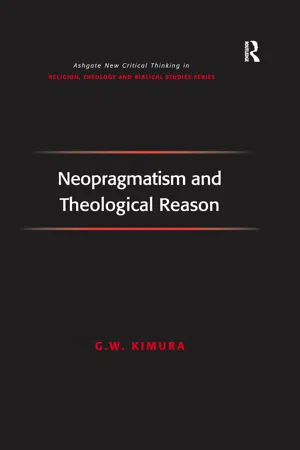
Neopragmatism and Theological Reason
About this book
Neopragmatism and Theological Reason examines the recent explosion of interest in pragmatism. Part I traces the source of classical pragmatism's distinctive thought to Peirce, James, and Dewey - specifically to their shared theological understanding inherited from Emerson's Transcendentalism and British Romanticism. Part II reconstructs this rationality for postmodernity, showing how neopragmatism, properly understood, is theological reason. Kimura discusses the return of religious themes in philosophers like Putnam, Cavell, and Rorty and critiques the neopragmatic theologies of West, McFague, and Kaufman. Neopragmatism and Theological Reason explores pragmatic themes across philosophy, theology, and literary theory, arguing that neopragmatism must acknowledge its theological sources and then reconstruct its rationality to the religious context of modernity/postmodernity.
Information
PART 1
Part I
Introduction
Neopragmatism in Crisis
Neopragmatism faces a dilemma. This dilemma is of its own making, the result of its rapid success in the world of ideas. It is an unintended consequence created by its own enthusiasts that now threatens the pragmatic revival from the inside. This dilemma is the internal coherence, or lack thereof, of neopragmatist philosophy. This predicament is especially acute inepistemology, going to the heart of neopragmatism’s self-sufficiency as a theory of knowledge.
Of course, such accusations are nothing new. In its earliest forms, both empiricist and rationalist critics derided classical pragmatism as pseudo-philosophy for its lack of systématisation. Today, however, leading neopragmatists - Cornel West and Richard Rorty to name two - make the case, instead of the opponents. They gleefully characterise pragmatism as an ‘American evasion of philosophy’1 and ‘cultural criticism’,2 respectively, rather than epistemology. Rorty even fashions his version of neopragmatism as parallel to deconstructionism, casting himself as the North American equivalent to ‘[Jacques] Derrida...the most intriguing and ingenious of contemporary’ thinkers.3
Compare such anti-philosophical, anti-realist characterisations with two other leading neopragmatists: Nicholas Rescher and Hilary Putnam. Rescher states ‘[p]ragmatism takes the traditionalistic line of seeing the purposive character of the philosophical enterprise to lie in its very nature as a venture in seeking to answer our larger questions in a systematic way.’ Neopragmatism for Rescher is not just traditionally philosophical, it is also epistemologically ‘objective’. It involves ‘metaphysical realism’ of specific neoKantian construction, the polar opposite of Rorty and West.4 Putnam’s neopragmatist epistemology, likewise, is ‘realism’, although he has evolvedfrom ‘internalism’ and ‘internalist’5 realism to ‘commonsense realism’6 to a ‘“direct” realism’7 that is non-metaphysical.
These brief examples illustrate the dilemma. Neopragmatism cannot, intuitively or logically, be both ‘philosophy’ and its ‘evasion’; epistemology and anti-epistemological ‘deconstructionism’; anti-realism/irrealism and realism, whatever the stripe. Simply stated, neopragmatism cannot be all things to all people championing it as a distinctive form of thought. This lack of internal consistency, if not outright contradiction, over the most basic constitutive notions is now more of athreatto the neopragmatic revival than competing philosophies. Neopragmatism cannot sustain its numerous divergent and frequently irreconcilable interpretations without becoming a meaningless term.
Classical pragmatism, of course, entertained disparate versions. C. S. Peirce, whom William James credited with originating the name and philosophy of pragmatism, temporarily redubbed his version ‘“pragmaticism,” which is ugly enough to be safe from kidnappers’ to differentiate his thought, ironically enough, from James.8 Dewey likewise evolved his own interpretation.
Despite their differences, what each thinker held in common about mind and world was greater than what separated them, hence their creation of the philosophy known as pragmatism. Furthermore, none of the original three would have imagined that what they were engaged in was not ‘philosophy’ per se. Rather, pragmatism was, as James said, ‘a new name for some old ways of thinking’.9 It was a recovery of the pragma, the practical heart of philosophy lost, according to this view, by the abstract and arcane machinery of empirical and rationalist thought.
Pragmatism was, therefore, for Peirce, James and Dewey the return of philosophy to its proper Socratic milieu, reconnecting reason to life expressed in all its facets. This life specifically included the religious faith and epistemology too frequently trivialised or dismissed by other philosophical schools of the time. Pragmatism for the classical pragmatists was in this way the apotheosis of the philosophical tradition, not its ‘evasion’.
The dilemma for neopragmatism now runs opposite. Neopragmatists increasingly tout their radical differences rather than similarities, whilst perversely continuing to trade under a common name. This is in spite of the evident fact that neopragmatism cannot support, epistemologically or otherwise, all that is claimed for it.
Part of the dilemma is due to the newness of the revival. As a relatively recent development, neopragmatism has been up to now an open field of notional experimentation. By its nature qua pragmatism, exactly what neopragmatism means could not be determined a priori. But now such unrestricted development is itself the problem.
It is not that the evolution of neopragmatism was ever predetermined, yet because it grows from classical pragmatism the tradition does exert an influence, at least in a proximal sense (even if untheorised or inadequately theorised by some of its proponents). Part I of this book develops a specific genealogy to clarify this historical background and describe the peculiar epistemological shape that neopragmatism carries over from classical pragmatism.
Neopragmatism’s heritage is, of course, not the only determining force. The other major factor is the contemporary epistemological situation giving rise to the revival. Part II evaluates the current philosophical context, critiquing the varieties of neopragmatism in light of Part I. Chapter 6 traces neopragmatism’s origins to the breakdown of analytical thought around the mid-twentieth century. In the past twenty-five years that literature on neopragmatism has exploded and chapters 7-10 examine the trajectory of that development in depth. However, it may be stated succinctly here that neopragmatism’s attraction, contrary to Rorty, is as a viable epistemological alternative to deconstructionism.
Neopragmatism is widely seen as addressing the current crisis within modernity/ postmodernity about the breakdown of rationality and the future of epistemology as a philosophical study. This book develops an argument throughout that goes beyond mere genealogy to a substantive philosophical proposal. It reconstructs neopragmatism epistemologically as scientifico-Romantic theological realism.
Neopragmatism and the Crisis of Epistemology
Classical pragmatism attracts contemporary philosophers because it carved out in its own day a middle epistemological position. It balanced issues such as the conceptualisation of knowledge with ^rows-oriented realism, epistemological fallibihsm with epistemological corrigibility and cultural-linguistic relativism with the search for generally universalisable standards. Such balance not only resisted scepticism, but also made possible the type of robust epistemic and moral claims that late nineteenth-, early twentieth-century philosophy sought. The success the classical pragmatists enjoyed as that middle position between empiricism and rationalism is now read as a token for today. It offers at least a possible model of how such a balance might be struck, when neopragmatism stands between the breakdown of analytical thought and rise of deconstructionism.
But neopragmatism is now, even by conservative dating, a generation old. No longer in its infancy, more clarity needs to be established as to what is possible, epistemologically-speaking, and what is mere claim or hope as a revived ‘new name for some old ways of thinking’. What counts and, perhaps more importantly, what does not count as neopragmatism needs to be clearly articulated and defended. If not, the revival will be unable to sustain itself and die its own pragmatic-style death. In other words, spread so thin as a notion, appealing to it will not make a practical difference in the areas of inquiry towards which it is addressed.
Furthermore, philosophy has had a generation not only to look forward to the reconstruction of neopragmatism, but also to look back through the earlier tradition. It now possesses a more thorough understanding of classical pragmatism. Knowing this history, it can better gauge those characteristics from classical pragmatism, and from sources behind it, that make contemporary reconstructions possible and give shape to a neopragmatism adequate to the current crisis of epistemology.
This book aims at such clarity. It describes a particular epistemological profile for neopragmatism, if neopragmatism is to accurately reflect its classical forebear. That is, if neopragmatism is to carry forward and reconstruct those characteristics that make it so attractive to the present epistemological crisis - features such as practicalism, contextualism, ‘critical common-senseism’,10 naturalism (in a non-materialist sense), holism, fallibilism, corrigibility, methodological adaptability and pluralism, revaluation of the aesthetic-literary sensibility and so forth - it must adopt a rational form that makes possible the very features it wants to reconstruct.
The issue, in short, is what makes «eopragmatism pragmatism. Proponents have adopted numerous strategies in their reconstructions, but they tend towards two camps: those who cast wide the genealogical net and those who draw it narrow. Philosophers like West and Rescher represent the latitudinarian impulse. This is not to say that they do not, in the end, reconstruct a specified neopragmatism of their own. Yet, they are more inclined towards a view of the pragmatic tradition that is both as inclusive as possible and pliable in its epistemological direction. They may not even see the explosion in versions of neopragmatism as a real epistemological problem. As Rescher states:
[P]ragmatism has not managed to achieve a uniform stability but has come to be construed very differently by different philosophers. Nor has pragmatism’s practice always lived up to is own teachings. ...The fact is that pragmatism has been many things to many people and this characterization has been applied over the years to a considerable variety of different theses, theories and teachings - positions of a diversified and sometimes doctrinally conflicting tendency.11
Rescher’s strategy is to establish a genealogy that is so wide it extends the range of the classical pragmatists from Peirce, James and Dewey to their contemporaries and near-contemporaries G. H. Mead, F. C. S. Schiller, C. I. Lewis, to near-present and present-day thinkers, including Rudolph Carnap, Nelson Goodman, Donald Davidson, Putnam and Rorty.
His genealogy is overly broad and unsustainable for two reasons. First, Rescher grants secondary early thinkers like Mead, Schiller and Lewis an undeserved influence in defining a pragmatic tradition clearly set and still led in neopragmatism by the classical pragmatists Peirce, James and Dewey. It is not that other early and middle thinkers’s work was insignifica...
Table of contents
- Cover Page
- Title Page
- Copyright Page
- Table of Contents
- Part I
- Part II
- Index
Trusted by 375,005 students
Access to over 1.5 million titles for a fair monthly price.
Study more efficiently using our study tools.
Frequently asked questions
Yes, you can cancel anytime from the Subscription tab in your account settings on the Perlego website. Your subscription will stay active until the end of your current billing period. Learn how to cancel your subscription
No, books cannot be downloaded as external files, such as PDFs, for use outside of Perlego. However, you can download books within the Perlego app for offline reading on mobile or tablet. Learn how to download books offline
Perlego offers two plans: Essential and Complete
- Essential is ideal for learners and professionals who enjoy exploring a wide range of subjects. Access the Essential Library with 800,000+ trusted titles and best-sellers across business, personal growth, and the humanities. Includes unlimited reading time and Standard Read Aloud voice.
- Complete: Perfect for advanced learners and researchers needing full, unrestricted access. Unlock 1.5M+ books across hundreds of subjects, including academic and specialized titles. The Complete Plan also includes advanced features like Premium Read Aloud and Research Assistant.
We are an online textbook subscription service, where you can get access to an entire online library for less than the price of a single book per month. With over 1.5 million books across 990+ topics, we’ve got you covered! Learn about our mission
Look out for the read-aloud symbol on your next book to see if you can listen to it. The read-aloud tool reads text aloud for you, highlighting the text as it is being read. You can pause it, speed it up and slow it down. Learn more about Read Aloud
Yes! You can use the Perlego app on both iOS and Android devices to read anytime, anywhere — even offline. Perfect for commutes or when you’re on the go.
Please note we cannot support devices running on iOS 13 and Android 7 or earlier. Learn more about using the app
Please note we cannot support devices running on iOS 13 and Android 7 or earlier. Learn more about using the app
Yes, you can access Neopragmatism and Theological Reason by G.W. Kimura in PDF and/or ePUB format, as well as other popular books in Philosophy & Philosophy History & Theory. We have over 1.5 million books available in our catalogue for you to explore.