- 164 pages
- English
- ePUB (mobile friendly)
- Available on iOS & Android
eBook - ePub
About this book
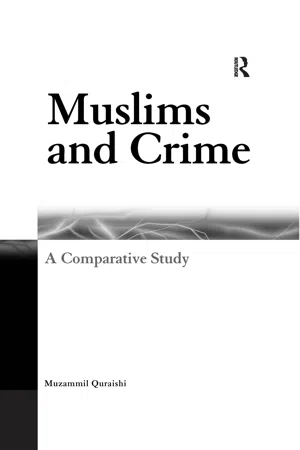
In the aftermath of 9/11 a critical analysis of offending and victimisation of Asian Muslims is desperately required. Muslims and Crime addresses this need by means of a comparative criminological evaluation of British and Pakistani South Asian Muslims. In addition to providing a succinct review of contemporary studies in the field, Muzammil Quraishi evaluates issues of offending and victimization amongst South Asian Muslims; develops an understanding of Islamic criminal law and its influence on crime and social control by means of a comparative evaluation between Britain and Pakistan; explores the nature of Islamophobia and its impact on South Asian Muslims in Britain and Pakistan; explores the American 'Critical Race Theory' perspective within British and Pakistani contexts; and examines the construction of racial stereotypes during colonial encounters and how far these may be traced into the post-colonial social terrain. The book will interest academics in sociology, criminology, race and ethnicity, and law. The themes explored will also be of significant interest to practitioners within criminal justice institutions.
Information
1
Islam and South Asian Muslims
The purpose of this chapter is to familiarize the reader with the salient aspects of Islam via an exploration of Islamic history, theology and jurisprudence (fiqh). The emphasis is on brevity, but whilst this necessarily involves exclusion of much material, matters are addressed as comprehensively as deemed essential to the understanding of the study.
This work cannot attempt to detail the richness and depth of Islam in a just manner. In essence, therefore, this chapter is a brief introduction to Islam in order to evaluate the significance of Islamic laws, culture and practices on the sample Muslim population for this study. It is not a sociology of Islam, nor a historical analysis of Islam, these matters are the subject of vibrant academic enquiry on a global scale by both Muslim and non-Muslim scholars1.
The Qur’ān2
The origin of the ‘five pillars’ of Islam is the Qur’ān. The Qur’ān is considered by Muslim scholars to be a written record of the divine utterances made by the Prophet Muhammad (SAW)3 in the course of his prophetic ministry starting around 610 CE and ending with his death in 632 CE (Cook, 2000).
The divine utterances of the Prophet Muhammad (SAW) have been distinguished in Islamic tradition from his normal speech and actions, which formed a second legal canon known as the hadīth (traditions). Following the death of the Prophet Muhammad (SAW) there were four Caliphs identified historically as being responsible for collating, maintaining and disseminating the text of the Qur’ān. There is general consensus amongst historians and traditionalists that the official codex was adopted under the auspices of the third Caliph ‘Uthmān4 around 650 CE (Humphreys, 1991).
The Qur’ān is organized into 114 chapters or sūras. They are presented in order of length, with the longest near the beginning and the shortest at the end; this is with the exception of the Fātihā (opening). The Fātihā forms the first sūra and is an invocation repeated during the five daily prayers obligatory upon Muslims. The Qur’ān contains a fusion of prose and poetry and orthodox Muslims maintain that it is incapable of being satisfactorily translated from Arabic, although translations have been made in many languages, including the first in Latin in 1143 (Arberry, 1964).
The Qur’ān forms the first legal canon in Islam and reference to translated extracts from it shall be made throughout the course of this chapter. The Qur’ān defines what have popularly become known as the ‘five pillars’ of Islam. We shall consider each ‘pillar’ below.
The Five ‘Pillars’
The Arabic word ‘Islam’ is a verbal noun literally meaning self-surrender to God as revealed through the message and life of his Prophet Muhammad (SAW) (Ruthven, 2000). The word ‘Muslim’ refers to one who so surrenders him or herself to God. Islam is the religion established among the Arabs by the Prophet Muhammad (SAW) in the early seventh century. The holy scripture of the Muslims is the Qur’ān, and according to Islamic tradition this was revealed to the Prophet Muhammad (SAW) through the agency of the angel Gabriel5. This took place partly in Makkah, the Prophet’s hometown, in Saudi Arabia and partly in Medina, where he succeeded in creating a state in an otherwise stateless tribal society (Cook, 2000).
Islamic tradition records that although the revelation of the Qur’ān was complete before the death of the Prophet Muhammad (SAW) in 632 CE, he did not himself assemble the material into a definitive text. This was the responsibility of his successors, the Caliphs, who completed the task around 650 CE (Cook, 2000).
Islam spread from a small Arab community to a vast religious empire so that by 750 CE it ‘threatened the frontiers of Latin Christendom in the Pyrenees and on the other stood astride the northern approaches to the Indian sub-continent’ (Coulson, 1964:21). Islam had spread beyond the Arab peninsula into much of the ‘civilized world, including Egypt, Palestine, Syria, Mesopotamia and the highlands of Persia’ (Ruthven, 2000:28). Despite the historical and contemporary diversity of cultures encompassed by the Islamic empire, certain fundamental beliefs, practices and obligations, often known as the ‘five pillars’ of Islam, have come to represent the essential qualities of what being Muslim entails.
The Declaration of Faith
Known in Arabic as the shahāda, the following constitutes the declaration of faith: ‘There is no god but God; Muhammad is the Messenger of God’.
According to most of the classical authorities, virtually anyone could be considered Muslim as long as they proclaimed the shahāda, although historically the degree of conviction required of the believer became the subject of theological debate (Ruthven, 2000).
Salāh
Salāh is Arabic for prayer. Prayers are obligatory and should be performed five times daily. The prayers are timetabled as follows:
- Fajr - dawn
- Zhuhr - midday
- ´Asr - afternoon
- Maghrib - sunset
- ´Ishā’ - night
There are no priests in Islam and no hierarchical authority6. As a consequence, congregational prayers are led by a learned person who knows the Qur’ān. He is chosen by the community and is known as an Imam. The five prayers contain verses from the Qur’ān and are recited in Arabic, but personal supplication can be offered in any language. In addition to these daily prayers, salāh is offered in congregation on Fridays. This is obligatory for men but not for women. Although the prayers are lead in Arabic, the ‘sermon’ or topics of discussion by the Imam are conducted in the language most commonly spoken by the congregation. Other congregational prayers are offered during the holy month of Ramadān (Tarāwīh), Muslim festivals of ‘Īd, and for funerals. Muslims must perform ablution before praying, this is known as wudū (partial wash), or ghusl (the washing or full bath).
Zakāt (Alms-giving or Compulsory Charity)
Zakāt is Arabic for ‘purification’ or ‘growth’. Possessions are ‘purified’ by setting aside a proportion for those in need. Zakāt involves a payment of 2.5 per cent of ones net savings above a minimum, known as the nisāb, to be spent on the poor and needy. Zakāt implies that everything a person possesses belongs to God and therefore there is an obligation to share. In effect, the individual holds wealth in trust.
Sawm (Fasting)
Fasting is obligatory upon Muslims for the duration of the month of Ramadān in the Islamic calendar. The conditions of the fast include abstaining from food, drink and sexual intercourse from sunrise to sunset. It is regarded as a means of self-purification also as self discipline and experiencing what the poor and hungry go through.
Hajj
Hajj is the annual pilgrimage to Makkah in Saudi Arabia. Makkah is where, according to Islamic tradition, God ordered Prophet Ibrahim (AS)7 (Abraham) to settle his family and build the Ka‘ba as the House of God. The Ka‘ba is a cube-shaped structure at the centre of the sacred site at Makkah and it is towards the Ka‘ba that all Muslims face when offering prayers. Hajj is only obligatory for those physically and financially able to perform it at least once in a lifetime. The Hajj itself takes place in the twelfth month of the Islamic year. Since the Islamic calendar is lunar both Hajj and the month of Ramadān can fall anytime in the British solar calendar. There is also a minor pilgrimage known as ‘Umra, which can be undertaken at any time of the year.
Islamic Theology
Islam belongs to the Abrahamic family of faiths, which includes Judaism and Christianity. However, the cornerstone of Islam centres upon the concept of Tāwhīd. Tāwhīd literally means making one or unicity and it is the unicity of Allah8 (SWT)9 which challenges the Christian doctrine of divine incarnation (Ruthven, 2000).
The principal sources for the beliefs and practices of Muslims are the Qur’ān and hadīth, or traditions of the Prophet Muhammad (SAW). These will be discussed in this chapter in greater depth later. In simple terms, the Muslim believes in a single omnipotent God, creator and sustainer of the universe. The purpose for the creation of mankind is so that they may worship God. The following verse of the Qur’ān details how God created mankind:
We created man of an extraction of clay,
then We set him, a drop, in a receptacle secure,
then We created of the drop a clot
then We created of the clot a tissue
then We created of the tissue bones
then We garmented the bones in flesh
thereafter We produced him as another creature’ (Qur’ān: 23:12-14 ‘The Believers’)10.
Muslims believe in Adam (AS) as the first human created. Muslims also believe in the existence of Satan (‘Iblis) who was punished for failing to prostrate before Adam (AS) (Qur’ān, 18:45). Adam (AS), as in the Bible, commits sin by eating forbidden fruit, but in the Qur’ān he repents and is forgiven by God. Adam (AS) is subsequently appointed as the first Prophet in a line of prophets ending with Muhammad (SAW) (Ruthven, 2000). Therefore, as distinguished from Christianity, mankind is created as innocent and there is no concept of ‘original sin’ in Islam. All souls are created within the realm of God before they descend into the foetus and are born into the world of humans as pure and innocent. The soul is subconsciously aware of where it began its life and therefore struggles to return to its creator.
This struggle marks the commencement of the ‘test’ for the Muslim. Life on earth is considered a test for the eternal afterlife. Muslims are urged to use the Qur’ān as their criterion (al-fūrqān) in distinguishing truth from falsehood. If they live their life in accordance with the commands of God then they will pass into paradise eternally. Paradise is the reward for conduct in accordance with God’s commands, and hell is the punishment for straying from these commands.
Since creation, the divine message for a Muslim has been sent to mankind through prophets. The Qur’ān includes figures seen as prophets from the Judeo-Christian tradition such as Noah, Abraham, Moses and Jesus.
Day of Creation, Day of Resurrection and Day of Judgement
For Muslims there are two extremities of human existence. First the meeting of primordial souls at the dawn of existence for the ‘original covenant’, ritualized during Hajj on the Plain of ‘Arafāt where pilgrims stand, meditate and worship11 (Qur’ān 7:122). Second, the primordial end of time: the Day of Judgement12. The first sūra13 of the Qur’ān is known as the Fātiha or ‘The Opening’ and in it God is described as ‘Māliki Yawmi ‘I-dīn’ (Qur’ān 1:4), which literally translates as ‘Master of the Day of Judgement’.
There are references to the Day of Judgement throughout the Qur’ān (for example Qur’ān 4:40, and 20:100) and it is often mentioned together with...
Table of contents
- Cover Page
- Title Page
- Copyright Page
- Table of Contents
- Preface
- Acknowledgements
- 1 Islam and South Asian Muslims
- 2 Muslims and Crime: The Existing Picture
- 3 Colonialism, Criminalized Tribes and Islamophobia
- 4 Background to Fieldwork Locations
- 5 Crime, Deviance and Victimization in Britain and Pakistan
- 6 Theoretical Perspectives
- 7 Conclusion
- Glossary
- Bibliography
- Index
Trusted by 375,005 students
Access to over 1.5 million titles for a fair monthly price.
Study more efficiently using our study tools.
Frequently asked questions
Yes, you can cancel anytime from the Subscription tab in your account settings on the Perlego website. Your subscription will stay active until the end of your current billing period. Learn how to cancel your subscription
No, books cannot be downloaded as external files, such as PDFs, for use outside of Perlego. However, you can download books within the Perlego app for offline reading on mobile or tablet. Learn how to download books offline
Perlego offers two plans: Essential and Complete
- Essential is ideal for learners and professionals who enjoy exploring a wide range of subjects. Access the Essential Library with 800,000+ trusted titles and best-sellers across business, personal growth, and the humanities. Includes unlimited reading time and Standard Read Aloud voice.
- Complete: Perfect for advanced learners and researchers needing full, unrestricted access. Unlock 1.5M+ books across hundreds of subjects, including academic and specialized titles. The Complete Plan also includes advanced features like Premium Read Aloud and Research Assistant.
We are an online textbook subscription service, where you can get access to an entire online library for less than the price of a single book per month. With over 1.5 million books across 990+ topics, we’ve got you covered! Learn about our mission
Look out for the read-aloud symbol on your next book to see if you can listen to it. The read-aloud tool reads text aloud for you, highlighting the text as it is being read. You can pause it, speed it up and slow it down. Learn more about Read Aloud
Yes! You can use the Perlego app on both iOS and Android devices to read anytime, anywhere — even offline. Perfect for commutes or when you’re on the go.
Please note we cannot support devices running on iOS 13 and Android 7 or earlier. Learn more about using the app
Please note we cannot support devices running on iOS 13 and Android 7 or earlier. Learn more about using the app
Yes, you can access Muslims and Crime by Muzammil Quraishi in PDF and/or ePUB format, as well as other popular books in Social Sciences & Sociology. We have over 1.5 million books available in our catalogue for you to explore.