eBook - ePub
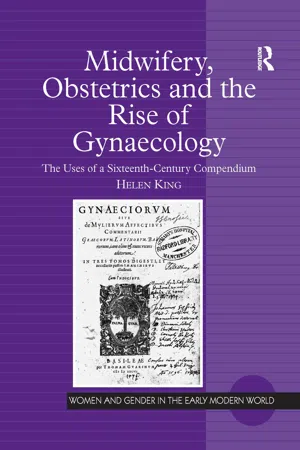
Midwifery, Obstetrics and the Rise of Gynaecology
The Uses of a Sixteenth-Century Compendium
- 238 pages
- English
- ePUB (mobile friendly)
- Available on iOS & Android
eBook - ePub
Midwifery, Obstetrics and the Rise of Gynaecology
The Uses of a Sixteenth-Century Compendium
About this book
The Gynaeciorum libri, the 'Books on [the diseases of] women,' a compendium of ancient and contemporary texts on gynaecology, is the inspiration for this intensive exploration of the origins of a subfield of medicine. This collection was first published in 1566, with a second edition in 1586/8 and a third, running to 1097 folio pages, in 1597. While examining the origins of the compendium, Helen King here concentrates on its reception, looking at a range of different uses of the book in the history of medicine from the sixteenth to the nineteenth century. Looking at the competition and collaboration among different groups of men involved in childbirth, and between men and women, she demonstrates that arguments about history were as important as arguments about the merits of different designs of forceps. She focuses on the eighteenth century, when the 'man-midwife' William Smellie found his competence to practise challenged on the grounds of his allegedly inadequate grasp of the history of medicine. In his lectures, Smellie remade the 'father of medicine', Hippocrates, as the 'father of midwifery'. The close study of these texts results in a fresh perspective on Thomas Laqueur's model of the defeat of the one-sex body in the eighteenth century, and on the origins of gynaecology more generally. King argues that there were three occasions in the history of western medicine on which it was claimed that women's difference from men was so extensive that they required a separate branch of medicine: the fifth century BC, and the sixteenth and nineteenth centuries. By looking at all three occasions together, and by tracing the links not only between ancient Greek ideas and their Renaissance rediscovery, but also between the Renaissance compendium and its later owners, King analyzes how the claim of female 'difference' was shaped by specific social and cultural conditions. Midwifery, Obstetrics and the Rise of Gynaecology makes a genuine contribution not only to the history of medicine and its subfield of gynaecology, but also to gender and cultural studies.
Chapter 1
Prefacing Women:
Owners and Users
Why were the texts included in the Gynaeciorum libri originally composed, and what did the collection mean to those who first encountered it? As Table 1 shows, virtually all of the works included were either composed or edited in the sixteenth century. Other works on the diseases of women were written at this time, but not included in the three editions of the compendium; it thus represents part of a wider interest in the nature of women, the diseases from which they suffer, and their treatment. As I have suggested in the Introduction, Calvi’s publication of the complete Hippocratic corpus in Latin, in 1525, made it possible to think of Hippocrates as a gynaecologist; it was a generation after this publication that there was a surge in publishing on both gynaecological and obstetrical matters. In this period, Hippocrates was praised as the great authority on the diseases of women even though it is clear that his admirers had not appreciated the detail of the theories put forward in the texts that bore his name. More immediately, Calvi’s translation was followed a year later not only by a reprint of the whole volume, but also by a separate, sextodecimo publication of the four main Hippocratic gynaecological works: Diseases of Women books 1–3 and Nature of Woman.1
Although I shall be drawing on evidence from all periods of ownership and use, in this chapter I shall mostly concentrate on those who encountered the book in the sixteenth and first part of the seventeenth centuries. In this period, medical readers would not have seen it as something of antiquarian interest, but rather as a work directly relevant to their practice. By the second half of the seventeenth century, the compendium was no longer seen as the cutting edge of medicine, but nor was it yet sufficiently old to be appreciated as a historic document.
Even at the beginning of the seventeenth century, however, not everyone saw the Gynaeciorum libri as a valuable collection. In a 1603 discussion of the idea that menstrual suppression led to the womb drying up and moving around the body in search of moisture, the Galenist Castro denounced the compendium as ‘an amalgam of excellent doctrine and wild speculation which could easily mislead students of medicine’, a position possibly reflecting its mixture of established Galenic medicine with Hippocratic suggestions of a two-sex model.2 He noted that the four ‘huge volumes’ of the previous edition had, in 1597, been collected into a single volume, which he criticized as bringing together different views without any attempt at organization.3 In particular, he mentioned de la Corde’s Hippocratic commentary, and stated that the Hippocratic view of the womb seeking moisture is ‘clearly ridiculous’.4 Elsewhere in his treatise he attacked other writers whose work was included in the collection, especially Luis de Mercado.5 Yet in his preface to the reader, Castro praised Hippocrates as ‘the most wise Hippocrates’. How did sixteenth and early seventeenth century writers reconcile such general enthusiasm for Hippocrates with criticism of the medical details of the gynaecological texts of the Hippocratic corpus? As we shall see later in this chapter, one solution was to question the authenticity of Diseases of Women, while continuing to hail Hippocrates as the great expert on the subject. For those who insisted that it was genuinely by the Father of Medicine, anything that did not make sense to them could be explained away as being due to textual error. Practical uses of these medical treatises were thus complemented by textual work on them.
The first part of this chapter will focus on the reasons for writing on the diseases of women given by those authors whose works were included in the various editions of the compendium: the second part will discuss how early readers, generally much more enthusiastic than Castro, engaged with the three editions, and will illustrate their engagement by briefly examining approaches to two important topics for sixteenth-century medicine: the treatment of menstrual disorders, and the materialization of sterility in the uterine mole. Both conditions were related to the different role of blood in the bodily economy of the female, and affected women’s social status.
Prefacing women
The Gynaeciorum libri normally removed the prefaces originally supplied by many of the authors of the constituent texts. Often highly rhetorical in their presentation, it is in these prefaces that we can find their authors’ reasons for writing about women’s diseases and for believing that such diseases need to be studied separately.6 Here I shall be discussing the original editions of the prefaces provided for three works published independently as well as being included in editions of the Gynaeciorum libri: the treatises of Luis de Mercado, Maurice de la Corde and, in its French translation, Jacques Dubois.
Luis de Mercado (1525?–1611), a Jewish convert to Catholicism, and personal physician to Philip II and Philip III, first published his De communibus mulierum affectionibus in Spain, in 1579. First included in the Gynaeciorum libri in 1588, as the long fourth volume to the 1586–88 edition, it has been assessed as ‘arguably the most important work in Spach’s collection’.7 The text is very thorough, detailed and original in its combination of medieval and classical material, the latter only being available because of the Latin translations of the Hippocratic corpus that were published from 1525 onwards. Mercado adapted the medieval material from the Trotula texts edited by the humanist Georg Kraut and published in 1544; this edition of Trotula was included in all three versions of the Gynaeciorum libri.8 But he combined this with sections of the Hippocratic Diseases of Women and Nature of Woman.9 An example of how he did this, showing the ethical dilemmas posed by combining texts, comes from a section on recipes to restore virginity. Here, Mercado used two recipes from the 1544 version of the Trotula texts; one from what has now been established as On Women’s Cosmetics, the other from On Treatments for Women.10 These recipes also appeared in the Kraut edition within the Gynaeciorum libri, being marked as of particular interest to the owner of at least one copy.11 While the original Trotula texts had no qualms about passing off deflowered women as virgins, and gave a total of nine recipes to tighten up the vagina, Mercado followed the 1544 version and set these in an entirely licit context, that of helping a virgin who, through no fault of her own, has a wide vaginal opening. The section began, ‘Unless it were permitted to discuss tightening up the width of the [opening of the] womb for honourable reasons, we would make no mention of it’ and went on to explain that sometimes this tightening up was necessary if conception were to occur.12 Mercado developed this approach, and introduced the first recipe by suggesting that this looseness may even lead to uterine prolapse, referring to a discussion of this in the Hippocratic Nature of Woman. He thus further widened the context from promoting conception, to a broader context of gynaecological disorders.
How did Mercado introduce this treatise, mixing as it did medieval and newly-discovered Hippocratic material? The preface opened not with an appeal to the authority of the past, but with a claim of present need, a reiteration of what were by then becoming standard remarks about the dreadful state of medicine in Mercado’s day. Another of the Gynaeciorum libri authors, Jean le Bon, the short preface of whose Therapia puerperarum remained with the text when it entered the compendium in 1586, similarly claimed that pregnant women were often ‘torn to pieces’ by surgeons, midwives and barbers, who similarly savaged ‘little babies barely alive’; however, he did not include physicians like himself in his list of guilty parties.13 Mercado also expressed fears of the imminent collapse of the medical profession due to the financial self-interest and lack of education of those who practise it.
On gynaecology specifically – ‘that other part of our art, which deals with what is special and peculiar to women’ – Mercado argued that it is ‘damaged and weakened, and so neglected that we see that women suffering from a thousand diseases are getting no help, or only that which is useless or inappropriate. This is because they are treated as if they were men’.14 His preface to the reader ended with a discussion of the word ‘Gynaecia’, in which he cited several classical writers – including Plutarch, Vitruvius and Procopius – in order to link the term to female seclusion in the ‘women’s quarters’ of the house; for him, gynaecology concerns separation. He noted that Hippocrates is ‘well known’ to have worked very hard on the topic of those diseases which develop in women by reason of their sex; he thus presented himself as following what I would call a ‘Hippocratic imperative’ ...
Table of contents
- Cover Page
- Title Page
- Copyright Page
- Table of Contents
- List of Illustrations
- Acknowledgements
- 1 Prefacing Women
- 2 Medical History and Obstetric Practice in William Smellie
- 3 Guilty of ‘Male-practice’? Burton’s Attack on Smellie
- 4 Delighting in a ‘Bit of Antiquity’: Sir James Young Simpson
- Bibliography
- Index
Trusted by 375,005 students
Access to over 1.5 million titles for a fair monthly price.
Study more efficiently using our study tools.
Frequently asked questions
Yes, you can cancel anytime from the Subscription tab in your account settings on the Perlego website. Your subscription will stay active until the end of your current billing period. Learn how to cancel your subscription
No, books cannot be downloaded as external files, such as PDFs, for use outside of Perlego. However, you can download books within the Perlego app for offline reading on mobile or tablet. Learn how to download books offline
We are an online textbook subscription service, where you can get access to an entire online library for less than the price of a single book per month. With over 1.5 million books across 990+ topics, we’ve got you covered! Learn about our mission
Look out for the read-aloud symbol on your next book to see if you can listen to it. The read-aloud tool reads text aloud for you, highlighting the text as it is being read. You can pause it, speed it up and slow it down. Learn more about Read Aloud
Yes! You can use the Perlego app on both iOS and Android devices to read anytime, anywhere — even offline. Perfect for commutes or when you’re on the go.
Please note we cannot support devices running on iOS 13 and Android 7 or earlier. Learn more about using the app
Please note we cannot support devices running on iOS 13 and Android 7 or earlier. Learn more about using the app
Yes, you can access Midwifery, Obstetrics and the Rise of Gynaecology by Helen King in PDF and/or ePUB format, as well as other popular books in History & World History. We have over 1.5 million books available in our catalogue for you to explore.