eBook - ePub
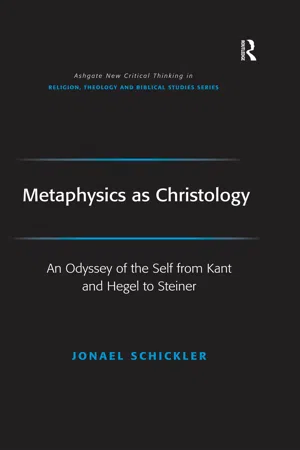
Metaphysics as Christology
An Odyssey of the Self from Kant and Hegel to Steiner
- 192 pages
- English
- ePUB (mobile friendly)
- Available on iOS & Android
eBook - ePub
Metaphysics as Christology
An Odyssey of the Self from Kant and Hegel to Steiner
About this book
In Metaphysics as Christology, Jonael Schickler presents a major contribution to both philosophy and theology. First he examines the key philosophical problems with which Kant and Hegel grappled, and finds in the work of Rudolf Steiner the essence of a solution to them; he claims that Steiner returned to Hegel's philosophical problems but was better able to solve them. Schickler uses these philosophical debates about knowledge and truth to understand the significance of Christ. Building on the work of Hegel, Schickler argues that Christ has made possible the developments in human consciousness that restore humanity's relationship to the surrounding world. This is a bold and rigorous work that opens up new directions in both philosophy and theology. Fraser Watts contributes the Foreword and George Pattison an extensive Preface.
Information
Chapter 1
Kant’s Faculties and the ‘I think’
Kant conceived of ordinary human experience as unfolding in a cognitive region where the intelligible and the sensible are encountered as a richly structured unity. One of the main tasks of reason is to ask how this unity – i.e. human experience – is possible. In brief Kant’s answer is that human beings are gifted with a set of cognitive faculties which issue in representations. These faculties can combine in different ways to produce a variety of kinds of representation – the different forms of human experience. The challenge of this chapter is to consider the nature of the faculties, how they combine, their relation to the transcendental subject (the ground of the understanding) and the shortcomings of Kant’s account.
As mentioned in the Introduction, the result of Kant’s consideration of the processes of cognition as the machinations of faculties and representations is a profound scepticism about the claims of ontology. Thus whereas Descartes saw experience as the result of an interaction between three distinct substances – mind, body and the extended world – transcendental idealism allows only talk of faculties. Concepts like ‘soul’ and ‘God’ are, for Kant, nothing but regulative ideas of reason whose purpose is to stand as the unattainable ends of reason; mere ideas in a land of thought where the child of epistemology, the representation, reigns supreme.
For Kant we thus begin by asking how experience is possible. This leads us to identify a set of necessary conditions that make it possible, which Kant calls transcendental conditions. Our experience of objects, for example, must be of objects experienced in space and time; these objects must be experienced as a unity of properties related to one another under a subject term – e.g. all the properties of a plant are of [i.e. are related to] a [a single] plant…. Space, time and categories such as unity and relation are thus all necessary conditions of the possibility of our experience, and they are conditions which are met by the harmonious interaction of our cognitive faculties.
The idea of a faculty responds to the need to provide a unifying subject term for specific classes of representations. The representations of each class have their conditions. Of these there are – as has been stated – two kinds: conceptual (or intelligible) and sensible conditions. Kant correspondingly distinguishes a faculty of under-standing, which provides the a priori conceptual conditions of experience, from a faculty of sensibility, through which we are given a priori and a posteriori sensible conditions of experience – i.e. space, time (which for Kant are a priori), and immediate sensory impressions (colours, sounds, smells…). To these are added two further faculties, reason and the imagination. Reason is introduced to account for the conditions of reflective experiences – i.e. for such activities as philosophical thinking, while the imagination is the faculty that unifies the conceptual and sensible conditions of experience, and so is in some ways both a sensible and a conceptual faculty (this will be discussed below). Its basic role is to perform certain kinds of cognitive synthesis.
In addition to these four faculties, Kant introduces the all-important concept of the ‘I think that must be capable of accompanying every representation’. This thinking self is, strictly speaking, a feature of the understanding, though Kant sometimes calls it a faculty, and it is also intimately related to both the imagination and reason.1 Although a precise interpretation of Kant’s conception opens up many different avenues for considering the nature of the ‘I think’, as will be seen, its basic function is to give formal unity to consciousness: it is the self-consciousness that is a necessary condition of thought and experience.
At the most basic level, then, Kant’s philosophy deals with relations among the faculties and with the different kinds of representation that arise both through each faculty and as a result of their relations to one another. How, then, does Kant conceive the faculties?
1.1 The Faculties of Cognition
1.1.1 Sensibility
The faculty of sensibility provides two forms of representation for Kant, pure and empirical intuitions. Pure intuitions give the forms of sensibility, which are space and time. Empirical intuitions are its matter and these are given via the senses. Kant defines sensibility in general as ‘the capacity (receptivity) to acquire representations through the way in which we are affected by objects…’.2 The form of our intuitions is given a priori, since Kant conceives space and time as non-empirical conditions of the possibility of representing empirical objects. Yet space and time are not conceptual or intelligible conditions of the experience of objects for Kant, since he conceives them to be immediately given rather than the products of spontaneous activity. Space and time thus occupy a mediating position between purely intelligible conditions of experience which are also a priori and a posteriori empirical ones.
Sensation is defined by Kant as ‘the effect of an object on the capacity for repre-sentation, in so far as we are affected by that object’.3 The effect an object (or rather the unknowable ground of sensibility) has on our sensibility when considered in its purely sensory constitution, can be determined a priori for Kant in only one respect: through what he calls intensive magnitude. A sound’s being loud or soft, a colour’s brightness or dullness are examples of intensive magnitudes of sensation. The range that determines such magnitudes begins at nothingness (e.g. silence) and passes with infinitely many possible variants up to an arbitrary upper limit – presumably reached with the destruction of the sense organ through excess stimulation in its own sensory medium. Kant distinguishes intensive from extensive magnitudes, which always involve aggregates of parts – for example a row of points forming a line in space – and so involve the pure forms of intuition (i.e. space and time). If I see a red flower, I have already united intensive and extensive magnitudes, and so a priori and a posteriori intuitions.
Hence all that can be said a priori about the a posteriori, for Kant, is that it always has an intensive magnitude. All other kinds of statement about sensations – e.g. that they are related to sense organs – are a posteriori.4 Aside from distinguishing pure from sensible or empirical intuitions, and analysing the relations between them in cognition, there is very little else Kant can say from the critical perspective about sensibility, since as shown above he has no means of providing a unified conception of the transcendental and empirical conditions of experience, and only the former have any fundamental philosophical validity. We are hence in no sense allowed to make claims about what causes sensibility. It must be accepted as a given.
1.1.2 Understanding
The understanding is without question the dominant faculty of Kant’s Critique of Pure Reason, since Kant’s analysis of it both shows it to provide the a priori conditions that make our experiences intelligible and ordered, and gives Kant his reasons for limiting the powers of reason. In this brief outline of it the aim is to present a summary version of the argument of Kant’s transcendental deduction of the categories, in which the role of the understanding in our cognition is described. This will prepare us to consider in more detail that crucial function of the understanding which Kant calls the transcendental unity of apperception or the ‘pure, original, unchanging consciousness’,5 the ‘I think’ that must be able to accompany every representation.
Kant’s conception of the understanding involves several important concepts. They and the relations between them can be described as follows:
- The understanding provides intelligible conditions of experience. (Kant thus says that the understanding is ‘…the faculty for bringing forth representations of objects, or the spontaneity of cognition…’.6)
- Experience always takes the form of a judgement. (E.g. as when I express the sentiment ‘this is a magical sunset’.)
- Judgement involves the application of categories. (Embedded in a simple cate-gorical judgement like ‘the flower is blooming’, for example, are – amongst others – the categories of substance [the flower], unity [it is a flower] and relation [the flower is blooming].) Judgements come in different forms and are related to different categories – e.g. the judgement ‘all men are rational animals’ contains the category of necessity in it.
- Categories are ‘pure [ursprünglich] concepts of synthesis that the understanding contains in it a priori’.7(Thus in the previous example, the implicit category of unity serves to synthesize the manifold of perceptions in a single substance.)
- The ground of the categories is the transcendental subject or the ‘I think that must be able to accompany every representation’. This subject is ‘that unity through which all of the manifold given in an intuition is united in a concept of the object’.8Without the transcendental subject there could thus be no notion of an object and so, a priori, no categories, since the categories are predicates of the concept of the object in general.9 (That is: they are the necessary concepts required to give coherence to the notion of an object. The notion of an object itself has content only through the transcendental unity of apperception – i.e. through that which is able to confer unity upon a sensory manifold, so consti-tuting an object.)
- In so far as the ‘I think’ is the ground of the understanding, then, it can be said that it is the ultimate origin of the unity and intelligibility that experience acquires through being formed in accordance with the categories and the different forms of judgement. (Kant thus says about a judgement that it is ‘nothing other than the way to bring given cognitions to the objective unity of apperception’.10)
For the purposes of this book the most contentious and important aspects of Kant’s conception of the understanding involve its use to explain the relation of the transcen-dental subject to the categories; this and the question of the understanding’s relation to the imagination. Before these are discussed in more detail, however, Kant’s other faculties will briefly be introduced.
1.1.3 Imagination
Kant introduces the concept of the imagination by saying that it is the cause in general of synthesis, and that it is ‘a blind though indispensable function of the soul, without which we should have no cognition at all, but of which we are seldom even conscious’.11 Synthesis itself he defines as ‘the action of putti...
Table of contents
- Cover Page
- Title Page
- Copyright Page
- Table of Contents
- Foreword
- Preface
- Acknowledgements
- Introduction: An Odyssey of the Self
- 1 Kant’s Faculties and the ‘I think’
- 2 From Kant to Hegel
- 3 Hegel’s Logic and the Self
- 4 Logic and Ontology in the Logic of the Concept
- 5 The Idea and the Loss of the Absolute in Hegel#x2019;s Logic
- 6 Soul between Body and Spirit in Hegel
- 7 From Kant and Hegel to Steiner
- Bibliography
- Index
Trusted by 375,005 students
Access to over 1.5 million titles for a fair monthly price.
Study more efficiently using our study tools.
Frequently asked questions
Yes, you can cancel anytime from the Subscription tab in your account settings on the Perlego website. Your subscription will stay active until the end of your current billing period. Learn how to cancel your subscription
No, books cannot be downloaded as external files, such as PDFs, for use outside of Perlego. However, you can download books within the Perlego app for offline reading on mobile or tablet. Learn how to download books offline
We are an online textbook subscription service, where you can get access to an entire online library for less than the price of a single book per month. With over 1.5 million books across 990+ topics, we’ve got you covered! Learn about our mission
Look out for the read-aloud symbol on your next book to see if you can listen to it. The read-aloud tool reads text aloud for you, highlighting the text as it is being read. You can pause it, speed it up and slow it down. Learn more about Read Aloud
Yes! You can use the Perlego app on both iOS and Android devices to read anytime, anywhere — even offline. Perfect for commutes or when you’re on the go.
Please note we cannot support devices running on iOS 13 and Android 7 or earlier. Learn more about using the app
Please note we cannot support devices running on iOS 13 and Android 7 or earlier. Learn more about using the app
Yes, you can access Metaphysics as Christology by Jonael Schickler,Fraser Watts in PDF and/or ePUB format, as well as other popular books in Theology & Religion & Religion. We have over 1.5 million books available in our catalogue for you to explore.