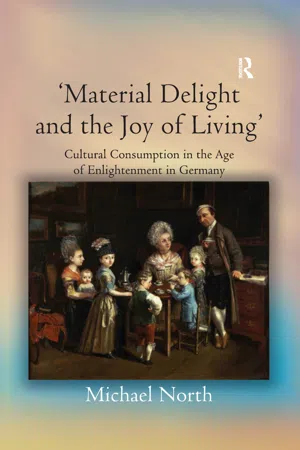
eBook - ePub
'Material Delight and the Joy of Living'
Cultural Consumption in the Age of Enlightenment in Germany
- 288 pages
- English
- ePUB (mobile friendly)
- Available on iOS & Android
eBook - ePub
'Material Delight and the Joy of Living'
Cultural Consumption in the Age of Enlightenment in Germany
About this book
Eighteenth-century Europe witnessed a commercialization of culture as it became less courtly and more urban. The marketing of culture became separate from the production of culture. New cultural entrepreneurs entered the stage: the impresario, the publisher, the book seller, the art dealer, the auction house, and the reading society served as middlemen between producers and consumers of culture, and constituted at the same time the beginning of a cultural service sector. Cultural consumption also played a substantial role in creating social identity. One could demonstrate social status by attending an auction, watching a play, or listening to a concert. Moreover, and eventually more significant, one could demonstrate connoisseurship and taste, which became important indicators of social standing. The centres of cultural exchange and consumption were initially the great cities of Europe. In the course of the eighteenth century, however, cultural consumption penetrated much deeper, for example into the numerous residential and university towns in Germany, where a growing number of functional elites and burghers met in coffee houses and reading societies, attended the theatre and opera, and performed orchestral and chamber music together. Journals, novels and letters were also crucial in forming consumer culture in provincial Germany: as the German states were remote from the cultural life of England and France, the material reality of London and Paris often passed as a literary construction to Germany. It is against this background, and stimulated by the research of John Brewer on England, that the book systematically explores this field for the first time in regard to the Continent, and especially to eighteenth-century Germany. Michael North focuses, chapter by chapter, on the new forms of entertainment (concerts, theatre, opera, reading societies, travelling) on the one hand and on the new material culture (fashion, gardens, country houses, furniture) on the other. At the centre of the discussion is the reception of English culture on the Continent, and the competition between English and French fashions in the homes of German elites and burghers attracts special attention. The book closes with an investigation of the role of cultural consumption for identity formation, demonstrating the integration of Germany into a European cultural identity during the eighteenth century.
Chapter 1
Books and Reading
I read … Swift and leafed through … the Göttingische Anzeigen. I would have liked to read more of Swift, but feared that I might become too accustomed to such reading matter.1
Today I had intended to work fiercely, but frittered away the morning again. I began reading Shandy early, and fell rather into lazing about once more.2
During my coiffure I read in Moore and felt rather merry, but afterwards was a bit downhearted, when I leafed through Whylt [sic]. Today I noticed once again, as I have so often before, although one might swear I had never noticed it at all, how greatly this sort of reading harms me.3
This was how the author Johann Anton Leisewitz, secretary to the Brunswick provincial diet (Landschaftssekretär), and one of the bookworms of the eighteenth century, commented on his own reading habits. Every day he documented not just what he read, but also his guilty conscience, since reading, much like watching television today, kept him from doing other things. Leisewitz read German and English philosophical and moral texts, but also Latin classics and above all the fashionable English literature of his day: Jonathan Swift, John Moore’s travel accounts, Oliver Goldsmith’s Vicar of Wakefield, Henry Fielding’s Tom Jones, John Gay’s Beggars’ Opera, James Thomson’s The Seasons and Laurence Sterne’s Life and Opinions of Tristram Shandy. He also read John Locke’s On Civil Government, David Hume’s History of England and Robert Whytt’s Sämmtliche zur praktischen Arzneykunst gehör. Schriften (The Works of Robert Whytt, MD, a translation from the English, published in Leipzig in 1771). He read Goethe’s Sorrows of Young Werther together with his wife, who recited to him from the novel. According to the reading list he compiled, by 1779 Leisewitz had studied 40 books, leafed through another five works ‘reading them almost completely’, started to read nine books, and continually consulted eight larger compendia, copying out excerpts from them.4
Although the learned world may always have included encyclopaedic readers, the obsessive readers who devoured nearly everything they could get their hands on were a phenomenon of the eighteenth century. Rolf Engelsing coined the term ‘reading revolution’ to characterize the change from the traditional manner of reading, in which people largely read the same works intensively and repeatedly, to a modern form of extensive reading.5 Although this style of reading now belongs to the past, and disparate reading practices coexisted even in the eighteenth century, with wide geographical and social variations, it was a time when reading attained a new importance for many people.6 Reading became a leisure activity that, unlike the theatre, opera and concerts, one could pursue at home whenever one liked. A literary market developed that exploded the traditional forms of book production. New media, new modes of distribution and new reading institutions arose to meet the demands of readers and at the same time facilitated a genuine reading revolution. In what follows, we shall accordingly examine the media, book production and the book trade, book ownership and reading preferences.
Media
The increasing complexity of the media landscape was typical of the eighteenth century. Not only did the book open itself up to new topics and new strata of readers, but a wealth of new genres also emerged in the periodical press. In addition to calendars and almanacs, which for the first time reached those with little reading experience, journals were published in all fields of scholarship and knowledge. Travel, art, literature, fashion, music, theatre and theology were but a few of the topics to which the often short-lived magazines – frequently targeting a female readership – were dedicated. The intelligence gazette (Intelligenzblatt) was another particular genre.7 Originally intended as an advertising paper, it developed into a medium for the economic-utilitarian enlightenment and even a forum for the discussion of the same moral and ethical questions that had been the focus of the moral weeklies in the first half of the eighteenth century. According to contemporary estimates, the most famous of these moral weeklies, the Hamburg Patriot, had already attained a circulation of up to 5,000 copies by the 1720s.8
In the second half of the century, few journals exceeded such print runs. Thus, Friedrich Schiller’s Historischer Calender für Damen (Historical Calendar for Ladies) had up to 10,000 subscribers in some years, and Christian Martin Wieland’s Teutscher Merkur (German Mercury) as well as Friedrich Nicolai’s Allgemeine Deutsche Bibliothek (Universal German Library) had 2,500 subscribers each. The number of subscriptions to Friedrich Justin Bertuch’s Journal des Luxus und der Moden (Journal of Luxury and Fashion) was comparably high (c. 1,500), while for the average periodical, a print run of between 500 and 750 may be considered substantial, since many were forced to make do with fewer than 300 paying readers. As a consequence, many new magazines did not survive their first year, and a few managed more than four years of publication, evidence of continuing demand by their readership. The long-lived journals accordingly surpassed their less successful rivals in the quality of printing and provision of copperplate illustrations.
We should also mention the incredible boom in the daily newspapers, which reached more than one million readers around 1750. Political events such as the Seven Years’ War, the American independence movement or the French Revolution seemed to increase newspaper consumption to unheard- of proportions, so that top publications such as the Hamburgische unpartheyische Correspondent (Hamburg Impartial Correspondent) reached editions of up to 30,000 at the end of the eighteenth century. At this period, approximately 200 newspapers with an average print run of 300 reached some three million readers in Germany every week.9
Not only publishers profited from the expanding literary market; a growing number of authors benefited as well. It is estimated that the number of published writers increased from 2,000–3,000 in 1755 to c. 10,000 in 1800.10 Even if the more prominent among them often held official positions – Gotthold Ephraim Lessing as ducal librarian, Friedrich Gottlieb Klopstock on a stipend from the Danish king, Wieland as a princely tutor, Goethe as a minister, Schiller as a professor of history – an increasing number of individuals took the risk of making a living as freelance writers.11 Often, economic hardship drove them to sell their services in the literary marketplace. Thus Sophie von La Roche justified her editorship of the first German women’s magazine, Pomona (1783), by explaining that she had to support her sons Carl and Wilhelm after her husband’s dismissal from his post in Trier.12
Another example is Christian August Vulpius, brother of Goethe’s future wife Christiane. While still at university, he had collaborated on Johann Friedrich Reichardt’s Bibliothek der Romane (Library of Novels) in 1783 and the journal Olla Potrida (the name of a kind of Spanish soup) in 1784. At the same time he published his Abenteuer des Ritters Palmendo (Adventures of the Knight Palmendo), which might be seen as a rehearsal for his famous later novel Rinaldo Rinaldini. With the help of his future brother-in-law, Vulpius gradually began to make a living from his writing. From 1792, he worked on a freelance basis for Goethe’s court theatre in Weimar, where he adapted plays and translated and wrote new dialogues for operas by Carl Ditters von Dittersdorf and Mozart. His earnings remained paltry, since an adaptation brought in only 1–3 taler and an opera text only 13 taler. Only when he gained a position as library registrar, and was later promoted to library secretar...
Table of contents
- Cover Page
- Title Page
- Copyright Page
- Contents
- List of Illustrations
- List of Tables
- Foreword
- Note on Coins and Currency in Eighteenth-Century Germany
- 1 Books and Reading
- 2 Travel and the Culture of Travel
- 3 Fashion and Luxury
- 4 The Culture of Domestic Interiors
- 5 Gardens and Country Houses
- 6 Art and Taste
- 7 Musical Culture
- 8 Theatre and Opera
- 9 The New Stimulants and Sociability
- Notes
- Select Bibliography and Archival Sources
- Index
Trusted by 375,005 students
Access to over 1.5 million titles for a fair monthly price.
Study more efficiently using our study tools.
Frequently asked questions
Yes, you can cancel anytime from the Subscription tab in your account settings on the Perlego website. Your subscription will stay active until the end of your current billing period. Learn how to cancel your subscription
No, books cannot be downloaded as external files, such as PDFs, for use outside of Perlego. However, you can download books within the Perlego app for offline reading on mobile or tablet. Learn how to download books offline
Perlego offers two plans: Essential and Complete
- Essential is ideal for learners and professionals who enjoy exploring a wide range of subjects. Access the Essential Library with 800,000+ trusted titles and best-sellers across business, personal growth, and the humanities. Includes unlimited reading time and Standard Read Aloud voice.
- Complete: Perfect for advanced learners and researchers needing full, unrestricted access. Unlock 1.5M+ books across hundreds of subjects, including academic and specialized titles. The Complete Plan also includes advanced features like Premium Read Aloud and Research Assistant.
We are an online textbook subscription service, where you can get access to an entire online library for less than the price of a single book per month. With over 1.5 million books across 990+ topics, we’ve got you covered! Learn about our mission
Look out for the read-aloud symbol on your next book to see if you can listen to it. The read-aloud tool reads text aloud for you, highlighting the text as it is being read. You can pause it, speed it up and slow it down. Learn more about Read Aloud
Yes! You can use the Perlego app on both iOS and Android devices to read anytime, anywhere — even offline. Perfect for commutes or when you’re on the go.
Please note we cannot support devices running on iOS 13 and Android 7 or earlier. Learn more about using the app
Please note we cannot support devices running on iOS 13 and Android 7 or earlier. Learn more about using the app
Yes, you can access 'Material Delight and the Joy of Living' by Michael North in PDF and/or ePUB format, as well as other popular books in History & World History. We have over 1.5 million books available in our catalogue for you to explore.