eBook - ePub
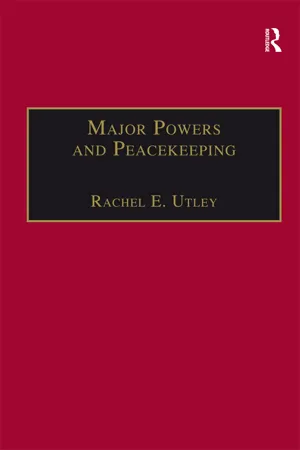
Major Powers and Peacekeeping
Perspectives, Priorities and the Challenges of Military Intervention
- 192 pages
- English
- ePUB (mobile friendly)
- Available on iOS & Android
eBook - ePub
Major Powers and Peacekeeping
Perspectives, Priorities and the Challenges of Military Intervention
About this book
The problems of peacekeeping in Somalia, Rwanda and former Yugoslavia marked a turning point for major powers in international military peacekeeping. Major support for a more pro-active UN role in peacekeeping has not been forthcoming and where major power involvement is deemed vital, non-UN peace operations have increasingly become the norm. This valuable volume explores the continuing significance of peacekeeping in international affairs, particularly in terms of its military dimensions, and examines the priorities and perspectives of the major powers in relation to their military participation in international peacekeeping and wider peace operations in the twenty-first century. It is ideal for scholars and students interested in contemporary international politics, international relations, international organizations, security and strategic studies, conflict resolution and foreign policy analysis.
Information
Chapter 1
Introduction
The end of the Cold War heralded a new era in international peacekeeping, and new hope for its main facilitator, the United Nations (UN). The Gulf War suggested – some thought decisively – that the bipolar divisions of the Cold War were over, and that the world's major powers could work together in pursuit of a common objective, that objective being the maintenance of international peace, order and stability. And at least in the immediate aftermath of the Cold War such a positive outlook seemed well founded. Major powers became involved in peacekeeping – particularly through the UN – to an extent unprecedented during the Cold War years.
However, international optimism was short-lived. The very difficult problems of 'peacekeeping' in theatres such as Somalia, Rwanda and former Yugoslavia, where there was precious little peace to keep, marked the onset of fundamental reconsideration by the major powers of their involvement in international military peacekeeping. In the main the results of these reassessments were not positive: major power support was not forthcoming for a more pro-active UN role in peacekeeping; major powers – in particular the permanent members of the UN Security Council – became rapidly more selective about their commitments to peacekeeping operations; and where major power involvement in peacekeeping was deemed vital, the UN was no longer necessarily the preferred agent for its implementation.
The practical consequences of this position are manifold. Calls for the UN to have more autonomous capabilities in peacekeeping, either through Secretary-General Boutros Boutros-Ghali's Agenda for Peace for example, or attempts to codify member states' troop contributions to peacekeeping in advance through standby arrangements, have generally met with resistance. Simultaneously the UN's peacekeeping strength in the field has markedly declined. From a numerical high point of almost 78,000 peacekeepers deployed around the world in 1993, the figure fell to around 12,000 in mid-1999. By the end of 2004 the figure was higher, at a monthly average' of just over 57,000, but this remains substantially below the force levels deployed only a few years earlier.1 If numbers of peacekeepers have fallen, so too have major power contributions, where major powers are understood primarily to be the permanent members of the Security Council. No major power featured among the top twenty contributors to UN peacekeeping operations in 2000, for example, and in 2004 none was higher than fifteenth.2 This does not mean to say, however, that major powers reject the idea of peacekeeping entirely. In fact where major powers are concerned non-UN peacekeeping has increasingly become the norm. On the one hand we have seen parallel American operations in Somalia, quasi-autonomous French actions in parts of Africa, continuing Russian peacekeeping efforts in the Caucasus, and Britain's refusal to place its troops under UN authority in Sierra Leone. On the other we see the priority attached by major powers to more widespread and effective deference to regional peacekeeping initiatives, such as NATO, for example, in the Balkans, involving troop contributions from a wider range of partner countries (including Russia), or support for African regional initiatives across that continent.
Peacekeeping itself then, including in its military dimensions, is not necessarily rejected by the major powers. Nonetheless they have effectively served notice that where they do participate militarily in peacekeeping operations, the nature, form, and function of that participation is likely to be closely controlled, and the framework for their intervention on current evidence seems unlikely to be the United Nations.
This book therefore seeks to consider the positions and priorities of the world's major powers regarding military aspects of peacekeeping at the beginning of the twenty-first century. Many of the tensions which characterised the 1990s remain unresolved: ethnicity, nationalism, religion and territorial disputes, for example, all continue to give rise to conflict. The possibility that such conflicts may require international military intervention, including on the part of the major powers, cannot be excluded. Consequently this book examines the concerns and reservations of the major powers in their approaches to military dimensions of peacekeeping; it considers examples of that peacekeeping in practice, through the UN, outside the UN, and in certain regional theatres; and it considers finally the dilemmas posed to major powers and peacekeeping by the media.
What is Peacekeeping?
But what is peacekeeping? As the UN itself acknowledges, the concept 'defies simple definition.'3 To compound the difficulty, operations undertaken in the name of peacekeeping since the 1940s have varied enormously in both their means and their functions. Furthermore since the late 1980s in particular peacekeeping missions have been generally broadened, increasingly encompassing more forceful characteristics and additionally including a range of non-military tasks, and widely referred to as "second-' or 'third-generation' peacekeeping (where second-generation peacekeeping was linked to implementation of peace agreements, and extended towards peacemaking and peacebuilding, and third-generation peacekeeping entailed a combination of military and civilian activities). More recently, the lexicon has included concepts of 'muscular' and 'robust' peacekeeping. Even beyond these variations, in the light of greater experience of peacekeeping in the 1990s certain of the major powers engaged in their own reassessments of the peacekeeping concept. In short, definitional clarity in respect of peacekeeping is most noticeable by its absence. While there is now more acceptance of a range of peace operations – from the 'traditional' peacekeeping, as discussed below, through more robust notions of peace restoration and peace enforcement towards the verge of limited war – it is still more than commonplace for the term 'peacekeeping' to be used almost as shorthand for the wide range of operations the term might encompass (and often a politically expedient shorthand, given the contention to which operations leaning rather more towards peace enforcement than peacekeeping can give rise).
Although peacekeeping has been most prominently conducted under UN auspices, it is wen known that such activities are not explicitly provided for anywhere in the UN Charter. Nevertheless Chapter VI of the Charter (on the Pacific Settlement of Disputes)4 has been used since the UN's earliest days to facilitate the deployment of military observer missions or monitoring groups, such as the UN Truce Supervision Organisation (UNTSO), and the UN Military Observer Group in India and Pakistan (UNMOGIP}, both of which were deployed in the late 1940s and still exist at the time of writing. More coercive action was taken in attempts to restore peace in Korea, from 1950-53, under the aegis of Chapter VII of the Charter (on Action with Respect to Threats to the Peace, Breaches of the Peace, and Acts of Aggression). Notably though, it was the despatch of the United Nations Emergency Force (UNEF I) to separate the protagonists of the Suez affair in 1956 which laid down the basic principles of what is now known as 'traditional' peacekeeping: first, that UN peacekeepers should be deployed in a buffer zone, in order to enforce an agreed ceasefire, and critically with the consent of the parties involved; second, that they should be impartial between the protagonists, and should not be empowered to use force except in self-defence; and third, that force composition as far as possible should exclude the major powers, and should mirror the diversity of membership of the United Nations. In view of the operations undertaken principally by the UN in the post-Cold War period, such characteristics were quickly overtaken by events and came to be inadequate given the tasks that 'peacekeepers' were expected to fulfil.
The differences between those peacekeeping operations instigated under UN auspices during the Cold War period, and those implemented from 1988 onwards, were both quantitative and qualitative. Thirteen missions were launched in the first four decades of the UN's existence, with a range of tasks including the monitoring of ceasefire lines,5 the separation of hostile forces,6 and the establishment of buffer zones between the parties.7 In contrast, as relations between the superpowers improved and Cold War tensions declined from the late 1980s, fourteen peacekeeping missions were launched just in the period from 1988-92. While monitoring ceasefires and troop withdrawals continued to be part of the UN forces' remit,8 the peacekeepers' roles increasingly extended to the protection of humanitarian aid supplies to those affected by conflict,9 the conduct of democratic elections,10 and the supervision of political change and state-building activities where countries had been riven by tension and fighting.11 Moreover recourse to UN peacekeeping has subsequently remained; over thirty missions were launched in the period from 1993 to 2004.
Thus, as traditional peacekeeping was increasingly overtaken by second-and third-generation peacekeeping, the longstanding function of interposition to maintain a ceasefire and buffer zone was challenged. Similarly the impartiality of peacekeeping forces was called into question in some cases, as for example in the case of Somalia, where American troops became embroiled in conflicts against one of the warring factions, and as also in the case of former Yugoslavia, where the French in particular were perceived to have a longstanding historical sympathy for the Serbs. Questions over the use of force in self-defence were raised – plainly the US went beyond any such limits in its battles with the warlord Aidid. On the other hand, when peacekeepers were deployed in decreasingly permissive situations with increasingly ambitious mandates to fulfil (the protection of safe areas in former Yugoslavia, for example), their failure to use adequate force to implement their mandates was a source of understandable criticism. And finally, as UN missions broadened, so too did the composition of the peacekeeping forces. In contrast with traditional peacekeeping activities, the major powers increasingly committed troops to UN operations: the French and British were the principal contributors to UNPROFOR in Yugoslavia for example, and the United States of America constituted the predominant component of UNOSOM in Somalia, and later the UN Mission in Haiti (UNMIH; 1993-6). Conceptions of traditional peacekeeping were therefore challenged on each of their key principles.
As the concept of peacekeeping came to imply something rather broader in the 1990s than it had in previous decades, UN Secretary-General Boutros Boutros-Ghali added to the debate in 1992, with An Agenda for Peace. Boutros-Ghali was keen for the United Nations to capitalise on the new international environment, and the associated international will to seek conflict resolution in many theatres through the UN. Reflecting both the wider recourse to UN peacekeeping in response to conflict, and the wider variety of tasks this entailed, he proposed four key areas in which the UN could act: preventive diplomacy, peacemaking, peacekeeping and peace-building. Boutros-Ghali was also keen for the UN to take on a more assertive, pro-active and potentially more autonomous role in the broader peacekeeping functions he envisaged.
While little progress was possible in the direction of the enhanced UN peacekeeping capabilities Boutros-Ghali would have preferred, and indeed a period of retrenchment on the part of the major powers followed An Agenda for Peace (the US Presidential Decision Directive of May 1994 [PDD 25] called into question the continuation of American participation in UN peacekeeping efforts,12 for example, and the British Army too was engaged in efforts to delineate strict peacekeeping operations from the "wider peacekeeping' and 'peace enforcement' elements which various missions in the 1990s took on13) it is doubtless the case that peacekeeping since the turn of the 1990s is a much broader activity than that conducted in the Cold War era. Traditional peacekeeping remains important, and indeed the continuation of such missions in Asia and the Middle East bears witness to this fact. Nevertheless new peace operations tend to be multidimensional, incorporating a range of non-military tasks alongside those requiring military action. Increasingly the military tasks a mission may be asked to fulfil may extend beyond the boundaries of traditional peacekeeping towards the restoration or enforcement of peace. The situations of their deployment may not correspond to the ideal of an agreed and accepted ceasefire, and even where generalised consent exists for a peacekeeping operation, that consent may be less solid at local levels, with potentially adverse implications for any peacekeeping force. In short, if peacekeeping defied simple definition duing the Cold War, that position has only been exacerbated since.
This book recognises the extent to which the term 'peacekeeping' is often – if at times inaccurately – used almost as a generic categorisation of a range of activities undertaken by elements of the international community to maintain, restore and even at times to enforce peace. Indeed the definitional complexity surrounding use of the term was one of the principal challenges facing the authors. Where this book uses the term 'peacekeeping' in its wider senses, it refers to traditional, second- and third-generation peacekeeping. Where such usage is inappropriate, definitional difficulties have been addressed in Part I by reflecting the terminology used by major powers themselves, and in Part II by reflecting more closely the nature of operations undertaken. Where no such terminology has been appropriate as a descriptor of missions undertaken, the broader term 'peace operations' has been used.
Successes and Failures of UN Peacekeeping
As peacekeeping has never therefore been an uncontested concept, debate has similarly surrounded questions of its effects and effectiveness. Even duing the Cold War its successes could be questioned. Under Chapter VI, monitoring India and Pakistan in Jammu and Kashmir from 1949, or observing events in Yemen in 1963-4, were largely considered to be positive actions and were essentially uncontentious. More questions could be asked where peacekeeping missions simply froze, rather than resolved, conflict situations (as with the UNFICYP deployment in Cyprus, for example). But more significantly at this point, the case of the Congo from 1960-64, when the UN appeared to have its own preferences in a civil war, and Lebanon after 1978, where again a civil war was involved, were not regarded as successful as the full consent of the parties involved was not available and as the peacekeeping missions were never clearly defined.
Nevertheless the successes and shortcomings of peacekeeping since the 1990s were vastly more open to question. There were notable successes, but the failures were both high-profile and high-impact. The reasons for failure, where it occurred, were varied, but their legacy has been critical for peacekeeping i...
Table of contents
- Cover
- Half Title
- Title
- Copyright
- Contents
- List of Contributors
- Acknowledgements
- 1 Introduction
- Part I: Major Power Perspectives
- Part II: Peacekeeping In Practice
- Appendix: Peacekeeping in the UN Charter
- Index
Trusted by 375,005 students
Access to over 1.5 million titles for a fair monthly price.
Study more efficiently using our study tools.
Frequently asked questions
Yes, you can cancel anytime from the Subscription tab in your account settings on the Perlego website. Your subscription will stay active until the end of your current billing period. Learn how to cancel your subscription
No, books cannot be downloaded as external files, such as PDFs, for use outside of Perlego. However, you can download books within the Perlego app for offline reading on mobile or tablet. Learn how to download books offline
Perlego offers two plans: Essential and Complete
- Essential is ideal for learners and professionals who enjoy exploring a wide range of subjects. Access the Essential Library with 800,000+ trusted titles and best-sellers across business, personal growth, and the humanities. Includes unlimited reading time and Standard Read Aloud voice.
- Complete: Perfect for advanced learners and researchers needing full, unrestricted access. Unlock 1.5M+ books across hundreds of subjects, including academic and specialized titles. The Complete Plan also includes advanced features like Premium Read Aloud and Research Assistant.
We are an online textbook subscription service, where you can get access to an entire online library for less than the price of a single book per month. With over 1.5 million books across 990+ topics, we’ve got you covered! Learn about our mission
Look out for the read-aloud symbol on your next book to see if you can listen to it. The read-aloud tool reads text aloud for you, highlighting the text as it is being read. You can pause it, speed it up and slow it down. Learn more about Read Aloud
Yes! You can use the Perlego app on both iOS and Android devices to read anytime, anywhere — even offline. Perfect for commutes or when you’re on the go.
Please note we cannot support devices running on iOS 13 and Android 7 or earlier. Learn more about using the app
Please note we cannot support devices running on iOS 13 and Android 7 or earlier. Learn more about using the app
Yes, you can access Major Powers and Peacekeeping by Rachel E. Utley in PDF and/or ePUB format, as well as other popular books in Politics & International Relations & Peace & Global Development. We have over 1.5 million books available in our catalogue for you to explore.