- 226 pages
- English
- ePUB (mobile friendly)
- Available on iOS & Android
eBook - ePub
Language and Revolution in Burke, Wollstonecraft, Paine, and Godwin
About this book
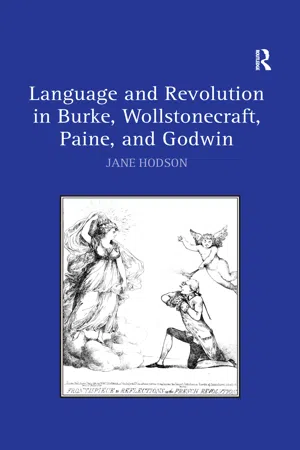
The Revolution in France of 1789 provoked a major 'pamphlet war' in Britain as writers debated what exactly had happened, why it had happened, and where events were now headed. Jane Hodson's book explores the relationship between political persuasion, literary style, and linguistic theory in this war of words, focusing on four key texts: Edmund Burke's Reflections on the Revolution in France, Mary Wollstonecraft's A Vindication of the Rights of Men, Thomas Paine's Rights of Man, and William Godwin's Enquiry Concerning Political Justice. While these texts form the core of Hodson's project, she ranges far beyond them to survey other works by the same authors; more than 50 contemporaneous books on language; and pamphlets, novels, and letters by other writers. The scope of her study permits her to challenge earlier accounts of the relationship between language and politics that lack historical nuance. Rather than seeing the Revolution debate as a straightforward conflict between radical and conservative linguistic practices, Hodson argues that there is no direct correlation between a particular style or linguistic concept and the political affiliation of the writer. Instead, she shows how each writer attempts to mobilize contemporary linguistic ideas to lend their texts greater authority. Her book will appeal to literature scholars and to historians of language and linguistics working in the Enlightenment and Romantic eras.
Information
Chapter One
The Language of Politics and the Politics of Language
The Revolution in France of 1789 provoked a major pamphlet war in Britain that was to last throughout the following decade. It has been estimated that around four hundred pamphlets were eventually published in Britain on the subject of France during the 1790s, a figure that does not include other forms of public engagement such as poems, ballads, periodical essays and novels.1 This meant that there were over four hundred voices all fiercely contesting what exactly had happened in France, why it had happened, what it meant for Britain and where events were now headed. In this war of words, questions of representation and interpretation became fundamentally important as writers attempted to convince readers of the truth of their own accounts, while discrediting those of their opponents.
In this book I explore the relationship between political persuasion, literary style and linguistic theory in that war of words. The central aim of the book is to provide an account of the role of language in four influential and widely read texts: Edmund Burke’s Reflections on the Revolution in France (1790), Mary Wollstonecraft’s A Vindication of the Rights of Men (1790), Thomas Paine’s Rights of Man (1791) and William Godwin’s Enquiry Concerning Political Justice (1793). My book as a whole, however, will range far beyond these four texts, surveying over fifty books on language from the period, as well as other works by these four authors, reviews from the period, and pamphlets, novels and letters by other writers.
There have, of course, already been a number of studies that have considered the role of language in relationship to politics during this period. Two of the most influential are James Boulton’s The Language of Politics in the Age of Wilkes and Burke (1963) and Olivia Smith’s The Politics of Language 1791–1819 (1984). These two books take different approaches to the relationship between language and politics, and they cover slightly different historical periods, although they overlap in covering the French Revolution debate in some detail. Boulton’s study is essentially literary critical in approach, assessing the style in which each pamphlet was written, and showing how it relates to the political viewpoint and rhetorical aims of its author. Smith’s study, on the other hand, is focused on the history of ideas, specifically on the way in which ideas about language were politicized during the period. As these brief summaries suggest, these writers use the word ‘language’ in rather different senses in their titles. In The Language of Politics Boulton is primarily concerned with the actual language of the texts in question, with what might be termed language in use. In The Politics of Language Smith is interested in analysing the discourses about language that were circulating at the time, that is, with social ideas about language.
I have found both Boulton’s and Smith’s books to be ground-breaking and inspirational, and my own book is heavily indebted to them. At the same time, however, both have limitations. In the following sections I explore these limitations and begin to define my own approach. In doing so, I will be devoting more space to my critique of Smith than to my critique of Boulton. This is for two reasons: first because the flaws in Smith’s approach seem rather more fundamental to me and need unpicking in greater detail, and second because Smith’s narrative of the development of linguistic thought during the period has been very influential in recent years and I want to make it clear exactly why and where I part ways with her. I will spend some time exploring just two linguistic texts and showing how my own understanding of their political implications differs from Smith’s. In the final section of this chapter, I will argue that focusing solely upon either language in use or social ideas about language artificially stratifies the role of language in the French Revolution debate (or, indeed, in any other debate). Instead, I argue that it is essential to move continually between analysing the way in which ideas about language functioned in the debate and the way in which the writers in question actually used the linguistic resources available to them.
The Language of Politics
Boulton’s book is detailed and perceptive in execution, as well as being original in conception. At the time he was writing, the language of these texts had received very little attention and he begins by defending his critical endeavour against two potential charges: first that such political writing is not worthy of serious literary attention and second that literary attention adds nothing to a historical understanding of the texts. In response to the first charge, he defines the function of the literary critic in the following terms:
His distinctive function is to elucidate the features of a piece of writing which produce permanent interest, pleasure, or attention, and the literary techniques employed to achieve this result. He will ask of a political pamphlet – as of any other kind of literature – questions such as whether human passions of a permanent or merely transient nature are involved, whether the quality of the writing provides the reader of any age with an exciting aesthetic experience, or whether the writers’ attitude to his immediate problem is of continuing relevance to the human condition.2
His validation of the ‘permanent’ over the ‘transient’ and his concern that a work should be ‘of continuing relevance to the human condition’ clearly reveal that, as might be expected of a researcher publishing in Britain in 1963, he was working within the New Critical paradigm. Such a programme of investigation does not, however, address the charge of historical irrelevance, so he adds a second set of aims, noting that the critic’s work is of particular significance to the historian when the critic seeks:
to enquire into the conditions under which the work was written, the impetus that brought it into being and the writer’s response to that impetus, the audience being addressed and the extent to which the chosen idiom, imagery, or prose style would affect it, or the precise meaning the writer’s language would carry for the original readers.3
Boulton is very well read in the period and he takes to care to contextualize the texts he discusses. Nevertheless, these two programmes of investigation pull him in opposite directions: it is difficult to prove the ‘permanent’ qualities of a work while also historicizing the way in which ‘original readers’ would have responded to it. Boulton is frequently concerned with finding the universal qualities in the prose of these writers and with exploring, for example, ‘the subtle control that Burke exercises over the reader’s response’.4 He does not consider whether ‘the reader’ in the eighteenth century might have responded differently from ‘the reader’ in our own time. The problem with this is that the way in which readers respond to the style of a text is significantly determined by the stylistic norms within which they are reading. As Sylvia Adamson notes, ‘historical shifts in stylistic norms affect not only the response of inexperienced readers but the judgements of professional critics and scholars’.5 For example, what may have appeared to be an obviously informal stylistic feature to a reader in the 1790s may be interpreted as connoting formality by a modern reader. John Mee highlights the hazards of reading across historical periods in his discussion of the word ‘enthusiasm’. He notes that the word ‘is far from being an unfamiliar one, but this familiarity contributes to a blindness that obscures its complex centrality to the period.’6 The same is true of style taken much more broadly: as modern readers, our feeling of familiarity with a range of stylistic features can blind us to historical shifts in their function, status and connotative value. In this book, therefore, I use a range of writings on language and style from the period, as well as contemporary reviews of the texts in question, in order to get a sense of how contemporary readers may have responded to the language of the texts I am studying.
It is not, however, quite as simple as that. Readers’ responses to style are complicated by the fact that what may appear to be a stylistic response is often encoding something rather different. As I show in Chapter Five, for example, readers politically sympathetic to Thomas Paine were prepared to read the style of his Rights of Man as plain, while more hostile readers repeatedly described it as artificial. In other words, readers projected as stylistic (and therefore objectively text-based) responses that were in reality much more to do with subjective responses to the content of the text, the context within which it was published, and the author’s reputation. As Marilyn Butler writes, ‘No form is confined to a single political message. Everything turns on how it is used, and on how the public at a given time is ready to read it.’7 This suggests that any attempt to use contemporary reviews in order to historicize responses to style must, for example, try to take into account the political allegiances of the reviewer in question. More fundamentally, it also suggests that any exploration of the language of a given text must focus not only on the stylistic properties of the text itself, and the ways in which that style was read, but also on the way in which language functions at a more symbolic level both in the text and its reception. Descriptions of a text as ‘plain’ or ‘artificial’ do not exist in an ahistorical vacuum. Instead, such descriptions draw on and participate in contemporary discourses about language, which in turn are often closely interwoven with discourses about power, politics and society. It is these contemporary discourses about language that Olivia Smith takes as her focus in The Politics of Language, and it is to these (and Smith’s interpretation of them) that I turn in the next section.
The Politics of Language
According to long-established narratives of the History of the English Language, the eighteenth century was an age of standardization and prescriptivism, during which the English Language was codified in its modern form.8 The century opened with repeated calls for the establishment of an English Academy on the model of the Académie Française: one such call was Swift’s A Proposal for Correcting, Improving and Ascertaining the English Language (1712). Although no English Academy was ever established, a flood of dictionaries, grammars and pronouncing dictionaries was produced by private writers, so that by the end of the century an individual could confidently solve a disputed matter of English usage by appealing to the authority of Samuel Johnson’s Dictionary of the English Language (1755), Robert Lowth’s Short Introduc...
Table of contents
- Cover Page
- Title Page
- Copyright Page
- Table of Contents
- Acknowledgements
- 1 The Language of Politics and the Politics of Language
- 2 The Linguistic Background
- 3 ‘A Wilderness of Words’: Edmund Burke’s Reflections
- 4 ‘The Effusions of the Moment’: Mary Wollstonecraft’s Vindication
- 5 ‘What is this Metaphor called a Crown?’: Thomas Paine’s Rights of Man
- 6 ‘The Transparent Envelop of our Thoughts’: Godwin’s Political Justice
- 7 Conclusion
- Bibliography
- Appendix Fifty Linguistic Texts First Published in England during the 1790s
- Index
Trusted by 375,005 students
Access to over 1.5 million titles for a fair monthly price.
Study more efficiently using our study tools.
Frequently asked questions
Yes, you can cancel anytime from the Subscription tab in your account settings on the Perlego website. Your subscription will stay active until the end of your current billing period. Learn how to cancel your subscription
No, books cannot be downloaded as external files, such as PDFs, for use outside of Perlego. However, you can download books within the Perlego app for offline reading on mobile or tablet. Learn how to download books offline
Perlego offers two plans: Essential and Complete
- Essential is ideal for learners and professionals who enjoy exploring a wide range of subjects. Access the Essential Library with 800,000+ trusted titles and best-sellers across business, personal growth, and the humanities. Includes unlimited reading time and Standard Read Aloud voice.
- Complete: Perfect for advanced learners and researchers needing full, unrestricted access. Unlock 1.5M+ books across hundreds of subjects, including academic and specialized titles. The Complete Plan also includes advanced features like Premium Read Aloud and Research Assistant.
We are an online textbook subscription service, where you can get access to an entire online library for less than the price of a single book per month. With over 1.5 million books across 990+ topics, we’ve got you covered! Learn about our mission
Look out for the read-aloud symbol on your next book to see if you can listen to it. The read-aloud tool reads text aloud for you, highlighting the text as it is being read. You can pause it, speed it up and slow it down. Learn more about Read Aloud
Yes! You can use the Perlego app on both iOS and Android devices to read anytime, anywhere — even offline. Perfect for commutes or when you’re on the go.
Please note we cannot support devices running on iOS 13 and Android 7 or earlier. Learn more about using the app
Please note we cannot support devices running on iOS 13 and Android 7 or earlier. Learn more about using the app
Yes, you can access Language and Revolution in Burke, Wollstonecraft, Paine, and Godwin by Jane Hodson in PDF and/or ePUB format, as well as other popular books in Literature & Literary Criticism. We have over 1.5 million books available in our catalogue for you to explore.