- 272 pages
- English
- ePUB (mobile friendly)
- Available on iOS & Android
eBook - ePub
About this book
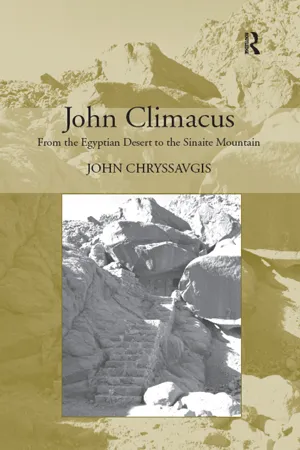
John Chryssavgis explores the ascetic teaching and theology of St John Climacus, a classical and formative writer of the Christian medieval East, and the author of the seventh-century Ladder of Divine Ascent. This text proved to be the most widely used handbook of the spiritual life in the Christian East, partly because of its unique and striking symbol of the ladder that binds together the whole book. It has caught the attention of numerous readers in East and West alike through the ages and is a veritable classic of medieval spirituality, whose popularity in the East equals that of The Imitation of Christ in the West. Chryssavgis follows the development and influence of earlier desert literature, from Egypt through Palestine into Sinai, and includes a discussion of the theology of tears, the concept of unceasing prayer, as well as the monastic principles of hesychia (silence) and eros (love).
Information

John Climacus
(Holy Transfiguration Monastery, Brookline, MA)
(Holy Transfiguration Monastery, Brookline, MA)
CHAPTER 1
John Climacus and the Ladder
Your tears and your words have spoken of
ascents to divine love and beauty.
(Menaion, March 30)
Exile is separation from everything in order
to hold onto God totally.
(John Climacus, Step 3)
Life of St John of the Ladder
The life and condition of the monks in the Sinaite desert are well described in the Spiritual Meadow of John Moschus, published by his friend and pupil Sophronius. Therein, John informs his readers of a series of incidents and stories that seemed to him noteworthy. Another source of information is the collection of forty Narratives attributed to Anastasius of Sinai, published by F. Nau.1 These documents offer us a picture of monks who enjoyed a high reputation, with an atmosphere and tradition of their own, distinct from that of Palestine or of Egypt yet at the same time blending both in an austere but balanced ethos. It is in these mountains that Moses encountered God; it is here that Elijah heard God; and it is here that John Climacus, or John of the Ladder, recorded his experiences of God.
The principal source, apart from the writings of John himself, is the Life of John written by a monk named Daniel of Raithou, whose biographical dates and origin are equally uncertain.2 Daniel writes as an eyewitness, or at the very least as a contemporary of the Sinaite ascetic and author of the Ladder. Yet we cannot be entirely sure of this; after all, in his Life, which resembles an edifying eulogy, Daniel too is imprecise. He does not, for example, provide any chronology and explicitly states that he does not even know John’s place of origin (596A). All other information, apart from the evidence mentioned below, goes no further than Daniel’s: such includes the Menaion for March 30, the day of John’s repose, as well as other synaxaria and menologia such as the tenth-century Life in the menologion of Emperor Basil.3
The precise dates of the period during which John, the author of the Ladder of Divine Ascent, lived are hard to determine with any certainty, owing to the lack either of sources or else of detailed information in the few sources available. However, it is possible to reconstruct a basic outline of John’s life using the evidence of the Ladder itself, which while limited is nonetheless authentic, the information provided by Daniel’s Life, which, despite its vagueness one may accept as basically reliable, and the above-mentioned Narratives of Anastasius, although with the reservations highlighted in the appendix to this chapter. How, then, does John’s biographical sketch emerge from these sources?
John of the Ladder is also known as John ‘the Scholastic’ (596A) or ‘Scholar,’ an indication that he was not unlettered, as earlier scholars have supposed.4 Possibly born into a noble family some time around or before the year 579, John enjoyed a good education, which his biographer describes as ‘wide learning’ (597B), a phrase denoting an all-round education that may or may not include higher learning. However, the fact that John was only sixteen years of age when he arrived at Sinai, as will be seen below, may rule out the last possibility, but need not imply that he had no education at all. The Ladder is a skillfully written work, from a stylistic point of view, and is not the work of a semi-literate person. Naturally, John may have acquired much of his knowledge after entering the monastic life.
It is not known where John was born (596A), but his biographer tells us that he arrived at Sinai when he was only sixteen.5 John appears to have been exceptionally mature already at this early age (597A). He immediately and humbly placed himself under the obedience of a spiritual guide, referred to as ‘Abba Martyrius’ (600B), who tonsured John on the Holy Peak (608B) at the age of twenty (608C). Interesting accounts have come down to us of prophecies by certain elders living in the Sinaite desert at the time. On descending from the Holy Mountain after John’s profession, Martyrius led his disciple to a certain abbot (hegoumenos) called Anastasius.6 This may have been the abbot of the central monastery. Anastasius predicted that John would one day become abbot – a prediction fulfilled forty years later. The fact that Martyrius is called ‘abba,’ a term which does not necessarily denote the office of abbot, whereas Anastasius is called hegoumenos, which clearly means ‘abbot’ in the narrower sense – coupled with the fact that Anastasius encounters John for the first time – seems to indicate that our John did not originally have the experience of living inside the main monastery. This may be a further reason why John was so impressed by the monastery he later visited in Alexandria. Soon after this meeting with Anastasius, and perhaps even on the very same expedition, Martyrius and John also visited John the Sabbaite, who lived some fifteen miles away in the wilderness of Goudda7 and who, having washed John’s feet, informed his own disciple that, although he did not know whose feet he had washed, he sensed that this person would one day become abbot (608B). Abba Strategius, too, on the day of John’s profession, ‘prophesied about him that he would be revealed as a great star’ (608C).
At the age of thirty-five and after Martyrius’ death (597B), John lived as a hermit at a place called Tholas (597C, Menaion 609C), some five miles from the central monastery itself.8 Although Daniel explicitly uses the phrase ‘removes himself’ to describe John’s action, it was not a ‘move out’ of the nearby monastic community, since in all probability he was never a novice or monk there. Above all, however, it was not a ‘move away’ from social interaction on John’s part. For he continued to see and to counsel numerous visitors (650A),9 even to the point that, out of envy, he was accused of being a chatterbox (604D–605A)! Indeed, it was only when his accusers themselves pleaded for him to return to his former way of life that he once more agreed to receive visitors (605A). In a meaningful and profound way, then, John’s silence as well as his talking, his flight from the world and his retreat into the solitary life were not an escape from people, but rather a result of his burning love (600A) for others as well as for God (601C). After a time, Climacus assumed the third way of monasticism, the middle or intermediate path, also known as the semi-cenobitic or semi-eremitic way,10 where small groups lived as a close-knit cluster of families, each under the immediate guidance of a spiritual director. Accordingly, John accepted a disciple, Moses, to live with him (601B). The normal custom in eastern monasticism is to treat the community as a preparation for the desert.11 The alternative view of Basil, however, regards the cenobitic life as superior and even actively discourages the eremitic way.12 Evagrius of Pontus and his disciple, John Cassian, refer to the temptations and dangers of solitude, although Evagrius does not actually express a preference for the cenobitic life;13 in any case, he himself was a solitary, and not a cenobite. As regards John, he did not enter a cenobium initially, precisely because the preparation for the solitary life may take place equally in the cenobitic and in the semi-eremitic life. On the whole, John agrees with the former view, which is also in general the Palestinian line, although passages to the contrary may also be found in the Ladder.14
As a man of sincere ascesis and intense love (600B), at least according to the esteem of Daniel, John was also known to have worked miracles through prayer (604A, 608–12A):15 he was recognized as a healer of body and soul (604C). According to John Cassian, who both appreciated and appropriated the desert tradition of Egypt, the further that ascetics move from people and the closer they are to God, the more visitors inevitably will approach them. This certainly proved tr...
Table of contents
- Cover
- Half Title
- Title Page
- Copyright Page
- Table of Contents
- Chronological Table
- List of Illustrations
- Acknowledgements
- Abbreviations
- Introduction
- 1 John Climacus and the Ladder Appendix: Biographical Note
- 2 Soma–Sarx: The Body and the Flesh
- 3 Kardia: The Heart
- 4 Nous: The Intellect
- 5 ‘Joyful Sorrow’: The Double Gift of Tears
- 6 Ascesis: The Ascetic Struggle of the Monk
- 7 The Ascetic at Prayer
- Conclusion
- Bibliography
- Name Index
- Subject Index
Trusted by 375,005 students
Access to over 1.5 million titles for a fair monthly price.
Study more efficiently using our study tools.
Frequently asked questions
Yes, you can cancel anytime from the Subscription tab in your account settings on the Perlego website. Your subscription will stay active until the end of your current billing period. Learn how to cancel your subscription
No, books cannot be downloaded as external files, such as PDFs, for use outside of Perlego. However, you can download books within the Perlego app for offline reading on mobile or tablet. Learn how to download books offline
Perlego offers two plans: Essential and Complete
- Essential is ideal for learners and professionals who enjoy exploring a wide range of subjects. Access the Essential Library with 800,000+ trusted titles and best-sellers across business, personal growth, and the humanities. Includes unlimited reading time and Standard Read Aloud voice.
- Complete: Perfect for advanced learners and researchers needing full, unrestricted access. Unlock 1.5M+ books across hundreds of subjects, including academic and specialized titles. The Complete Plan also includes advanced features like Premium Read Aloud and Research Assistant.
We are an online textbook subscription service, where you can get access to an entire online library for less than the price of a single book per month. With over 1.5 million books across 990+ topics, we’ve got you covered! Learn about our mission
Look out for the read-aloud symbol on your next book to see if you can listen to it. The read-aloud tool reads text aloud for you, highlighting the text as it is being read. You can pause it, speed it up and slow it down. Learn more about Read Aloud
Yes! You can use the Perlego app on both iOS and Android devices to read anytime, anywhere — even offline. Perfect for commutes or when you’re on the go.
Please note we cannot support devices running on iOS 13 and Android 7 or earlier. Learn more about using the app
Please note we cannot support devices running on iOS 13 and Android 7 or earlier. Learn more about using the app
Yes, you can access John Climacus by John Chryssavgis in PDF and/or ePUB format, as well as other popular books in Theology & Religion & Religion. We have over 1.5 million books available in our catalogue for you to explore.