eBook - ePub
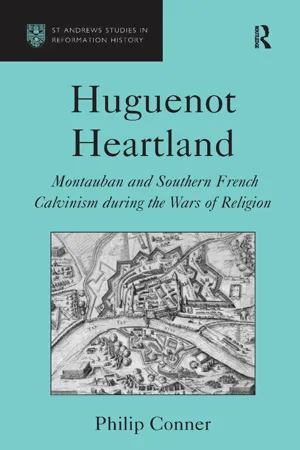
Huguenot Heartland
Montauban and Southern French Calvinism During the Wars of Religion
- 272 pages
- English
- ePUB (mobile friendly)
- Available on iOS & Android
eBook - ePub
About this book
In the immediate years and months before the outbreak of religious war in 1562 the growth of Protestantism in France had gone unchecked, and an overriding sense of Protestant triumphalism emerged in cities across the land. However, the wars unleashed a vigorous Catholic reaction that extinguished Protestant hopes of ultimate success. This offensive triggered violence across the provinces, paralysing Huguenot communities and sending many Protestant churches in northern France into terminal decline. But French Protestantism was never a uniform phenomenon and events in southern France took a rather different course from those in the north. This study explores the fate of the Huguenot community in the area of its greatest strength in southern France. The book examines the Protestant ascendancy in the Huguenot stronghold of Montauban through the period of the religious wars, laying open the impact that the new religion had upon the town and its surrounding locality, and the way in which the town related to the wider political and religious concerns of the Protestant south. In particular, it probes the way in which the town related to the nobility, the political assemblies, Henry of Navarre and the wider world of international Calvinism, reflecting upon the distinctive cultural elements that characterised Calvinism in southern France.
CHAPTER ONE
The French Midi: a world apart
Anyone travelling through France is aware of the rich and diverse heritage of the country. France is a chequer-board of cultural identities. These very different identities have a profound effect upon the way in which those living within the country’s borders understand what it means to be ‘French’. Indeed, many today cling tightly to memories, customs, dialects and languages which maintain and even intensify the degree of separation that is manifest between different regions within France.
Perhaps the most striking differences are still those that exist between northern and southern France. Pointing to southern France, many French commentators acknowledge that there ‘always has been and always will be “another” France’ in the south, and even within this region there exist ‘all manner of various originalities’.1 The fundamental difference between the north and south of France has paradoxically become ever more pronounced as a sense of national consciousness has emerged in the latter centuries. In the nineteenth century, those accustomed to the sophisticated salons of Parisian society looked aghast at those that appeared to taint their image of what it meant to be French. To the governing élite of Paris the south of France – the French Midi – must have seemed a distant and uncontrollable region. The political difficulties that they faced in mastering the Midi accentuated misunderstandings between the two regions. Those from the French Midi were caricatured as unruly, ungovernable, irrational; in short, a people more akin to their Italian neighbours than their French counterparts.2 The Parisian élite that toured the French provinces seeking to reflect upon the romantic delights of the nation often discovered – particularly when they entered the sun-soaked landscape of the Midi – that their expectations were rarely fulfilled. Many were left ‘panic-stricken’ as they realized ‘how socially and anthropologically alien were the human faces in the hinterlands of the country, how internally contradictory was the population of France’.3
The diversity of France is rooted in the variant ethnic, economic, cultural and historical experiences that mark the lands that today are held within the boundaries of France. The gradual and piecemeal composition of the country through time raises all sorts of questions as to what it means to be ‘French’. This fundamental question has vexed the French people particularly since the time of the Revolution which sought to create an indivisible nation of equal citizens living under a common law. While cultural diversity existed before the Revolution, the concept of the ‘nation’ was exalted in such a way as to mythologize France. France became a projection of what the country should be rather than what it was. The identity crisis that this engendered has remained unresolved to the present day. By the same token this confusion has had a profound impact upon the way in which the French have attempted to understand themselves and the way in which they have written their history, and in particular the parts of their history – such as the Reformation – which have traditionally divided them.
This study of southern French Huguenot culture will seek to get behind the all too real cultural obstacles to examine at first hand the depth of the crisis that the Wars of Religion posed to the nascent French state and the divisions that it left. Most studies of the French Reformation have concentrated on what happened in northern France. This is perhaps because in retrospect what are now perceived as the crucial encounters of the wars occurred in northern France: the key battles and sieges of the wars, the Massacre of St Bartholomew’s Day, the Day of the Barricades and the formation of the League, and the ongoing intrigue of factional politics that revolved around the court and the capital city.4 Reflecting upon the weight of literature, it would not be unfair to say that events in southern France have been treated as if they were of little consequence to the ultimate outcome of the wars.
For this reason the French Wars of Religion in southern France is a largely untold story. This appears particularly strange when one reflects that events in the French Midi rarely followed the same trajectory to those in the north of the country. Few seem to have questioned whether the ebb and flow of the wars – as they were seen from the court’s point of view – conformed to the ebb and flow of events in the outlying provinces. Philip Benedict’s study of Rouen was exceptional in showing how local events could unravel quite separately from events in the centre. Benedict demonstrated that ‘the religious parties had an existence at the local level that was substantially independent of the actions of the court elites’ and he concluded that “their fate was determined as much or more by the play of local forces as it was by events in Paris’.5 Indeed, the reverberations of events in the provinces could alter court policy. In this context it would be short-sighted to ignore the impact that events in southern France had upon the wider body politic. Few have reflected, for example, upon the impact on the country of an ongoing guerrilla war in the south which continued irrespective of the peace accords signed at court. And most striking of all, few have ventured to explore in depth one of the most significant features of French Calvinism, namely the profound interaction of Protestantism with southern French culture.
In the immediate years and months before the outbreak of religious war in 1562 the growth of Protestantism across France had gone unchecked. An overriding sense of Protestant triumphalism emerged in cities across the land. For a time it seemed entirely possible that Protestantism might succeed in its goal of dominating the country. But the wars unleashed a vigorous and violent Catholic riposte that extinguished Protestant hopes of success. While many Huguenot communities were able to find strength to draw themselves together in the years after the first war, the massacres of St Bartholomew’s Day in August 1572 proved to be a death knell for many Protestant communities. The blood spilt in Paris triggered an unprecedented wave of violence across the provinces, paralysing Huguenot communities and sending many Protestant churches in northern France into terminal decline. But French Protestantism was never a uniform phenomenon. Far from Paris, events in southern France had always followed a rather different course, and this was no less the case for the Reformation. In the French Midi many Protestant towns proved themselves more successful in withstanding the Catholic offensive. Rather than seeing their influence eroded in the years after the first war, Protestants in towns such as Montauban, Castres, Millau, Montpellier and Nîmes succeeded in consolidating their hold upon town life. This position of strength endured in the years after the St Bartholomew’s Day Massacre; few southern Protestant towns were affected by the mass defections that characterized their northern counterparts.
It seems somewhat perverse that most studies of French Calvinism have focused on northern France where Calvinism ultimately failed, whereas in the south, the Huguenot movement achieved a position of domination that was not so easily relinquished. Scholars of the French Reformation often puzzle at the geographical configuration of French Protestantism, the so-called ‘Huguenot crescent’ of Protestant churches extending across the Midi in an arc-shape from La Rochelle on the western coast of France to Dauphiné in the south-east of the country.6 Following the Edict of Nantes in 1598, it has been calculated that of the total Huguenot population of France, an estimated 850 000, a whole three-quarters of the Protestant population resided in this crescent; a situation which reflects the difficulties that Louis XIV later had in this area in attempting to expel the Huguenots at the Revocation of the Edict of Nantes. And it is a situation which largely reflects the pattern of Protestant churches even today.7 This position of strength, however, is not reflected in the balance of the literature that has concentrated, by and large, on northern centres. What remains conspicuously absent is a single study of a major Protestant stronghold in southern France. This is a particularly strange omission when one considers the allusions made in the literature to the revolutionary Protestant ‘state within a state’ that supposedly developed in southern France in the wake of St Bartholomew’s Day.
Over the past 25 years there has been an ever sharper awareness that one cannot fully explain cultural, religious and political change solely by reference to the court.8 This recognition has given the archival-based urban study a new lease of life. Anglo-American historians have dominated this branch of scholarship. Natalie Zemon Davis, Philip Benedict, Barbara Diefendorf, Penny Roberts and Kevin Robbins, in particular, have been the standard-bearers for this new historical emphasis upon the town.9 The gathering interest in towns among historians of the French Reformation reflects a more general shift in Reformation scholarship towards the localities, towards urban and provincial studies and the relationship between these localities and their wider political environment. Through urban studies of towns and cities across Europe, historians have come to appreciate the complexities of the Reformation in its adoption and in its implementation.10 The question being asked by historians of these localities is how the message of Luther, Zwingli and Calvin was being put into practice on the local level. How was the Reformed message being received, and how was it changed upon its absorption into local European society?
This study seeks to contribute to this continuing debate and focuses particularly upon the Huguenot bastion of Montauban, a town located in southern France, midway between the Atlantic and Mediterranean seas on the provincial borders of Languedoc and Guyenne. Among those towns that adhered to the Reformation in the opening months of the religious wars Montauban is hardly striking. It was a medium-sized town of about 12 000 inhabitants and like most towns across France it had witnessed a growing culture of sectarian hatred auguring the terrible explosion of religious warfare in 1562. Its adherence to the Reformation during the first war made the town a target of besieging royal armies on three separate occasions. Peace returned to the country in 1563 and in the king’s visit the following year the political élite of Montauban agreed to dismantle the town’s fortifications and divide the town’s magistracy between Protestant and Catholic representatives. But with the resumption of war in 1567, the town’s defences were hastily reconstructed and all office-holding was reserved for Protestants, a situation that endured until 1632. Over this time Montauban’s Protestant ministers and magistrates consolidated their grip both within the city and over its surrounding towns and villages. The Protestant domination of Montauban and its strategic location at the heart of the French Midi between La Rochelle on the west coast and the nexus of Protestant churches in Lower Languedoc in the south-east of France greatly heightened the town’s importance for the Huguenot cause. As early as 1570 Montauban had been designated as one of the four safe havens or places de sûreté for Huguenots across France and after 1621 it remained one of the two left, the other being La Rochelle. Indeed by the early seventeenth century Montauban stood at the centre of the single greatest concentration of Huguenot faithful in the whole of France.11
The most striking feature of the Huguenot ascendancy within Montauban was its tenacity. Over a continuous period of 70 years, the Protestant élite had the opportunity to transform the cultural parameters of the town and its status within France as a whole. With little in its history to mark it out as extraordinary, Montauban became a defiant voice for the Huguenot cause. Many recent studies – echoing the findings of sociologists – have illustrated how persecuted Protestant communities in largely Catholic cities such as Paris and Rouen functioned.12 Their minority status often encouraged a sense of religious solidarity that transcended the normal social boundaries and intensified the religious identity of the community.13 It would appear that the social cohesion of the Huguenot movement was that much stronger where the church was a beleaguered minority. What is less clear in the literature is what the impact of being the dominant religion had upon Huguenot culture in the Protestant towns of the south. If anything, in towns such as Montauban, it was the Catholics who were the beleaguered minority. In these Huguenot strongholds residence in the town became almost identical with membership of the Reformed church, the two mirroring one another. Hence there was no ‘community within a community’, no group to define oneself against. In this situation it was less easy to demarcate the church of the ‘godly’ few from the rest of the urban community, since the vast majority of the population was at least nominally Protestant.
The extent of the Protestant domination in Montauban was perhaps exceptional even for southern French towns. But there did exist several Huguenot strongholds across the Fre...
Table of contents
- Cover
- Half Title
- Dedication
- Title Page
- Copyright Page
- Table of Contents
- List of figures
- Acknowledgements
- List of abbreviations
- 1 The French Midi: a world apart
- 2 Power, prestige and Protestantism in Montauban
- 3 The shaping of a ‘godly’ society
- 4 Montauban as a ‘mother’ church
- 5 Myth and reality: the ‘United Provinces’ of the Midi
- 6 The politics of association in southern France
- 7 Henry of Navarre and the Huguenot enclave of Montauban
- 8 Montauban and the world of International Calvinism
- 9 Conclusion
- Select bibliography
- Index
Trusted by 375,005 students
Access to over 1.5 million titles for a fair monthly price.
Study more efficiently using our study tools.
Frequently asked questions
Yes, you can cancel anytime from the Subscription tab in your account settings on the Perlego website. Your subscription will stay active until the end of your current billing period. Learn how to cancel your subscription
No, books cannot be downloaded as external files, such as PDFs, for use outside of Perlego. However, you can download books within the Perlego app for offline reading on mobile or tablet. Learn how to download books offline
Perlego offers two plans: Essential and Complete
- Essential is ideal for learners and professionals who enjoy exploring a wide range of subjects. Access the Essential Library with 800,000+ trusted titles and best-sellers across business, personal growth, and the humanities. Includes unlimited reading time and Standard Read Aloud voice.
- Complete: Perfect for advanced learners and researchers needing full, unrestricted access. Unlock 1.5M+ books across hundreds of subjects, including academic and specialized titles. The Complete Plan also includes advanced features like Premium Read Aloud and Research Assistant.
We are an online textbook subscription service, where you can get access to an entire online library for less than the price of a single book per month. With over 1.5 million books across 990+ topics, we’ve got you covered! Learn about our mission
Look out for the read-aloud symbol on your next book to see if you can listen to it. The read-aloud tool reads text aloud for you, highlighting the text as it is being read. You can pause it, speed it up and slow it down. Learn more about Read Aloud
Yes! You can use the Perlego app on both iOS and Android devices to read anytime, anywhere — even offline. Perfect for commutes or when you’re on the go.
Please note we cannot support devices running on iOS 13 and Android 7 or earlier. Learn more about using the app
Please note we cannot support devices running on iOS 13 and Android 7 or earlier. Learn more about using the app
Yes, you can access Huguenot Heartland by Philip Conner in PDF and/or ePUB format, as well as other popular books in History & World History. We have over 1.5 million books available in our catalogue for you to explore.