- 766 pages
- English
- ePUB (mobile friendly)
- Available on iOS & Android
eBook - ePub
Handbook of World Exchange Rates, 1590–1914
About this book
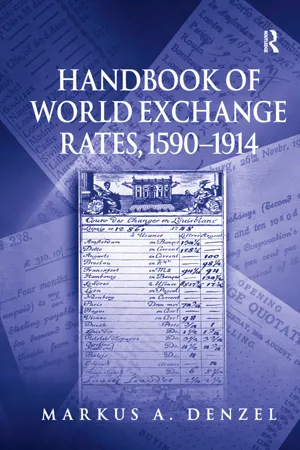
As a world economy emerged from the 16th-17th centuries onwards, a global cashless payment system arose. This had its base in Europe, first in Italy, then in the rising regions of the north-west, with Amsterdam and then London as the central financial market. The mutual quotation of exchange rates, which provide the data tabulated and analysed here, mark the integration into a global network of all areas with significant economic potential. The primary aim of this book is to provide a compact account of the exchange rates in all these financial markets, from the late 16th century up to the First World War. This makes possible an instant conversion between the major world currencies at nearly any date within that period, while the important introduction provides the explanation and context of developments. The present handbook therefore serves as an invaluable resource for those concerned with all aspects of commercial and financial history.
EUROPE
1
England/Great Britain (1590–1914)
Exchange market: London (1590–1914)
Sources: MCCUSKER / HART [1979], pp. 697–700 (1590–1660); MCCUSKER [1978], pp. 37f., 56f., 75f., 93f., 103, 110 (1660–1697); IISG Amsterdam, The Prices of Merchandise in London (1667); ibid., Prix Courant des Marchandises a Londres (1668, 1671–1675, 1679/80, 1682, 1684/85); ibid., The Merchants Remembrancer, London (1680); ibid., Le Memorial Des Marchands, Londres (1681– 1683, 1685); The Course of the Exchange, and Other Things (1698–1850); The Economist, London (1850–1914). For the India Exchange: The Oriental Observer, Calcutta (1830–1832); The Economist, London (1858–1882); Indian Daily News / The Overland Summary of the Indian Daily News, Bengal Hurkarn and Indian Gazette (1883–1885, 1897–1901); GRUBER [1890], pp. 37–40 (1885–1889).
Concordance: WdW III, pp. 113–122; WdW I/II, pp. 3–110; WdW VII, pp. 361–364; WdW IV, pp. 337–371; WdW II, pp. 66, 107–115
Currency: Since the Middle Ages the pound sterling at 20 shillings of 12 pence had been the currency unit of England, gold and silver being equally accepted as currency metals since 1423. Although a gold coin with a value of 1 pound, the so-called ‘sovereign’, had already been minted for the first time in 1489 and had gained greater importance for payment transactions after 1544, the shilling remained the most important money of account until late into the 17th century – especially within the exchange transactions – and silver did so as the most important currency metal. However, the silver money lost so much of its value at the end of the 17th century, above all after 1690, as a consequence of the Third Anglo-Dutch War (1672–1674) and the Nine Years’ War (War of the League of Augsburg, 1689–1697) that on average only 48% of its expected weight was left in 1696 (cf. QUINN [1996], passim). Therefore, on the one hand, the premium on unminted silver money and the export of English silver was generally forbidden in 1695 (in 1696 this regulation was extended to gold coins) and, on the other hand, the withdrawal and the reminting of the English silver money was ordered. Thus the old silver money disappeared from circulation but since a new one could not be minted very quickly, gold coins became more and more important as means of payment, although bills of exchange and the notes of the Bank of England, founded in 1694, should normally have been paid with silver. It was not until the reminting was finished in 1699 that the English monetary system regained its position at the time before 1672, and in November 1696 the rate on Amsterdam once again exceeded the parity, since exchanges on the Netherlands could then be paid again with full weighted silver coins. It was also possible to force the premium for gold coins – to be more precise, for the ‘guineas’ minted since 1663 (officially at 20 shillings) – which had risen up to 30 shillings in 1695, in various steps down to 21½ shillings until 1699. This tariffing was immediately accepted in trade as well. Thus gold money circulated again in payment transactions after it had become a trade coin since the end of...
Table of contents
- Cover
- Half Title
- Title Page
- Copyright Page
- Table of Contents
- Introduction
- Sources and Bibliography
- Europe
- America
- Asia
- Australia/Oceania
- Africa
Trusted by 375,005 students
Access to over 1.5 million titles for a fair monthly price.
Study more efficiently using our study tools.
Frequently asked questions
Yes, you can cancel anytime from the Subscription tab in your account settings on the Perlego website. Your subscription will stay active until the end of your current billing period. Learn how to cancel your subscription
No, books cannot be downloaded as external files, such as PDFs, for use outside of Perlego. However, you can download books within the Perlego app for offline reading on mobile or tablet. Learn how to download books offline
Perlego offers two plans: Essential and Complete
- Essential is ideal for learners and professionals who enjoy exploring a wide range of subjects. Access the Essential Library with 800,000+ trusted titles and best-sellers across business, personal growth, and the humanities. Includes unlimited reading time and Standard Read Aloud voice.
- Complete: Perfect for advanced learners and researchers needing full, unrestricted access. Unlock 1.5M+ books across hundreds of subjects, including academic and specialized titles. The Complete Plan also includes advanced features like Premium Read Aloud and Research Assistant.
We are an online textbook subscription service, where you can get access to an entire online library for less than the price of a single book per month. With over 1.5 million books across 990+ topics, we’ve got you covered! Learn about our mission
Look out for the read-aloud symbol on your next book to see if you can listen to it. The read-aloud tool reads text aloud for you, highlighting the text as it is being read. You can pause it, speed it up and slow it down. Learn more about Read Aloud
Yes! You can use the Perlego app on both iOS and Android devices to read anytime, anywhere — even offline. Perfect for commutes or when you’re on the go.
Please note we cannot support devices running on iOS 13 and Android 7 or earlier. Learn more about using the app
Please note we cannot support devices running on iOS 13 and Android 7 or earlier. Learn more about using the app
Yes, you can access Handbook of World Exchange Rates, 1590–1914 by Markus A Denzel in PDF and/or ePUB format, as well as other popular books in Business & Foreign Exchange. We have over 1.5 million books available in our catalogue for you to explore.