- 448 pages
- English
- ePUB (mobile friendly)
- Available on iOS & Android
eBook - ePub
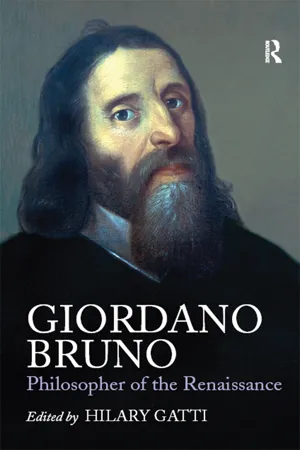
Giordano Bruno: Philosopher of the Renaissance
About this book
Giordano Bruno was burnt at the stake in Rome in 1600, accused of heresy by the Inquisition. His life took him from Italy to Northern Europe and England, and finally to Venice, where he was arrested. His six dialogues in Italian, which today are considered a turning point towards the philosophy and science of the modern world, were written during his visit to Elizabethan London, as a gentleman attendant to the French Ambassador, Michel de Castelnau. He died refusing to recant views which he defined as philosophical rather than theological, and for which he claimed liberty of expression. The papers in this volume derive from a conference held in London to commemorate the 400th anniversary of Bruno's death. A number focus specifically on his experience in England, while others look at the Italian context of his thought and his impact upon others. Together they constitute a major new survey of the range of Bruno's philosophical activity, as well as evaluating his use of earlier cultural traditions and his influence on both contemporary and more modern themes and trends.
PART ONE
Introduction
CHAPTER ONE
Giordano Bruno as Philosopher of the Renaissance
While the title of my chapter – a title which to a large extent coincides with that of the conference itself – might at first sight seem quite unproblematic, on reflection it reveals itself quite questionable from various angles. Unproblematic at first sight because the philosopher in question does chronologically belong to a period of European cultural history which since the nineteenth century has been included in a wider period historiographically labelled as the Renaissance. Already at this factual chronological and descriptive level, however, marginal doubt could be raised. Although Giordano Bruno’s life started in 1548 and ended in the year 1600, his extant works – the only ones on which we can base our judgement – date from 1582; and men of my generation cannot forget that in the 30s and early 40s of the last century, when Italian historians were busy suggesting a periodization for the literary and philosophical output of the past – not unlike their counterparts in the field of the history of art, who had found an indeed easy solution by adopting a periodization by centuries (the Trecento, the Quattrocento, Cinquecento and so on) – for the literary and philosophical output as well, the Italian historians, or some of them, adopted a similar periodization. This is still generally accepted in the histories of literature, albeit with some variations, by which, for example, the Cinquecento, or sixteenth century, does not terminate at the end of the sixteenth century but, for reasons not entirely evident to me, 20 years earlier, namely in 1580, while the Seicento, or seventeenth century, in its turn, does not terminate at the end of the seventeenth century but in 1690, in coincidence with the foundation of the Arcadia Academy. If this is the case, Bruno’s extant production would not find a place within the Renaissance Cinquecento, but rather in the following baroque and scientific Seicento. But let us put aside or even forget altogether such subtle questions of periodization. There is, on reflection, another more recent difficulty inherent in the very concept of the Renaissance, a concept which is becoming a historiographical notion in the process of extinction. It was only last year that – partly in coincidence with what the illustrious critic of English Literature, Frank Kermode, had to say in his 1998 Presidential Address to the Modern Humanities Research Association – I deplored such a process which seems to be due to the misconceived persuasion that the term ‘Renaissance’ is not, to use a current expression, politically correct. This is because it would seem to imply the approval of a male-dominated society and culture, and also to be partial, in its implicit exaltation of artistic and literary values, at the expense of civil and social considerations. To this could be added that the term itself is semantically conservative in that it implies the revival of a culture belonging to the classical past. I deplore the recent tendency of historians and critics – prevalently American (but which seems to have extended to most European countries, including Britain and Italy) – by which a new terminology is being applied to historical and cultural notions: a change which, however, does not necessarily find correspondence in an actual change of method. So, in our particular case, it has happened that, in the English-speaking countries, the term Renaissance used in an adjectival way has been substituted by the compound adjective ‘Early Modern’ (for example, Early Modern England, or Italy and so on). To the partialities mentioned earlier, new ones have been substituted, which are implicit in the new expression. Among the most obvious I would like to note the inversion of the referential pole – classical antiquity has been substituted by modern civilization; art and literature by science (also modern, if not altogether contemporary), not to mention technology and so on. However, it is not by changing terminology that the objective meaning of observed phenomena can be altered. In fact, between the two poles – classical and modern – the phenomena themselves continue to appear equidistant, as was clearly formulated (long before the present preoccupation with terminology took place) by that great student of humanism and the Renaissance, Eugenio Garin. In a preliminary Note (Avvertenza) to the first edition (dated 1970) of his collection of essays entitled Dal Rinascimento all’Illuminismo (From the Renaissance to the Enlightenment) Garin wrote with reference to the Italian humanism of the early fifteenth century that: ‘Initially, the going back to the past and the coming back of the past basically expressed a project fed by a myth and which in its turn nourished that myth, namely the myth of classical Graeco-Roman civilisation as a model to be imitated.’
Quite soon, however, continued Garin, another myth was emerging, overlapping with the previous one, that of the very ancient origins of ‘truth’, of a prisca sapientia, or ancient wisdom, revealed throughout time. Thus the contradiction of a radical renewal presented as a going back to the past (a revolutio understood as a cyclical process) is complicated by the ambiguity of a rebirth which sometimes seems to indicate simply the constancy of a rhythm, not, however, the identical repetition of previous stages in an unavoidable necessity, but the duration of categorical forms in a progressive ascension.

1.1 Frontispiece of Giordano Bruno, Camoeracensis Acrotismus, 1588, with autograph dedication by Bruno.
Garin himself, in that very Note, issued a warning against the abuse of pseudo-categories and artificial schema such as a Christian renaissance, a classical humanistic renaissance or the scientific revolution, given the impossibility of accommodating single personalities within any of them.
However, if – mainly by reference to sixteenth-century Italian personalities – we take the term Renaissance to indicate a dynamic period of cultural history which by looking back, through the classical civilization, to the prisca philosophia, tries to develop (if only intuitively) the data acquired by the so-called ‘new science’, then a philosopher like Giordano Bruno can legitimately be considered not only as a Renaissance philosopher, but as the Renaissance philosopher par excellence – a consideration which remains valid even if we take the notion of Renaissance as implying the versatility of some of the most representative personalities of the period. On both counts I shall attempt to show the validity of my statement by way of reference to his works, which so intrinsically reflect the vicissitudes of his life, having in mind at least three main components of the works themselves, that is, apart from the philosophical proper, the other main expressions of his thought, the dramatic and the poetic (not to mention the xylographic component as shown by both his geometrical and his mnemotechnical diagrams, which were engraved by himself for the first editions of his works).
Bruno’s extant works were all produced within a decade of his life, namely between the year 1582 – when the first of his mnemotechnical works (the De umbris idearum) appeared in Paris – and the year 1591 when his three Latin poems appeared in Frankfurt on the Main: in order of publication the De minimo and the De monade, followed by the De immenso, although the latter preceded in order of composition. That was Bruno’s last year of freedom. In May 1592 he would be arrested in Venice, accused of heresy, and between Venice and Rome he would be subjected to an inquisitional trial which would end with the burning at the stake on 17 February 1600.
To go back to his production in print, if the De umbris idearum (The Shadows of Ideas) reveals by its very title a Neoplatonic characteristic, the tangible world being considered as a reflection of the Idea, and ‘to know’ meaning to go through the shadow of the ideas in order to reach a fragmented unity; on the other hand, as has recently been pointed out by Yves Hersant (in Le Monde of 17 February 2000) though Bruno was fascinated by diversity, by varietas – making it look as if he had forgotten unity as his goal – in point of fact the question of the One and the multiple was posed. As Hersant again points out, Bruno detached himself from the Neoplatonic tradition, which puts Unity above and diversity below, postulating a kind of ladder of being in which, ontologically, the various was of an inferior quality compared with the One. For this vertical axis Bruno substituted a horizontal one, abolishing any hierarchical distinction. This was an anticipation, and almost a conditio sine qua non, of his subsequent cosmological conception, which found a parallel in his sociological and literary conceptions. The initial year of the already mentioned decade saw also the publication, again in Paris, of his only comedy: the Candelaio, which is basically a satire of ill-directed human passions as exemplified by the elderly Bonifacio’s infatuation for a courtesan, by the gold-obsessed character Bartolomeo, and by Mamfurio’s grammarian pedantry not to mention his paedophile tendencies. These three negative characters are contrasted by the ‘positive’ character Gio. Bernardo (a name which not by chance is paraphonic of the author’s): a character whose love for the beautiful young wife of Bonifacio will be fulfilled and – albeit illicit – implicitly condoned by the author, in view of its naturalness. This is not unlike the conclusion of that other great Renaissance comedy, Machiavelli’s Mandragola (produced in 1518), which condones the adulterous relation of Callimaco and Lucrezia (not without expressing an irony in her name) in view of the natural basis of their reciprocal attachment. In the case of both Bruno and Machiavelli, it seems that the theoretical naturalism of their times found a practical application to human passions, irrespective of social and moral conventions.
As for Bruno’s natural philosophy, we have witnessed, particularly during the last decade, a revaluation, certainly in Italy, in France and in Spain, not quite to the same extent in Britain, and only marginally in America, a reaction against the previous predominant interpretation of Bruno’s thought as exclusively Hermetic magic. This interpretation emphasized the cultural mediation of Ficino’s Neoplatonism and originated, at least in such exclusive terms, in 1964, with the publication in London of the well-known volume by the great Bruno scholar, Frances Yates. The volume was entitled Giordano Bruno and the Hermetic Tradition, and it conditioned for well over two decades the field of Bruno studies in Europe and in America, although – if I may be allowed a personal reference – soon after receiving the volume in 1964, in a review of the same which appeared in the following year, I expressed my reservations about a global magic-Hermetic interpretation of Bruno’s work, while recognizing the great merit of Frances Yates in her indication – not without some exaggeration – of recurrent traces of Hermeticism in his works. Actually they appear to be prevalently imbued with a materialistic naturalism of a kind which, at the last stage of his production with the poetic trilogy published in Frankfurt, notably in the De minimo, will reveal itself as a kind of universal atomism. This is the last stage, indeed, in the development of a Renaissance natural philosophy which, moving from fifteenth-century humanistic premises, would yield its mature fruits in the first half of the seventeenth century with Galileo’s major work, namely the Dialogo sui due massimi sistemi del mondo, il tolemaico e il copernicano (1632), Galileo’s own conception of matter not being alien to atomism.
After a brief season of mnemotechnical production between Paris and London (1582–83) – a production which, although utilizing a Neoplatonic terminology, nonetheless reveals some anticipation of his successive astronomical and cosmological conception (including an allusion to the movement of the earth) – Bruno proceeded, during his London stay (1583–85), towards the elaboration and publication, between 1584 and 1585, of his six philosophical dialogues written in the Italian vernacular. Three of these were of a cosmological bearing and three of a moral bearing (the first two of the latter group having a strong satirical intent, while the third and last of the entire series reveals a remarkable poetic inspiration). Already at this stage of Bruno’s activity we can discern a characteristic of his personality which seems to conform not only with the widespread conception of a Renaissance man endowed with multifarious attitudes, but, more specifically, with a Renaissance philosopher, in that his thought combines a renovation of ancient tenets with an anticipation of what will historically follow, notably in the field of cosmology. This characteristic of his personality is also consistent with the rejection of the sterile grammarian humanism of the late sixteenth century. Parallel to this, we find the repudiation of the Petrarchan models relaunched by Pietro Bembo at the beginning of the century, in spite of their reutilization at the level of poetic expression in the last of Bruno’s Italian Dialogues, albeit in a semantic adaptation by which the explicit love content of the Petrarchan models is implicitly substituted – without any analogy with the so-called ‘spiritual’ Petrarchism in a Christian direction – by the frustrated attempt to reach a transcendental divinity; an attempt followed by the satisfactory realization of the immanency of the divinity in the infinite universe, as well as in all living creatures. Here we have a conception by which the humanistic notion of the ‘dignity of the human being’ is surpassed in the passage from a dignity consisting in the intermediate position of humans between brute animals and spiritual creatures towards a conception of humans as participating in the divinity of the infinite universe.
In fact, as he revealed in his cosmological Dialogues, which move from the premise of a Copernican heliocentricity, Bruno declared his ultra-Copernican and anti-Aristotelian intuition of an infinite Universe constituted by an unlimited number of celestial bodies (possibly inhabited) grouped, or otherwise, in an equally unlimited number of planetary systems, the substance of which does not differ from that of the earth. Thus he eliminated the Aristotelian dualism of a corruptible sub-lunar world and a celestial (still limited) extension formed of an incorruptible substance, the so-called quintessence. Parallel to such a cosmological perspective, another Aristotelian distinction was eliminated, this time at the ontological level: that between passive matter and the active form and, by extension, between the world and God. The divinity is identified with Being, which is matter itself, producer of all forms, as well as being recognizable in interiore hominis (inside man himself).
Such a cosmological and ontological conception, in which there is no room for metaphysical components, is expounded first of all in the cosmological dialogues, the Cena de le Ceneri (The Ash-Wednesday Supper), the De la causa, principio et Uno (Concerning the Cause, the Principle and the One), De l’infinito, universo et mondi (Concerning the Infinite, the Universe and the Worlds), of which the first reflects the recent break on his part with the Oxonian Aristotelianism as well as with the belatedly renewed grammarian and rhetorical humanism of the same university. To this he opposes, in this first of his Dialogues, with enthusiasm and exaltation, his already mentioned cosmological conception; not without, at the same time and in the same work, taking the opportunity to attack both the English academic trends and the London society of the time in its various strata, with the exception of the Elizabethan court. Between 1584 and 1585 he proceeded with the publication of his subsequent three dialogues still in London and in the same Italian vernacular – a linguistic choice which, as I suggested in an essay of 1953 on Bruno’s adoption of the vernacular in his London philosophical dialogues and only in those, may well be due not only to the Italianate fashion predominant in the Elizabethan court, but also, by analogy, to the fact that English scientists such as Robert Recorde, Leonard Digges and his son Thomas, who had shown interest in the Copernican heliocentricity, were expressing themselves, outside the universities, in their own vernacular. These writers were publishing under the patronage of those very Italianate courtiers who in their turn favoured astronomical observations for their practical application to the maritime expansionistic policy favoured by the queen herself. This could indicate, by analogy, another aspect of Bruno’s pertinence to a Renaissance trend: were it not for his strong (and exceptional at that date, on the part of an Italian observer) opposition to the methods of the European colonization of the New World.
In this respect, Bruno seems to accept, in the organization of human society, a variety of civilizations: a variety which was unacceptable to the European mentality of his own times (and, alas, of subsequent times), conditioned as it was by a particular religious conception of life, in its turn subdivided in a variety of differentiated interpretations which had already led to bloody struggles within Europe itself and extreme intolerance within its states. Paradoxically, Bruno’s own advocacy of reciprocal tolerance between different Christian denominations often assumed the tone of an extreme polemical attitude, which, however – meant, as it was, not for the vulgus of the faithful, but for their leaders – seemed to be prompted by what can be described as one of the typical Renaissance conceptions of religion, namely the Machiavellian one, which – not without an Averroistic inspiration – seemed to advocate religion entirely for pragmatic purposes of a civil and social nature. Here we can detect yet another characteristic of the Renaissance civilization in its concern for life in this world, as distinguished from the prevalent medieval concern for transcendency and mysticism.
But to proceed with a rapid survey of the philosopher’s extant production in print – in order to point out (explicitly or implicitly) the pertinence of his thought both in its external traits and in its inner substance, to a line of production describable as rinascimentale – we can note that in the three cosmological Dialogues (Cena, Causa and Infinito) the main external structures correspond to those of the Renaissance ‘regular’ comedy in the vernacular. The preliminary epistle merges the prologue and argument of the latter; while the five dialogues contained in each of the cosmological Dialogues correspond...
Table of contents
- Cover
- Half Title
- Title Page
- Copyright Page
- Table of Contents
- List of Illustrations
- List of Contributors
- Preface
- Acknowledgements
- List of Abbreviations
- Part One Introduction
- Part Two Bruno and Italy
- Part Three Bruno in England
- Part Four Philosophical Themes
- Part Five Influence and Tradition
- Index
Trusted by 375,005 students
Access to over 1.5 million titles for a fair monthly price.
Study more efficiently using our study tools.
Frequently asked questions
Yes, you can cancel anytime from the Subscription tab in your account settings on the Perlego website. Your subscription will stay active until the end of your current billing period. Learn how to cancel your subscription
No, books cannot be downloaded as external files, such as PDFs, for use outside of Perlego. However, you can download books within the Perlego app for offline reading on mobile or tablet. Learn how to download books offline
Perlego offers two plans: Essential and Complete
- Essential is ideal for learners and professionals who enjoy exploring a wide range of subjects. Access the Essential Library with 800,000+ trusted titles and best-sellers across business, personal growth, and the humanities. Includes unlimited reading time and Standard Read Aloud voice.
- Complete: Perfect for advanced learners and researchers needing full, unrestricted access. Unlock 1.5M+ books across hundreds of subjects, including academic and specialized titles. The Complete Plan also includes advanced features like Premium Read Aloud and Research Assistant.
We are an online textbook subscription service, where you can get access to an entire online library for less than the price of a single book per month. With over 1.5 million books across 990+ topics, we’ve got you covered! Learn about our mission
Look out for the read-aloud symbol on your next book to see if you can listen to it. The read-aloud tool reads text aloud for you, highlighting the text as it is being read. You can pause it, speed it up and slow it down. Learn more about Read Aloud
Yes! You can use the Perlego app on both iOS and Android devices to read anytime, anywhere — even offline. Perfect for commutes or when you’re on the go.
Please note we cannot support devices running on iOS 13 and Android 7 or earlier. Learn more about using the app
Please note we cannot support devices running on iOS 13 and Android 7 or earlier. Learn more about using the app
Yes, you can access Giordano Bruno: Philosopher of the Renaissance by Hilary Gatti in PDF and/or ePUB format, as well as other popular books in History & World History. We have over 1.5 million books available in our catalogue for you to explore.