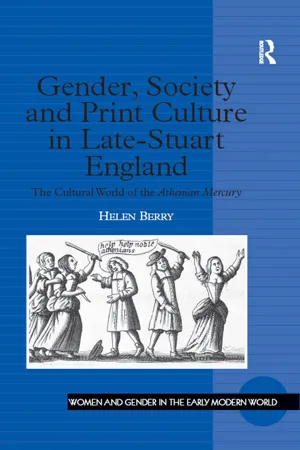
eBook - ePub
Gender, Society and Print Culture in Late-Stuart England
The Cultural World of the Athenian Mercury
- 280 pages
- English
- ePUB (mobile friendly)
- Available on iOS & Android
eBook - ePub
Gender, Society and Print Culture in Late-Stuart England
The Cultural World of the Athenian Mercury
About this book
Focusing on a largely unknown type of popular print culture that developed in the late 1600s-the coffee house periodical-Helen Berry here offers new evidence that the politics of gender, far from being a marginal or frivolous topic, was an issue of general interest and wide-spread concern to the early modern reader. Berry's study provides the first full length analysis of John Dunton's Athenian Mercury (1691-97), an influential specimen of the coffee-house periodical genre, as well as the original question-and-answer publication which addressed both men's and women's issues in one journal. As the chapter headings in this book indicate, the topics addressed in the "agony column" of the Athenian Mercury-for example, the body, courtship, and sex-are of enduring interest across the centuries. Berry's study of this periodical provides new insights into the gendered ideas and debates that circulated among middling sorts in early modern England. An historical survey of the social effects of mass communication in the early modern period, this volume makes an important contribution to the ongoing study of how gendered ideas and values were communicated culturally, particularly beyond the milieu of elite groups such as the nobility and gentry. It argues that the mass media was from its infancy an important means of communicating powerful messages about gender norms, particularly among the middling sorts. The study will appeal not only to historians, women and gender studies scholars and literature scholars, but also to scholars of publishing history.
1 Introduction: Pressing Anxieties
The person who pretends to advise does, in that particular, exercise a superiority over us, and can have no other reason for it, but that in comparing us with himself, he thinks us defective either in our conduct or our understanding. For these reasons, there is nothing so difficult as the art of making advice agreeable.
The Spectator (October 17, 1721).
This book is about gender and print culture and the historical roots of the dynamic relationship that exists between the two. The proliferation of books on gender history has, by now, ensured that the topic is by no means a marginal one, with standard works on early modern England incorporating without compunction the obligatory chapter (or indeed few pages) on ‘women’ or ‘gender’ (the two are still often used interchangeably).1 The reader may balk at the prospect of another tome on the subject. Yet, for all the volumes that have now been written on gender as a primary ‘dialectic of power’2 in history, we are still only just beginning to gauge the precise mechanisms through which dominant discourses in society shape our understanding of the ‘natural’ expression of the innate capacities of both sexes.3 Moreover, our attention to the question of gender is still myopic in its over-emphasis upon the female sex. For example, one corollary of the trend for regarding ‘women’s history’ as ‘gender history’ is that the focus of gender history is often assumed to be those areas which were undoubtedly of particular relevance to women’s lives, notably the private sphere of marriage, the household, and childbearing.4 This tends to encourage a false dichotomy between public and private spheres along gender lines. Certain aspects of life may be seen to be of mutual interest to men and women, while others may be deemed to be of specific male or female concern at different historical moments, but there may also be a considerable overlap between the two.5 The delineation of gender roles is unintelligible unless regarded as a mutually interdependent process which counterbalances male and female roles. The term ‘gender’, as deployed throughout this book, is taken to be a fluid and relational concept which changes over time, and differs according to cultural setting.6 Within this analytical framework, the male gender is taken to be as much a social construction as the female.7
One political objection to the study of gender history rather than women’s history is that it supposedly elides political inequalities by fostering the impression that men experienced as many problems and limitations upon their lives as women by virtue of their gender alone. There is no doubt that early modern England, which is the particular subject of this book, was essentially a patriarchal society in which women’s subordination was enshrined in the institutional power structures of the church, legal system, household and government. One example of this is that married women were not regarded in common law as individuals, but femes covert, whose legal personalities were merged with those of their husbands.8 Another is that all women (as well as the majority of the male population at this time) were disenfranchised. Women below the ranks of the nobility had little access to education, all women were debarred from the universities, thus ensuring that they had no place in the professions, and fewer opportunities than men to earn their own living. Within marriage, the church taught that a wife’s duty was to obey her husband – the ideal wife was one who kept silent, chaste and obedient.9 While it is important not to lose sight of these inequalities, privileging the victimization of women seems to be a distorted, and essentially meaningless project, particularly when separated out from specific cultural circumstances and the distinctions of social rank.10 The idea that men and women ought to behave appropriately in their prescribed roles according to their sex and social status was an official desiderata that was often undermined by the variables of personality, location and circumstance. In spite of the many insights gained in recent years through the work of historians in this field, the distance between prescription and practice means that many questions remain unanswered. In what conditions, for example, did men and women appropriate, enact, or test the boundaries of, their prescribed roles? To what extent did relationships between men and women in early modern England involve an element of negotiation?
An additional problem in the study of gender history, besides the political debates about where the focus of emphasis ought to lie, is that of sources. Too often it is a case of the ‘cart leading the horse’: the further back in time one goes, the fewer sources there are available. No matter how much we attempt to read against the grain, the plain fact is that the vast majority of people (including the vast majority of men, as well as most women) left no written record of their lives. Rare personal written records, such as diaries, letters, and autobiographies have increasingly been scrutinized for the information they contain about aspects of gender relations in early modern England. Anthony Fletcher, for example, included several case studies of married couples in a wide-ranging survey of gender history, using evidence from private correspondence and diaries.11 The late Alan Bray in his pioneering work on masculinity employed the diary of Thomas Wigglesworth to explore otherwise ‘hidden’ aspects of men’s attitudes to sex in the mid-seventeenth century.12 Linda Pollock used diaries and autobiographical works to explore parent/child relationships in the pre-modern period,13 and surveys by Ralph Houlbrooke and Keith Wrightson employ diaries and autobiographies to illuminate aspects of early modern marriages and family life.14 Personal written records have thus proved their value as historical sources, but they are limited in number. Another drawback is that fewer were written by women than by men, and they tend to reflect only the lives of the upper ranks of society (especially the nobility and gentry).15 Diaries and autobiographies may also be biased as forms of self-representation, skewed by the author’s subjective portrayal of themselves and others, and selective in content. Many were written for spiritual purposes, and therefore focus primarily upon religious experience. Historians have thus had to look elsewhere for primary material. Some have turned to court records, pursuing fruitful subjects such as the gendered use of language in defamation cases involving women, and the diverse strategies which women could employ in bringing law suits.16 The study of court records by historians such as Martin Ingram, Tim Stretton and Laura Gowing has certainly provided welcome new insights into the lives of ordinary men and women. None of these sources provides an unproblematic ‘hotline’ to the past, however: as with diaries and letters, legal records are flawed as historical sources, in this case, the difficulty is that they are primarily about disputes and/or deviancy, and are mediated through the words set down by the clerk of the court.
Given the relative scarcity of other sources for the early modern period, print culture (particularly popular literature and ephemera beyond the well-worked canonical texts) has greater potential to contribute to the history of gender in the early modern period than has yet been realized.17 Indeed, it is a central contention of this book that print culture was a crucial form of mass communication and thus a significant means of constructing and transmitting ideas about gender norms in society. The use of printed sources by historians is by no means new, but interest in popular literature has undoubtedly gained ground in recent years, thanks in particular to historians of the family. J. A. Sharpe, for example, has used popular literature to show how plebeian marriage was depicted in Stuart England,18 while Elizabeth Foyster uses ballad literature and plays in her studies of early modern manhood and marital violence.19 As with other sources, printed texts have their problematic aspects. These include doubts over whether the opinions they contain are representative, the distorting effect of commercial motives upon text production, and their unknown contemporary impact, given the subtle and diverse responses which were likely to have been elicited in contemporary readers.20 These texts would be useless as historical documents without an appreciation of their context and contemporary reception. The term ‘print culture’, as deployed in this book, thus encompasses not only the wide variety of popular, mass-produced genres mentioned (from periodicals to chapbooks, plays to ballad literature) but also the material aspects of the texts themselves, and the social context of their production and consumption. There can be little doubt that, when employed with due caution, print culture has the potential to yield information on otherwise hidden aspects of life in early modern England. By highlighting this influential form of cultural communication about gender, and the values which were thereby upheld, we shall gain a deeper understanding of how such roles were defined and ingrained in the past.
The term ‘late Stuart’ was used in the title of this book to denote the chronological scope of the majority of printed and manuscript sources marshaled in the course of research, which date mainly from the Restoration to the reign of Queen Anne. Within this broader chronology, a focus emerges upon the 1690s, a crucial decade of change in English history that also witnessed the publication of one of the most original and culturally-significant works to have emerged from the popular press at this time. Its full title is the Athenian Gazette, or Casuistical Mercury, Resolving all the most Nice and Curious Questions proposed by the Ingenious of Either Sex (1691–7), but it is more usually known by its short title, the Athenian Mercury. The periodical as a genre, and the Athenian Mercury in particular, belongs to the world of coffee houses and animated debate characteristic of a new form of urban sociability that emerged in late-seventeenth century England. A productive combination of new print technologies, rising literacy and philanthropic experimentation with printed genres facilitated the rise of what we would now recognize as an embryonic mass media.
The Athenian Mercury was the brainchild of a roving publisher of precarious reputation, yet it has provided one of the most valuable, and underrated, cultural documents of its era. It was published and edited by the London bookseller John Dunton between 1691 and 1697, and has several claims to our attention, chiefly because it was the first periodical to solicit readers’ letters, and also because it was the only seventeenth-century periodical to appeal deliberately to both male and female readers. The authors invited their readers to explore points of tension in all aspects of human life, the first time that such subjects had been addressed in the public sphere by, and on behalf of, ordinary men and women beyond the social élite. As such, it is a vital and unique ‘public transcript’ of their lives and concerns, addressing the gap between the distinct but overlapping spheres of private and public interest.21 The Athenian Mercury delineates, yet challenges, dominant ideas about gender at the time, revealing tensions and contradictions that rattled hegemonic discourses on the subject. More than this, it provides a route into a traditional mental world that was being tested by novel ideas and questions. This book is shaped by the debates present within the text of the Athenian Mercury. It also draws upon a much wider range of contemporary (mostly printed) material in order to broaden out the thematic and chronological investigations into the contemporary mentalités that intertwined, and indeed collided, in the early modern world.
Three main themes are dealt with in the following chapters, and are grouped according to their primary concern: the body, courtship and sexual behaviour. These themes relate crucially to the history of gender, and recurred throughout the text of the Athenian Mercury. It is often extremely difficult to find contemporary evidence for these subjects beyond the social élite at this time. Ludmilla Jordanova and Londa Schiebinger have used eighteenth century medical texts to study sex difference in relation to gender construction.22 Other historians have drawn upon a combination of sources, such as the surveys of early modern sexual behaviour by Tim Hitchcock and Michael McKeon, which employ court records, literary evidence, and personal written records.23 There are fewer histories still of courtship per se, and those surveys which do exist, such as Diana O’Hara’s comprehensive survey of courtship in the diocese of Canterbury, are again based upon court records and diaries.24 It is therefore rare to find a popular periodical like the Athenian Mercury, which covered all of these subjects within one printed text, and represented both male and female viewpoints. As we shall see, this periodical represented a new type of dialogue, between an anonymous ‘club’ of experts and their reading public, offering novel debates on ancient themes that were framed within the unparalleled circumstances of late-seventeenth century urban society.
Chapter Outline
The first four chapters of this book provides a historical context and theoretical framework for interpreting the Athenian Mercury, locating the periodical among other contemporary publications, and examining in detail the relationship between the text and its readers. Chapter two starts with a survey of London and its coffee house society at the end of the seventeenth century. It provides a close study of how Dunton’s periodical was compiled and disseminated, including the many forms in which it was purchased and read. This is followed by a brief biographical overview of the Athenian Mercury’s editor and co-authors. Reasons why such a publication was popular at this time are considered in the context of the prevailing influence of the Reformation of Manners campaign at this time. Chapter three proceeds to a critical evaluation of whether the questions contained within the periodical were authentic reproductions of readers’ letters, and whether women as well as men were integral to the project. The demographic profile of the periodical’s readership according to social status is considered in chapter four, which proposes that the middling sort of people were those for whom the Athenian Mercury would have been of most interest and relevance.
Chapter five concern...
Table of contents
- Cover
- Half Title
- Title Page
- Copyright Page
- Dedication
- Table of Contents
- List of Illustrations
- Preface
- List of Abbreviations
- 1 Introduction: Pressing Anxieties
- 2 Coffee Houses, Print Culture and the Public Sphere
- 3 Authenticity and Women Readers
- 4 The Community of Readers
- 5 Casuistry and the Ambiguity of Advice
- 6 Interpreting the Body
- 7 Courtship Dilemmas
- 8 Problems with Sex
- 9 Questioning Friendship
- 10 Conclusion
- Tables
- Bibliography
- Index
Trusted by 375,005 students
Access to over 1.5 million titles for a fair monthly price.
Study more efficiently using our study tools.
Frequently asked questions
Yes, you can cancel anytime from the Subscription tab in your account settings on the Perlego website. Your subscription will stay active until the end of your current billing period. Learn how to cancel your subscription
No, books cannot be downloaded as external files, such as PDFs, for use outside of Perlego. However, you can download books within the Perlego app for offline reading on mobile or tablet. Learn how to download books offline
Perlego offers two plans: Essential and Complete
- Essential is ideal for learners and professionals who enjoy exploring a wide range of subjects. Access the Essential Library with 800,000+ trusted titles and best-sellers across business, personal growth, and the humanities. Includes unlimited reading time and Standard Read Aloud voice.
- Complete: Perfect for advanced learners and researchers needing full, unrestricted access. Unlock 1.5M+ books across hundreds of subjects, including academic and specialized titles. The Complete Plan also includes advanced features like Premium Read Aloud and Research Assistant.
We are an online textbook subscription service, where you can get access to an entire online library for less than the price of a single book per month. With over 1.5 million books across 990+ topics, we’ve got you covered! Learn about our mission
Look out for the read-aloud symbol on your next book to see if you can listen to it. The read-aloud tool reads text aloud for you, highlighting the text as it is being read. You can pause it, speed it up and slow it down. Learn more about Read Aloud
Yes! You can use the Perlego app on both iOS and Android devices to read anytime, anywhere — even offline. Perfect for commutes or when you’re on the go.
Please note we cannot support devices running on iOS 13 and Android 7 or earlier. Learn more about using the app
Please note we cannot support devices running on iOS 13 and Android 7 or earlier. Learn more about using the app
Yes, you can access Gender, Society and Print Culture in Late-Stuart England by Helen Berry in PDF and/or ePUB format, as well as other popular books in History & World History. We have over 1.5 million books available in our catalogue for you to explore.