eBook - ePub
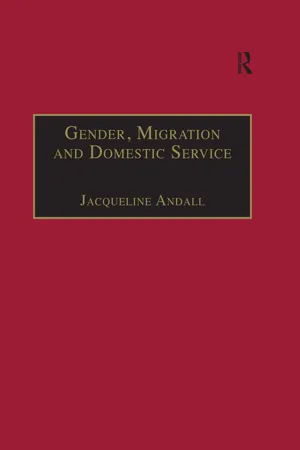
Gender, Migration and Domestic Service
The Politics of Black Women in Italy
- 360 pages
- English
- ePUB (mobile friendly)
- Available on iOS & Android
eBook - ePub
About this book
The book examines the experiences of Black women in Italy from the 1970s to the 1990s. Although Italy is still perceived as a recent immigration country, the book demonstrates how Black women were among the first groups of new migrants to the country. Black women migrating to Italy were employed almost exclusively as live-in domestic workers and detailed attention is paid to the history and political organization of this sector. Unlike much published work in Italian, this book adopts an integrated form of analysis where gender, ethnicity and class are seen to be interconnected constructs. The book also situates Black women within the framework of the national constituency of gender. This approach challenges the ideology surrounding the Italian family and demonstrates that while live-in domestic work created specific forms of social marginality for Black women, it paradoxically allowed Italian women to express their new social identities within and outside the family. The book concludes that Italian women have largely failed in their attempts to transform the division of labour within the home and that the decision to employ other (migrant) women to fulfill household tasks is a trend which sits uneasily within the framework of an inclusive feminist project for women.
Information
1 Italian Gender Models
As in other national contexts, there has been a persistent and as yet unresolved tension between Italian women's reproductive and productive roles. In the post-war period,1 the maternal role of Italian women has historically been privileged above other roles, although more recently there have been moves towards a more equitable accommodation of women's multiple social identities. These trends have led to parallel but differentiated gender models for Italian women and migrant women and in subsequent chapters I will be arguing that, in contrast to Italian women, migrant women's labour identity has been privileged above other social identities. This chapter will establish the nature and direction of Italian debates on women, providing a specifically gendered framework within which to situate the experiences of migrant women. Given that the post-war debate on gender is so vast, I shall concentrate my discussion on providing an account of the tension between family work and paid work with reference to a few limited areas – the Italian Constitution, legislation regarding work and maternity and the empirical realities of women's family and work experiences. The activities of political feminists in the postwar period will also be addressed.
The Constitution
After the defeat of fascism, a Constituent Assembly was elected in June 1946 to establish a new Italian Constitution. The Assembly included members from the dominant political parties – the Christian Democrat Party, the Communist Party and the Socialist Party – and it would be these Catholic and Marxist traditions which would influence the Italian Constitution in different spheres. The most influential Catholic group within the Constituent Assembly was the dossettiani.2 They were keen to include Catholic values into the Constitution and as Bedani (1996, p. 14) has shown their ideal was for the state to 'coordinate social relations as understood in Catholic social teaching'. Although the Catholics' strategy was ostensibly amenable to an accommodation of secularisation, their true goal was to 'keep alive the prospects of a Christian civilisation' (Bedani 1996, p. 15). Moreover, organized Catholicism established a range of committees to guide the dossettiani in issues such as the role of women in society and this influence can be seen in the nature of articles pertaining to women. There are several articles in the Constitution which refer specifically to women.3I shall focus principally on Article 37 as it most evidently embodies the tension referred to above regarding productive and reproductive roles.41 Article 37 is contained within the section of the Constitution which deals with employment and working conditions and reads:
Female workers have the same rights and pay for the same work as male workers. Working conditions must allow them to fulfill their essential family function and ensure a special and adequate protection for mothers and children.
The affirmation that women's working conditions should not stand in conflict with their essential family role appears as indisputable evidence of the perceived importance of the maternal role for women – a role to which all other roles were to be subordinated. The discussion which preceded the eventual acceptance of this article confirmed this. On 8 October 1946, the president of the Drafting Subcommittee opened the discussion on the following draft:
Female workers are assured of the same rights and the same treatment afforded to male workers. Furthermore, they are guaranteed special conditions to allow them to fulfill, along with their work, their family mission.5
The Christian Democrat La Pira wanted to add 'prevalent family mission' (p. 503), while his colleague Moro suggested alteration to 'essential family mission' (my emphases) (p. 503).6
By 1947, the article was being discussed in the Main Assembly as Article 33 in the following formula: Female workers have the same rights and pay for the same work as male workers. Working conditions must allow them to fulfill their essential family function.7
The discussion which took place on 10 May 1947 suggested a fairly consensual vision of women's role. The Christian Democrat member of the drafting Committee of 75, Maria Federici, proposed an amendment which aimed to give even greater emphasis to the maternal role. Federici sought to underline the essential and natural aspect of the maternal role: '... we should be surprised that we need to introduce a norm which is so human and natural' (La Costituzione della Repubblica, Vol. II, p. 1571). Indeed maternal care as opposed to parental care was presented as irreplaceable: 'Mothers are irreplaceable for children in relation to their interior development, their spiritual growth, the formation of their moral world' (p. 1572), Numerous Christian Democrats expressed a similar view regarding the mother's duty to care for her child. Moro, for example, referred to the maternal and family role as functions innate to women.
Speaking on behalf of some of the Left-wing members, the Socialist Angelina Merlin did propose to exclude the adjective 'essential', arguing that its inclusion was both superfluous and indicative of a reductive and outdated model of women's role. She insisted that women's role could no longer be seen as one confined to the family:
We feel that maternity, that is our natural function, is not a condemnation, but a benediction which needs to be protected by the laws of the State without circumscribing and limiting our right to give as much as we know how to and want to in all areas of national and social life ... (ibid., p. 1574).8
The Socialist Ghidini referred to: 'the fulfillment of her highest office' (ibid., pp. 1575-6) proposing the substitution of 'essential' with 'special'. The Socialists tended to argue that 'essential' diminished the male role while 'special' simply differentiated on the basis of function. Within Christian Democrat quarters, a family wage to be paid to the husband was promoted as an appropriate strategy to allow women to fulfill their natural maternal roles:
This is where our specific demand resurfaces; ... that is that salaries are such that the male worker can, with the income from his work, not only live in a dignified manner, but also form, raise, educate and maintain a family in a dignified way (Maria Federici, ibid., p. 1572).
Thus an explicit asymmetry of roles between men and women was included in the Constitution. While there was some consensus over protecting mothers in the workplace, implicit within this was an inevitable tension as to whether the nature of this protection would or indeed should limit women to a dominant role within the family.
Article 29 of the Constitution did establish the legal and moral equality of spouses but then subordinated this equality to the concept of family unity:
The State recognises the family as a natural society based on marriage. Marriage is based on the moral and legal equality of spouses, within the limits laid down by the law to guarantee family unity.9
Despite Article 29 appearing in the above form, it is worth accentuating that Catholics had tried to give priority to the husband. In the drafting committee, the Christian Democrat La Pira was reported as follows:10
. .. despite being perfectly in agreement regarding the moral and legal equality of spouses, he would like the pre-eminent position of the father of the family, as the head of the family, to be more prominent.11
There were also some Catholics more extreme than the Dc. Rodi, for instance, belonged to the Uomo Qualunque Party.12 In the debate he objected to the expression 'moral and equal equality of spouses' because:'... it is clear that we are before a harmonious law of the universe and that this harmonious law has sanctioned, based on natural criterion, the supremacy of the husband over the wife'.13
While the Dc was often cautious and anxious to accommodate the Left as far as it could, the Catholic right often represented a more widespread view. The ideas of the Catholic right were in fact consonant with the ideology of the Church which had adopted an unambiguous line with regard to women's employment. As Pope Pius XII stated in 1945, 'Women who do go out to work become dazed by the chaotic world in which they live, blinded by the tinsel of false glamour and greedy for sinister pleasures'.14
The finalised articles of the Constitution reflected a tension between granting women legal and moral equality while simultaneously privileging women's maternal role above other potential roles and social identities. It has in fact been argued that this intrinsic ambiguity explains the enduring conflict regarding the social construction of women in post-war Italy (Bimbi 1993a).
Maternity and Employment Legislation
An account of post-war maternity and employment legislation is utilised here to ascertain the nature of the state's regulation of these issues in the post-war period. This background information does not simply illuminate the situation for Italian women but is again an indication of the gender context which would also define migrant women's opportunities and circumstances. Like Article 37 of the Constitution, it could be argued that maternity and employment legislation pertaining to women displayed a desire to protect Italian women's maternal role, with an ensuing subordination of their paid employment function. More recently, the evolution of feminist debate within Italy has influenced state legislation, leading to an acceptance of the need to legislate for greater equilibrium between Italian women's work and family roles.
Protective maternity legislation offers a useful indication of the state's perception of the value of the maternal role. When compared to other European countries, Italy's protective maternity legislation is, in theory, quite generous.15 Law 1204, which regulates the protection of working mothers, was introduced in 1971, replacing an earlier law dating back to 1950 (law n. 860). Italian maternity law provides for five months of benefit at an income replacement of 80 per cent (Art. 15). The mother is entitled to a further six months of benefit at an income replacement of 30 per cent (Art. 15). At this stage, the father is permitted to substitute for the mother, but only if the mother expressly waives her right to the benefit.16 During the child's first year of life, the mother is entitled to two hours less work each day (Art. 10). Provision for protection during pregnancy and up to seven months after birth stipulates that women should not do heavy or dangerous jobs (Art. 3). Early maternity leave must also be granted if the woman has health problems related to the pregnancy, if the working environment is considered harmful to mother or baby and if the working mother cannot be moved to a more suitable task within the firm (Art. 5).
These provisions demonstrate a clear desire to facilitate the maternal process. However, there is a tension between the formal regulation of this issue and its informal practice. One of the problems of the maternity legislation is that access to its generous benefits are limited. The provisions do not cover self-employed women, women on short term contracts, women in the informal economy; and categories of workers such as domestic workers and homeworkers are only partially covered by the legislation (see Art. 1). In one of the few studies which address the legislation's functioning in practice, Romito (1993)17 found that most female employees remained at work until the beginning of their maternity leave. Conversely, those women not eligible for maternity benefit tended to continue to work until a few days before birth. In a number of cases, those women employed on short term contracts did not have their contracts renewed. Some women employed in the informal economy were dismissed, while others simply resigned. These findings evidently demonstrate that those women who remain outside the scope of the law suffer severe disadvantages in terms of job protection during and after pregnancy. Those women protected by the law, on the other hand, not only find good legislative provision but are further protected by a generalised consensus which prioritises the maternal role. According to Romito's (1993, p. 588) study, early maternity leave to women protected by the law was often offered and accepted in a fairly liberal way:
Consider the perfectly healthy teacher who stayed at home, fully paid, on the grounds of an alleged threatened miscarriage. None of her family, friends, or colleagues seemed to object to the fact that she and her doctor lied in order to give her the possibility of staying home. The very eagerness with which the leave was requested and accorded suggest that the home is still considered the more appropriate place for a woman, even if she is employed; therefore, a little cheating is acceptable as long as it results in her being led back there.
Some writers have pointed to the ambiguous implications of generous maternity provision in Italy, arguing that it contributes to employers' reluctance to employ women. Padoa Schioppa Kostoris (1993, p. 132) for example sees the 1971 maternity legislation as symptomatic of a policy which 'pays no heed to market reactions or to the perverse effects on the weak party it was supposed to protect'.
The concept of protection in relation to maternity is additionally evident in legislation regulating women's employment. For example, the fascist regime not only legislated to restrict women's employment (e.g. law n. 1514, 1938), but also legislated to protect women from dangerous and unsuitable jobs (law n. 653, 1934). It was only in 1963, that a law was promulgated (law n. 7) to prohibit employers from dismissing married women. This marked an important legislative watershed for Italian women as...
Table of contents
- Cover
- Half Title
- Dedication
- Title
- Copyright
- Contents
- List of Tables
- Series Editor's Preface
- Acknowledgements
- Introduction
- 1 Italian Gender Models
- 2 Italy and Immigration
- 3 Setting the Scene: the Regional Context
- 4 The ACLI-COLF and the Domestic Work Sector in Italy
- 5 Black Women and Domestic Work: the Early Years
- 6 Transformation and Change
- 7 Domestic Work and Family Life
- 8 Gender, Ethnicity and Class: the Evolution of the ACLI-COLF Organisation
- 9 Crossing Boundaries: the Libere, Insieme Association
- Conclusion
- Appendices
- Appendix 2: Country Profiles
- Appendix 3: Some Evidence of Supply and Demand within the Domestic Work Sector in Rome: Advertisements Placed in the Roman Newspaper Il Messaggero 1967–87
- Bibliography
- Index
Trusted by 375,005 students
Access to over 1.5 million titles for a fair monthly price.
Study more efficiently using our study tools.
Frequently asked questions
Yes, you can cancel anytime from the Subscription tab in your account settings on the Perlego website. Your subscription will stay active until the end of your current billing period. Learn how to cancel your subscription
No, books cannot be downloaded as external files, such as PDFs, for use outside of Perlego. However, you can download books within the Perlego app for offline reading on mobile or tablet. Learn how to download books offline
Perlego offers two plans: Essential and Complete
- Essential is ideal for learners and professionals who enjoy exploring a wide range of subjects. Access the Essential Library with 800,000+ trusted titles and best-sellers across business, personal growth, and the humanities. Includes unlimited reading time and Standard Read Aloud voice.
- Complete: Perfect for advanced learners and researchers needing full, unrestricted access. Unlock 1.5M+ books across hundreds of subjects, including academic and specialized titles. The Complete Plan also includes advanced features like Premium Read Aloud and Research Assistant.
We are an online textbook subscription service, where you can get access to an entire online library for less than the price of a single book per month. With over 1.5 million books across 990+ topics, we’ve got you covered! Learn about our mission
Look out for the read-aloud symbol on your next book to see if you can listen to it. The read-aloud tool reads text aloud for you, highlighting the text as it is being read. You can pause it, speed it up and slow it down. Learn more about Read Aloud
Yes! You can use the Perlego app on both iOS and Android devices to read anytime, anywhere — even offline. Perfect for commutes or when you’re on the go.
Please note we cannot support devices running on iOS 13 and Android 7 or earlier. Learn more about using the app
Please note we cannot support devices running on iOS 13 and Android 7 or earlier. Learn more about using the app
Yes, you can access Gender, Migration and Domestic Service by Jacqueline Andall in PDF and/or ePUB format, as well as other popular books in Social Sciences & Emigration & Immigration. We have over 1.5 million books available in our catalogue for you to explore.