- 146 pages
- English
- ePUB (mobile friendly)
- Available on iOS & Android
eBook - ePub
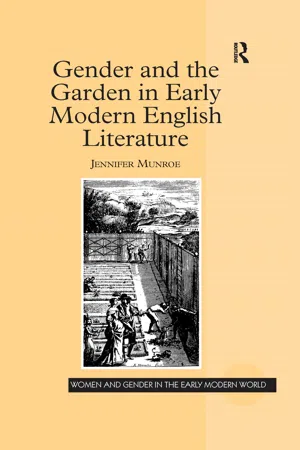
Gender and the Garden in Early Modern English Literature
About this book
Radical reconfigurations in gardening practice in sixteenth- and seventeenth-century England altered the social function of the garden, offering men and women new opportunities for social mobility. While recent work has addressed how middle class men used the garden to attain this mobility, the gendering of the garden during the period has gone largely unexamined. This new study focuses on the developing gendered tension in gardening that stemmed from a shift from the garden as a means of feeding a family, to the garden as an aesthetic object imbued with status. The first part of the book focuses on how practical gardening books proposed methods for planting as they simultaneously represented gardens increasingly hierarchized by gender. The second part of the book looks at how men and women appropriated aesthetic uses of actual gardening in their poetry, and reveals a parallel gendered tension there. Munroe analyzes garden representations in the writings of such manuals writers as Gervase Markham, Thomas Hill, and William Lawson, and such poets as Edmund Spenser, Aemilia Lanyer and Lady Mary Wroth. Investigating gardens, gender and writing, Jennifer Munroe considers not only published literary representations of gardens, but also actual garden landscapes and unpublished evidence of everyday gardening practice. She de-prioritizes the text as a primary means of cultural production, showing instead the relationship between what men and women might imagine possible and represent in their writing, and everyday spatial practices and the spaces men and women occupied and made. In so doing, she also broadens our outlook on whom we can identify and value as producers of early modern social space.
Information
Chapter 1
Gardens, Gender, and Writing
Gardening books printed during the sixteenth and early seventeenth centuries in England documented the shifting meanings of the garden at the same time they mobilized the differentiated positions among those who designed, worked, and owned them. Directly tied to practical methods and design, these manuals shaped a developing discourse about how to garden, who planted gardens, and what people sought when they planted them; in the process, they also cultivated the gendered relationships relevant to gardening practice and the garden spaces that people made. As such, these books have much to teach us about the interrelationship between the garden as a physical and a social space. But what, more precisely, is the nature of this interrelationship in these books? As prescriptive texts for everyday activities, these books certainly taught people how to plant the food they would later eat and how to grow the flowers they would later enjoy. At the same time, as Rebecca Bushnell rightly reminds us, these books also represented imagined relationships, what “ought to be,” as much as what arguably was to be found in the average household's working garden (109).
The manuals studied in this chapter establish a context for the remaining chapters of this book; at the same time, their significance is more than contextual. They are, as scholars have recently argued, themselves texts worth studying as such.1 As the motivation for planting turned more to earning social and economic capital, gardens increasingly functioned as contested sites where men and women from different classes vied for positions in a reconfigured and dynamic system of growing things. If men from the middling sort sought status as writers about gardening, then what they wrote also helped men and women achieve status in gardening, whether that meant designing the gardens of the elite or arranging the parterres and knots, or even more modest plantings, in their own yards. Printed books by such popular writers as Gervase Markham, William Lawson, and others suggest how planting an artful flower garden might function as a means of asserting one's social position. One of the most prolific writers on husbandry and gardening, Markham writes, for example, “I say, to behold a delicate, rich, and fruitfull Garden, it shewes great worthinesse in the owner, and infinite art and industry in the workeman, and makes mee both admire and love the begetters of such excellencies” (The English Husbandman, 1635 ed., 192).
A growing emphasis in artistic and specialized methods, plants, and roles in the garden thus demarcated boundaries between those who worked in and those who might assert dominion over the garden space. Men from the middling sort acquired social status as professional gardeners and as landowners, while women and lower class men were, generally speaking at least, relegated to positions of less authority (although, of course, there were exceptions to this rule). Establishing creativity and authority in gardening became more acute as gardening was seen increasingly as a viable art form accessible to members of the non-elite as well as the elite, which in turn generated new points of conflict between men and women. Publishing practical gardening manuals served as one way to translate gardening experience into authority, as was the professional claim to have mastered the art of gardening itself. Only select men may have published practical manuals, though, and only men were permitted the professional status of “gardener.” By the early seventeenth century, these relationships became subdivided more transparently along gendered lines, with women increasingly associated with smaller-scale decorative and kitchen gardening and men linked to larger-scale pleasure and profit-oriented gardening and orchard management.
I begin this chapter by tracing the shift in gardening from a subsistence to an artistic and profit-oriented endeavor, the effects of which left their mark on both the physical and the social landscape in England; specialized ways to garden, that is, went hand in hand with hierarchized roles for gardening practitioners. Specialized forms of gardening practice were increasingly understood in gendered terms—professional and profit-oriented gardening for men, and amateur gardening for women—and they are the subject of the second section. Printed books, all written by men, may well give the impression that women became, like the flowers they planted, silent recipients of pruning and shaping, but such is the case only if we exclusively consider printed representation. Manuscript writings, on the other hand, offer concrete evidence of a thriving gardening practice conceived of and recorded by women who understood their garden work to be active and of consequence. The chapter concludes, therefore, with an elaborated consideration of manuscript evidence by women as a counterbalance to printed books on the topic by men. These unpublished texts reveal how women sometimes used their gardens in the ways prescribed for them by male writers, but at other times, their practice deviated considerably from discursive norms; and women were by no means passive vessels for men's use, as suggested by Shakespeare's “Sonnet 3,” in which the woman is the field to be tilled and in whose womb (the field) the man plants his seed. Rather, women were in their own right creative agents who implemented, adapted, and shaped gardening practice in ways that defied simply characterized gendered dichotomies.
Dividing Plots: Specialization and the Art of Gardening
This section focuses on how profit, pleasure, and the art of gardening together compelled people to rethink the boundaries between skillful and amateur gardening and the gardens people made. As printed books posited a transition from primarily subsistence to aesthetic gardening they simultaneously qualified the specific duties of those who gardened. Rather than devoting exclusive attention to planting methods and plant varieties, manual writers concerned themselves as much or more with how to organize a household around the practical aspects of growing, harvesting, and using garden plants. One reason for this might be that available plant varieties remained mostly the same during the first half of the sixteenth century as they had been in the past—typically just barley, oats, wheat, rye, peas, and beans. Therefore, male and female audience members for these books were more than likely already familiar with planting practices for these crops and probably relied on common knowledge instead of institutionalized practices for their information. At the same time, throughout this period, there was an increasing interest in codifying a discourse about gardening, possible in part by the work of published gardening books, that stood in tension with (or at times even openly contradicted) routine common knowledge practices regularly practiced by men and women, literate or illiterate, from different classes and geographical areas of the country.
The transition from utilitarian to aesthetic planting was also aided by the widespread trend of converting previously communal land to enclosures, which sparked controversy across the countryside. Conceiving of land as private property led to individuals redirecting the use of that land for personal (or individual family's) gain, which typically took the form of enclosing or engrossing land for the purposes of maximizing productivity and yield. While the move to enclose land was definitely present long before the dissolution of the monasteries under Henry VIII, the scale and motivation for doing so changed during the sixteenth century.2 Whereas in the later Middle Ages, enclosed land allowed small-scale tenants a piece of property to lease and farm for household subsistence, by the mid-sixteenth century (and increasingly), enclosed land served several different purposes, all related to increasing profits and maximizing productivity: 1) landlords sought to maximize the productivity on the land they controlled by evicting tenants and hiring day laborers so that the profits would remain in the primary (landholding) household instead of being shared with the tenants who farmed the land. This land could be turned into large-scale commercial farmland, which yielded greater profits through market sale than through shared cultivation on commons; 2) private landowners might convert arable land into sheep pasture, which eliminated the overhead of having to hire farm labor and made the land more profitable per acre; and 3) a landlord could turn common fields into enclosed fields that he could divide up and rent to small-scale tenant farmers. Although there was an increase in small tenant farming families, especially during the first half of the sixteenth century, the amount of land they farmed was in most cases large enough only to sustain their individual household not to turn a profit (Overton 147).
The enclosure movement sparked controversy both in early modern England and with scholars today about how widespread the impact of this practice was on the working poor and the effects it had on the population shifts from the rural to urban areas. Viewing land use as a profitable enterprise instead of a subsistence activity enabled some members of the merchant and gentry classes (as well as upper class landowners) to gain wealth and social status along with property while those at the lowest end of the social scale suffered the greatest losses. In The Country and the City Raymond Williams argues that the enclosure movement had devastating effects on the rural countryside, which caused urban populations to soar, families to starve as they sought work in cities without ready employment, and agricultural productivity to shift from small-scale farming to large-scale planting for market consumption. Historians more optimistic about the impact enclosures had on the English social and physical landscape suggest that these changing land practices may have displaced rural families at the expense of some of the poorer ones, but these were a necessary trade-off that enabled other gains, such as the development of markets and a more defined middle class. At best, land privatized and put into the hands of the so-called morally responsible (and financially-viable) men of England might be envisioned as a system by which those who held land were good stewards and took care to ensure that both the land and the poor who worked it might thrive. At worst, though, enclosures were portrayed as a nefarious system by which land passed from the church to the state and then to a (still) relatively small cross-section of England's families, even if that number was larger than before and included part of the population previously more marginalized.
The up-and-coming gentry and merchant families, who, as a group, accumulated the most total land during this period, comprised the primary audience for husbandry and gardening manuals. Attesting to their widening and secular audience, these manuals first appeared in the vernacular early in the sixteenth century and increased in numbers throughout the period as the number of landholding families who could potentially use them multiplied too. Practical manuals engaged with contemporary debates about the effects of enclosing land but were marketed for the group most likely to benefit from this practice, we find, not surprisingly, that early manuals in particular idealize enclosure methods as the best means possible to maximize productivity and profit for the private landowners who might buy these books.3 Enclosed land, John Fitzherbert insists in the first vernacular husbandry manual in England, is the great social equalizer; it keeps everyone fed, rich and poor alike: with enclosed land, he argues, “then shall not the ryche man over-eate the poore man with his cattel” (77, my emphasis). Though Fitzherbert encourages enclosures for better sheep health and as the means to generate the most profit from land use, he frames enclosures as part of a community system of agriculture and husbandry, with the assumption that land enclosed for pasture does not detract from potentially arable plots but rather supplements them for the good of all (44). In effect, Fitzherbert frames enclosures as a utopian method of land use, focusing still on using that land for the greatest good, while later in the period, and even by the time Thomas Tusser makes his own argument for enclosures thirty-four years later, the motivation for enclosing land was shifting more toward private use and private profit.
Like Fitzherbert, Thomas Tusser concedes in his Fiue hundreth points of good husbandry the potential abuses of the enclosure system, but he still praises its potential to spawn relatively egalitarian social systems by which men earn their own living through hard work—ideals in line with a developing market economy. On the one hand, for example, Tusser writes:
The poor at enclosures do grutch,
Because of abuses that fall;
Lest some man should have but too much,
And some again nothing at all. (182)
But he nevertheless reassures his readers that enclosed land for pasture is ideal for maximizing agricultural productivity and individual profit:
More profit is quieter found,
(Where pastures in severall be;)
Of one seely acre of ground,
Than champion maketh of three.
Again what a joy it is known,
When men may be bold of their own? (181)
Though Tusser here promises a three-fold return on enclosures for grazing pasture, he elsewhere promises the same return on enclosures as sectioned off plots of arable land for planting. In his section titled, “Concerning Tillage,” Tusser contends, “Good land that is severall, crops may have three, / in champion country, it may not so be” (1580 ed., 112); “severall,” or enclosed, land makes it possible to diversify the farm, to plant different varieties at once and therefore increase the likelihood of having at least one crop survive if the climatic conditions are unfavorable for growing another. John Hales similarly defends enclosures as safeguarding the productivity of England's landscape: “Experience sheweth that tenauntes in common be not so good husbandes as when every man...
Table of contents
- Cover Page
- Title Page
- Copyright Page
- Table of Contents
- List of Figures
- Acknowledgements
- Introduction: Laying the Groundwork
- 1 Gardens, Gender, and Writing
- 2 “Planting English” and Cultivating the Gentleman: Spenser's Gardens
- 3 Inheritance, Land, and the Garden Space for Women in Aemilia Lanyer's Salve Deus Rex Judaeorum (“Hail, God, King of The Jews”)
- 4 “In this strang labourinth how shall I turne?”: Needlework, Gardens, And Writing In Mary Wroth’s Pamphilia To Amphilanthus
- Epilogue: Looking Ahead
- Works Cited
- Index
Trusted by 375,005 students
Access to over 1.5 million titles for a fair monthly price.
Study more efficiently using our study tools.
Frequently asked questions
Yes, you can cancel anytime from the Subscription tab in your account settings on the Perlego website. Your subscription will stay active until the end of your current billing period. Learn how to cancel your subscription
No, books cannot be downloaded as external files, such as PDFs, for use outside of Perlego. However, you can download books within the Perlego app for offline reading on mobile or tablet. Learn how to download books offline
Perlego offers two plans: Essential and Complete
- Essential is ideal for learners and professionals who enjoy exploring a wide range of subjects. Access the Essential Library with 800,000+ trusted titles and best-sellers across business, personal growth, and the humanities. Includes unlimited reading time and Standard Read Aloud voice.
- Complete: Perfect for advanced learners and researchers needing full, unrestricted access. Unlock 1.5M+ books across hundreds of subjects, including academic and specialized titles. The Complete Plan also includes advanced features like Premium Read Aloud and Research Assistant.
We are an online textbook subscription service, where you can get access to an entire online library for less than the price of a single book per month. With over 1.5 million books across 990+ topics, we’ve got you covered! Learn about our mission
Look out for the read-aloud symbol on your next book to see if you can listen to it. The read-aloud tool reads text aloud for you, highlighting the text as it is being read. You can pause it, speed it up and slow it down. Learn more about Read Aloud
Yes! You can use the Perlego app on both iOS and Android devices to read anytime, anywhere — even offline. Perfect for commutes or when you’re on the go.
Please note we cannot support devices running on iOS 13 and Android 7 or earlier. Learn more about using the app
Please note we cannot support devices running on iOS 13 and Android 7 or earlier. Learn more about using the app
Yes, you can access Gender and the Garden in Early Modern English Literature by Jennifer Munroe in PDF and/or ePUB format, as well as other popular books in Literature & Literary Criticism. We have over 1.5 million books available in our catalogue for you to explore.