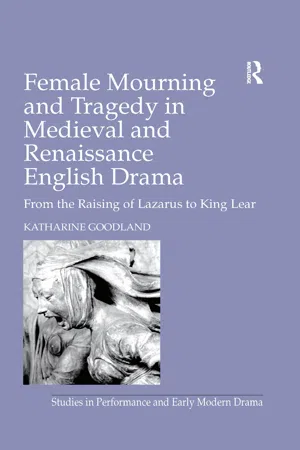
eBook - ePub
Female Mourning and Tragedy in Medieval and Renaissance English Drama
From the Raising of Lazarus to King Lear
- 264 pages
- English
- ePUB (mobile friendly)
- Available on iOS & Android
eBook - ePub
Female Mourning and Tragedy in Medieval and Renaissance English Drama
From the Raising of Lazarus to King Lear
About this book
Grieving women in early modern English drama, this study argues, recall not only those of Classical tragedy, but also, and more significantly, the lamenting women of medieval English drama, especially the Virgin Mary. Looking at the plays of Shakespeare, Kyd, and Webster, this book presents a new perspective on early modern drama grounded upon three original interrelated points. First, it explores how the motif of the mourning woman on the early modern stage embodies the cultural trauma of the Reformation in England. Second, the author here brings to light the extent to which the figures of early modern drama recall those of the recent medieval past. Finally, Goodland addresses how these representations embody actual mourning practices that were viewed as increasingly disturbing after the Reformation. Female Mourning and Tragedy in Medieval and Renaissance English Drama synthesizes and is relevant to several areas of recent scholarly interest, including the performance of gender, the history of emotion, studies of death and mourning, and the cultural trauma of the Reformation.
Information
PART ONE
Female Mourning and Tragedy in Medieval English Drama

Figure 1: Lamentation Group. Terra Cotta Sculpture, Niccolo della Arca. Bologna, circa 1500.
The medieval English construction of grief was the site of gendered and contradictory discourses. In sacred and secular texts of the period women were either sanctified or demonized for what was viewed as their natural propensity for tears. Humoral theory construed women's bodies as cold and wet and therefore more prone to the fluid imbalance that caused melancholia.1 Women's bodies were also seen as more permeable than men's and thus more susceptible to the whims of the passions. Yet this permeability endowed women with a greater capacity for empathy. This uniquely feminine strength – the ability to identify with and suffer for others – graced them with special powers to commune with the supernatural: God would hear and answer their tears.
But this spiritual agency was the province of only a few. Religious writings of the period celebrate the heroic compassion of particular women: Monica, Mary Magdalene, and the Virgin Mary. Monica's grieving over her son's waywardness was instrumental in effecting Augustine's pilgrimage of conversion and grace.2 Augustine reports in his Confessions that one Bishop exclaimed, “it cannot be that the son of these tears should perish” (Book III.xii.21).3 Mary Magdalene's tears at Christ's tomb were also richly rewarded: she was the first to see her risen Lord. The narrative shape of the scriptural source, John 20:11–18, implies a connection between Mary's tears and Jesus’ appearance: Mary stands outside the empty tomb, “wailing” (klaio). She looks into the tomb and sees two angels who ask her whom she is seeking. She tells them that she seeks her lord, and, turning away, sees a man, whom she does not recognize as Christ until he recalls her to herself by announcing her name, “Mary.” Medieval renderings of this moment dilate upon the Gospel sequence with elaborate descriptions of Mary Magdalene's relentless laments. The resulting treatises are exquisite and strange. One of the most intriguing is the Pseudo-Origen Homelia De Maria Magdalena. This text, which Chaucer purportedly translated into English, blurs gender in its portrayal of the Magdalene’ grief. Her tears possess the procreative power of semen: as she weeps, she engenders Christ in her womb. Laura Severt King explains that the treatise was written for the contemplative exercises of medieval monks, who would meditate on the Magdalene’ grief in order to induced weeping in themselves. Their empathetic tears would melt the boundary between them and the figure in the text, so that they too might conceive Christ within (16–48).
The generative tears of Saint Monica and the Magdalene have their wellspring in the Mater Dolorosa par excellence of the Middle Ages: the Virgin Mary. Mary's Compassion, also known as the Planctus Mariae, denoted her mourning for Jesus as he suffered on the cross. Some medieval exegetes were guided by Saint Ambrose who argued that, as scripture implies, Mary did not weep at Calvary: “I read that she stood, but I do not read that she wept.”4 But others followed the Mariology of Bernard of Clairvaux in believing that Mary mourned copiously under the cross and that her physical suffering was more severe than the pangs of childbirth, which she was spared when she gave birth to Jesus because she conceived without sin. While Jesus died to redeem the world, Mary gave birth to the Church in the world. Her procreative sorrow crowned her as co-redeemer, “Mother of God.”5
In the High Middle Ages the Virgin Mary stood at the center of a spiritual pedagogy of tears. Her call, “Who cannot Wepe Come lern at Me” is a frequent refrain in meditative treatises and carols representing her Compassion.6 In the sepulcher ritual of Good Friday, parishioners were exhorted to imagine the three Maries weeping for Christ and to weep with them.7 Weeping with the Virgin for Christ's suffering and for the sin that caused his suffering was central to medieval religious practice: it was the doctrinally sanctioned emotion of “compunction.”8 This celebration of female tears as essential to the spirituality of all believers, male and female alike, sharply contrasts with the negative depictions of mourning women in the secular literature of the period.
Here grieving women are most frequently portrayed as deceptive and sinister. In medieval romance narratives we find them wailing in open landscapes where knights unwittingly stumble upon them, only to be overcome by their seductive tears.9 Widows are especially manipulative. A widow's mourning is a performance, the means by which she draws attention to herself, thereby securing a new husband. The poor man who falls for the ruse admires her extravagant but false devotion to her first husband, believing (wrongly) that she will be similarly devoted to him. Mourning widows who did not become vowesses are especially threatening because of their ambivalent social position. They might be economically independent and therefore less subject to masculine control and authority than wives, nuns, and vowesses.10
In these secular narratives, the men, notwithstanding their impenetrable bodies and superior minds, are easily tricked by the cries of weeping widows, while in the sacred texts women's tears compel fate and transform human nature. These seemingly opposed characterizations of female mourning are grounded upon the same premise: both attribute uncanny power to women in the throes of sorrow. Both are shaped by the paradox of the grieving woman whose passionate nature invests her with the ability either to undermine or nurture the social order. These contradictions are especially acute in the depictions of female sorrow in medieval English religious drama, where mourning women both threaten and sustain the Christian eschatology of the plays. In the Nativity, Lazarus, Passion, and Resurrection plays of the Corpus Christi cycles female mourning is central to the unfolding dramatic action. The bereaved mothers of the slaughtered innocents call down God's vengeance upon King Herod; the tears of Lazarus's sisters invoke Jesus’ presence and are integral to the miracle he performs; the Virgin's Lament in the Passion plays is portrayed as heroic agony: suffering that is intrinsic to her son's sacrifice; and in the Resurrection plays the sorrow of the three Maries transforms them into God's earthly messengers.
The scriptural passages that correspond to these moments in medieval English drama are substantially different. Whereas the drama spotlights female grief, the biblical narratives relegate it to a choric, supporting role. The public confrontation between the mothers of the slaughtered children and Herod's henchmen in the cycle plays diverges markedly from the account in Matthew, which does not show the anguish of the mothers; instead, their cries are subsumed by the disembodied voice of sacred history in fulfillment of Jeremiah's prophecy: “A voice was heard in Ramah, wailing and loud lamentation, Rachel weeping for her children; she refused to be consoled, because they are no more” (2:18). Likewise, John's Gospel mentions only briefly the tears of Lazarus's sisters and friends. In contrast, the medieval plays dwell upon Martha's and Mary Magdalene's grief, characterizing their tears as at once disruptive and efficacious. In the Resurrection plays, the arrival of the women at Jesus’ burial site follows the Gospel accounts. But with the exception of John's Gospel where Mary Magdalene wails outside the empty tomb, there is no mention that the women wept. In all of the cycle plays, by way of contrast, the three Marys lament at the tomb until the angels interrupt them. The Virgin's elaborate mourning in the Passion plays is the most striking departure, for John's Gospel simply states that Mary was standing near the cross on which Jesus was crucified.
These deviations from scripture are perhaps not surprising in light of the past generation of scholarship on medieval drama, which has long since refuted the simplistic and biased notion of the plays as merely pedagogical enactments of sacred history. Yet the episodes are noteworthy for their simultaneous emphasis upon and ambivalence toward female grief. Even the portrayals of the Virgin Mary's mourning are paradoxical, for her laments pose resistance to the dominant Christian ideology. Peter Dronke attends to Mary's dissonant tone in the four Passion plays, noting that her unredeemable grief prevails over the Christian promise of salvation. The extra-scriptural tradition the Lament of the Virgin was central to medieval Catholicism, sanctioned by the learned commentary of such luminaries as Bernard of Clairvaux. But Dronke shows that “the nature of the texts we have suggests… that the lament of Mary was not primarily a learned invention at all.”11 He analyzes a wide array of dramatic representations of the medieval Planctus Mariae, including those in the four English Passion plays, demonstrating that “when these laments surface in the learned world, they still bear all the marks of a non-theological genre and lyric impulse, the marks of a traditional type of woman's lament” (103–4). Dronke's approach to the texts of the Passion, as themselves evidence of the medieval English social practice of lament for the dead, lays a valuable foundation for further inquiry into the characterization of female mourning in medieval drama.
Yet the question of whether these portrayals of female grief originate in the learned or popular worlds may not be properly formulated. Scholars have found evidence of both: the archaic “European koiné” of ritual lament that Dronke identifies, as well as a learned tradition of transmission reaching back to antiquity via sixth-century Byzantium.12 It may be that the indigenous practice of female ritual lament for the dead prepared the field for the flourishing of the elite forms. However, as Patrick Geary explains, we should interpret them – high and low, elite and vulgar – as strands in a larger web of meaning:
The prevalence of this trope of female mourning and the ambivalent nature of its characterization, I propose, is not random or innocent; rather, it embodies latent social anxieties and the structuring contradictions of medieval English discourses of mourning and death.
In the ensuing chapters of Part One, I analyze the portrayals of female mourning in the four medieval Corpus Christi cycles and the Digby plays, arguing that the discursive practices of the plays attempt to reconcile the ethos of the residual practice of female lament with that of the dominant Christian ideology. The resulting topos of the excessively grieving woman simultaneously threatens and legitimizes Christian eschatology.
Medieval scholars rightfully observe that approaching these diverse plays as a single phenomenon of the period risks over–simplification because each pageant is unique in its thematic and theological emphasis. The significant dramaturgical and doctrinal differences among them are integrally related to the local concerns of the provincial capitals where they were produced. Eric Josef Carlson observes that “each urban area accommodated itself to religious changes in a unique way which grew organically out of the particular and peculiar past experiences and internal structures of the place” (7). But for my purposes, the distinct evolution of each cycle within its township makes the similarities among them all the more significant, especially with respect to the representation of mourning women. Theresa Coletti demonstrates the value of focusing “on dramatic tests as historical resources in their own right, capable of localizing the cultural performances to which they bear witness, if not in relation to a geographical or material site, at least with respect to the dialogues they conduct with the extratextual world”(Mary Magdalene and the Drama of Saints, 13). As “instances of late medieval English cultural performance that melded spectacles of sacred subjects with festive practice, social action, and religious ritual,” the extant manuscripts of the Corpus Christi cycles are one of the most important resources we have for understanding late medieval culture (Coletti, Drama of Saints, 3). Here we find official doctrine, vernacular theology, and the social practices of all levels of society – elites, middle class, the masses, lay and clerical – commingling in the textual remains of these ambitious communal enterprises.13 A synoptic study of the four cycles and the Digby plays yields glimpses into English mourning and burial practices on the eve of the Reformation, illuminating how these plays embody the ritual resolution of opposing constructions of death: the residual practice of female lament and the dominant Christian eschatology.
Three prominent rhetorical features of the genre of female lamentation emerge from an analysis of the mourning women in medieval English drama: the mourner's cry of anguish as she gazes upon the corpse, her inconsolable grief, and her apostrophes to those who are absent: the deceased, death itself, and God. These motifs articulate the ethos of the female mourner, an ethos that poses resistance to the tenets of Christian doctrine, which the discursive practices of the plays attempt to displace and contain.
The mothers of the innocents in the Herod plays, Lazarus's sisters, the Virgin Mary, and the three Maries of the Resurrection plays all lament the deaths of their loved ones. Their cries raise fundamental questions about the relationship between evil and justice, the nature of death and grief, and the possibility for compassion in a world of suffering. They also expose an inherent conflict between residual ideas about death manifested in female lamentation and the Christian construction of the afterlife articulated in Jesus’ Passion and Resurrection. The resulting portrayals are women who are at once spiritually exemplary and tragically human.
1See Ian Maclean, The Renaissance Notion of Women: A Study in the Fortunes of Scholasticism and Medical Science in European Intellectual Life.
2Augustine nevertheless presents his mother’ tears as troublesome. She had to be cleansed first of the sin of loving her son overly much before her tears could be spiritually efficacious; see Book V.viii–ix.
3Augustine, Confessions, trans. Henry Chadwick, page 51.
4Ambrosius, De Obita Valentiniani Consolata, P.L., 16, col. 1431; cited in Hamburgh, 52.
5See Hamburgh, 50–56.
6See Greene, esp. Chapter V, “The Carol and Popular Religion”; and Woolf, The English Religious Lyric.
7See Sheingorn.
8See McEntire.
9See Velma Bourgeois Richmond, Dramatic Elements in Laments for the Dead; and Renate Haas, The Laments for the Dead.
10On vowesses see Coletti, Mary Magdalene and the Drama of Saints, 50–99; on widows see Cindy Carlson and Angela Weisl.
11Dronke's position challenges the longstanding scholarly assumption that these laments derive from sixth-century Byzantium via learned literary transmission. Keiser asserts, “While the line of transmission is still far from clear, we can be reasonably confident that the ultimate source of the English Planctus, and its French and Latin antecedents was the Byzantine Marian lament, which had a learned tradition going back at least to the early sixth century and a popular tradition probably going back to antiquity” (169). Woolf considers it “inevitable that the question of what the Virgin did from the time of the arrest until the burial should in due course be both asked and answered” (The English Mystery Plays, 246), and attributes the Virgin's lament to “invented detail.found fairly early in the writings of the Eastern Church” (246), pointing out that “between this tradition and that of later Western works there are so many coincidences of detail and treatment that a connexion is certain” (247). Similarly, Sticca attributes the Western Planctus to the Eastern church: “The motif of the Planctus Mariae was born originally, like that of the Pietà, in the bosom of the Greek spiritual tradition, and transfigured when it came in contact with the Western Latin spirituality of the eleventh and twelfth centuries” (178). Henry Mayr-Harting also notes the connection: “English devotion to the Blessed Virgin… certainly took something from the Syrian pope, Sergius I (A.D.687–701)” (189). Lochrie repeats this notion: “The image of the noisy, boisterous, hysterical virgin in medieval culture is derived from the East particularly following the Crusades” (180). Alexiou, however, convincingly refutes the notion that the pietà was born inside a Christian spiritual tr...
Table of contents
- Cover Page
- Title Page
- Copyright Page
- Contents
- Acknowledgments
- Female Mourning and Tragedy in Medieval and Renaissance English Drama
- General Editor's Preface
- List of Figures
- Introduction
- PART 1 Female Mourning and Tragedy in Medieval English Drama
- PART 2 Deranging Female Lament in Renaissance Tragedy
- Bibliography
- Index
Trusted by 375,005 students
Access to over 1.5 million titles for a fair monthly price.
Study more efficiently using our study tools.
Frequently asked questions
Yes, you can cancel anytime from the Subscription tab in your account settings on the Perlego website. Your subscription will stay active until the end of your current billing period. Learn how to cancel your subscription
No, books cannot be downloaded as external files, such as PDFs, for use outside of Perlego. However, you can download books within the Perlego app for offline reading on mobile or tablet. Learn how to download books offline
Perlego offers two plans: Essential and Complete
- Essential is ideal for learners and professionals who enjoy exploring a wide range of subjects. Access the Essential Library with 800,000+ trusted titles and best-sellers across business, personal growth, and the humanities. Includes unlimited reading time and Standard Read Aloud voice.
- Complete: Perfect for advanced learners and researchers needing full, unrestricted access. Unlock 1.5M+ books across hundreds of subjects, including academic and specialized titles. The Complete Plan also includes advanced features like Premium Read Aloud and Research Assistant.
We are an online textbook subscription service, where you can get access to an entire online library for less than the price of a single book per month. With over 1.5 million books across 990+ topics, we’ve got you covered! Learn about our mission
Look out for the read-aloud symbol on your next book to see if you can listen to it. The read-aloud tool reads text aloud for you, highlighting the text as it is being read. You can pause it, speed it up and slow it down. Learn more about Read Aloud
Yes! You can use the Perlego app on both iOS and Android devices to read anytime, anywhere — even offline. Perfect for commutes or when you’re on the go.
Please note we cannot support devices running on iOS 13 and Android 7 or earlier. Learn more about using the app
Please note we cannot support devices running on iOS 13 and Android 7 or earlier. Learn more about using the app
Yes, you can access Female Mourning and Tragedy in Medieval and Renaissance English Drama by Katharine Goodland in PDF and/or ePUB format, as well as other popular books in Literature & Literary Criticism. We have over 1.5 million books available in our catalogue for you to explore.