- 84 pages
- English
- ePUB (mobile friendly)
- Available on iOS & Android
eBook - ePub
English Cursive Book Hands, 1250-1500
About this book
First published in 1969, English Cursive Book Hands rapidly established itself as a key resource for the study and teaching of palaeography. It covers the changes in handwriting that arose from the mid-twelfth century, tracking the growth and development of the cursive script that came to dominate book production in medieval England. This reprint is a re-issue of the 1979 second edition published by Scolar Press. This study sets out the nature of the developments which took place in English book hands, from the mid-twelfth century, largely determined by two factors: the increasing demand for books, and the increase in the size of the works to be copied. The secularization of learning and the rise of the universities created a voracious demand for texts and commentaries. At the same time improving standards of literacy led to a demand from a wide range of patrons for books of a more general nature. In such circumstances speed and ease of writing became increasingly important. Scribes began to use different kinds of handwriting for different classes of books, and as a result a new 'hierarchy' of scripts arose, each with its own sequence of development. Towards the end of the thirteenth century the cursive script which had recently been evolved for the preparation of documents was introduced into books. A hierarchy also arose in the cursive script itself, as scribes began to devise more than one way of writing depending on the degree of formality they required. Eventually the varieties of cursive usurped the functions of other scripts in the copying of nearly all kinds of books and documents. English Cursive Book Hands illustrates the developments which took place in the cursive handwriting used in England for writing books.
The Plates
1
Plates 1–3. Anglicana Book Hands
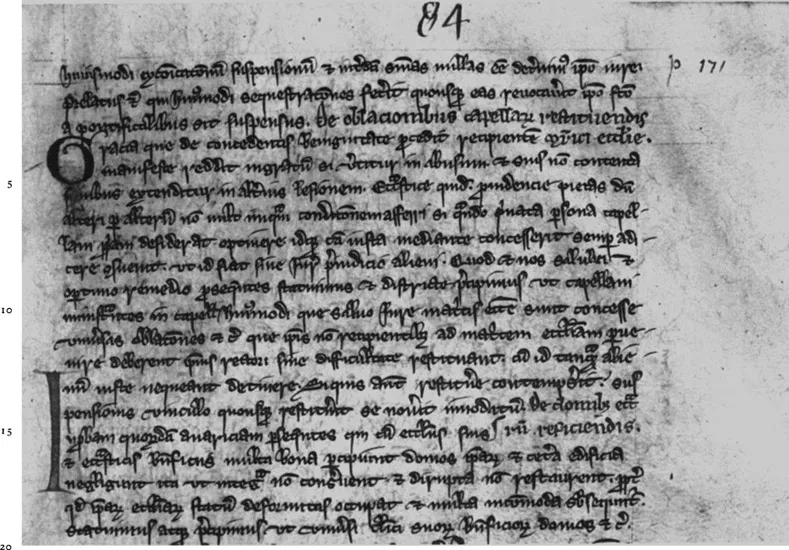
1 (i). End of the thirteenth century. Oxford: University College, MS. 148, fol. 84r.
Canons of the Legatine council held at London in April 1268, usually known as the ‘Constitutions’ of Cardinal Ottobuono; now forming part (fols. 71–89) of the memorandum book of John Croucher, Dean of Chichester 1426–47 (ν. W. D. Pecham, ‘Dean Croucher’s Book’, Sussex Archaeological Collections, lxxxiv (1945), p. 11). Text of the Canons ed. F. M. Powicke and C. R. Cheney, Councils and Synods with other Documents relating to the English Church (Oxford, 1964), ii, p. 747, where this manuscript is designated as C. Text of this plate, ibid., ii, p. 766.
Written towards the end of the thirteenth century (cf. ECH., pl. xvii, b, dated 1272).
Typical example of Anglicana found in books of this kind at this period. Note the characteristic letter forms of the script (ν. p. xiv). Headings are in the smaller ‘gothic’ book hand. Features characteristic of hands of this period include: headstroke of a not always closed up to form the top lobe of the two–compartment form (12, ‘ecclesiam’); r has a pronounced shoulder stroke (2, ‘reuocauerit’); the elaborate forked ascenders of b, h, k, and l, in which the forks are ‘looped back’. The loop to the right of the ascender, formed by the approach stroke, became progressively larger during the course of the second half of the century. The broad headstroke of a (7, ‘persona’), the heavy diagonal of the looped ascender of d (6, ‘prouidencie’), and the broad strokes forming the marks of abbreviation (1, ‘suspensionum’, ‘interdicti’), indicate that the pen was held or cut at a very oblique angle.
huiusmodi excommunicationum suspensionum et interdicti sententias nullas esse decernimus ipso iure. Prelatus eciam qui huiusmodi sequestrationes fecerit quousque eas reuocauerit ipso facto | a pontificalibus sit suspensus.
De oblacionibus capellarum restituendis | Matrici ecclesie. Gracia que de concedentis benignitate procedit recipientem | manifeste reddit ingratum si vertitur in abusum. et suis non contenta | f<i>nibus extenditur in alterius lesionem. Ecclesiastice quidem prouidencie pietas dum | alteri per alterum non uult iniquam (for nunquam) conditionem afferri si quando priuata persona capel–|lam propriam desiderat optinere. idque causa iusta median te concesserit semper adi–|cere consueuit. vt id fiat sine Iuris preiudicio alieni. Quod et nos salubri et | oportuno remedio prosequentes statuimus et districte precipimus vt capellani | ministrantes in capellis huiusmodi que saluo lure matricis ecclesie sunt concesse | vniuersas oblationes et cetera que ipsis non recipientibus ad matricem ecclesiam perue–|nire deberent ipsius rectori sine difficultate restituant, cum id tanquam alie–|num iuste nequeant detinere. Si quis autem restituere contempserit.·1 sus–|pensionis vinculo quousque restituerit se nouerit innodatum.
De domibus ecclesia|rum reficiendis. Inprobam quorundam auariciam persequentes qui cum ecclesiis suis I et ecclesiasticis beneficiis multa bona percipiunt domos ipsarum et cetera edificia | negligunt ita vt integra non conseruent et dirupta non restaurent, propter | quod ipsarum ecclesiarum statum deformitas occupât et multa incommoda subsequntur. | statuimus atque precipimus vt vniuersi clerici suorum beneficiorum domos et cetera.
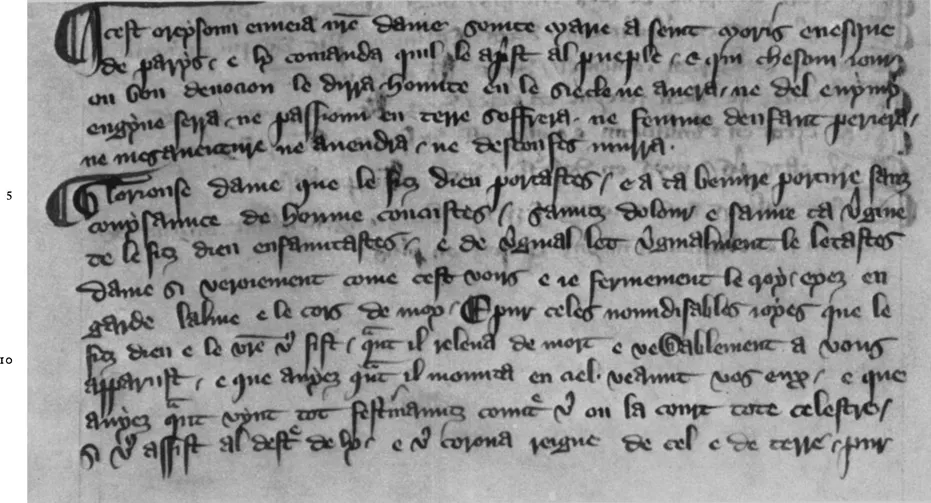
(ii). c. 1340–50. London: British Museum, MS. Harley 2253, fol. 134v.
Prose version of ‘Les cinqs joies de Nostre Dame’, here attributed to Maurice de Sully, Bishop of Paris (d. 1196) (ν. P. Meyer, Romania, xv, p. 307; E. Stengel, Codex Digby 86 (1871), p. 6; N. R. Ker, Facsimile of British Museum MS. Harley 2253, E.E.T.S. (o.s.), 255, p. xv, item 104).
Written c. 1340–50 (ν. Ker, op. cit., p. xxi).
The bulk of the manuscript was written in a somewhat half–hearted attempt to produce Anglicana Formata, mainly by adding feet to the minims, but in some of the prose texts, as here, the scribe reverts to the less formal variety of the script.
Compare with the previous plate and note here the change in the angle at which the pen was held or cut, resulting in broader vertical strokes. The elaborate forked ascenders have been abandoned, and the approach stroke to the right of the ascender has been developed into a pronounced hook. For the most part r has lost its shoulder stroke (1, ‘oreysoun’, but cf. 1, ‘Moris’). The limb of h regularly descends below the line of writing (7, ‘homme’). The rounded w (11, ‘vewablement’) is prominent at this date, but is found as late as the fifteenth century. The g form (8, ‘virginalement’) is unusual, a is always a two–compartment form.
The scribe distinguishes between the less formal Anglicana used for the text of the book and that used for the documents (Ker, op. cit., fols. 1v, 142). In the book he writes a slightly larger hand, and omits certain current features such as the connecting strokes between the descenders and the headstrokes of f and s.
On the problems to be encountered when transcribing French vernacular manuscripts produced in England ν. F. W. Maitland’s introduction to Year Books of Eduard II, i, Seiden Soc. xvii (1903), pp. xxxix ff.
¶ Icest oreysoun enueia nostre dame seinte Marie a seint Moris euesque | de parvs/ e ly comanda quil le aprist al pueple/ e qui chescun iour | ou bon deuocion le dirra hounte en le siecle ne auera/ ne del enymy | engyne serra/ ne passioun en terre soffrera/ ne femme denfant periera/| ne mesauenture ne auendra/ ne desconfes murra.
¶ Gloriouse dame que le fitz dieu portastes/ e a ta benure porture sanz | conysaunce de houme concustes / sauntz dolour e sauue ta virgine|te le fitz dieu enfauntastes/ e de virginal let virginalment le letastes | dame si veroiement come cest voirs e ie fermement le croy/ eyez en | garde lalme e le cors de moy/ E pur celes noundisables ioyes que le | fitz dieu e le vostre vous fist/ quant il releua de mort e vewablement a vous | apparust/ e que auyez quant il mounta en ciel, veaunt vos eux/ e que | auyez quant vynt tot festinauntz country vous ou la court tote celestre/| si vous assist al destre de ly/ e vous corona reigne de cel e de terre/ pur |
1
2 (i). 1381. Oxford: Bodleian Library, MS. Douce 257 (SC. 21831), fol. 38r.
Alexander de Villa Dei, ‘Massa Compoti’ (Thorndike and Kibre, 1557, ν. Sarton, ii (1931), p. 617), with commentary possibly by Simon Bredon (Thorndike and Kibre, 1085. On Bredon ν. Emden, BRUO.; and R. T. Gunther, Early Science in Oxford, ii, O.H.S. lxxviii (1923), p. 52.). The text of the poem ed. R. Steele, Opera hactenus inedita Rogeri Baconi, Fasc. vi (1926),p. 268; text of lines 1–8 of this plate from lines 198–205 of the poem.
Written in 1381 (fol. 02v, ‘Explicit massa compoti Anno Domini MloCCCmo Octogesimo primo ipso die felicis et andacti’, i.e. 30 August 1381).
The scribe has copied the text of the poem (lines 1–8) in Anglicana Formata, and the commentary (9–20) in the less formal variety of the script. Note the difference in the size of the two kinds of handwriting, and in the formation of the minim strokes. In the hand used for the text the letter a does not extend so far above the general level of the other letters as it does in the com mentary (1, ‘anno’, cf. 14, ‘alius’); the back of d is more upright (2, ‘due’, cf. 9, ‘de’); the shaft of t protrudes above the headstroke, whereas in the commentary it does not (4, ‘tibi’, cf. 9, ‘autor’); and the form of short–s is different from that used in the commentary (1, ‘decies’, cf. 9, ‘concurrens’). In the hand used for the commentary the duct of the handwriting is more fluent; ascenders and descenders are longer in relation to the size of the body of the letter forms. The cursive form of e appears in the commentary (12, ‘concurrens’), but not in the text.
Compare with the previous plate and note developments which had taken place in this variety: the changes in the shapes of r and s (9, ‘concurrens’), in the treatment of the ascenders, and in the more fluent handling of the minim strokes.
The influence of the new style of calligraphy associated with the recently introduced Secretary script is more obvious in the Anglicana Formata, particularly in the lobes of the letters d and q (2, ‘due’, ‘quas’).
(E)bdomode decies quini numera(n)tur in anno.
Atque due post quas lux vna dueve supersunt
Anno bisexti. superesse duas tibi scito.
Ex his augmentis concurrentes tibi fiant
Addendo semper vnum formabis in anno.
Bisexti. binos iungas numéro preeunti.
Quod superat 7 retine septemque iacendo.
Per concurrentes curres annis quater apta.
Atque due post quas lux vna dueve supersunt
Anno bisexti. superesse duas tibi scito.
Ex his augmentis concurrentes tibi fiant
Addendo semper vnum formabis in anno.
Bisexti. binos iungas numéro preeunti.
Quod superat 7 retine septemque iacendo.
Per concurrentes curres annis quater apta.
//Hic agit autor de (con)currentibus. Vnde concurrens | est numerus non excedens septenarium qui simul | iunctus cum regulari feriali sit quota feria men|sis quilibet incipiat et ideo dicitur concurrens a con | quod est simul et a currens quasi simul currens cum...
Table of contents
- Cover
- Half Title
- Title
- Copyright
- Dedication
- PREFACE
- PREFACE TO THE REPRINT
- CONTENTS
- REFERENCES AND ABBREVIATIONS
- INTRODUCTION
- A NOTE ON PALAEOGRAPHICAL TERMS
- SELECT BIBLIOGRAPHY
- A NOTE ON THE TRANSCRIPTIONS
- LIST OF PLATES
- PLATES, NOTES, AND TRANSCRIPTIONS
- INDEX I. Medieval Persons Connected with the Manuscripts Illustrated
- INDEX II. Scribes Mentioned but not Illustrated
Trusted by 375,005 students
Access to over 1.5 million titles for a fair monthly price.
Study more efficiently using our study tools.
Frequently asked questions
Yes, you can cancel anytime from the Subscription tab in your account settings on the Perlego website. Your subscription will stay active until the end of your current billing period. Learn how to cancel your subscription
No, books cannot be downloaded as external files, such as PDFs, for use outside of Perlego. However, you can download books within the Perlego app for offline reading on mobile or tablet. Learn how to download books offline
Perlego offers two plans: Essential and Complete
- Essential is ideal for learners and professionals who enjoy exploring a wide range of subjects. Access the Essential Library with 800,000+ trusted titles and best-sellers across business, personal growth, and the humanities. Includes unlimited reading time and Standard Read Aloud voice.
- Complete: Perfect for advanced learners and researchers needing full, unrestricted access. Unlock 1.5M+ books across hundreds of subjects, including academic and specialized titles. The Complete Plan also includes advanced features like Premium Read Aloud and Research Assistant.
We are an online textbook subscription service, where you can get access to an entire online library for less than the price of a single book per month. With over 1.5 million books across 990+ topics, we’ve got you covered! Learn about our mission
Look out for the read-aloud symbol on your next book to see if you can listen to it. The read-aloud tool reads text aloud for you, highlighting the text as it is being read. You can pause it, speed it up and slow it down. Learn more about Read Aloud
Yes! You can use the Perlego app on both iOS and Android devices to read anytime, anywhere — even offline. Perfect for commutes or when you’re on the go.
Please note we cannot support devices running on iOS 13 and Android 7 or earlier. Learn more about using the app
Please note we cannot support devices running on iOS 13 and Android 7 or earlier. Learn more about using the app
Yes, you can access English Cursive Book Hands, 1250-1500 by M.B. Parkes in PDF and/or ePUB format, as well as other popular books in History & World History. We have over 1.5 million books available in our catalogue for you to explore.