eBook - ePub
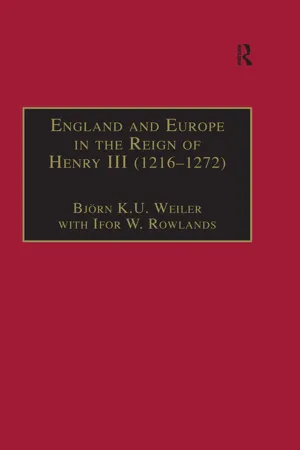
England and Europe in the Reign of Henry III (1216–1272)
- 264 pages
- English
- ePUB (mobile friendly)
- Available on iOS & Android
eBook - ePub
England and Europe in the Reign of Henry III (1216–1272)
About this book
The close political, economic and cultural ties that developed between England and its neighbours were a defining feature of the rule of Henry III, which permeated nearly all levels of society from the king and his barons to the Church and merchants, artisans and fortune hunters. They were evident both in the high politics of Henry III, as well as in the more general cultural developments, as can be seen in the French architecture, Italian masonry and German goldwork of Westminster Abbey. They can likewise be traced with regard to individuals such as Simon de Montfort, whose family was active in the Holy Land, Languedoc, Northern France and England. In short, thirteenth century England formed part of a broader European cultural, political and economic commonwealth. The essays that form this volume demonstrate the variety and strength of these contacts between England and her neighbours during Henry's reign, and by seeking to place Henry's England within a broader geographical and thematic range, will contribute to a broader understanding of England's place within thirteenth century Europe.
Chapter 1
Negotiating Anglo-Welsh Relations: Llywelyn the Great and Henry III
Huw Pryce
The spring of 1230 was a critical time in the career of Llywelyn ap Iorwerth, the ruler of Gwynedd in north-west Wales traditionally known as Llywelyn the Great. At Easter, which fell on 7 April, William de Braose, the young Marcher lord of Brecon and Builth, was discovered in the prince's chamber with Llywelyn's wife, Joan, illegitimate daughter of King John and thus a half-sister to Henry III. About three weeks later, on 2 May, William was hanged at Crogen, a princely estate near Bala, reportedly before a crowd of over 800 onlookers, following his condemnation by Llywelyn's magnates who judged that he had deceitfully brought dishonour upon the prince.1 As far as is known, the execution did not elicit any protest from the royal government, which continued its efforts to arrange a meeting with Llywelyn to agree a further truce or peace (Henry himself had arrived at Saint-Malo in Brittany the day after William was hanged).2 Whatever the justification for the sentence in terms of Welsh custom, the royal authorities appear to have accepted that the matter fell under Llywelyn's jurisdiction, referring tactfully in August 1230 to the 'misfortune' which had befallen William.3
The events which unfolded following the discovery of William de Braose's affair with Joan highlight the complexity of Anglo-Welsh relations during Llywelyn's reign. On the one hand, the hanging of de Braose can be seen as simply a dramatic instance of the deep hostility that so often characterized relations between the Welsh and the Marchers: according to the abbot of Vaudy in his report to the chancellor, Ralph de Neville, the enemies of the Braoses were summoned especially to attend the execution.4 It may well be that the severity of the sentence reflected the hatred of the Braose family among some leading Welsh families, especially in the south, and that we should not dismiss as mere rhetoric the prince's claim, in letters to William de Braose's widow, Eva, and her brother, William Marshal II, earl of Pembroke, that he had little choice but to acquiesce in his magnates' judgement. At the same time, it is quite possible that Llywelyn, irrespective of whether he succumbed to a desire for personal revenge, welcomed the prospect of the fragmentation of a great Marcher lordship among William's heiresses, one of whom was engaged to marry his son and designated successor, Dafydd.5
Certainly the crisis brings into sharp focus the importance of marital alliances as one of the means whereby, to a greater extent than any previous native Welsh ruler, Llywelyn forged close links between Gwynedd and both England and the lordships of the Welsh March. His own marriage to Joan in 1205 was a key stage in the consolidation of his power as prince of Gwynedd, reflecting his success in securing the support of the English crown as well as the importance he attached to maintaining that support. No doubt Joan's presence in Gwynedd helped to open the principality to Anglo-French influences, perhaps including the adoption of some French loanwords attested in Welsh law-texts composed in the region by the mid-thirteenth century.6 Llywelyn ensured in turn that all his children (except Gruffudd) were married into leading Marcher families, thereby drawing his family into a network of aristocratic and royal connections extending into England, Scotland and Ireland.7 The political advantages of such matches were particularly clear in the proposed marriage between Dafydd, Llywelyn's designated successor since 1220, and Isabella de Braose. This was negotiated as one of the terms of the release of her father, William, following his capture by Llywelyn in Henry III's disastrous Ceri campaign in 1228, and included the crucial agreement that the lordship of Builth should be given as her dowry, a concession that held out the prospect of extending the authority of Gwynedd into mid-Wales.8 Llywelyn was determined that William's execution should not jeopardize this valuable alliance and, despite the anger of Eva de Braose, Dafydd's marriage to Isabella, still a minor, went ahead (though the transfer of Builth was disputed by the crown).9 Nor did the prince allow the events of the spring of 1230 to cause irreparable damage to his own marriage: Joan was released from imprisonment the following year and is found negotiating again on her husband's behalf in 1232.10
Aristocratic marriages were only one facet of Welsh connections with England and the English societies of the March. These connections grew more numerous in the thirteenth century than before and form an important backdrop to the political relations which are the main concern of this paper.11 Gerald of Wales had noted the dependence of the Welsh on imports from England of iron, cloth, salt and corn, and Llywelyn employed English or French merchants to procure the necessities of courtly life: two of these merchants, Simon le Petit and Henry Long, were granted licences in 1227 to enter England and return with wine and other merchandise.12 Other links were created through the Church. The bishops of Bangor and St Asaph attended ecclesiastical councils and episcopal consecrations in England, and Welsh clerics were educated in the English schools and sometimes also held benefices in England: Hywel ap Gruffudd of Bromfield, parson of Myddle in Shropshire, was granted permission by Henry III in 1232 to remain 'in the king's land in the schools' notwithstanding the disputes between the king and Llywelyn.13 Particularly interesting in the context of the present discussion is Llywelyn's clerk, Instructus, one of probably at least two individuals bearing this name, who was granted money by Henry III in 1222 to keep him in the schools.14 Instructus acted in both a legal and a diplomatic capacity for the prince, but was also, it seems, employed by the king: Joan, in her sole surviving letter, sought to allay Henry's suspicions concerning Instructus, whom she described as 'your and my lord's [Llywelyn's] clerk', adding that he was no less faithful to the king by faithfully carrying out the prince's business, just as he faithfully carried out that of the king in dealing with Llywelyn.15 How typical Instructus was of the prince's clerks is difficult to tell, but he illustrates how an individual's career could transcend the Anglo-Welsh border, making him well placed to negotiate Anglo-Welsh relations.
This paper will explore, then, some of the issues raised by the case of a Welsh ruler who sought, on the one hand, to associate his dynasty and principality more closely with English and Marcher aristocratic society and culture and, on the other, to establish a wide hegemony over Wales which would involve significantly reducing the English crown's authority in the country. Historians of Wales, understandably much interested in attempts by Llywelyn and other medieval Welsh rulers to give political expression to Welsh national identity, have tended to focus on the latter aspect of the prince's relations with England. For J.E. Lloyd, the father of modern Welsh historiography, in his History of Wales from the Earliest Times to the Edwardian Conquest, first published in 1911, Llywelyn stood out as a great national hero: 'no man ever made better or more judicious use of the native force of the Welsh people for adequate national ends; his patriotic statesmanship will always entitle him to wear the proud style of Llywelyn the Great.'16 However, this upbeat picture has been dented in several respects by more recent work, notably in an article by Gwyn A. Williams in the early 1960s which underlined the fragility of the prince's political achievement, and also by J. Beverley Smith, who has emphasized Llywelyn's failure to secure recognition from the crown of his wider hegemony beyond Gwynedd.17 As I shall argue, there is much to commend this shift towards a more cautious assessment of what Llywelyn achieved. At the same time, though, it is important to remember that the prince's relations with England belonged to the wider context of interaction and integration already mentioned.
It should be stressed that what follows is not intended as a comprehensive account of Henry III's relations with Wales, even in the period down to Llywelyn's death in 1240, a subject already well covered in its military and diplomatic aspects by previous scholars.18 Still less will it look at the later chapters of the king's relations with Wales, which, from an English perspective, arguably have a greater claim to attention than the period under consideration here, for it was in the 1240s and 1250s that Henry embarked on a policy of royal assertiveness in both the March and native Wales or pura Wallia that was unparalleled, as Rees Davies has observed, since the days of Henry I.19 Yet even then the king failed to prevent the ascendancy in Wales from 1256 of Llywelyn ap Iorwerth's grandson, Llywelyn ap Gruffudd (d. 1282), whose relations with the king have been examined in detail by J. Beverley Smith in his excellent recent biography of that prince.20 Scrutiny of Henry's credentials as an early architect of devolution, as represented by the Treaty of Montgomery of 1267, thus falls outside the scope of the present discussion.
My aim, rather, is to offer a Welsh perspective on Anglo-Welsh relations in the time of Llywelyn ap Iorwerth and Henry III. More particularly, the paper draws on work undertaken in preparing an edition of the acts issued by twelfth- and thirteenth-century Welsh rulers, together with peace agreements or truces to which they subscribed (including those extant only in royal letters patent).21 Forty-seven such documents survive in Llywelyn's name, and a further dozen are known from mentions in other sources. Most of these acts are authentic, though, as Charles Insley has recently demonstrated, this is not the case with the two charters allegedly issued by the prince in favour of the Cistercian abbey of Aberconwy, dated at the abbey on 7 January 1199.22 The charters, letters and agreements are, of course, further testimony to the impact on Wales of Anglo-French or English culture, for the documents show few distinctively Welsh characteristics, conforming rather to diplomatic forms commonly used in England.23
The political background can be sketched quickly. In important respects, as Ifor Rowlands has recently reminded us, King John was the making of Llywelyn.24 First, the king, after some initial misgivings in 1199, had decided by 1201 to recognize L...
Table of contents
- Cover
- Title
- Copyright
- Contents
- List of Illustrations
- List of Contributors
- Preface
- List of Abbreviations
- Introduction
- 1 Negotiating Anglo-Welsh Relations: Llywelyn the Great and Henry III
- 2 Reconfiguring the Angevin Empire, 1224-1259
- 3 Henry the Peaceable: Henry III, Alexander III and Royal Lordship in the British Isles, 1249-1272
- 4 England and the Albigensian Crusade
- 5 Henry III (1216-1272), Alfonso X of Castile (1252-1284) and the Crusading Plans of the Thirteenth Century (1245-1272)
- 6 The Monastic World
- 7 Henry III Through Foreign Eyes - Communication and Historical Writing in Thirteenth-Century Europe
- 8 Royal Women of England and France in the Mid-Thirteenth Century: A Gendered Perspective
- 9 Roger of Wendover and the Wars of Henry III, 1216-1234
- 10 How to get on in England in the Thirteenth Century? Dietrich of Cologne, burgess of Stamford
- 11 Henry III's England and the Curia
- Index
Trusted by 375,005 students
Access to over 1.5 million titles for a fair monthly price.
Study more efficiently using our study tools.
Frequently asked questions
Yes, you can cancel anytime from the Subscription tab in your account settings on the Perlego website. Your subscription will stay active until the end of your current billing period. Learn how to cancel your subscription
No, books cannot be downloaded as external files, such as PDFs, for use outside of Perlego. However, you can download books within the Perlego app for offline reading on mobile or tablet. Learn how to download books offline
Perlego offers two plans: Essential and Complete
- Essential is ideal for learners and professionals who enjoy exploring a wide range of subjects. Access the Essential Library with 800,000+ trusted titles and best-sellers across business, personal growth, and the humanities. Includes unlimited reading time and Standard Read Aloud voice.
- Complete: Perfect for advanced learners and researchers needing full, unrestricted access. Unlock 1.5M+ books across hundreds of subjects, including academic and specialized titles. The Complete Plan also includes advanced features like Premium Read Aloud and Research Assistant.
We are an online textbook subscription service, where you can get access to an entire online library for less than the price of a single book per month. With over 1.5 million books across 990+ topics, we’ve got you covered! Learn about our mission
Look out for the read-aloud symbol on your next book to see if you can listen to it. The read-aloud tool reads text aloud for you, highlighting the text as it is being read. You can pause it, speed it up and slow it down. Learn more about Read Aloud
Yes! You can use the Perlego app on both iOS and Android devices to read anytime, anywhere — even offline. Perfect for commutes or when you’re on the go.
Please note we cannot support devices running on iOS 13 and Android 7 or earlier. Learn more about using the app
Please note we cannot support devices running on iOS 13 and Android 7 or earlier. Learn more about using the app
Yes, you can access England and Europe in the Reign of Henry III (1216–1272) by Ifor W. Rowlands, Björn K.U. Weiler in PDF and/or ePUB format, as well as other popular books in History & World History. We have over 1.5 million books available in our catalogue for you to explore.