- 496 pages
- English
- ePUB (mobile friendly)
- Available on iOS & Android
eBook - ePub
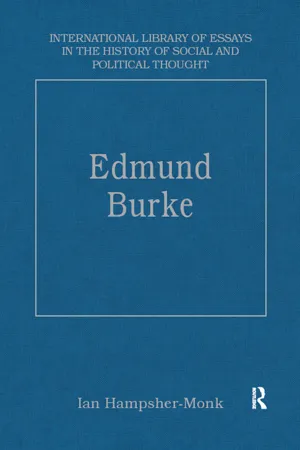
Edmund Burke
About this book
Edmund Burke's iconic stance against the French Revolution and its supposed Enlightenment inspiration, has ensured his central role in debates about the nature of modernity and freedom. It has now been rendered even more complex by post-modern radicalism's repudiation of the Enlightenment as repressive and its reason as illusionary. Not only did Burke's own work cover a huge range - from aesthetics through history to constitutional politics and political theory - it has generated an enormous literature drawing on many disciplines, as well as continuing to be recruited in a range of contemporary polemics. In Edmund Burke, Iain Hampsher Monk presents a representative selection of articles and essays from the last 50 years of this scholarship. His introduction provides a brief biography and seeks to guide the reader through the chosen pieces as well as indicating its relationship to other and more substantial studies that form the critical heritage of this major figure.
Information
Part I
Initial Orientations
[1]
The Basis of Burke’s Political Conservatism
My principles enable me to form my judgment upon men and actions in history, just as they do in common life, and are not formed out of events and characters, either present or past. History is a preceptor of prudence, not of principles. The principles of true politics are those of morality enlarged; and I neither now do, nor ever will, admit of any other.
—Burke, Correspondence, (1960), 282.
IT IS A COMMONPLACE of scholarship on Burke that his political genius consisted of an extraordinary ability to understand the complex relationships between the constantly changing empirical and historical conditions of practical politics, and the basic principles of common morality. Yet during the century and a half since his death, and until very recently, studies of Burke’s political philosophy have been concerned almost exclusively with what has been called the “empirical,” “utilitarian” and “pragmatic” elements in his thought, or with those conservative principles which have an historical rather than an ethical foundation. Burke’s own explicit words, that “the principles of true politics are those of morality enlarged,” have generally been ignored.
Ever since Henry Buckle published The History of Civilization in England (1857–61), it has been universally assumed by Utilitarian and positivist writers, and even by some Christian humanists, that Burke’s political philosophy rests upon a purely empirical, utilitarian and pragmatic foundation. John Morley, the outstanding Victorian disciple of Bentham and Mill, and the recognized authority on Burke during the late nineteenth century, wrote two books on Burke, in which he emphasized “Burke’s utilitarian liberalism,” and praised Burke for having overthrown “the baneful superstitution that politics … is a province of morals.” According to Morley, Burke refused “to reason downwards from high sounding ideas of Right, Sovereignty, Property, and so forth,” because such ideas “have no invariable conformity to facts, and … are only treated with reverence because they are absurdly supposed to be ultimate, eternal entities.”1 Thus Morley claimed Burke as a fellow political liberal, whose strict regard for “circumstances,” “expediency” and “prudence” made “the standard of convenience,” rather than appeals to absolute ethical principles, the ultimate foundation of politics.
The path charted by Morley’s interpretation of Burke was followed, with some slight variations, by William Lecky, Sir Leslie Stephen, and a whole host of Victorian and twentieth century writers in the liberal tradition of politics. Charles E. Vaughan, a learned political scientist and recognized authority on Burke, applied the usual Benthamite antithesis between “natural rights” and “expediency,” and concluded that in Burke’s politics “the last appeal is not to Rights but to expediency.”2 Vaughan noted that Burke’s “expediency” differed from that of Hume and Bentham, because it was qualified by “higher principles” and “a tissue of moral and religious ideals,” but like Morley, he never doubted that Burke made “expediency the ultimate principle of politics.” In 1913, John Mac-Cunn, an excellent Burke scholar, also assumed Burke was a utilitarian, and concluded: “To Burke, as to Bentham, all rights … are not ultimate but derivative,”3 Elie Halevy supplied a variation on this theme in 1928: “From a utilitarian philosophy Burke deduced an anti-democratic political theory …. The utilitarian morality led Burke to social views which were profoundly different from those to which it led Bentham.”4 In 1934, Lois Whitney, a noted eighteenth century literary scholar, contended: “Priestley, Burke, and Bentham are in harmony in their utilitarianism, Burke developing the doctrine in the form of a philosophy of expediency.”5 Two years later, Henry V. S. Ogden extended this common conviction concerning Burke: “The repudiation of natural rights was implicit not only in his utilitarian conviction that the end of government is the happiness and welfare of the people governed, but also in his reliance on experience and in his rejection of all abstract doctrines of political theory … Burke’s opposition to the theory of natural rights and to the use of nature as the norm in political theory was … a conviction unshaken during his whole career.”6 In 1940, John H. Randall repeated this point, and during the 1940’s two other writers on Burke, Annie M. Osborn and John A. Lester, added their voices to this chorus of scholars who supposed Burke was a utilitarian and pragmatist in his political philosophy.7
Thus, for the past century liberals have always interpreted Burke’s political philosophy by resorting to formulas based on “utility” versus “natural rights,” and they have interpreted Burke’s frequent attacks on metaphysical abstract rights as a rejection of belief in absolute moral principles. They have made much of Burke’s strict regard for “circumstances,” and have praised his “expediency” and “prudence,” and his appeals to consider the practical consequences of following a given political policy to its logical but fatal conclusion. All these elements in Burke’s thought have been praised as the ultimate in political wisdom.
Accepting the utilitarian frame of reference, a conservative writer, Richard M. Weaver, denies that Burke has any real claim to be considered a conservative political philosopher:
Burke is widely respected as a conservative who was intelligent enough to provide solid philosophical foundations for his conservatism. It is perfectly true that many of his observations upon society have a conservative basis; but if one studies the kind of argument which Burke regularly employed when at grips with concrete policies, one discovers a strong addiction to the argument from circumstance. Now … the argument from circumstance is the argument philosophically appropriate to the liberal. Indeed, one can go much further and say that it is the argument fatal to conservatism.8
Since Burke always argued from circumstances, rather than from “the nature of things,” Professor Weaver concludes that “Burke should not be taken as prophet by the political conservatives.” The basic error in this argument, as we shall see, lies in the assumption that Burke’s strict regard for circumstances is merely a matter of empirical observation and rational analysis, and wholly disconnected from any ethical principles. Weaver’s basic error involves as complete a misinterpretation of Burke’s principle of prudence as that held by Morley or Lord Acton, both of whom identified Burke’s “prudence” with the calculated expediency of utilitarianism, and failed to understand its vital connection with the absolute ethics of the Natural Law in Burke’s political philosophy.
Quite apart from the utilitarian tradition of Morley, many recent writers who have claimed Burke as a conservative have laid great stress upon the historical elements in his political philosophy. They have emphasized the importance of Burke’s appeals to social traditions and manners, to legal prescription and laws, to his passion for liberty connected with civil order and legal justice, to his veneration of “the wisdom of our ancestors,” as embodied in Church and State, to his defense of the constitutional safeguards to life, liberty and property, to his praise of “prejudice” and duty as against abstract reason and “rights,” and to his conception of man as a civil or political animal, who finds his self-fulfillment in the gradually unfolding corporate life of his nation.9 This conception of Burke as an historical conservative has the merit of avoiding the over-simplified errors of doctrinaire liberalism. Also, on the positive side, by taking into account many of the most important aspects of civil society, as these are discussed by Burke, this view of his political philosophy has illuminated many of the most vital principles in Burke’s complex thought. Yet the ultimate basis of Burke’s political conservatism is not to be found in history, but in his moral principles.
All the elements perceived by utilitarian liberals and historical conservatives are to be found in Burke’s political thought, but none of them, in themselves alone, or in any combination, constitute the ultimate principles of Burke’s political philosophy. Writers who have converted these elements in Burke’s thought into his supposed ultimate political principles have invariably reduced the scope and complexity of Burke’s political philosophy to the measure of their own thought and temperament. Thus, both liberals and conservatives have praised or condemned Burke for insufficient reasons, on a consideration of those parts of his political philosophy which fitted or failed to fit into their own thought.
Since history is descriptive, not normative; since, as Burke said, “history is a preceptor of prudence, not of principles,” to fully understand the basis of Burke’s political philosophy it is necessary to look beyond history to his religious and ethical principles. But before doing this it is necessary to understand in what sense “history is a preceptor of prudence,” and why it was that Burke considered prudence to be “in all things a virtue, in politics the first of virtues.” For the past century, the most common single error of writers on Burke has been the failure to understand the nature and function of “prudence” in his political philosophy.
For Burke, political philosophy was the practical art of governing man as a moral agent in civil society. It was not and could not be a speculative science dealing with abstract truth. The politician, by Burke’s definition, was “the philosopher in action,” and he could never assume a priori knowledge that would enable him to attain exact mathematical certainty in the consequences of his decisions. Politics was a part of practical reason, not theoretical reason; it was concerned with the good, not the true. The nature and actions of men are under general laws of moral necessity, but because the will of man is free to obey or defy the moral law, and because his social circumstances are infinitely varied, in contingent matters and details there can be no general laws. Although justice must always be observed, the determination of what is just in each particular instance, under the different institutions and conditions of mankind, must always vary in its means, according to the infinite variations of men’s temporal circumstances. The common nature of man is infinitely modified by climate, geography, history, religion, nationality and race, by institutions, customs, manners and habits, by all the civil circumstances of time, place and occasions, which cut across and qualify, but do not impair the different means by which the moral ends of society are fulfilled. “The progressive sagacity that keeps company with times and occasions,” Burke wrote, “and decides upon things in their existing position, is that alone which can give true propriety, grace, and effect to a man’s conduct. It is very hard to anticipate the occasion, and to live by a rule more general.” To Burke, “no moral questions are ever abstract questions.” Prudence was for Burke not an intellectual, but a moral virtue, and as such it was a corrective and the best positive alternative to the errors of metaphysical abstraction:
Nothing universal can be rationally affirmed on any moral or political subject. Pure metaphysical abstraction does not belong to these matters. The lines of morality are not like ideal lines of mathematics. They are broad and deep as well as long. They admit of exceptions; they demand modifications. These exceptions and modifications are not made by the process of logic, but by the rules of prudence. Prudence is not only the first in rank of the virtues political and moral, but she is the director, the regulator, the standard of them all.
Burke always maintained that “the exercise of competent jurisdiction is a matter of moral prudence,” because “moral necessity is not like metaphysical, or even physical.” Tyranny was a more common abuse in government than usurpation, Burke believed, because even under legitimate legislatures, “if the rules of benignity and prudence are not observed” oppressive actions may result. Prudence, or a strict regard for circumstances, is not merely a matter of empirical observation and intellectual calculation; it is morally imperative to regard circumstances, because otherwise political action could mortally injure those whom the statesman wishes to serve.
In Burke’s attempted economical reform of 1780, h...
Table of contents
- Cover
- Half Title
- Title Page
- Copyright Page
- Table of Contents
- Acknowledgements
- Series Preface
- Introduction
- PART I INITIAL ORIENTATIONS
- PART II POLITICAL ISSUES
- PART III PHILOSOPHICAL PRESUPPOSITIONS
- PART IV REVOLUTION
- PART V REPUTATION AND LEGACY
- Name Index
Trusted by 375,005 students
Access to over 1.5 million titles for a fair monthly price.
Study more efficiently using our study tools.
Frequently asked questions
Yes, you can cancel anytime from the Subscription tab in your account settings on the Perlego website. Your subscription will stay active until the end of your current billing period. Learn how to cancel your subscription
No, books cannot be downloaded as external files, such as PDFs, for use outside of Perlego. However, you can download books within the Perlego app for offline reading on mobile or tablet. Learn how to download books offline
Perlego offers two plans: Essential and Complete
- Essential is ideal for learners and professionals who enjoy exploring a wide range of subjects. Access the Essential Library with 800,000+ trusted titles and best-sellers across business, personal growth, and the humanities. Includes unlimited reading time and Standard Read Aloud voice.
- Complete: Perfect for advanced learners and researchers needing full, unrestricted access. Unlock 1.5M+ books across hundreds of subjects, including academic and specialized titles. The Complete Plan also includes advanced features like Premium Read Aloud and Research Assistant.
We are an online textbook subscription service, where you can get access to an entire online library for less than the price of a single book per month. With over 1.5 million books across 990+ topics, we’ve got you covered! Learn about our mission
Look out for the read-aloud symbol on your next book to see if you can listen to it. The read-aloud tool reads text aloud for you, highlighting the text as it is being read. You can pause it, speed it up and slow it down. Learn more about Read Aloud
Yes! You can use the Perlego app on both iOS and Android devices to read anytime, anywhere — even offline. Perfect for commutes or when you’re on the go.
Please note we cannot support devices running on iOS 13 and Android 7 or earlier. Learn more about using the app
Please note we cannot support devices running on iOS 13 and Android 7 or earlier. Learn more about using the app
Yes, you can access Edmund Burke by Iain Hampsher-Monk in PDF and/or ePUB format, as well as other popular books in Philosophy & Philosophy History & Theory. We have over 1.5 million books available in our catalogue for you to explore.