- 216 pages
- English
- ePUB (mobile friendly)
- Available on iOS & Android
eBook - ePub
About this book
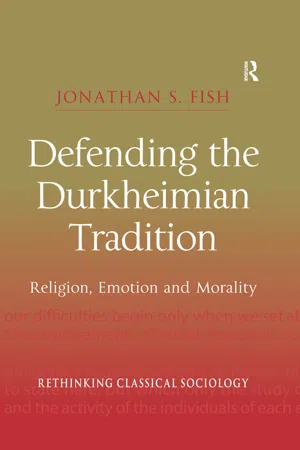
This book provides an exciting, accessible and wide-ranging guide to the development of classical and contemporary Durkheimian thought. Jonathan Fish offers a re-reading of the writings of Emile Durkheim and Talcott Parsons on religion. He aims to move beyond rationalistic readings which have neglected the key significance of collective human emotion in Durkheim's accounts of the link between society, religion and morality. He goes on to look at the development of these ideas in the work of Parsons and more recent Durkheimian thinkers. Making an important contribution both to studies of Durkheim and the Durkheimian tradition and to the sociology of emotion, the book is distinctive in arguing that religion is an essential backdrop for understanding emotion. In making this claim the author provides a key to re-establishing links between the sociology of religion and the wider discipline of sociology.
Information
Bibliography
Adams, B. N. (2002), Classical Sociological Theory, Pine Forge Press, London.
Alexander, J. C. (1988), ‘Culture and Political Crisis: “Watergate” and Durkheimian Sociology’, in Alexander, J. C. (ed.), Durkheimian Sociology: Cultural Studies, Cambridge University Press, Cambridge, pp. 187-224.
Alexander, J. C. (1996), ‘The Centrality of the Classics’, in Turner, S. P. (ed.), Social Theory and Sociology: The Classics and Beyond, Blackwell, Oxford, pp. 21-38.
Allan, G. and Crow, G. (2001), Families, Households and Society, Palgrave, Basingstoke.
Allcock, J. B. (1983), ‘Editorial Introduction to the English Translation’, in E. Durkheim (1955) Pragmatism and Sociology, tr. J. C. Whitehouse, Cambridge University Press, Cambridge, pp. xxiii-xli.
Allen, N. J. (1994), ‘Primitive Classification: the Argument and its Validity’, in W. S. F. Pickering and H. Martins (eds), Debating Durkheim, Routledge, London.
Allen, N. J. (1998), ‘Effervescence and the Origins of Human Society’, in N. J. Allen, W. S. F. Pickering and W. Watts-Miller (eds), On Durkheim’s The Elementary Forms of the Religious Life, Routledge, London pp. 149-161.
Allen, N. J. Pickering, W. S. F. and Watts-Miller, W. (eds) (1998) On Durkheim’s The Elementary Forms of the Religious Life, Routledge, London.
Alpert, H (1939) ‘Emile Durkheim and Sociologismic Psychology’, American Journal of Sociology, Vol 45 (1), pp. 64-70.
Ashley, D. (1994), ‘Postmodernism and Anti-Foundationalism’, in D. Dickens and A. Fontana (eds), Postmodernism and Social Inquiry, UCL Press, London, pp. 53-75.
Averill, J. R. (1980), ‘A Constructionist View of Emotions’, in R. Plutchik, and H. Kellerman (eds), Theories of Emotion, Academic Press, New York, pp. 305-339.
Baehr, P. and O’Brien, M. (1994), ‘Founders, Classics and the Concept of a Canon’, Current Sociology, Vol 42(1), pp. 1-48.
Barbalet, J. M. (1994), ‘Ritual Emotion and Body Work: A Note on the Uses of Durkheim’, in W. M. Wentworth and J. Ryan (eds), Social Perspectives on Emotion, Vol 2, JAI Press, Greenwich, CT, pp. 111-123.
Barbalet, J. M. (1998), Emotion, Social Theory and Social Structure, Cambridge University Press, Cambridge.
Baudrillard, J. (1983a), In the Shadow of the Silent Majorities…or the End of the Social and Other Essays, Semiotext(e), New York.
Baudrillard, J. (1983b), Simulations, Semiotext(e), New York.
Baudrillard, J. (1988), Selected Writings, in M. Poster (ed.), Polity Press, Cambridge.
Baudrillard, J. (1993), Baudrillard Live: Selected Interviews, in M. Gane (ed.), London, Routledge.
Bauman, Z. (1976), Towards a Critical Sociology. An Essay on Common-sense and Emancipation, Routledge, London.
Bauman, Z. (1993), Postmodern Ethics, Polity Press, Cambridge.
Baxi, U. (1974), ‘Durkheim and Legal Evolution: Some Problems of Disproof’, Law and Society Review, Vol 8, pp. 645-651.
Beckford, J. (1985), ‘The Insulation and Isolation of the Sociology of Religion’, Sociological Analysis, Vol 46(4), pp. 347-354.
Beckford, J. (1989), Religion and Advanced Industrial Society, Unwin Hyman, London.
Bell, C. (1992), Ritual Theory, Ritual Practice, Oxford University Press, Oxford.
Bellah, R. (1967), ‘Civil Religion in America’, Daedalus, Vol 96, Winter, pp. 1-21.
Bellah, R. (1970), Beyond Belief, Harper and Row, New York.
Bellah, R. (ed) (1973) Emile Durkheim on Morality and Society, University of Chicago Press, Chicago.
Bellah, R., Madsen, R., Sullivan, W. M., Swidler, A. and Tipton., S. M. (1985), Habits of the Heart: Individualism and Commitment in American Life, Harper and Row, NewYork.
Berger, P. L. (1974), ‘Some Second Thoughts on Substantive Versus Functional Definitions of Religion’, Journal for the Scientific Study of Religion, Vol 13(2), pp. 125-133.
Bershady, H. J. (1973), Ideology and Social Knowledge, Blackwell, Oxford.
Besnard, P. (1993), ‘De la datation des cours pédagogiques de Durkheim à la techerche du theme dominant de son oeuvre’ in F. Cardi and J. Plantier (eds), Durkheim, Sociologique de l’education, L’Harmattan Paris, pp. 120-130.
Bogard, W. (1990-91), ‘Closing Down the Social: Baudrillard’s Challenge to Contemporary Sociology’, Sociological Theory, Vol 8-9(1), pp. 1-15.
Bouglé, C. (1926), The Evolution of Values, tr. H. Sellars, Henry Holt and Co, New York.
Brunetière, F. (1895), La Science et la Religion, Firmin-Didot, Paris.
Budd, S. (1973), Sociologists and Religion, Collier-Macmillan, London.
Burkitt, I. (1996), ‘Civilisation and Ambivalence’, British Journal of Sociology, Vol 47, pp. 135-150.
Burkitt, I. (1997), ‘Social Relationships and Emotions’, Sociology Vol 31(1), pp. 37-55.
Bury, M. (1986), ‘Social Constructionism and the Development of Medical Sociology’, Sociology of Health and Illness Vol 8, pp. 137-169.
Callois, R. (1950), L’Homme et le sacré, Gallimard, Paris.
Camic, C. (1989), ‘Structure After Fifty Years: The Anatomy of a Charter’, American Journal of Sociology, Vol 95(1), pp. 38-107.
Camic, C. (ed) (1997) Reclaiming the Sociological Classics. The State of Scholarship, Blackwell, Oxford.
Chen, K. H. (1987), ‘The Masses and the Media: Baudrillard’s Implosive Postmodernism’, Theory, Culture and Society, Vol 4(1), pp. 71-88.
Clark, T. N. (1968a), ‘Emile Durkheim and the Institutionalization of Sociology in the French University System’, Archives Européenes de Sociologie, Vol IX(1), pp. 37-71.
Clark, T. N. (1968b), ‘The Structure and Functions of a Research Institute’, Archives Européenes de Sociologie, Vol IX(1), pp. 72-91.
Clarke, M. (1976), ‘Durkheim’s Sociology of Law’, British Journal of Law and Society, Vol 3, pp. 246-255.
Cohen, J. (1975), ‘Moral Freedom Through Understanding in Durkheim’, American Sociological Review, Vol 40, pp. 104-106.
Cohen, J., Hazelrigg, L. and Pope, W. (1975), ‘De-Parsonizing Weber: A Critique of Parsons’s Interpretation of Weber’s Sociology’, American Sociological Review, Vol 40, pp. 229-241.
Collins, R. (1975), Conflict Sociology....
Table of contents
- Cover Page
- Title Page
- Copyright Page
- Table of Contents
- Acknowledgements
- One Setting the Scene
- Two Emile Durkheim’s The Elementary Forms of Religious Life
- Three Emile Durkheim’s Lectures on Moral Education
- Four Emile Durkheim’s Lectures on Professional Ethics and Civic Morals
- Five Emile Durkheim’s The Division of Labour in Society and The Two Laws of Penal Evolution
- Six Talcott Parsons’s The Structure of Social Action
- Seven Talcott Parsons’s Post-War Writings on Religion
- Eight Jean Baudrillard’s ‘Implosive’ Critique of the Durkheimian Tradition
- Nine Stjepan Meštrović’s and Michel Maffesoli’s ‘Implosive’ Defence of the Durkheimian Tradition
- Ten Conclusion
- Bibliography
- Index
Trusted by 375,005 students
Access to over 1.5 million titles for a fair monthly price.
Study more efficiently using our study tools.
Frequently asked questions
Yes, you can cancel anytime from the Subscription tab in your account settings on the Perlego website. Your subscription will stay active until the end of your current billing period. Learn how to cancel your subscription
No, books cannot be downloaded as external files, such as PDFs, for use outside of Perlego. However, you can download books within the Perlego app for offline reading on mobile or tablet. Learn how to download books offline
Perlego offers two plans: Essential and Complete
- Essential is ideal for learners and professionals who enjoy exploring a wide range of subjects. Access the Essential Library with 800,000+ trusted titles and best-sellers across business, personal growth, and the humanities. Includes unlimited reading time and Standard Read Aloud voice.
- Complete: Perfect for advanced learners and researchers needing full, unrestricted access. Unlock 1.5M+ books across hundreds of subjects, including academic and specialized titles. The Complete Plan also includes advanced features like Premium Read Aloud and Research Assistant.
We are an online textbook subscription service, where you can get access to an entire online library for less than the price of a single book per month. With over 1.5 million books across 990+ topics, we’ve got you covered! Learn about our mission
Look out for the read-aloud symbol on your next book to see if you can listen to it. The read-aloud tool reads text aloud for you, highlighting the text as it is being read. You can pause it, speed it up and slow it down. Learn more about Read Aloud
Yes! You can use the Perlego app on both iOS and Android devices to read anytime, anywhere — even offline. Perfect for commutes or when you’re on the go.
Please note we cannot support devices running on iOS 13 and Android 7 or earlier. Learn more about using the app
Please note we cannot support devices running on iOS 13 and Android 7 or earlier. Learn more about using the app
Yes, you can access Defending the Durkheimian Tradition by Jonathan S. Fish in PDF and/or ePUB format, as well as other popular books in Social Sciences & Sociology. We have over 1.5 million books available in our catalogue for you to explore.