eBook - ePub
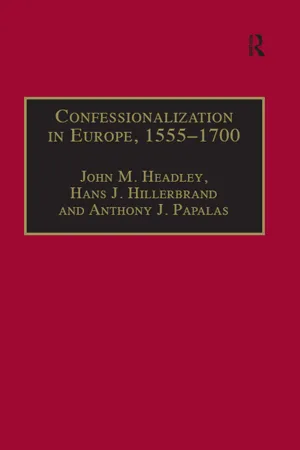
Confessionalization in Europe, 1555–1700
Essays in Honor and Memory of Bodo Nischan
- 400 pages
- English
- ePUB (mobile friendly)
- Available on iOS & Android
eBook - ePub
Confessionalization in Europe, 1555–1700
Essays in Honor and Memory of Bodo Nischan
About this book
Confessionalization in Europe, 1555-1700 brings together a closely-focused set of essays by leading scholars from the USA, UK, and Europe, in memory of Bodo Nischan. They address what historians of the Early Modern period have recently come to define as the pre-eminent issue in the history of the Reformation, as they turn their emphases from the earlier part of the 16th century to the relatively neglected latter half of the century. By the time of his death Bodo Nischan had distinguished himself as a significant contributor to this central problem of confessionalization. The concept involves the practice of 'confession building' which in relation to that of 'social disciplining', promoted interrelated processes contributing decisively to the formation of confessional churches, greater social cohesion, and the emergence of the Early Modern absolute state. Many religious practices, earlier considered as adiaphora (indifferent matters), now became treated as marks of demarcation between the emerging Protestant confessional churches and at the same time politicized as the early modern state sought to impose greater social control. Through the analysis of such liturgical, ritual, and ceremonial practices Nischan helped show the way towards a better understanding of the Reformation's engagement with the people. These are the themes treated in this volume.
“Founding a New Church …” The Early Ecclesiology of Martin Luther in the Light of the Debate about Confessionalization*
1 Introduction
The turning point of Luther’s way to become the reformer of Christianity in Germany was his struggle with the theological tradition – theology as much as its practical consequence in piety and church – of his time. In his view these developments culminated in the question of a merciful God.1 Luther had received answers to this and other related questions, which did not satisfy his existential search for eternal security.2 Traditional theology and pastoral care guided those searching Christ to the church. The Holy Catholic Church acted as mediator and guarantee of God’s eternal will to redeem the sinner and to guarantee atonement through the sacrament of penance.
Even though throughout the middle ages ecclesiology was never in question, at the end of the fifteenth century some reform-oriented theologians turned away from the unquestioned conviction of the church and its offered sacraments as the one and only way to heaven. One of them was John of Staupitz.3 He was the general vicar of the observant branch of the Order of the Augustinian Hermits and for some time a close friend of the younger brother. He showed the merciful God and Christ’s atonement on behalf of man through his life, suffering and death to Luther. Staupitz took Luther out of a circle of never-ending questions about eternal grace and his personal salvation. Staupitz pointed to the suffering Christ who reveals the love and mercy of God instead of the common pastoral advice of the church regarding the sacrament of penance. In front of the picture of Christ as mediator of salvation the question of individual salvation, of election or condemnation, became less important. Staupitz asked Luther to look for the love and mercy of God instead of tempting himself by questions about his own dignity and salvation or the value of the ecclesiastically offered mediation of God’s grace. For Luther the integer and pious words of Staupitz opened a new dimension of pastoral care. Later he remembered: “Staupitz lighted the flame of the gospel for me. … Without Staupitz I would be rather in hell than in heaven. I would have been drowned by the questions of eternal election and salvation. … Staupitz’s word stuck in my heart like the arrow of an archer.”4
Thus Luther started to read Scripture again. And he found the passive meaning of “righteousness of God”.5 That term became – according to his biographical report from 15456 – the key to Scripture for Luther. Righteousness is the nature of God and his acts – not the merit of man. From this point of view Luther started to criticize the sacrament of penance and especially the praxis of indulgence-letters. For Luther these doctrines and especially the false legitimation of its exercise deceive Christians: it shows false security and guaranties salvation on uncertain ground.7
During the increasing dispute,8 which was multiplied by the new technique of printing all over Germany, it became more and more obvious that Luther’s attempt to discuss the theological legitimation of the praxis of indulgence leads to a more general problem: the question of the last authority in the church.9
As a consequence ecclesiology became the center of Luther’s polemics and his reformation attempts.10 To many later theologians the question of justification became the focus of a merely systematic approach to Luther’s theology. But one has to see that ecclesiology, as the focus of the question of authority, is still the center of all disputes, either in the sixteenth century or in contemporary ecumenical discussion.
In his first years Luther did not see the dimensions of his argument. While he had finished his lecture on the Romans and worked out guidelines for the reform of theological studies in Wittenberg in the year 1517/18 he found out that his question touched the basics of the Roman Church and curial theology. He did not discuss the question of what possibilities the church had to replace temporary penalties through other penalties like money or pious works, but he asked for what reason the church developed the doctrine of eternal purgatory and how the priest was legitimized to forgive sin and why he could influence the eternal judgment of God.
Luther started the dispute by emphasizing the authority of Scripture above any other authority. Scripture alone is the rule of any ecclesiastical praxis. On the contrary Alexander Prierias – the Dominican from Rome who formulated the accusation of Luther – pointed out: “Who says about the indulgence praxis, that the church is not able or allowed to do what it does is a heretic.”11 With this the positions became clear: Luther’s request had touched the foundations of the church.12
One of the few Roman theologians who realized the dimensions of Luther’s request and their explosive potentials quite early was the cardinal legate Thomas de Vio Cajetanus.13 He had written a book about the theological foundation of the praxis of the indulgence letter which later on gave birth to the suspicion of a certain sympathy for Luther and his theology.14 Reflecting the colloquy in Augsburg in 1518 Cajetan prophetically envisioned that Luther’s reform attempts if they ever would be realized meant ‘to found a new church’.15 Obviously the Roman theologian had recognized the groundbreaking power of Luther’s request for a final and invincible authority16 within church and state, for piety and mentality, for family and society, for culture and law. Even though Cajetan did not follow this argument – and unfortunately Luther did not either – he felt the dawn of a new epoch. This new epoch would spoil the inner relation between imperium et sacerdotium: religio est vinculum societatis. New and probably competing authorities will occur. The development towards more individuality and an individual conscience cannot be overseen. This matches with historical processes of particularization, territorialization, communalism, the stronger impact of imperial cities and their citizens on politics, culture and society, and several more developments within the fourteenth and fifteenth centuries.17 Luther must be seen, as part of this historical process, as both continuing and competing with the medieval precedent; as both a conservative reformer leading back to the origins of the Christian church and doctrine, and against his own intentions as an innovative modernizer secularizing and disciplining society in early modern times. To acknowledge this particular blend neither reduces the importance nor the quality of his reform ideas.
The tension between tradition and innovation not only characterizes Luther and his reform attempts; it seems to be the proprium of the century in total. Thus a question arises, which was intensively discussed in the last decades of early modern historiography: how much is Luther and his initiation of the Reformation the doorway to a new age of Reformation and Counter-Reformation? What – if not Luther and the Reformation in particular – qualifies the sixteenth century as a new epoch?
2 Confessionalization as the paradigm for a new epoch
The concept of confessionalization was developed to answer this question. Over the years a growing number of historians and theologians have broadly discussed the historiographical invention of Wolfgang Reinhard and Heinz Schilling.18 Rather quickly it became inextricably linked to the problem of whether the reformation is a unique phenomenon. If so we have to ask again about its character: was the reformation merely a theological dispute with fatal consequences for the unity of the church? Could the process in total better be understood as a wide-ranging incident which touched all dimensions of life, politics, economy, culture, and religion? Following the latter the theological question is only a part of the whole and cannot be used to understand the full meaning of what has happened between 1517 and … when does this process come to an end: 1555 with the diet of Augsburg, 1580 with the book of concord, 1648 with the peace of Osnabrück, or even later?
Let us briefly recall the results of an intensive dispute in history and theology: the discussion started with the question of periodization of early modern history in Europe. Traditionally, German, and to a certain extent European early modern history as well, is divided into three periods: the “Reformation” 1517–55, the “Counter-Reformation” 1555–1648, and the “Age of Absolutism” 1648–1789. This division has become almost indestructible because of the simple dialectical pattern it is based upon: a progressive movement, the “Reformation”, as thesis, evokes a reaction, the reactionary “Counter-Reformation”, as antithesis; their contradiction leads to extremely destructive armed conflicts, until Europe is saved by the strong hand of the absolutist early modern state, which because of its neutrality in the religious conflict is considered the synthesis.
This view of history is wonderfully convincing, but quite incorrect. The labels “progressive Reformation” and “reactionary Counter-Reformation” are no longer viable; neither as dialectic contradictions nor as successive periods of history, because they are in no sense mutually exclusive. In particular the so-called “Counter-Reformation period” is at least as much characterized by the “second Reformation”, the expansion of Calvinism, as by increasing Catholic activity in society, culture and church. Since in the second half of the sixteenth century Calvinism proves much stronger than Lutheranism, the Protestant “Reformation” reached its culmination at the very moment when traditional historiography placed the “Counter-Reformation” in ascendancy.
Even though the “Reformation” and the “Counter-Reformation” are closely connected by their origin and background in the late medieval reform-movements, the early “evangelical movement” initiated by Luther remains something particular, since it proved an innovative force of modernizing tendency. However, as soon as the princes took over in the 1520s after the Peasants War, the movement became “Reformation”, that is, a process of religious change organized by conservative authorities in their legal terms.
Empirical research leads several historians to the conclusion that it would be more appropriate to separate a comparatively short-lived spontaneous “Evangelical Movement” from 1517–25 from these two almost parallel organized processes of “Reformation” and “Counter-Reformation”, which both began in the early 1520s and lasted two centuries. According to the sources, both could be defined as rather conservative operations with authorities in the lead and legal devices predominating. In this regard, Calvinists, Catholics, Lutherans, and to a certain extent even Anglicans, all acted in remarkably similar ways. No wonder: each faced the same problem. Under the pressure of mutual competition the religious groups had no choice but to establish themselves as “churches”, i.e. stable organizations with well-defined membership. These new “churches” had to be more rigid than the old pre-Reformation Church, where membership was self-evident and required no careful preservation. Particular confessions of faith served to distinguish these separate religious communities from each other. And since the German word “Konfession” covers both the confessions of faith and the respective communities, Wolfgang Reinhard and Heinz Schilling decided to call the formation of the new churches Konfessionalisierung (confessionalization). To the older concept this process began with the first Lutheran visitations and some tentative measures on the Roman Church side in the 1520s and ended after the late seventeenth century; when France re-established religious unity by force (1685), when England secured the protestant character of its monarchy (1688–1707), and when the Prince-Archbishop of Salzburg expelled the Protestants from his country (1731). Obviously “Church” and “State” collaborated everywhere to cut autonomous parts out of the body of one single Christian community by establishing a particular group conformity of religious doctrine and practice among their members. However, the instruments used, and the institutions and personnel employed to handle them, deserve a closer look, just to demonstrate once again how closely they corresponded to each other in all communities, in spite of theological differences:
1 As already mentioned, the basic procedure consisted in the establishment of the respective pure doctrine and its handy formulation in a confession of faith, which could be used to measure everybody’s orthodoxy. The Lutherans took the first step in this direction with their “Augsburg Confession” of 1530. But the decisive years were the late 1550s and early 1560s, when various Calvinist confessions were followed by the Catholic Professio Fidei Tridentina. Then in 1577, the majority of German Lutherans agreed to the Formula Concordia and finally signed the Book of Concord (1580).
2 A complementary measure to this establishment of pure doctrine was the extinction of possible sources of confusion, which might lead the faithful astray: double confessional duties of priests, the lay chalice, and so on.
3 The new rules had to be spread widely in the territory and, if necessary, enforced. Propaganda might be the first instrument to that purpose. The invention of printing had made Luther’s initial success possible; the calculated use of the printing press now became essential for indoctrination as for fighting the enemy. Censorship was the negative complement of propaganda, keeping away competitors.19
4 Theology under those conditions deteriorated from lofty speculations to continuous battles and almost by definition became controversial.20 On a lower level, the education and even indoctrination of simple believer...
Table of contents
- Cover
- Half Title
- Title Page
- Copyright Page
- Dedication
- Table of Contents
- Acknowledgments
- Tribute to Bodo Nischan
- The Bibliography of Bodo Nischan
- Introduction
- I. Historical Definitions
- II. Confessionalization in German Lands
- III. Confessionalization beyond the Germanies
- IV. Toward the Dismantling of Confessionalization
- Index
Trusted by 375,005 students
Access to over 1.5 million titles for a fair monthly price.
Study more efficiently using our study tools.
Frequently asked questions
Yes, you can cancel anytime from the Subscription tab in your account settings on the Perlego website. Your subscription will stay active until the end of your current billing period. Learn how to cancel your subscription
No, books cannot be downloaded as external files, such as PDFs, for use outside of Perlego. However, you can download books within the Perlego app for offline reading on mobile or tablet. Learn how to download books offline
Perlego offers two plans: Essential and Complete
- Essential is ideal for learners and professionals who enjoy exploring a wide range of subjects. Access the Essential Library with 800,000+ trusted titles and best-sellers across business, personal growth, and the humanities. Includes unlimited reading time and Standard Read Aloud voice.
- Complete: Perfect for advanced learners and researchers needing full, unrestricted access. Unlock 1.5M+ books across hundreds of subjects, including academic and specialized titles. The Complete Plan also includes advanced features like Premium Read Aloud and Research Assistant.
We are an online textbook subscription service, where you can get access to an entire online library for less than the price of a single book per month. With over 1.5 million books across 990+ topics, we’ve got you covered! Learn about our mission
Look out for the read-aloud symbol on your next book to see if you can listen to it. The read-aloud tool reads text aloud for you, highlighting the text as it is being read. You can pause it, speed it up and slow it down. Learn more about Read Aloud
Yes! You can use the Perlego app on both iOS and Android devices to read anytime, anywhere — even offline. Perfect for commutes or when you’re on the go.
Please note we cannot support devices running on iOS 13 and Android 7 or earlier. Learn more about using the app
Please note we cannot support devices running on iOS 13 and Android 7 or earlier. Learn more about using the app
Yes, you can access Confessionalization in Europe, 1555–1700 by John M. Headley,Hans J. Hillerbrand in PDF and/or ePUB format, as well as other popular books in History & World History. We have over 1.5 million books available in our catalogue for you to explore.