- 360 pages
- English
- ePUB (mobile friendly)
- Available on iOS & Android
eBook - ePub
About this book
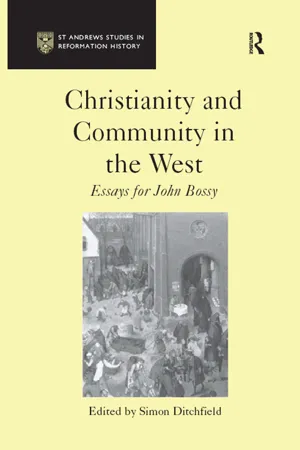
How did Christians in early modern Western Europe express their sense of community? This book explores the various ways in which religious identities were defined, developed and defended - within both Protestant and Roman Catholic contexts, in England and on the Continent - over a period vital for the history of Christianity. As such it will be of interest not only to historians of religion but also to students of social and cultural history in general.
Chapter 1
Cathar Peacemaking*
After the fires went out there were the remains of the dead bodies of the Cathar Good Men and Women.1 Sometimes the bones and ashes were collected and kept by Cathar followers as relics.2 Hardly surprising, this, until we reflect on Cathars’ utter rejection of the material world and human bodies, all of which were entirely the creation of an evil principle or evil God. How could holiness reside in these material objects? Elsewhere we find the opposite, shocking disregard for the bodies of the dead. After receiving the body of a dead Cathar Good Man Bernard Gralh of Vielmur handed it over to a fisherman, who threw it into the river Tarn. Bernard was talking to inquisitors in 1244, and he went on to tell them about the body of another dead Cathar, which was thrown into an old pit.3 And elsewhere we find what we might expect, examples of the Good Men receiving more dignified burial, in cemeteries.
An obvious way of making sense of this variety of attitudes to the bodies of dead Cathars is to sort them into three groups. First, throwing a body away was done by those Cathars who saw clearly what was entailed by their belief that the human body was not only not going to be resurrected but was the creation of an evil principle or evil God, like the rest of the material world. Secondly, traditions of thought, belief and family sentiment were powerful enough to modify such true Catharism and produce to some degree more conventional ‘proper’ burial. Thirdly, some followers behaved like Catholics, venerating the material remains of their martyrs. At any one time one of these three could predominate: pure Cathar belief or traditional or Catholic outlook. Clarity and this analytic triad may exist in modern minds trying to make sense of all this, but often in the past ordinary human fuzziness will have led to the three being mixed.
If the evidence of Cathar followers venerating relics provokes the elementary question, ‘What was going on?’, so also does the sight of the Good Men making peace. Several depositions describe the Good Men making peace between followers who had fallen into discord.4 Perhaps they were acting like Catholic friars who came into Italian cities to settle strife between warring families and parties, or the Waldensian friars who grappled similarly (but undercover) with feuds and quarrels among their followers. Again, all this is hardly surprising, until we take a broader view of these actions. In both the Catholic Church and the Waldensian Order there was a moral and pastoral continuum between such peacemaking efforts and grappling with the sins of their flocks, partly through the preaching of morality and partly through confession, absolution and penance. In the Cathar church, however, there was no such continuum. In principle Cathar withdrawal from the moral world of their followers was as radical as their rejection of the utterly evil material world. Until they received the consolamentum and became Cathar perfects, the men and women who shared the beliefs of the Good Men and Women and supported them were not theologically members of a Cathar church. They were outside, waiting to enter. No Cathar sacraments marked their births and marriages, no Cathar system of penance5 intertwined with their good and bad deeds. Once again, what was going on?
In order to suggest answers to this I am going to look at the stories of the Cathar Good Men settling disputes which are to be found among depositions made in front of inquisitors between 1243 and 1247. Some survive in a manuscript which is now in the Bibliothèque Municipale in Toulouse, a copy made around 1260 of originals from 1245–46,6 while the others are preserved in three of the volumes in the Collection Doat, now lodged in the Bibliothéque Nationale in Paris, which contain seventeenth-century copies of thirteenth-century inquisition registers.7 I provide transcripts of the depositions in thirteen cases in an appendix. I start here by going through the cases one by one, summarising them. The reader may need patience.
The earliest cases are from 1225. In one of them Raimond Bernard, Cathar deacon in Laurac and a fellow Good Man, made a ‘settlement’ (compositio) of a debt between one knight and two other knights, father and son, of St Martin-la-Lande: they made ‘peace’ between men who had been ‘enemies’. In another case the presiding Good Men were Bernard Bonnefous, Deacon of Lanta, and an unnamed fellow Good Man. The Lord of the deponent forced him to make peace with another man with whom he was in discord, and he had to do this ‘in the hand’ (in manu) of the Good Men. There were at least seven men present: the Good Men, the quarrelling parties, and two other men. The deacon then preached for a long time, and all except the two who were at odds then ‘adored’ the Good Men, that is to say, engaged in the rite of melioramentum – which I shall describe later. The deponent in another case around 1225, the knight Raimond Bérenger, Lord of Cambon, had killed some of the men (clientes) of Raimond Unaud, co-Lord of Lanta. The Lord of Rabat, Raimond Sans, had acted as an intermediary, and the deponent then came to a meeting in a garden where there were two Good Men, the Deacon of Caraman, Guiraud de Gourdon, and Bernard of La Mothe, who became filius major of the Church of Toulouse in 1225. Also present was the Lord of Rabat and four other men. The Good Men asked Raimond Bérenger whether he wished to be in amore et paria8 of Raimond Unaud, and he assented. There was no ‘adoration’.
In 1227 was seen a case between Sicard, Lord of Puylaurens and ‘un des premiers personnages de la noblesse rurale du Toulousain’.9 He had been in enmity with another knight of Puylaurens. The Cathar deacon of Lanta, Bernard Engilbert, made peace between them in the Hall of a noble lady in Puylaurens, with many others present. Everyone then ‘adored’ the Good Men, and the exchange of the kiss of peace concluded proceedings.
In the following year a knight of Paulhac had a causa with his sister-in-law. Perhaps this meant that he was engaged in a lawsuit with her? The relationship suggests the possibility of a dispute over succession to the property of a now defunct man, between a surviving brother and widow. The Good Man Ademar of Roquemaure made a settlement between them, with two other men present, after which everyone ‘adored’ the Good Men.
In 1229 or a little earlier there was settlement of the enmity which existed between the Lord of Lanta, Raimond Unaud, and a blood relative who bore the same name. They came together in the house of one of the noble Rocovillas of Toulouse, and there the Cathar Bishop of the Church of Toulouse, the filius major and a third Good Man made peace and concord between the two, in the presence of many knights, including the knight engagingly known as Tres Eminae, ‘Three Measures’. All present adored the Good Men. One deponent refers to the peace and then the adoration, another deponent refers to them in reverse order; neither makes it clear whether the sequence in the description was supposed to imply the sequence in the events described.
The first of two cases in 1230 involved discord between two families in Pradelles. The Orre family went to the house of one of the Daide family, where they found Peter Polhan and four other Good Men. Peter Polhan was an important Cathar, and later to be Bishop of the Cathar Church of Carcassonne (1238–67). In the ‘hand and the power’ of the Good Men the Orres and Daides made peace and concord, and exchanged the kiss ‘as a sign of peace’. There were more than ten other men present, and all ‘adored’ the Good Men. In the other case one of the rulers of Mas-Saintes-Puelles, the knight Bernard de Mas, held another man ‘in hatred’. He went to the man’s house, where there were two Good Men, one of whom asked him to make peace, which he did. The Good Men then preached, with up to forty other persons present.
The house of a Lord of St-Michel-de-Lanès provided the setting for another settlement in 1233. In the house were the Good Men Bertrand Marty and his companion, and among the many others present nineteen names survive, including the lord, his wife, his bailli, and the parish priest of Saint-Michel. The dispute seems to have involved most of these. Everyone, apart from the witness and the parish priest, ‘swore and made peace among themselves’. Among the Good Men there was the apparelhamentum – of which more later – and the Good Men preached. The parish priest confabulated apart with the Good Men, to the effect that no one present should talk about what had taken place. An amiable character, the parish priest is glimpsed on another occasion playing chess with a Cathar follower, with the penance he had imposed as the stake; the Cathar follower won the game and was relieved of his penance.10
In 1235 a deponent living in Fanjeaux went to the house of a man who ‘held him in hatred’. Present there were the Cathar Bertrand Marty and ‘many other Good Men and Good Women’, and the deponent’s enemy and immediate family (wife, father and uncle), and three other men. The Good Men and Women ‘did the apparelhamentum’ and then ‘the witness made peace’ with his former enemy ‘in the hand of Bertrand Marty’. There was no adoration.
The next case was in 1237, this time in Mas-Saintes-Puelles. The deponent, a butcher, was in the house of Lady Richa. There he saw two Good Men, the first of whom was Lady Richa’s son, Raimond de Mas, deacon of Vielmur, as well as a certain Arnaud Maestre, Lady Richa and three other men. The Good Men made peace between the deponent and Arnaud Richa, and then all except one of the men ‘adored’ the Good Men.
The last two cases were both set in Montségur, and both involved the leaders of Montségur. In the first case there was discord between Pierre-Roger of Mirepoix, co-Lord of Montségur, and the men of the castrum of Laroque d’Olmes, around 1242. The men of Laroque came to Montségur for peace, and they included Arnaud Pons, bailli of the Marshal of Mirepoix. They went to the house of Bertrand Marty, Bishop of the Church of Toulouse, and there Bertrand made the peace between the two parties, in the presence of many other men. All present ‘adored’ the Good Men, and the kiss of peace was exchanged. In the last case there was discord between Pierre-Roger and his fellow co-Lord of Montségur, Raimond de Péreille, who was also Pierre-Roger’s father-in-law, over the division of Montségur, at around the same date, 1242. The knight Pons Arnaut and another man came from Châteauverdun into Montségur, in order to make peace between them. In one account the two men ‘dealt with’ the peace between Pierre-Roger and Raimond, and then visited the house of the bishop Bertrand Marty. There the Good Men preached, others ‘adored’ the Good Men, and then the Good Men ‘made’ the peace. While the account of another witness fits this, the other two know nothing of the role of the Good Men.
How problematic is the source? Inquisitors’ interrogations of heretics have such a bad reputation that it is necessary to state two things very emphatically. On the one hand the Languedoc depositions are not at all like the interrogations of Free Spirit suspects or Templars, where words were put in people’s mouths, and their statements were little more than the question repeated and put in the affirmative. The Languedoc depositions are open, varied and full of colour and quotidian detail. On the other hand this very openness can deceive the historian, for these sources still have a series of filters, beginning with language: translation from the Occitan of the court-room to the Latin of the record.11 The material recorded was limited and shaped at an earlier stage by inquisitors’ sticking mainly to a certain schema of questions. These represented a mixture of (1) what inquisitors expected, namely archetypical actions of Good Men and Women and archetypical relations between them and their followers, and (2) within these archetypical actions, those matters upon which they wanted information. Their view of archetypical actions was intelligent and observant, but it was of course simply one view, and it was also coloured by theological translation; for example, ‘Good Men’ being rendered as ‘the heretics’. Their selection from Cathar actions was police-detective – Who? When? Where? – and they tended not to be interested in much that might interest us, such as motivation and the content of sermons. Questions, then, were these: ‘Did you see a heretic (Good Man)?, and, if so, ‘Who? When? Where? Who else was present? Did you hear them preaching?’ If so, who else was present? Did yo...
Table of contents
- Cover
- Half Title
- Title Page
- Copyright Page
- Table of Contents
- List of Figures
- Notes on Contributors
- Acknowledgements
- Abbreviations
- Introduction
- 1 Cathar Peacemaking
- 2 Contrasting Cults: St Cuthbert of Durham and St Thomas of Canterbury in the Fifteenth Century
- 3 Three Suffolk Pieces
- 4 Guilds, Purgatory and the Cult of Saints: Westlake Reconsidered
- 5 A Yorkshire Religious House and its Hinterland: Monk Bretton Priory in the Sixteenth Century
- 6 The Conservative Voice in the English Reformation
- 7 Bibles to Ballads: Some Pictorial Migrations in the Reformation
- 8 Merry England on the Ropes: The Contested Culture of the Early Modern English Town
- 9 ‘All people that on earth do dwell. Sing to the Lord with cheerful voice’: Protestantism and Music in Early Modern England
- 10 The Black Legend of the Jesuits: An Essay in the History of Social Stereotypes
- 11 An Early Christian School of Sanctity in Tridentine Rome
- 12 Science and the Theological Imagination in the Seventeenth Century: Baptism and the Origins of the Individual
- 13 Observations on French Christian Feasts and their Histories
- 14 Richard Mead’s Communities of Belief in Eighteenth-Century London
- 15 Church, Community and Culture in Rural England, 1850–1900: J. C. Atkinson and the Parish of Danby in Cleveland
- 16 St Francis and Modern English Sentiment
- 17 John Bossy: A Personal Appreciation
- Select Bibliography of the Writings of John Bossy
- Index
Trusted by 375,005 students
Access to over 1.5 million titles for a fair monthly price.
Study more efficiently using our study tools.
Frequently asked questions
Yes, you can cancel anytime from the Subscription tab in your account settings on the Perlego website. Your subscription will stay active until the end of your current billing period. Learn how to cancel your subscription
No, books cannot be downloaded as external files, such as PDFs, for use outside of Perlego. However, you can download books within the Perlego app for offline reading on mobile or tablet. Learn how to download books offline
Perlego offers two plans: Essential and Complete
- Essential is ideal for learners and professionals who enjoy exploring a wide range of subjects. Access the Essential Library with 800,000+ trusted titles and best-sellers across business, personal growth, and the humanities. Includes unlimited reading time and Standard Read Aloud voice.
- Complete: Perfect for advanced learners and researchers needing full, unrestricted access. Unlock 1.5M+ books across hundreds of subjects, including academic and specialized titles. The Complete Plan also includes advanced features like Premium Read Aloud and Research Assistant.
We are an online textbook subscription service, where you can get access to an entire online library for less than the price of a single book per month. With over 1.5 million books across 990+ topics, we’ve got you covered! Learn about our mission
Look out for the read-aloud symbol on your next book to see if you can listen to it. The read-aloud tool reads text aloud for you, highlighting the text as it is being read. You can pause it, speed it up and slow it down. Learn more about Read Aloud
Yes! You can use the Perlego app on both iOS and Android devices to read anytime, anywhere — even offline. Perfect for commutes or when you’re on the go.
Please note we cannot support devices running on iOS 13 and Android 7 or earlier. Learn more about using the app
Please note we cannot support devices running on iOS 13 and Android 7 or earlier. Learn more about using the app
Yes, you can access Christianity and Community in the West by Simon Ditchfield in PDF and/or ePUB format, as well as other popular books in History & World History. We have over 1.5 million books available in our catalogue for you to explore.