eBook - ePub
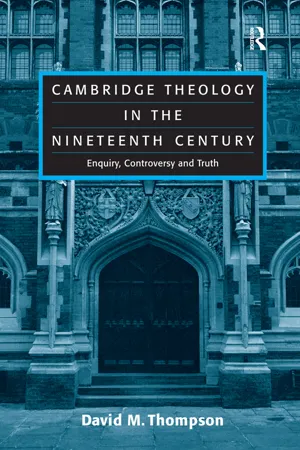
Cambridge Theology in the Nineteenth Century
Enquiry, Controversy and Truth
- 222 pages
- English
- ePUB (mobile friendly)
- Available on iOS & Android
eBook - ePub
About this book
Many books have been written about nineteenth-century Oxford theology, but what was happening in Cambridge? This book provides the first continuous account of what might be called 'the Cambridge theological tradition', by discussing its leading figures from Richard Watson and William Paley, through Herbert Marsh and Julius Hare, to the trio of Lightfoot, Westcott and Hort. It also includes a chapter on nonconformists such as Robertson Smith, P.T. Forsyth and T.R. Glover. The analysis is organised around the defences that were offered for the credibility of Christianity in response to hostile and friendly critics. In this period the study of theology was not yet divided into its modern self-contained areas. A critical approach to scripture was taken for granted, and its implications for ecclesiology, the understanding of salvation and the social implications of the Gospel were teased out (in Hort's phrase) through enquiry and controversy as a way to discover truth. Cambridge both engaged with German theology and responded positively to the nineteenth-century 'crisis of faith'.
Information
Chapter 1
The End of the Eighteenth Century
It is a very wonderful thing, that a being such as man, placed on a little globe of earth, in a little corner of the universe, cut off from communication with the other systems which are dispersed through the immensity of space, imprisoned as it were on the spot where he happens to be born, almost utterly ignorant of the variety of spiritual existences, and circumscribed in his knowledge of material things, by their remoteness, magnitude, or minuteness, a stranger to the nature of the very pebbles on which he treads, unacquainted, or but very obscurely informed by his natural faculties of his condition after death; it is wonderful, that a being such as this should reluctantly receive, or fastidiously reject, the instruction of the Eternal God! or, if this is saying too much, that he should hastily, and negligently, and triumphantly conclude, that the Supreme Being never had condescended to instruct the race of man.1
This arrestingly rhetorical passage could only come from an eighteenth-century writer, aware of the Copernican and Newtonian revolutions in thought, yet convinced that Christianity was true. It is, as it were, poised between the worlds of the Reformation and the later challenges of nineteenth-century science. The author was Richard Watson (1737–1816), Regius Professor of Divinity at Cambridge from 1771, and it comes almost midway through the Preface to his six-volume collection of Theological Tracts, published in 1785.
The work was dedicated to Queen Charlotte. As a wife and mother she was an example of the sex, which was expected to provide the first principles of religious education; and since its purpose was to preserve youth from infidelity, Watson felt his dedication was appropriate. His specified intention was to give ‘young persons of every denomination, and especially to afford the Students in the Universities, and the younger Clergy, an easy opportunity of becoming better acquainted with the grounds and principles of the Christian Religion than, there is reason to apprehend, many of them at present are’.2 Watson did not contribute anything himself to the collection. The works included came from the late seventeenth and eighteenth centuries and were primarily concerned with the authenticity of scripture and the reasonableness of Christianity. Locke’s essay with the latter title was included, as was Nathaniel Lardner’s History of the Apostles and Evangelists (1760) and his Argument for the Truth of Christianity (1764). Samuel Clarke’s Discourse concerning the unchangeable Obligations of Natural Religion and the Truth and Certainty of the Christian Revelation (1705), David Hartley’s Truth of the Christian Religion (1749), and Joseph Addison’s posthumous treatise of the same title were there; as were Thomas Secker’s Charges (1769) as a guide to the pastoral duties of the clergy. By his own account nearly a thousand copies were sold in less than three months; a second edition was published in 1791.
Watson has not had a good press as Regius Professor.3 Norman Sykes described him as having ‘an individual creed, strikingly different from the official articles of subscription of the Established Church’.4 On the other hand, he might have articulated what many others believed, but did not dare to say, since one of his striking characteristics was a readiness to say what he thought, regardless of the consequences. The key to Watson’s theology was John Locke, and it is no coincidence that The Reasonableness of Christianity was reprinted in Watson’s collection.5 In 1775 Watson advised his former pupil Lord Granby, who had just become MP for the University, to read Bacon and Locke, together with Shakespeare; and of Locke he said that all of his writings ‘may be read over and over again with infinite advantage’.6 Moreover Edmund Law, who in many ways was a critic of Watson, also edited an edition of Locke’s Works. He noted the way in which Newtonian mathematics ‘together with Mr Locke’s Essay [and] Dr Clarke’s works went hand in hand through our public schools and lectures’. By contrast the Heads of Houses at Oxford had attempted to ban the study of Locke’s Essay on Human Understanding in 1703, though with only limited success.7 Watson affirmed that ‘the truth of the Christian religion depends upon testimony … and I consider the testimony concerning the resurrection of Jesus (and that fact is the corner-stone of the Christian church) to be worthy of entire credit’.8 This captures in a single sentence the significance attached to evidences of Christianity in general, and the authenticity of the New Testament in particular, which was to determine the pattern of theological study in eighteenth-century Cambridge, and ultimately to lead to the development of biblical criticism.
Locke’s influence was significant in Cambridge, not only for the thought of dons, but also for undergraduates. In the disputations in the Senate House in the Lent Term of the third year students were expected to argue propositions with one another. Usually two of these were mathematical and one philosophical. The written examination in the Senate House, which followed later, also contained a predominance of mathematical questions, but there were questions on philosophy.9 In all questions students were expected to argue using major and minor premises, and drawing conclusions from them. This is one explanation of the surviving importance of geometry. Watson provided a list of the propositions to be debated in 1762: twenty-eight were mathematical or scientific; forty-eight were philosophical or theological.10 It is true, as is usually said, that mathematical questions increasingly dominated, under the influence of Newton, but philosophical questions also had to be discussed, and here the influence was Locke.
Nor was this development simply a matter of intellectual fashion, though it was that. Eighteenth-century England still lived in the shadow of the religious wars of the previous century, not least the English Civil War. Although Bonnie Prince Charlie’s invasion in 1745 is nowadays regarded as a romantic episode doomed to fail, he did get as far as Derby; and the threat of Popery assumed a new reality. Politically, the fear was of foreign domination – now by France rather than Spain – but theologically, the worry was that the differences between Protestantism and Roman Catholicism were perceived in issues of speculative theology, which were not amenable to resolution by reason, but only by appeal to religious authority, an argument which rapidly became circular. When the Hanoverians secured the throne in 1714, they also needed to secure a base in the Universities: in May 1724, at the instigation of Edmund Gibson, Bishop of London, George I informed the Vice-Chancellors of Oxford and Cambridge of his intention to found Professorships of Modern History at both universities and royal letters patent to establish the Cambridge chair were issued in September 1724.11 Generally speaking, the Whig political success was more complete (though not entirely so) in Cambridge than Oxford. Hence the significance of Locke’s influence was both political – the doctrine of consent – as well as theological – toleration, or faith and reason.12 Locke’s understanding of toleration did not extend to Roman Catholics, but his conviction that all significant theological questions could be settled by using human reason to interpret the Bible, was felt to be consonant with the traditional Protestant emphasis on ‘sola scriptura’. It is widely agreed now that Locke did not go along the Deist road, which concentrated on natural religion and made the appeal to revealed religion irrelevant, and this is why eighteenth-century Anglican, Dissenting and Scottish divines could appeal to him with such confidence.
Watson became a Fellow of Trinity in 1760 and was elected Professor of Chemistry in 1764; he immediately set about learning Chemistry and within fourteen months read a course of lectures to ‘a very full audience, consisting of persons of all ages and degrees, in the University’. This was the more significant since students were under no obligation to attend lectures in Chemistry at all. His collection of Chemical Essays, published in 1781, was commended by Sir Humphrey Davy, and in 1787 he was advising the Government on how to strengthen gunpowder!13 However, when the Regius Chair of Divinity became vacant in 1771 as a result of the early death of Dr Rushforth, Watson set about securing the support of the electors, and also the King’s mandate to be created a Doctor of Divinity without fulfilling the usual Act in order to be eligible for election. He had to write on two subjects: the reconciliation of the genealogies in Matthew and Luke, and the interpretation of 1 Cor 25:29 on baptism for the dead. Upon submitting these two pieces to the electors, he was asked to write a Latin dissertation of an hour’s length on Genesis 10:32 (the division of the nations according to the families of the sons of Noah after the flood); this was read in the Divinity Schools a fortnight later, and he was elected unanimously the next day.14 The distance between these exercises and the preoccupations of later eighteenth-century theology is striking. Watson was clearly popular. In his Reminiscences Henry Gunning remarked that the first time he presided in the Divinity School at a disputation, it was crowded to excess. On the first occasion, because the Opponents were ‘alarmed at the thought of exhibiting before such a crowded audience as the high reputation of the Regius Professor of Divinity could not fail to draw together’, they did not appear; but Watson dashed the Respondent’s hopes of not having to defend his thesis by questioning him himself. Disputations did not always proceed so smoothly. Gunning described the Act kept by Isaac Milner for his BD, where both Milner and his opponent, Henry Coulthurst, repeatedly talked across one another and failed to respond to the arguments presented. Watson two or three times made ineffectual attempts to enforce the rules of disputation but neither took any notice, and he resumed his seat in despair leaving them to finish in their own way. Apparently the Divinity School was crowded for most of Watson’s time, but latterly the numbers began to decline because some of the Colleges changed the hour of dinner from 1.00 to 3.00, provoking Watson to make an adverse comment on this in one of his Commencement speeches.15
Watson did not hesitate to join the agitation against the...
Table of contents
- Cover
- Half Title
- Title Page
- Copyright Page
- Dedication
- Table of Contents
- Preface
- Acknowledgements
- Abbreviations
- Introduction
- 1 The End of the Eighteenth Century
- 2 Herbert Marsh and the Beginning of Biblical Criticism
- 3 Evangelicals, Protestants and Orthodox
- 4 The Coleridgean Inheritance
- 5 Theological Reconstruction: Historical Criticism
- 6 Theological Reconstruction: Atonement, Incarnation and Church
- 7 Some Nonconformist Voices
- 8 Conclusion
- Epilogue
- Bibliography
- Index
Trusted by 375,005 students
Access to over 1.5 million titles for a fair monthly price.
Study more efficiently using our study tools.
Frequently asked questions
Yes, you can cancel anytime from the Subscription tab in your account settings on the Perlego website. Your subscription will stay active until the end of your current billing period. Learn how to cancel your subscription
No, books cannot be downloaded as external files, such as PDFs, for use outside of Perlego. However, you can download books within the Perlego app for offline reading on mobile or tablet. Learn how to download books offline
Perlego offers two plans: Essential and Complete
- Essential is ideal for learners and professionals who enjoy exploring a wide range of subjects. Access the Essential Library with 800,000+ trusted titles and best-sellers across business, personal growth, and the humanities. Includes unlimited reading time and Standard Read Aloud voice.
- Complete: Perfect for advanced learners and researchers needing full, unrestricted access. Unlock 1.5M+ books across hundreds of subjects, including academic and specialized titles. The Complete Plan also includes advanced features like Premium Read Aloud and Research Assistant.
We are an online textbook subscription service, where you can get access to an entire online library for less than the price of a single book per month. With over 1.5 million books across 990+ topics, we’ve got you covered! Learn about our mission
Look out for the read-aloud symbol on your next book to see if you can listen to it. The read-aloud tool reads text aloud for you, highlighting the text as it is being read. You can pause it, speed it up and slow it down. Learn more about Read Aloud
Yes! You can use the Perlego app on both iOS and Android devices to read anytime, anywhere — even offline. Perfect for commutes or when you’re on the go.
Please note we cannot support devices running on iOS 13 and Android 7 or earlier. Learn more about using the app
Please note we cannot support devices running on iOS 13 and Android 7 or earlier. Learn more about using the app
Yes, you can access Cambridge Theology in the Nineteenth Century by David M. Thompson in PDF and/or ePUB format, as well as other popular books in Theology & Religion & Religion. We have over 1.5 million books available in our catalogue for you to explore.