- 312 pages
- English
- ePUB (mobile friendly)
- Available on iOS & Android
eBook - ePub
About this book
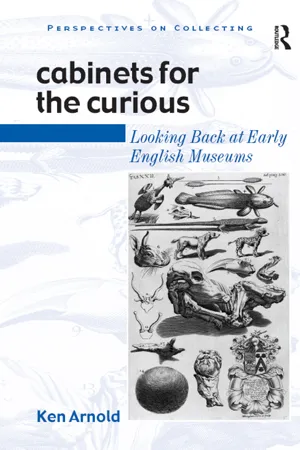
The last few years has, within museums, witnessed nothing short of a revolution. Worried that the very institution was itself in danger of becoming a dusty, forgotten, culturally irrelevant exhibit, vigorous efforts have been made to reshape the museum mission. Fearing that history was coming to be ignored by modern society, many institutions have instead marketed a de-intellectualised heritage, overly relying on computer technology to captivate a contemporary audience. The theme of this work is that we can do much to reassess the rationale that inspires contemporary collections through a study of seventeenth century museums. England's first museums were quite literally wonderful; founded that is on the disciplined application of the faculty of wonder. The type of wonder employed was not that post-Romantic idea of disbelief, but rather an active form of curiosity developed during the Renaissance, particularly by the individuals who set about gathering objects and founding museums to further their enquiries. The argument put forward in this book is that this museological practice of using objects actually to create, as well as disseminate knowledge makes just as much sense today as it did in the seventeenth century and, further, that the best way of reinvigorating contemporary museums, is to return to that form of wonder. By taking such a comparative approach, this book works both as a scholarly historical text, and as an historically informed analysis of the key issues facing today's museums. As such, it will prove essential reading both for historians of collecting and museums, and for anyone interested in the philosophies of modern museum management.
Chapter 1
Introduction: Museum-Science
A Man of Polite Imagination is let into a great many Pleasures, that the Vulgar are not capable of receiving… It gives him, indeed, a kind of Property in every thing he sees, and makes the most rude uncultivated Parts of nature administer to his Pleasures.
By the Pleasures of the Imagination… I here mean such as arise from visible objects, either when we have them actually in our View, or when we call up their Ideas into our Minds.1
Objects speak to us and we delight in the ideas they “call up”. Joseph Addison’s eighteenth-century audience was familiar enough with the notion for him to leave it unexplained. For us too – perpetually surrounded by a galaxy of things playing upon the pleasures of our imaginations – the proposal still stands as a self-evident truth. A century earlier than Addison’s time, however, Elizabethan intellectuals would have been baffled by the contention. It is the evolution of this basic idea from the beginning of the seventeenth through to the early eighteenth century, as well as its contemporary legacy, which provides the subject of this book.
My study of museums and their use of objects began as a contribution to the history of science. Its subject was, for want of a better term, museum-science. For some readers this coupling might appear a little curious. Was science really pursued in early museums? The scientific heroes of that era – Galileo, Newton, Huygens, Boyle, and their like – were clearly not museum men. And unlike the grand theories they hatched, the ideas that I will discuss in the pages that follow seem, at first sight, to shed rather little light on the enormous triumphs of early-modern technical thought. But the history of science has, in the last three decades, witnessed a distinct shift away from an exclusive focus on the ideas of great men. First, moving away from the first rank of ‘great men’, it was broadened to embrace the social and cultural influences that sustained them. Then its focus spread further to investigate not only what scientists discovered, but also how and where they worked. Historians ploughing these auxiliary furrows have shown the importance of understanding not just scientific knowledge itself but also the context of scientific practice. This study of museum-science has been extensively influenced by this more recent scholarship, and is consequently concerned with the activities of some rather neglected enquirers, as well as the somewhat overlooked places in which they worked.2
If the idea of focusing on the day-to-day activities of working scientists has gained fairly widespread acceptance by historians of science, there is less consensus about the importance of including natural historians, collectors and humble fact-gatherers within the standard histories. In an important essay published in 1977, the historically informed philosopher Thomas Kuhn distinguished two scientific traditions: mathematical and experimental. His contention was that only the former, based on subjects like astronomy and mechanics, had seriously contributed to the intellectual energy of the scientific revolution. But it was not until the eighteenth and nineteenth centuries that the latter, featuring subjects like chemistry, magnetism and electricity, made any significant impact. Missing entirely from Kuhn’s subtle analysis, are “softer” subjects such as botany, zoology, and ornithology. A number of historians have since challenged this omission. What my own investigations of these amongst other subjects suggest is that seventeenth-century English museums provided a forum and workshop in which a vitally important aspect of the scientific revolution took shape: namely various “natural historical” practices of observation and experimentation. Through them a disparate group of researchers and more humble “curiosi” collectively fashioned a methodology in which factual information could be extracted from discrete bits of the material world. Far from being incidental to the intellectual upheavals of the time, I will argue that this transformation in the relationship between the realms of knowledge and the physical world has to be placed at its very core.3
Not just a home for natural history, museums also functioned as something of a focus for intellectuals and professionals dealing with issues of evidence and reliability, certainty and probability, opinion and proof. What was happening in museums was therefore reflected in the simultaneous evolution of studies in history, literature, philosophy, statistics and the law. But in an era when the inductive methodology – the accumulation of individual instances leading almost automatically to the formation of generalised laws – was heralded as the mantra for how science should proceed, museums enshrined a rather different way of conducting research. Museum-science was instead characterised by the rhythm of passing from one particular to the next, by what William Eamon has called the “epistemology of the hunt”, forming a type of knowledge that ultimately remained bonded to individual instances, rather than leaving them behind in the ascent to loftier abstractions.4
Seldom supported through broad philosophical proclamations, the alternative approach to producing knowledge that threw up collected instances, examples, samples and exhibits has also been highlighted in the pioneering work of the Italian historian Carlo Ginsburg. Concentrating on a range of late-nineteenth-century research traditions – exemplified in Morelli’s use of pictorial marks to understand works of art, in Freud’s analysis of symptoms of his patients’ mental states, and even in Sherlock Holmes’s forensic approach to clues in criminal investigations – Ginsburg has uncovered what he champions as a second unsung tradition of scientific inquiry. Its essence lies in the investigation of the single example. A similar epistemological distinction has been highlighted by archaeologist Bruce Trigger, though in his case it is applied to different types of knowledge within contemporary humanities. “Idiographic” thinking, he tells us, is significantly different to its alternative intellectual tradition: “nomothetic” thinking. As an emblem of the former, “History differs from the generalising social sciences, only in that its primary aim is to explain individual situations in all their complexity rather than to formulate general laws for indefinitely repeatable events and processes.” Trigger does not seek to trace the origins of his “idiographic” form of thought, while Ginsburg posits the emergence of his alternative model at the end of the nineteenth century. The versions of this type of approach that I focus on were already in evidence in the seventeenth century. In the grand sweep of the history of ideas they might perhaps be seen as the culmination of a Renaissance mentality, which, as Walter Ong argued, virtually enshrined the idea of “examples” as the fundamental source of authority. In fact, as Ginsburg makes clear, something very similar was already embodied in ancient Hippocratic medicine, made manifest in its stubborn refusal to let go of details from specific patients, cases and instances in the quest to gain insights into the world at large. Those who pursued museum-science in seventeenth-century England, I argue, shared much with these other instances of a long-standing, but somewhat overshadowed, epistemological tradition.5
Historiography
The history presented in the following pages sets out a particular vision of how ideas do and do not change over time. In all but the last of the historical chapters, where I look at the development of the taxonomic approach to museum-science, material is presented in a more-or-less synchronic fashion. The interests in local natural history, coins and medals, exotic objects from overseas and materia medica that form the subjects of chapters three, four, six and seven are all examined without particularly focusing on their evolution during the seventeenth and early eighteenth century. However, they nonetheless do cumulatively begin to indicate a gradual shift from a broad and eclectic form of investigation in the seventeenth century to a much more focused one in the eighteenth – an impression confirmed in chapters nine and ten where my focus shifts to the rise of classification as the posited core function of museum-science.
By contrast, the approach taken in chapters five, eight and eleven, in which I describe the subsequent development of three dominant strategies for knowledge-creation in museums – narrative, functional and taxonomic – is instead more explicitly diachronic. Each of these chapters attempt to plot the subsequent evolution of museum thinking – the telling of stories, the use of objects, and the imposition of order upon them – right up to the situation in today’s museums. While the historical chapters chart change within strata of continuity, the other more analytical ones uncover continuity across centuries of evolution. The book therefore lays out an epistemological tradition that has for centuries been similar without ever quite being the same.
The issue of sameness and difference between then and now has exercised a number of other commentators on early museums. Douglas Crimp, for example, has claimed that Renaissance museums should decidedly not be seen as the progenitors of what might seem like their modern counterparts, the only relation between the two lying in the occasional Renaissance cabinet that survives intact today. Steven Mullaney similarly argues that early collections cabinets are not properly comparable with museums that came later, insisting that the former rather than starting the modern museum movement came instead as “the final stage of an historical dynamic specific to the period in question”.6 These are useful warnings against the mistake of thinking that we might automatically know what we are looking at when we inspect early museums. Rather less usefully, they mask a number of ways in which linking then and now can prove highly illuminating. The audiences and objects, the economics and technology, the aesthetics and politics of seventeenth-century England are all almost incomprehensibly different to our own. But at their core both early cabinets and our own museums played host to remarkably similar ideas about how curiosity, wonder and knowledge can be channelled through discrete elements of the material world. Those working in them would no doubt find it difficult to understand each other’s patterns of activity, let alone personal motivations; but they surely share many of the same tool skills, and at least some of the same core beliefs.
In fact, what makes the history of museums of particular interest to me is precisely this tussle between continuity and discontinuity. Enough is different about early museums for it to be intriguing to try to make sense of them; but enough is similar to make the differences meaningful and instructive intriguing. The historiographic stance of this book lies in this fine balance. It presents a self-consciously backward looking history – an attempt to make sense of those early repositories in a way that nevertheless adamantly refuses to lose sight of our own vantage point. This then is a history that deliberately seeks to understand the past through the present, and then to expand our expectations of what a future informed by the past might offer.7
Objects in Museums
This is a study with a clear locus of activity; almost all the action takes place within museums. It is important therefore to set out at the start a few observations about the role of these buildings in the story being told. Museums primarily function as containers. Their triumph, however, has been that they do so three times over: housing not only the objects, but also the people who work with them and the knowledge generated about them. As monuments they also lend to that set of ideas a physical permanence as well as an implied symbol of legitimacy. More specifically, as described in some detail in the next chapter, it was the museum’s walls that signalled their defining function: they kept the objects in, whilst simultaneously keeping out other distractions. Museums have therefore to be considered not only as receptacles for established knowledge, but also as places that nurture processes for creating new knowledge.8
As Thomas Markus has insisted in his Buildings and Power, museums must also be understood as networks of personal activities and social relations: as destinations, for example, in the pursuit of controlled public delight, as guarantors of value and prestige, as houses of entertainment, as studies for applied intellect and as gravitational foci for the culture of curiosity and wonder.9 From their inception, they fairly quickly became hosts to different types of people doing different sorts of things. Founders, curators and other professionals, scholarly guests, curious visitors and tourists all gradually became distinguished as separate groups of users, each with their own agendas. During the early modern period, however, these distinctions had not yet become entrenched. Almost everyone involved with museums was basically motivated by wonder and curiosity and set about applying themselves to a broad range of research activities in its pursuit. This investigative tradition is what this book is about – a tradition that effectively turned warehouses of material things into what philosopher Hilde Hein has termed “reservoirs of meaning”, or even more lyrically “dynamic transformers in which [intellectual] energy is converted, redistributed, and re-released”.10
For my purposes then, museums are most fruitfully thought of as places where people release the knowledge potential of objects, where they give voice to them as “ideas reified”.11 My researches into seventeenth-century English museums have revealed three interestingly different strategies by which objects were made to divulge those ideas. The broad tripartite structure of the book unpacks each of them in turn, showing both how they were coined and exploited in those early museums, and how they have continued to play a part in the museum mission ever since. In this way, the idea of producing knowledge from things can be located at the intersection of three methodological co-ordinates, which reduced to their most basic components are concerned with words, essences and relationships. Unpacking these a bit, there is first the question of how verbally to identify, describe and tell stories about objects in museums – an issue that lies at the heart of the “narrative strategy” laid out in the first part of this book. Next is the question of what constitutes an object’s essence: what makes it uniquely what it is and not something else. This fundamental concern is what inspires the “functional strategy” for studying how objects might be used – particularly in medicine and commerce – as explored in part two. Finally in part three I come to the question of how to order and arrange the gathered objects – a practical dilemma at the heart of the “taxonomic strategy” for analysing how objects relate to each other.
All three interests emerged from the instinct, already evident in seventeenth-century museums, to isolate objects explicitly in order to understand something about the world from which they had been removed. As this habit of investigation matured, it refined its focus, so that the broad mixture of narrative, functional and taxonomic approaches evident in the earlier seventeenth century became narrowed towards a dominant concern with the latter. By then museums had become seriously focused on their core role of surveying and classifying the extraordinary range of God’s creation. Many commentators who have written about the history of museums have seen this shift as representing a crucial moment in their development – a juncture when they ceased simply to be cupboards of playful bric-a-brac, evolvin...
Table of contents
- Cover
- Half Title
- Title Page
- Copyright Page
- Dedication
- Table of Contents
- General Preface to the Series
- Preface
- Acknowledgements
- 1 Introduction: Museum-Science
- 2 Museums Arrive in England
- PART I: THE NARRATIVE TRADITION
- PART II: THE FUNCTIONAL TRADITION
- PART III: THE TAXONOMIC TRADITION
- Bibliography
- Index
Trusted by 375,005 students
Access to over 1.5 million titles for a fair monthly price.
Study more efficiently using our study tools.
Frequently asked questions
Yes, you can cancel anytime from the Subscription tab in your account settings on the Perlego website. Your subscription will stay active until the end of your current billing period. Learn how to cancel your subscription
No, books cannot be downloaded as external files, such as PDFs, for use outside of Perlego. However, you can download books within the Perlego app for offline reading on mobile or tablet. Learn how to download books offline
Perlego offers two plans: Essential and Complete
- Essential is ideal for learners and professionals who enjoy exploring a wide range of subjects. Access the Essential Library with 800,000+ trusted titles and best-sellers across business, personal growth, and the humanities. Includes unlimited reading time and Standard Read Aloud voice.
- Complete: Perfect for advanced learners and researchers needing full, unrestricted access. Unlock 1.5M+ books across hundreds of subjects, including academic and specialized titles. The Complete Plan also includes advanced features like Premium Read Aloud and Research Assistant.
We are an online textbook subscription service, where you can get access to an entire online library for less than the price of a single book per month. With over 1.5 million books across 990+ topics, we’ve got you covered! Learn about our mission
Look out for the read-aloud symbol on your next book to see if you can listen to it. The read-aloud tool reads text aloud for you, highlighting the text as it is being read. You can pause it, speed it up and slow it down. Learn more about Read Aloud
Yes! You can use the Perlego app on both iOS and Android devices to read anytime, anywhere — even offline. Perfect for commutes or when you’re on the go.
Please note we cannot support devices running on iOS 13 and Android 7 or earlier. Learn more about using the app
Please note we cannot support devices running on iOS 13 and Android 7 or earlier. Learn more about using the app
Yes, you can access Cabinets for the Curious by Ken Arnold in PDF and/or ePUB format, as well as other popular books in History & World History. We have over 1.5 million books available in our catalogue for you to explore.