eBook - ePub
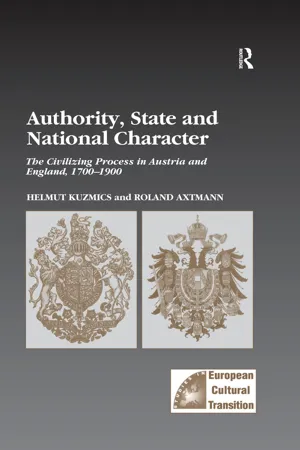
Authority, State and National Character
The Civilizing Process in Austria and England, 1700–1900
- 376 pages
- English
- ePUB (mobile friendly)
- Available on iOS & Android
eBook - ePub
Authority, State and National Character
The Civilizing Process in Austria and England, 1700–1900
About this book
This book presents a cross-disciplinary and methodologically innovative study, combining historical macro-sociology and a sociology of emotions with historical anthropology and cultural studies. Drawing on the concepts and theories of Norbert Elias on the Civilizing Process, it sets out to pin down and compare qualities that are simultaneously instantly recognisable and highly elusive, that is a kind of typical 'Englishness' and of 'Austrianness' that developed contemporaneously in the period up to the First World War. The authors chart the development of political authority structures in their varied historical manifestations, as well as their affective sedimentation as collective habitus ( national character ), comparing England and Austria from 1700 to 1900 as a case study. Their argument is based on an analysis of literary sources, mainly novels and plays, applying a sociology of literature approach. Axtmann and Kuzmics argue that the very different national characters formed in England and Austria during this time are related to differences in the affective experience of power and powerlessness, in short, of authority. They show that the formation of national character is determined partly by the different mixture of authoritative external constraints and milder self-restraint, and partly by the affective experience of human beings in uneven power balances. Specifically, they show how the formation of the bureaucratic state with strong patrimonial features in Austria, and of a self-organizing civil society with strong bourgeois-liberal features in England resulted both in different institutional structures of authority, and in different modes of the affective experience of this authority. Employing empirical detail of individual cases and texts to analyse and illuminate broad processes, the authors reach a clearer and deeper understanding of seemingly intangible and irrational aspects of national identity.
Chapter 1
Introduction
Authority and affect-modelling
A number of films well evoke the spirit and existential certainties of the departed British Empire and its even more utterly vanished pendant, the Habsburg Monarchy. There is, for example, Chariots of Fire (1981), an epic film of now iconic stature, which follows the making of British athletes through to Olympic triumph in the middle-distance track events. A numinous 'Englishness' that fairly evades the sociologist's net shines through this saga of enterprise and fair play, of altercations with college authorities set against the spirit of commercialization, down to the final sporting breakthrough, as sensational as it is hard-won. Just such a tussle between university authorities and headstrong students, waged sotto voce but no less boisterously for all that, marked also by elements of great mutual respect and enacted in scenes of subtly deployed bodily language against the backdrop of an instantly recognizable college landscape, strikes the Continental observer as 'typically English', though she might be unable to say exactly why this is so. Altogether different is the impression made by grumpy privy councillors and fetching chamber maids (equally familiar fare to Austrian cinema-goers) in films starring the 'people's actor' himself, Hans Moser: somehow we know stories like this could never have happened in London or Cambridge. But how do we know? What is it that makes these slightly absurd portrayals of moaning subalterns, ready to burst into song at the drop of a hat, so unmistakeably and so utterly Austrian? In this book we assume that such sociologically vexed questions will yield only, if at all, to a multi-layered analysis of authority and co-incident patterns of psychic sedimentation.
'Authority' covers an exceptionally broad spectrum. Essentially, we shall proceed from two different angles. One is to analyze the balance of forces within the respective societies as manifested in struggles between major social groups since early modern times, a balance that had acquired clear contours by the First World War, the caesura that would see off Habsburg Monarchy and English global hegemony alike. The clearest expression of this balance of forces is the strength and status of the organs of state control – the police, the military and the administration. The other angle is to analyze the psychic structures whereby power is internalized in inculcation, deployment and toleration. We shall assume that the structures of (legitimate) authority and emotions associated with deployment and also toleration of power can indeed vary greatly. Taking our cue from Norbert Elias, we postulate a social 'habitus' (Elias 1996), explicable in terms of the 'biography of state societies'. Not only social macro-structures such as states or markets, but 'inner' psychic structures for modelling emotions and affects, show an astonishing degree of stability. Despite undergoing slow transformation from generation to generation, they still manage to reproduce themselves. Here it is important to isolate the formative settings for the imprinting of human emotions and relationships. The social character of the courtier, merchant or soldier also specifies, at least in part, the character of the French, Dutch or Prussians. This dimension of how power and powerlessness is experienced is usually hard to probe historiographically. In order to analyze the link between developmental structures and the formation of 'national character' or 'state character', we explore belletristic literature that flourished in Austria and England between the early 18th and early 20th centuries.
Different mentalities in different cultures can never be a mere reflex of state formation processes; they can derive equally well from environmental factors like the climate or social processes prior to state formation – such as ethnogenesis. Much of all this would likely yield to scholarly or scientific scrutiny; much, to be sure, would continue to elude our gaze. In any event, it is a useful heuristic device to begin by asking: what can we say in light of what is known about the state and state-formation processes?
Certainly in central and northwestern Europe these diverged as widely as can be. In England and Austria we have two of the longest-lasting European great powers (along with France, Russia, Prussia and the Ottoman Empire, later joined by the new nation-states of Italy and Germany – the latter taking over from Prussia). Their comparison alone suffices to justify the present study, particularly as the contrast could hardly be greater between the island state, which was unified at a comparatively early date, and the multi-national patchwork state situated at the junction of diverse civilizational roads between East and West, North and South. The collapse of the Habsburg Monarchy at the end of the First World War may therefore be seen as a natural caesura – after which something new was embarked on, though the old would long continue to impact on the new. Comparisons of Austria with England are not exactly thick on the ground, even in the macro-sociological literature. This stands in marked contrast to the well-researched variations between France, Germany and England. Though the state-formation processes of the two have been comparatively treated – for example, by Parsons (1970), Anderson (1974) and M. Mann (1988) – the aspect of how these processes impacted on the respective mentalities remains, however, unchartered territory. The Baroque bulbous spires – the 'onion domes' – of Catholic Austria were no less alien to English travellers as the understated greys of English churches and churchyards were to itinerant Austrians. No less alien to each visitor were the political cultures, the rules of etiquette in public spaces, the sporting cultures, etc. Impressions of this kind – which can also be gleaned from how individuals related to the state authority – belie touted clichés of a uniform Western modernity. Thus, a not unimportant point of departure for this work is to demonstrate just how different these societies were on the affective level of emotions and imprinting of experience. Our book studies a period terminating at that caesura that was to bathe the 20th century (so hopefully begun) in the lurid and red colour of blood now inseparable from how we think of it. Naturally, it is clear that each history is written from the vantage of a discrete present and its problems. But it is no disservice to point out that the differential civilizational processes in England and Austria (countries which found themselves in 1914 on opposing sides in a war neither wanted - they were the last of the major belligerents to declare war on each other, yet they almost never met on the field of battle) helped shape their respective destinies in the 20th century. The Austria of former times has gone; England still holds on as a great power, albeit on a reduced scale.
To what extent did habituations developed by 1914 influence the further domestic and foreign policy fortunes of England and the Central European states that succeeded the Dual Monarchy? Interesting as the question is, we must leave its resolution to others. We attempt in this book to get beyond bald assertions to the effect that Austria was an authoritarian system with an inchoate parliamentary presence, while England was a paragon of democracy and parliamentary bourgeois society – assertions that have much to do with the legenda negra, the 'black legend' of Habsburg, as described by Friedrich Heer. This begins with the image of a repressive Catholic Spain (Habsburg being seen in Protestant-Anglo-Dutch perspective); proceeds via the notion of the 'dungeon of the peoples' as developed in the 19th century on the basis of identification with Hungarian, Czech and Italian national movements; and culminates in the derisory appraisals of the truncated republic heard at the dying days of the 20th century (cf. Heer 1981: 344-5; Bruckmüller 1996: 132-3). Turning to England, there has been - presumably no new development this – a 'Central European' perception of England oscillating between the poles of 'bulwark of freedom' (as in reports by Germanophone visitors: see Maurer 1992) and 'perfidious Albion' (especially common before, during and after the Great War). These images vent observations and appraisals of perturbing – in an Austrian perspective! – encounters with parliamentary rule and the unbridled sway of the marketplace, neither of these two institutions being well understood at home.
We build upon the sociology of Norbert Elias, whose leading idea (Elias 2000) itself comes from Freud's psycho-analytic theory of culture. The enculturation process consists, for Freud, in an incremental steering, or repression, of 'drives' (lumped together as the 'id') by a 'super-ego' (which internalizes external constraints) and a controlling 'ego' (which delimits itself energetically from its amorphous initial state to a greater or lesser degree). This process, which is repeated in every individual, gives rise to denials and conflicts, many of which cannot be accessible to ego control and so are discharged, poorly processed, into the neurotic substrate of the cultural social order. Elias has historicized and empiricized this line of thought, plausibly suggesting that the European upper classes, as they passed from being savage warriors to refined courtiers, have all undergone just such a 'civilizing' process.
According to Elias, humans are exposed to acute 'external' constraints – either natural or human. Harsh nature does this by deficiencies and shortfalls of all kinds – a cold or hot climate or inadequacies in the food supply, for instance. 'External' constraints (or, as Elias also calls it, 'constraints by others' ) of human provenance might be bloody wars or the overseer's whip or the daily burdens of social communication, things humans are given to inflicting on their fellows. These all model the 'plastic psychic apparatus' of humans (Freud) and pave the way for nonuniform 'apparatuses of self-constraint', sharply regimented in their individual dimensions and able freely to unfold in others. If human growth is associated with severe and sudden fluctuations in external constraints on behaviour and if, as a result, social and naturally induced insecurity is great (as when contagious disease rapidly brings about death), then the human self is hard put to know what preemptive stance to adopt. The challenge facing the human self is to learn, despite fluctuations and incivilities of social development, to maintain some sense of joie de vivre and to achieve such stability as serves this end. But what if the social pressure which emanates from without (or from nature) becomes more equitable, predictable or calculable? What if eruptions of physical violence by stronger against weaker become rare or are eliminated almost entirely? Then the modelling of the 'affective household' (as Elias calls it, in the sense of a 'drive economy' ) becomes more equitable. Constraints become easier to foresee, and are foreseen. Deliberate self-control becomes easier; at the same time the individual has implanted in him or her an automatically (i.e., blindly) functioning apparatus of self-control. The stability and peacefulness of the social processes without are matched by enhanced stability and peacefulness of the psychic processes within.
According to Elias, there arose a general constraint for foresight and for planned behaviour that spread as Western civilization evolved. This also applies to what he calls a social constraint for self-constraint (Elias 2000: 365). What does this mean for the individual affective household? What Freud calls 'sublimation', Elias calls a muting of drives, that is, the diminishing of psychic contrasts, which in turn is accompanied by more ways in which to satisfy needs. Life becomes richer in nuances, if less colourful. Life psychologizes and rationalizes itself. A key role is played here by shame-related anxieties. Shame is a fear of social degradation, occurring even when there are no physical constraints and chiefly dependent on one's super-ego; and it tends to accompany relationships of authority. To cite Elias:
The conflict expressed in shame-fear is not merely a conflict of the individual with prevalent social opinion; the individual's behaviour has brought him into conflict with the part of himself that represents this social opinion. It is a conflict within his own personality; he himself recognizes himself as inferior. (Elias 2000: 415)
The shame and embarrassment threshold for a whole series of vital bodily needs has been lowered, even as the number of rules and situations where we are expected to keep our affects on a tight leash has grown. So it is that in our bureaucratized and marketed worlds a decidedly fine-meshed network of invisible social constraints has accreted, making all talk of 'spontaneity', of fully embracing the here-and-now, seem doomed in advance.
The gradual spread of functional democratization during the civilizing process has a dampening effect on the affective household, in conjunction with an overall lengthening of action chains that impells to greater rationality and foresight. Given a crass disparity of power, A can live at B's cost virtually unchecked. Rules of etiquette rise to the fore as power is distributed more equitably, which happens as parties are drawn increasingly into a denser 'network of interdependencies'. Thus the larger princely courts were generally pacific and rich in human relationships, as compared with castles where minor knights presided over local society. And today's bureaucratic settings are less authoritarian than the hierarchical orders of the 19th century had ever been.
National habitus
In his seminal work of 1939, Norbert Elias set out the conceptual approach associated with his name.
The social units that we call nations differ widely in the affect-economies of their members, in the schemata through which the emotional life of the individuals is moulded under the pressure of institutionalized tradition and of the present situation. (Elias 2000: 29)
This statement adumbrates what Elias would later come to refer to as 'national habitus'. Elias still uses the term 'national character', which he drops as 'pre-scientific' later on in The Germans (Elias 1996). However, it is roughly coterminous with 'national habitus'. Moreover, in his Process book we already find him talking of a 'psychic habitus', especially in the final section of the second volume. Not that the term 'national character', in the context of the above statement, is used randomly or just in passing; indeed, the opposition between 'civilization' (with its French courtly connotations) and 'culture' (of middle-class German provenance) was Elias's point of departure for mounting his own notion of 'civilization', so much so that comparing France and Germany became one of the core themes of The Civilizing Process. Here too we find the idea advanced that 'national characters' arose from 'social characters'. In the French case, for example, the social character of a courtly class underwent slow transformation in what he terms an ever-widening movement (Elias 2000: 32), yielding the French national character as we know it. Compared to either France or England, the German national character, when it crystallized, was much more exclusively bourgeois since the German middle-class intelligentsia of the 18th century remained separate from the nobility.
For Elias, the 'national character' or 'habitus' must be construed in terms of a relatively permanent imprinting of emotions and affects, or, to be more precise, in terms of the entire 'affective household' of nations. Even on a 'pre-scientific' level, that is, in day-to-day interactions, members of different nations usually have little trouble recognizing each other. We thus have the 'typical Italian' or the 'typical German', who are readily discernible no matter what that person's individual traits may be. Yet when one attempts to perceive oneself as a typical representative of a nation, this proves much more difficult. Success here presupposes 'self-distancing', as Elias argues in The Germans (Elias 1996). Typical, and therefore recurrent, behavioural patterns (such as the pliant courtier that is never far below the surface in many a Frenchman; the German who cannot forbear dispensing advice to all and sundry, whose remote ancestor was a professor or bureaucrat in the 18th century) can be observed immediately and correspond to typical modes of feeling and experiencing. By 'habitus' Elias essentially means something akin to 'second nature' or social learning that has become embodied (cf. Dunning/Mennell 1996: IX). In this context, 'affect modelling' refers to emotions whose expression is communicated socially to others, as part of an older emotional system of self-control, of regulating group relationships as well as relationships between group and individual. It is more rigid than the language-mediated control system of the neo-cortex. Elias (1987) distinguishes three components of this emotional system: an emotional component (pleasure or aversion) in the narrow sense; a somatic component (a palpitating heart, for instance); and also a behavioural component (flight or attack), which includes too the expression of emotions that have signal character for group members (laughter or weeping, etc.). According to distinctions made in social psychology, we can discriminate mimicry, gesticulation, acoustic signals, physical appearance and comportment, or how one approaches or withdraws from others, as expressions of affects (cf. Argyle 1972). This means that members of different nations can tell themselves apart in terms of all these dimensions. For example, older Continental Europeans distinguish themselves from older middle-class Americans by their facial expressions, by their bodily comportment, and (of course) by their clothes: evidently, clothes can be changed, the former presumably can not. In some cultures people speak louder than in others, or they gesticulate more, and so on and so forth; yet these cultural imprints are scarcely expressions of our genes. These imprints reflect the fact that self-regulation and individualization are mirrored in a social habitus as well as in a national habitus.
Concomitantly with the development of societies from 'survival units' of band, village or tribe into towns or states, there occurs the development of personality structure in the direction of greater individualization. This process of individualization is owed to the affiliation of individuals to larger survival units and the corresponding need to face up to the complex demands of denser webs of social interdependence.
In less differentiated societies, such as the Stone Age hunter-gatherer groups, the social habitus may have had a single layer. In more complex societies it has many layers. [...] It depends on the number of interlocking planes in his society how many layers are interwoven in the social habitus of a person. Among them, a particular layer usually has special prominence. It is the layer characteristic of membership of a particular social survival group, for example, a tribe or state. In members of a society at the developmental stage of a modern state this is referred to by the expression 'national character'. (Elias 1991b: 183)
Since Austria was a multi-national state with as many languages as nations (and even more dialects, each one manifesting regional diversity), this problem becomes extremely virulent (not least in practical terms). But in the English case too we can assume multiple infolded loyalties and a similar profusion of layers of habitual imprints.
In his treatise on the ethnic origins of nations, Anthony Smith (1986) developed an extremely rich casuistry of ethnic and national societies. This he did from a process-sensitive perspective. Recognition of the relative permanence of such processes brings him to religion, tradition, language, indeed to all semi-enduring institutions capable of conferring identity and continuity on an ethnic group or a nation. Especially in the case of Austria, but also to a considerable extent in the case of England with its Celtic fringe, it is necessary to distinguish analytically between ethno-linguistic layers of social habitus on the one side, and layers where the state has influenced the social habitus on the other. There are German theorists who are not at all keen to release Austria from the German fold. In particular, those theorists who take their cue from Elias should know what a central role the state-formation process plays for him in terms of habitus formation. While on the one hand today's Rump Austrians are linguistically close to Bavarians (and in the Vorarlberg to Alemanns) and even share with them a taste for certain dishes and traditions, like celebrating the Baby Jesus rather than Father Christmas, Austrians differ from Bavarians and Swabians, on the other hand, because, for example, of the great-power status of their monarchy, the complex way in which their bureaucracy was structured, and the many wars fought on their southern flanks. We shall discuss the significance of these factors later on. To take the English case, it is a fact that many of that country's competitive team sports have Celtic roots, which opens up the possibility that the spirit of fair play might be ethnically derived as well. Nevertheless, we focus as far as possible on the state-formation process and its aftermath. But since the English influence on the British state formation was preponderant since at least the time of union with Scotland (1707), it is legitimate, to argue that English state character constitutes the 'national character'. With regard to the Austrian part of the Habsburg Monarchy as it was in 1914, we do not find a similar convergence between state and nation. Quite the contrary. It was the forces of nationalism that finally ripped apart the multi-national state; therefore, in this work...
Table of contents
- Cover
- Half Title
- Title
- Copyright
- Contents
- General Editor's Preface
- List of Tables
- Acknowledgements
- 1 Introduction
- 2 The Formation of the English State and the Sociogenesis of Political Authority
- 3 The Formation of the Austrian State and the Sociogenesis of Political Authority
- 4 Feudal Patrimonialism and Ecclesiastical Coercion of Conscience in Austria
- 5 Feudal Paternalism in England: Developments Within the Gentleman Canon
- 6 The Courtly Element in the Austrian Character: Authority, Pretence and Servility
- 7 Proud Detachment as an Element of English Authority Relationships: 'Indirect Rule'
- 8 Bureaucratization as an Austrian Civilizing Process
- 9 Puritanism, Book-Keeping and the Moralization of Authority in the English Habitus
- Bibliography
- Index
Trusted by 375,005 students
Access to over 1.5 million titles for a fair monthly price.
Study more efficiently using our study tools.
Frequently asked questions
Yes, you can cancel anytime from the Subscription tab in your account settings on the Perlego website. Your subscription will stay active until the end of your current billing period. Learn how to cancel your subscription
No, books cannot be downloaded as external files, such as PDFs, for use outside of Perlego. However, you can download books within the Perlego app for offline reading on mobile or tablet. Learn how to download books offline
Perlego offers two plans: Essential and Complete
- Essential is ideal for learners and professionals who enjoy exploring a wide range of subjects. Access the Essential Library with 800,000+ trusted titles and best-sellers across business, personal growth, and the humanities. Includes unlimited reading time and Standard Read Aloud voice.
- Complete: Perfect for advanced learners and researchers needing full, unrestricted access. Unlock 1.5M+ books across hundreds of subjects, including academic and specialized titles. The Complete Plan also includes advanced features like Premium Read Aloud and Research Assistant.
We are an online textbook subscription service, where you can get access to an entire online library for less than the price of a single book per month. With over 1.5 million books across 990+ topics, we’ve got you covered! Learn about our mission
Look out for the read-aloud symbol on your next book to see if you can listen to it. The read-aloud tool reads text aloud for you, highlighting the text as it is being read. You can pause it, speed it up and slow it down. Learn more about Read Aloud
Yes! You can use the Perlego app on both iOS and Android devices to read anytime, anywhere — even offline. Perfect for commutes or when you’re on the go.
Please note we cannot support devices running on iOS 13 and Android 7 or earlier. Learn more about using the app
Please note we cannot support devices running on iOS 13 and Android 7 or earlier. Learn more about using the app
Yes, you can access Authority, State and National Character by Helmut Kuzmics,Roland Axtmann in PDF and/or ePUB format, as well as other popular books in History & World History. We have over 1.5 million books available in our catalogue for you to explore.