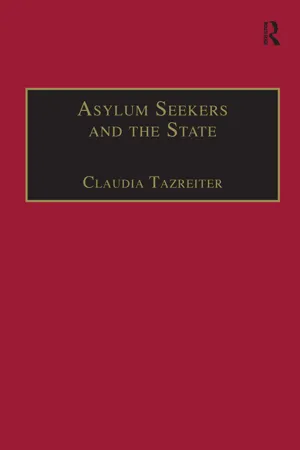
eBook - ePub
Asylum Seekers and the State
The Politics of Protection in a Security-Conscious World
- 280 pages
- English
- ePUB (mobile friendly)
- Available on iOS & Android
eBook - ePub
Asylum Seekers and the State
The Politics of Protection in a Security-Conscious World
About this book
Highly topical in subject matter, Asylum Seekers and the State reveals immigration policy as a political process which has social consequences not only for the newcomer group, but also for the wider receiver society. This work considers the obligations which receiver societies have for considering refugee claims, but at the same time assesses contemporary security concerns; it also provides an introduction to the roles of non-government organizations as stake-holders in the political process. The book also offers a study of the historical and cultural context of immigration in Germany and Australia, which demonstrates the practical impact of these issues. Taking a fresh approach to the issue of asylum seekers and refugees, this book offers unique perspectives from non-state actors as significant brokers and advocates of social and political processes.
Information
Chapter 1
Introduction: ambivalence and the outsider
Media outlets around the world are saturated with stories focused on security, war and terrorism. From many vantage points, East and West, in economically developed and less developed countries, fear and suspicion of outsiders has intensified into visceral hatred expressed in overt and covert acts of violence. Some acts of violence against outsiders are carried out by individuals, others are the actions of states using coercive force in both symbolic and in tangible ways to exclude certain groups and individuals. Some of these actions may well be justified. Many are not.
Individuals express opinions, and states carry out actions premised on a complex interplay of social, economic and political anxieties. Caught in the web of these anxieties are refugees and asylum seekers. Those individuals seeking protection have faced an increasingly hostile reception in the countries in which they seek asylum in the period since the end of Communism in Europe. Hostility toward refugees and asylum seekers has intensified since 2001. In no small measure, such sentiment rests on a fear of terrorism. The human rights of the most threatened and marginalised people in the world; those at risk of severe forms of persecution, torture, or loss of life - have been put at greater risk by the new emphasis on security in the developed world since the September 11, 2001 terrorist attacks on New York and Washington.
This book seeks to deal with an aspect of the global dilemma of people moving across borders in search of protection and safety. The way in which such people are received and treated in countries which are signatories to International Human Rights Conventions is significant in a number of ways. With a world that is increasingly interconnected in economic, political and in cultural ways, harsh and exclusionary measures by one state are likely to have negative knock-on effects for neighbouring states. To be sure, the root-causes of refugee flows need to be identified, and real solutions found to the violence which causes flight. At the same time, the obligations placed on states who are signatories to the 1951 United Nations Refugee Convention (hereafter, Refugee Convention) are fundamental to ensuring those in need of protection are not placed in danger by being sent back to the source of their persecution - refouled. Indeed the test of a state's commitment to human rights principles and the spirit of the Refugee Convention, is in the treatment of asylum seekers who will almost always of necessity enter a country in a clandestine fashion in order to ask for protection. This book examines the dilemma which asylum seekers present to states they enter through the case studies of Germany and Australia.
Protection: a background
In 1999, the National Gallery of Great Britain held an exhibition of work by the Brazilian artist Ana Maria Paeheco. The subject matter of the paintings and sculptures draws on Christian images of trial, tribulation, sacrifice and pain such as the martyrdom of Saint Sebastian and the temptation of Saint Anthony. The artist's interpretations evoke some of the most harrowing excesses of the twentieth century: the torture and death of innocent martyrs on the altar of modern cruelty. A large triptych in the exhibition, Luz Eterna, is evocative of the experience of exile. On the left, an exhausted figure is dragged away by two men, a surveillance camera taking in the scene. The central panel shows a mass of frightened exiles attempting to flee, at the same time transfixed by a horde of helicopters hovering above them. Pacheco says that one of the inspirations for this central panel was a photograph of refugees in Jordan in 1990 along with a strikingly similar image of huddled masses from 1897, depicting victims of religious strife in Brazil. The last panel depicts a writhing martyr, drawing on Saint Anthony, fleeing the menacing clutches of two Sphinxes. In the background, burnt-out, bombed remains of a city suggest the decimated cities of Europe after World War II. The added spectre of a concentration camp is suggested on the horizon, where rings of barbed wire are suggestive of this twentieth century form of mass cruelty.
Visual representations of the human condition can have the power to synthesise the complexity of persecution and degradation, freezing a moment, an emotion, a cry, and communicating it with energy and clarity which can escape the written form. Images of exile and of punishment, whether in painted or photographic form, give us a view into an expansive world of displacement and homelessness: themes which seem to traverse historical epochs.
The persecution of individuals and groups on political religious or cultural grounds has persisted in various waves throughout human history. While the reasons for persecution have varied greatly, so has the preparedness of host countries to receive those fleeing persecution. This book explores the reception asylum seekers face in the late twentieth century. In particular, the developments in Germany and Australia since 1989 are explored. The approach of this book, as a comparative study, indicates the response of two particular liberal democracies to problems at their borders and the tensions of arbitrating between national political, economic and social interests and transnational obligations pertaining to human rights. Secondly, the structure of the book, focusing on the issue of asylum seekers through the vehicle of NGOs, highlights the way in which non-state actors are of increased significance as representatives of groups and individuals rendered mute or powerless by violence, coercion and political upheaval.
The year 2001 marked the 50th anniversary of Refugee Convention, which most directly articulates the grounds of protection that should be offered those fleeing persecution. The majority of countries in the world do have real obligations to people who claim to be refugees, as signatories to the Refugee Convention and its Protocol of 1967.1 In the fifty-year period since the establishment of the Refugee Convention, the idea of (some) rights being universal, and thereby applicable to all of humanity rather than the members of a particular state, has been given political efficacy through the vehicle of human rights. Rights, such as those embodied in the Universal Declaration of Human Rights of 1948 privilege no particular concept of human life, of cultural traits, beliefs or practices. Moreover, the rise in the international efficacy of human rights as principles of broad value to all people has been enabled, at least in part, through the proliferation of non-government organisations (NGOs) since the end of the Second World War, who have advocated for the extension of such rights in many forums: locally, nationally and internationally, with governments, business and citizen groups. NGOs such as Amnesty International and Human Rights Watch, are only the most prominent of hundreds of organisations which advocate for human rights in situations where they see such rights being abused. NGOs have increasingly spoken out for the marginalised and the voiceless around the world in an 'advocacy revolution' (Ignatieff 2001; 8). The proliferation of such activity has not only occurred in economically developing countries and in 'emergent' democracies, but also in the affluent democracies of the West.
We see that the consolidation of human rights has gathered momentum in the later half of the twentieth century through the proliferation of human rights institutions and the efficacy of the idea that protecting such rights is of intrinsic value across and between cultures and nations. The central pillars of human rights, including the Refugee Convention, continue to be important instruments for ensuring the protection of people in vulnerable, life-threatening circumstances. Yet at the same time, the persecution of individuals and groups has continued around the world, testing the practical efficacy of the universal norms embodied in the obligations of 'transnational' justice. The grounds for persecution of particular individuals or groups continue to relate to those characteristics which differentiate people, such as race, religion, nationality, gender and particular political affiliations. Those very distinctions are what should be irrelevant, or at least suspended, if more than lip service is paid to the normative framework of human rights.
While we may agree that the penetration of human rights as valued principles have proliferated during the late twentieth century, geopolitical shifts in the balance of political order from the early 1990s have resulted in an increase in localised conflicts and in humanitarian crises in many parts of the world. The dissolution of the Soviet Union ruptured the Cold War stand-off which had maintained a false sense of certainty with the political polarisation of the world around the camps of two superpowers, the Soviet Union and the United States of America. The effects of decolonisation in Africa and Asia also continued to be felt into the 1990s with regional and local conflict in the African continent and in many parts of Asia.
A brief overview of developments in the last decade, related to the processes resulting in people becoming refugees, begins the story from which I formulate the central problem addressed in this book. I ask: how can we best ensure a balance between the protection obligations which those claiming asylum seek to engage, and the local needs and interests within societies which are asylum destinations? Moreover, what are some of the recent models which address this question?
Before elaborating the various questions and dilemmas which flow from this problem, I will briefly sketch the context. In 1989 there were 15 million 'persons of concern' according to the UNHCR.2 In 1995 there were more than 27 million; in the year 2000 over 22 million. The UNHCR warns that such figures should only be used as a 'snapshot', as data is collected haphazardly - even by industrialised nations - and in areas of war and conflict, hazard and inaccessibility can make the collation of accurate statistics impossible. This would suggest that the true numbers of 'people of concern' could well be much higher. New 'push factors' forcing people to flee their homes surface in different parts of the world every few months, sometimes every few weeks. In 1992, the world witnessed a mass exodus from Somalia. A few years later Rwanda erupted in hatred and violence, in the form of 'ethnic cleansing'; a phenomenon we also witnessed with horror in the former Yugoslavia. Violence spread through the Balkans during the late 1990s in Kosovo and further east, in Chechnya. In 2001, the United States of America instigated a 'war on terrorism', following the September 11 attacks on the World Trade Centre in New York and on the Pentagon in Washington. This 'war on terrorism' has resulted in a renewed exodus and displacement of people in Afghanistan, and more recently, Iraq. In many other locations, disaster, violence and persecution have led to individuals and groups fleeing their homes in search of safety and peace. Though there are many 'root causes' of the social, political and economic problems that create the mass displacements of populations, durable solutions are not easily found.
Paradoxically, it is the countries which themselves safeguard democratic principles, uphold the rule of law, and are the most vocal defenders of human rights around the globe which have felt the need to increase mechanisms of immigration control over the last decade. Western democracies, which have in the past benefited from immigration, whether through guest worker programmes, or other planned immigration intakes, are increasingly concerned to guard their borders from the movement of people, including those claiming protection under the Refugee Convention, with the result that migration has become increasingly clandestine, with people-smugglers profiting from the trade in human cargo.
Herein lies a dilemma for the defenders of human rights as a universal ideal: the ongoing and incommensurable nature of such rights and the question of how they are to be defended and articulated as obligations alongside the legitimate needs and priorities within sovereign states. Of course, if we are only talking of human rights as 'negative rights', as neoliberals might - stopping short of causing harm to others - the dilemma remains narrowly contained. However, if human rights are to be substantiated through the dispensation of 'positive' rights, we have a more substantive dilemma. The idea of 'positive' rights, applicable across borders even in a minimal sense, requires some form of cosmopolitan institutional and legal framework with coercive powers (Habermas 1998; 319). Moreover, a human rights framework, as outlined in the Universal Declaration of Human Rights of 1948 (UDHR), differentiates between civil and political rights, and social and economic rights.3 While most attention within human rights discourse in the post Second World War period, has been on civil and political rights, economic and social rights have increasingly been raised by various parties and organisations in the late twentieth century as important rights to facilitate full human development. With the issue of 'positive rights', human needs and the thorny issue of resources and their distribution become central.
The 1951 Refugee Convention promises non-refoulement; that those with genuine fears of persecution will not be returned to the source of their persecution. With this promise, receiver societies also bear the consequence (burden), of providing for the needs of such new arrivals. It would follow that addressing the 'root causes' of flight would be in the long-term interest of receiver societies, ensuring that the numbers of unanticipated arrivals claiming protection are reduced. However, through the 1990s we have seen efforts on the part of Western states directed at deterring such 'irregular' arrivals, and measures aimed at their removal, rather than initiatives seeking the resolution of refugee-causing conflict and violence. Monetary aid to economically developing countries has been in decline in many countries of the West, and what development assistance is given is often in the form of 'tied aid', focusing on particular projects with an economic or other benefit to the donor country. Certainly diplomatic, development and democratic institution-building efforts in refugee-producing states continue to take place. At the same time though, measures aimed at deterring the arrival of asylum seekers have become a priority for states of the West, with an infusion of significant resources to fund internal and external measures to detect, detain, deport and in other ways discourage 'irregular' or 'illegal' immigrants, or 'aliens', including those with protection claims.
The response to those who have fled their homes and seek protection elsewhere requires careful and detailed differentiation, highlighting the needs and the rights of the resident as well as the newcomer. It is this tension between the 'needs of strangers' and the needs of citizens which both state and non-state actors reflect in their arguments for admission or expulsion (rejection) of asylum seekers. Michael Ignatieff (1984) reminds us that understanding human needs and their fulfilment is a process open to politicisation and manipulation, as it is a process based upon a presumption that someone knows the needs of another, or indeed that we truly understand our own needs. Ignatieff asks the penetration question: 'when is it right to speak for the needs of strangers? Politics is not only the art of representing the needs of strangers; it is also the perilous business of speaking on behalf of needs which strangers have had no chance to articulate on their own' (ibid.; 12). Ignatieff's invocation reminds us that the issue of representation is by no means clear-cut.
On obligation and the stranger: theoretical perspectives
How then shall we consider an obligation to be held across borders in the form of transnational justice? Moreover, how should we think about an obligation to a stranger who may be either near or distant? The idea of an obligation to an 'other' raises the issue of justice and what boundaries demarcate it, as well as the persons to whom just conduct should be extended. In other words, how do we decide the extent to which we are obliged to act in a just manner? The literature conceptualising and debating the definitions and boundaries of justice and of obligations is vast and wide-ranging, emerging from the social contract tradition of the seventeenth and eighteenth centuries and beyond. In the late twentieth century the seminal work on justice, A Theory of Justice, by John Rawls, has been the trigger for a vigorous debate on the limits of justice, more particularly in view of the conditions of modern life. The polarities of this debate lie between cosmopolitans, holding the view that justice must have a transnational character in order to be consistent with the idea that all people share 'basic rights'; and at the other end of the spectrum, communitarians, who hold that duties are in the main held to members of the same community, defined according to descent or to culture, and the bonds of common citizenship (O'Neill 2000; 187)
Rights, in the form of human rights, must be given substance through detailing to whom obligations lie and what the basis of such obligations is. In this regard the moral standing of a person, or how we see others, will help to answer the question of obligation, indicating where and how a claim can be made. In our daily lives we make countless assumptions about others which guide our own actions and choices. Such assumptions may be unconscious or part of a routine action repertoire; taken-for-granted ways of judging, thinking and acting. However, does action towards distant strangers carry the same 'regularity' or ease, which action toward those closer at hand can exhibit? Is nearness or distance a sufficient guiding principle for determining who remains within the domain of moral concern and who is excluded from it? On what basis is such a concept of distance grounded; physical distance, cultural distance? Rights, in isolation from the question of obligation, make it difficult to define where a claim can be lodged and which institutional mechanisms can fulfil or guarantee a right:
Since action at a distance is usually institutionally and technologically mediated action, it is hard and often impossible to determine just which individual's action harms or injures which others, and hence hard to discern who might have rights of redress against whom
(O'Neill 2000: 199).
The obligation that holds specifically for those seeking protection requires a state to properly consider a protection application. The refugee policy of a state reveals much more than just the most evident, superficial administrative and strategic techniques and priorities of a particular government. Refugee policy also reveals aspects of the core values of a state, which immigration policy per se does not reveal. Immigration policy is broadly understood as an aspe...
Table of contents
- Cover
- Half Title
- Title
- Copyright
- Contents
- List of Tables
- Acknowledgements
- List of Abbreviations
- 1 Introduction: ambivalence and the outsider
- PART I: THEORETICAL CONCEPTS
- PART II: HISTORICAL AND CULTURAL DEVELOPMENTS IN IMMIGRATION AND PROTECTION: THE CASE STUDIES
- PART III: THE POLITICS OF EXCLUSION
- Appendix: Interviews
- Bibliography
- Index
Trusted by 375,005 students
Access to over 1.5 million titles for a fair monthly price.
Study more efficiently using our study tools.
Frequently asked questions
Yes, you can cancel anytime from the Subscription tab in your account settings on the Perlego website. Your subscription will stay active until the end of your current billing period. Learn how to cancel your subscription
No, books cannot be downloaded as external files, such as PDFs, for use outside of Perlego. However, you can download books within the Perlego app for offline reading on mobile or tablet. Learn how to download books offline
Perlego offers two plans: Essential and Complete
- Essential is ideal for learners and professionals who enjoy exploring a wide range of subjects. Access the Essential Library with 800,000+ trusted titles and best-sellers across business, personal growth, and the humanities. Includes unlimited reading time and Standard Read Aloud voice.
- Complete: Perfect for advanced learners and researchers needing full, unrestricted access. Unlock 1.5M+ books across hundreds of subjects, including academic and specialized titles. The Complete Plan also includes advanced features like Premium Read Aloud and Research Assistant.
We are an online textbook subscription service, where you can get access to an entire online library for less than the price of a single book per month. With over 1.5 million books across 990+ topics, we’ve got you covered! Learn about our mission
Look out for the read-aloud symbol on your next book to see if you can listen to it. The read-aloud tool reads text aloud for you, highlighting the text as it is being read. You can pause it, speed it up and slow it down. Learn more about Read Aloud
Yes! You can use the Perlego app on both iOS and Android devices to read anytime, anywhere — even offline. Perfect for commutes or when you’re on the go.
Please note we cannot support devices running on iOS 13 and Android 7 or earlier. Learn more about using the app
Please note we cannot support devices running on iOS 13 and Android 7 or earlier. Learn more about using the app
Yes, you can access Asylum Seekers and the State by Claudia Tazreiter in PDF and/or ePUB format, as well as other popular books in Politics & International Relations & Politics. We have over 1.5 million books available in our catalogue for you to explore.