- 356 pages
- English
- ePUB (mobile friendly)
- Available on iOS & Android
eBook - ePub
About this book
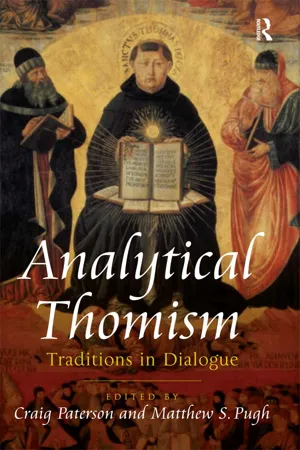
Analytical Thomism is a recent label for a newer kind of approach to the philosophical and natural theology of St Thomas Aquinas. It illuminates the meaning of Aquinas's work for contemporary problems by drawing on the resources of contemporary Anglo-Saxon analytical philosophy, the work of Frege, Wittgenstein, and Kripke proving particularly significant. This book expands the discourse in contemporary debate, exploring crucial philosophical, theological and ethical issues such as: metaphysics and epistemology, the nature of God, personhood, action and meta-ethics. All those interested in the thought of St Thomas Aquinas, and more generally contemporary Catholic scholarship, problems in philosophy of religion, and contemporary metaphysics, will find this collection an invaluable resource.
Information
Chapter One
Aquinas, God and Being
1. Introduction
Some critics, while praising Aquinas on many counts, have concluded that his view of God’s eternity and immutability depends upon a misconceived Platonism, consequently, his explanations of God’s so-called “simplicity” are based on sophistry and illusion.1 Against this, I present Aquinas’s views as the coherent whole I believe them to be, his later works showing some development as well as greater indulgence in metaphor.
The prologue of the Summa theologiae makes it plain that Aquinas is speaking as a theologian, giving an exposition of sacred doctrine, intending to speak of the God of Abraham, Isaac and Jacob. In considering the names of God in ST I, q. 13, all the names considered are concrete and of the sort theologians use – he is strong, wise and good, that he is a lion or a stone of stumbling, that he is Lord, Savior and Creator, rightly called God and He Who Is.
It is of the essence of this God to be a living God and it is in keeping with this that Aquinas conceives God’s existing and living in terms of the notion of an act or activity. God’s act or activity of being, in Latin his actus essendi, is his activity of living, is his activity of knowing and understanding, is his activity of loving. It is a unitary or simple actus, act or activity, with many aspects, inasmuch as we speak of it as being, living, knowing, loving, and so on according to the respect in which the being, living, knowing, loving, and so on of creatures resemble it. The facts that God is, that he lives, that he knows, and so on, are all distinct facts stated in different propositions, but these propositions are all made true by one unitary actuality.
This actus, Aquinas understands to be the act of a subsistent thing, the word actus serving as a translation of Aristotle’s word energeia. In the modern logical sense, this act or activity is a particular, not in the sense of being a member of a wider group of particulars, but in the sense of being logically a singular act, not a kind of act. This energeia of being is the furnace which gives and maintains being and vigor in all things. It is in no way an abstract entity. Therefore there is for him no resemblance at all between the kind of immutability possessed by God and the immutability which belongs to abstract objects such as general properties and numbers. General properties and numbers are incapable of exercising any causal action or of suffering any passion because they are merely abstract in character – objects only of the mind.
Aquinas considers eternity, not simply negatively as non-temporality, but as a form of life, in particular as complete and perfect possession all in one act of a life without beginning or end. God’s immutability is not a stasis contrasting with movement within the world of moving things, but arises from his being pure activity.
Much modern consideration of eternity by believers has been very superficial. Many have come to argue that immutability is incompatible with thinking of God as living and personal, usually on the basis that life and personhood involve not only intellect but also emotion and responsiveness to other persons, in particular to changeable free human beings.2 These arguments, however, seem to depend on supposing that we ought to be able to imagine what it is like for God to live his life, as if to be able to empathize with God, something which traditional theism has always excluded, insisting on God’s unimaginability and incomprehensibility.
True, in the Scriptures of those many religions which hold that God is unimaginable and incomprehensible, the same God often speaks of himself and is spoken of in very anthropomorphic ways. In Hebrew scripture he is spoken of as walking in the garden of paradise, of resolving on things and then relenting, and of exercising motherly care. Each of these three cases has been explained, each in a different way. In Christian tradition, Jesus in his humanity has been taken as the chosen image of whatever in God is expressed in the language of the emotions. But this does not make us able to feel what it feels like to live God’s life.
These doctrines of God’s simplicity and immutability are shared with Muslims. They reject any idea of Allah having added qualifications, or of his attributes being separate from his being, or of his being subject to change or changeable. These doctrines are part of any orthodox Jewish, Christian or Muslim doctrine of God. Modern philosophers’ difficulties spring from their trying to imagine things which according to this shared tradition are necessarily umimaginable. Their fight is not primarily with God’s simplicity and eternity, but with his unimaginability and incomprehensibility, data in this tradition. These data have the consequence that every positive statement about God has to be understood as subject to negative qualifications, so that in the words of the Fourth Lateran Council in 1215 “between Creator and creature no likeness can be expressed without implying a greater unlikeness.”
Modern criticism of the idea of eternity is also superficial because it fails to take account of the underlying structure of the relationship between God and creation.
Firstly, in our understanding of the world of bodily or physical things, temporality has become increasingly inseparable from a causal order within which space and time are wrapped together. It is therefore not credible that time should have any existence separate from the whole physical created order; and therefore, if this order has been given existence by a creator, then the same creator must have in the same act concreated time (I say “concreated” since it is the things of nature that are created and time with them, and not time that is created as an independent thing within which the things of nature come to be). Therefore there can be no sense in describing God as present in time, except in the sense that the whole of him in his simple unity is immediate to that to which he gives being at any particular place and time, as the agent who is internal and immediate to this action of giving being.
One of the blind spots of those who try to temporalize God is that their view involves a Time which embraces both God and creation and this involves, contrary to relativity theory, that simultaneity is always absolute throughout space independently of observers. Relativity theory reinforces the awareness shared by Augustine and Aquinas of the inseparability of time from the natural created universe. Physically, being past, present or future are always in relation to a juncture in space and time; there is no absoluteness in temporal relations in nature except within the “time-cones” familiar in presentations of relativity theory, and as causal order requires, which excludes circles in causation.
Secondly, even in the most sophisticated of proposed physical theories, ones in which there are nine or ten dimensions of space, time still stands alone in a unique relation to them. And our whole understanding of physical causal order, including our understanding of what is involved in experimentation, depends upon a cause having effects which are later than its action. That is, it is our understanding of causal action, and not only what notions we may have about the contingency of the future, whether arising from free will or from any supposed existence of absolute chance, which requires the reality of time. The future relative to any juncture in space and time does not yet exist and is not already established in the sense that the past is established, for even though what is past to a juncture no longer exists at that juncture, this past is still then established in some way which sets it together with what is present in that juncture, in contrast with what is future to that juncture. If the future is open so that there is some real contingency or undeterminedness about it, this depends upon the fact that it does not yet exist. Accordingly, any God who gives existence to nature must also be a God who makes nature continue in existence. But nothing in time or in any way localized in time can do anything to make itself or anything else exist in the future. Only a non-temporal upholder can uphold the temporal order.
Logically, it is possible for someone to say that nature goes on of itself, by what Norman Kretzmann calls “existential inertia,”3 so that there is no need for it to be explained by there being a non-temporal upholder, but to say this is just to gwe no explanation, not to give an alternative explanation. And many philosophers make very queer remarks about existence needing no more explanation than nonexistence, even when it is a matter of the existence of a universe whose nature is to reliably continue. The possibility of saying such things, however, does not effect the conclusion that here, if anything is to be able to uphold things in existence, to cause their continuance, it has to be non-temporal.4
2. The Being of God and the Being of Creatures as Acts or Activities
2(a) Being as an Act or Activity
When Aquinas speaks of the simplicity of God, he is denying that there is any distinction between the actuality of his existing and the actuality, for instance, of his knowing or loving.
By contrast, in considering creatures we have to make a distinction between their act of being as substances and their acts of accidental being. Thus in considering the esse of a creaturely self-standing bodily substance, such as a human being, as we shall see, Aquinas’s view is that it consists primarily of what is involved in its being a human being, since for him “life is a particular form of esse, specified by the relevant living principle” (Quodl. 9). However, in addition to this, “through superadded acts,” creaturely substances “have being (esse) secundum quid (according to something), as being white signifies being according to something” which he explains in terms of the actualization of being white presupposing the actual existence of the substance which is white (ST I, q. 5, a. 1). More particularly in SCG I, 28, he says “any excellence of anything attaches to it according with its esse. No excellence would attach to a human being from his wisdom unless because of it he were (esset) wise,” and, in the Summa theologiae, “the good can be more or less according to some supervening actus, for example, according to knowledge or virtue” – that is, a human being is more or less in some accidental respect, for instance in being more or less knowledgeable or virtuous.5
Thus whereas in God the acts of knowing, understanding and loving are each identical with his act of being and living (and therefore also with each other), by contrast, in human beings (and in any other created intellectual beings, for example, angels) all acts of knowing, understanding and loving are acts by which the created substance concerned has accidental being superadded or supervening upon its being as a substance. They are ways in which the human being or other created substance is more fully (that is, is enriched in being or has fuller existence).
This resolves the people’s puzzle as to how he can speak of degrees of being, for example, in his statement of the argument of his Fourth Way,6 which represents each perfection as existing in varying degrees in creatures. Aquinas argues that the supreme cause of these perfections as they exist in lesser degree in creatures must be something which exemplifies them in a maximal way, namely God, the first cause of being.
Quite evidently, if esse is conceived of as the most general common predicate shared by all things (res), it could not serve to characterize God. But Aquinas explicitly and repeatedly argues that God’s act of being is not the common predicate, ens,7 predicated of every thing (res), that is of every ens from any of the ten categories.
If esse is conceived of as an act or activity in the way I have explained, however, there is no incoherence in holding that God’s esse can have nothing added to it because his activity of being, which is the same activity as his activity of living, is also the same activity as his understanding and loving. In God his life consists in his understanding and loving, whereas in creatures these activities of understanding and loving are accidents, superadded activities supervening upon their being and living as substances.
If a substance’s esse can indeed be conceived of as an activity, and if this expression does not always have to refer to a predicate of some kind, Kenny’s problem8 as to how esse or “being” are the most empty of predicates that can characterize God or be such that nothing can be added to them, is quite unreal. For it is a problem which only arises from rejecting the idea of esse as an act or activity as something absolutely distinct from esse signifying being as the subject of a proposition.
2(b) Subsistences as Alone in Having Esse as an Act
From the beginning Aquinas gives pride of place to the primary subject, that is a subject which is not itself either predicated of or present in any other subject, that which Aristotle says is primarily and chiefly called ousia – in modern writings commonly called first substance. When he particularly needs to avoid ambiguity, Aquinas uses the word subsistentia to indicate these first substances defined in this wa...
Table of contents
- Cover
- Half Title
- Dedication
- Title Page
- Copyright Page
- Table of Contents
- List of Contributors
- List of Abbreviations
- Preface and Acknowledgments
- Introduction to Analytical Thomism
- 1 Aquinas, God and Being
- 2 Thoughts Addressed to an Analytical Thomist
- 3 Three Theological Appropriations of Analytic-Philosophical Readings of Thomas Aquinas
- 4 Aquinas and Searle on Singular Thoughts
- 5 Casual Relations: a Thomistic Account
- 6 Instantaneous Change Without Instants
- 7 Aquinas’s Teleological Libertarianism
- 8 Medieval Theories of Intentionality: from Aquinas to Brentano and Beyond
- 9 Aquinas, Finnis and Non-Naturalism
- 10 Wittgenstein as a Gateway to Analytical Thomism
- 11 On Analytical Thomism
- 12 The Resistance of Thomism to Analytical and Other Patronage
- 13 Haldane’s Analytic Thomism and Aquinas’s Actus Essendi
- 14 God and Persons
- 15 Kenny on Being in Aquinas
- 16 G. E. M. Anscombe and Thomas Aquinas on Necessity and Contradiction in Temporal Events
- Afterword: Analytical Thomism: How We Got Here, Why It Is Worth Remaining and Where We May Go Next
- Select Bibliography
- Index
Trusted by 375,005 students
Access to over 1.5 million titles for a fair monthly price.
Study more efficiently using our study tools.
Frequently asked questions
Yes, you can cancel anytime from the Subscription tab in your account settings on the Perlego website. Your subscription will stay active until the end of your current billing period. Learn how to cancel your subscription
No, books cannot be downloaded as external files, such as PDFs, for use outside of Perlego. However, you can download books within the Perlego app for offline reading on mobile or tablet. Learn how to download books offline
Perlego offers two plans: Essential and Complete
- Essential is ideal for learners and professionals who enjoy exploring a wide range of subjects. Access the Essential Library with 800,000+ trusted titles and best-sellers across business, personal growth, and the humanities. Includes unlimited reading time and Standard Read Aloud voice.
- Complete: Perfect for advanced learners and researchers needing full, unrestricted access. Unlock 1.5M+ books across hundreds of subjects, including academic and specialized titles. The Complete Plan also includes advanced features like Premium Read Aloud and Research Assistant.
We are an online textbook subscription service, where you can get access to an entire online library for less than the price of a single book per month. With over 1.5 million books across 990+ topics, we’ve got you covered! Learn about our mission
Look out for the read-aloud symbol on your next book to see if you can listen to it. The read-aloud tool reads text aloud for you, highlighting the text as it is being read. You can pause it, speed it up and slow it down. Learn more about Read Aloud
Yes! You can use the Perlego app on both iOS and Android devices to read anytime, anywhere — even offline. Perfect for commutes or when you’re on the go.
Please note we cannot support devices running on iOS 13 and Android 7 or earlier. Learn more about using the app
Please note we cannot support devices running on iOS 13 and Android 7 or earlier. Learn more about using the app
Yes, you can access Analytical Thomism by Matthew S. Pugh, Craig Paterson in PDF and/or ePUB format, as well as other popular books in Theology & Religion & Religion. We have over 1.5 million books available in our catalogue for you to explore.