eBook - ePub
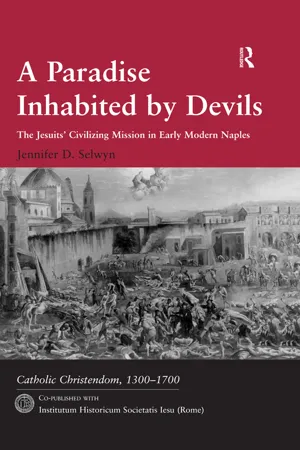
A Paradise Inhabited by Devils
The Jesuits' Civilizing Mission in Early Modern Naples
- 292 pages
- English
- ePUB (mobile friendly)
- Available on iOS & Android
eBook - ePub
A Paradise Inhabited by Devils
The Jesuits' Civilizing Mission in Early Modern Naples
About this book
In recent years much scholarly attention has been focused on the encounter of cultures during the early modern period, and the global implications that such encounters held. As a result of this work, scholars have now begun to re-evaluate many aspects of early culture contact, not least with respect to Christian missionary activities. Prominent amongst the missionaries were members of the Society of Jesus. Emerging as a dynamic new religious order in the wake of the Reformation, the Jesuits were deeply committed to promoting religious and cultural reforms both within Europe and in non-Christian lands. Yet whilst scholars have revealed much about the Jesuits' innovative educational endeavours, and their numerous missions to the Americas, Asia and the Sub-Continent, less attention has been paid to the nature of the Jesuits' global civilizing mission as a key feature of their institutional character. Nor has sufficient work been done to fully explain the relationship between the Jesuits' efforts to evangelize and civilize those areas within the Catholic fold and those without. Taking as its focus the city of Naples, this study illuminates how the Jesuits' work in a Catholic European setting reflected their broader global civilizing mission. Despite its Catholic heritage, Naples was popularly perceived as a place of spiritual and social disorder, thus providing an irresistible challenge to religious reformers, such as the Jesuits, who sought to 'civilize' the city. Drawing in considerable numbers of the order, Naples proved to be a training ground for the Jesuits that shaped the order's missionary praxis and influenced the thinking of many who would later travel further afield. By gaining a fuller understanding of this process, it is possible to better understand what drove the Jesuits to craft and perpetuate a cultural map that continues to resonate down to our own times. This book is published in conjunction with the Jesuit Historical Institute series 'Bibliotheca Instituti Historici Societatis Iesu'.
Chapter One
A paradise inhabited by devils
While the mythology of a beautiful but culturally backward southern Italy holds less power today than it did in earlier times, the intensity of stereotypes that represent southern Italians as overly emotional, violence-prone and lazy is still evident to a visitor in contemporary Italy. From at least the late Middle Ages forward, as Naples’ economic and political fortunes became increasingly bound up with the policies of the powerful monarchies that claimed sovereignty over it, and as the machinations of its own evidently anarchic and self-interested nobility took their toll, prominent images of the city likewise became more alarmist. The sixteenth and seventeenth centuries brought a dramatic influx of immigrants into the city. Individuals and families migrated from the southern Italian countryside, bringing with them a host of social problems not unfamiliar to other burgeoning early modern cities and towns, but apparently magnified in the minds of observers because the social problems that they observed in Naples took place in such an apparently idyllic climate.
When the first twelve Jesuits arrived in Naples in 1552 to establish a college and begin their program of moral reform in the southern Italian capital, they were no doubt aware of the stereotypes of the Mezzogiorno that prevailed by the mid-sixteenth century. In time, the Jesuits would join the chorus of those who duly noted the troubles in Naples, reifying many of those stereotypes even as they celebrated the challenges that the City and Kingdom offered to the Society of Jesus in its ambitious apostolic program. The period from the mid-sixteenth century through to the end of the seventeenth century saw an explosion in the publication of local and regional histories, ‘descriptions’ and travel guides for Naples. During this roughly 150-year period, some 36 works were published in vernacular Italian, 15 in Latin and an additional 7 in other vernacular languages.1
Dominant views of early modern Naples and its citizenry were shaped by a curious paradox: the city and its surroundings were viewed as an earthly paradise, while many Neapolitans, especially the poor, were seen in a different light. Benedetto Croce (1866–1952), the highly prolific and influential Neapolitan philosopher, historian and literary critic, noted that by the sixteenth and seventeenth centuries it was almost a cliché to refer to Naples as a ‘paradise inhabited by devils.’2 For the Jesuits, however, this characterization of the city reflected in microcosm the world that they hoped to reform through their educational and apostolic ministries.
To understand fully the paradoxical view of the southern Italian capital, we must begin by examining early modern perceptions of Naples within the context of the shifting political, social, economic and religious features of southern Italy in the late medieval and early modern periods. The sixteenth century is a critical period of transition in this respect, both because of the city’s rapid demographic growth and the larger political and economic changes that moved southern Italy further from the gravitational center of international commerce and trade.3
What were the key features of the emerging profile of Naples? Out of the anecdotal impressions of the city, penned by a vast array of commentators both foreign and native to the Mezzogiorno, we can trace several unifying themes. For many, Naples came to be defined as a city and region plagued by criminality and moral decay, including rampant prostitution and violent social unrest. Observing its complex urban landscape, many commentators produced vivid discourses of a barbarous popolo minuto (common folk) and, in a usually less derisive manner, spoke of the decadence of the southern Italian nobility that flocked to the city in the late sixteenth and seventeenth centuries. A few, like the sixteenth-century Neapolitan author Camillo Porzio, found common attributes across the social spectrum to highlight. Writing in a late sixteenth-century account of the Kingdom of Naples for the new viceroy, Porzio argues that both noble and lower-caste Neapolitans share ‘common qualities.’ Despite apparent differences, they are equally ‘desirous of new things, little fearful of the judicial system, make much esteem of honor, love appearances more than substance, [and are] courageous, [and] homicidal.’4 Porzio’s comments reveal a rather ambiguous rendering of Neapolitans that seems derisive and yet betrays a grudging admiration. In common with other commentators, he appears to scorn Neapolitans’ supposed love of novelty and superficiality, combined with a notorious violent streak. But he also seems to approve of their ‘courage’ and love of honor, suggesting the complexity of such representations.
Beyond broader stereotypes of Neapolitan character, early modern secular and religious critics alike were often troubled by the seemingly contradictory presence of ecstatic (and sometimes unorthodox) religious rituals and practices with evidence of irreligiosity, or laxity. Much of this irregularity was blamed on an ignorant and/or corrupt clergy that either could not or would not lead its flock, and on the supposed lack of civility among average Neapolitans. The prevailing view, as we shall see, suggested that radical reform of Neapolitan religious practices was both necessary and desirable, even if it apparently failed in the minds of many modern commentators. This argument has been echoed by several prominent scholars, who have often uncritically accepted the idea that southern Italians could not or would not practice orthodox Roman Catholicism and have focused their research on exploring the failures of Tridentine Catholicism to take hold in the Kingdom of Naples. My question is not whether or not religious and moral reform was a success or a failure in the Kingdom of Naples, but how contemporaries like the Jesuits understood the social, cultural and spiritual landscape of early modern Naples and the tasks set before them.
If Naples and its environs came to be viewed as a troubled urban center in the early modern period, such negative perceptions were not so prominent in the medieval period, or even into the fifteenth century. While the city had long been a battle ground among competing powers, from the Normans in the twelfth century to the Angevin and then Aragon monarchs in the thirteenth, fourteenth and fifteenth centuries respectively, Naples had also enjoyed a strong reputation as one of the premier cultural centers of medieval Italy. During the fourteenth century, both Francesco Petrarch and Giovanni Boccaccio, two central figures in early Renaissance humanist culture, sought out the patronage of the Angevin King, Robert ‘the Wise’ (r. 1310–43). While Petrarch spent little time in the southern Italian capital, Boccaccio arrived there as a youth and spent fifteen years in Naples, writing a number of his early works in and around the Angevin court.
Perhaps more than their Angevin predecessors, however, the reigns of Aragonese rulers (1442–1504) like Alfonso V (r. 1442–58) and Ferrante (r. 1458–94) were associated with artistic and cultural patronage and urban renewal. Alfonso began his effort to conquer the city from the Angevin Kingdom that had ruled it for nearly two centuries (1268–1435) in 1432, while the Spanish took formal control of Naples as part of its viceroyalty in 1503, after several years of struggles with the French for hegemony over peninsular Italy. Unlike the Angevin rulers who came before him, Alfonso V was credited with minimizing the power of the barons in the Kingdom of Naples, an important development since historians have long maintained that a selfish and anarchic nobility contributed in great part to Naples’ economic and political misfortunes.5
For his part, Ferrante is often credited with facilitating urban renewal in Naples, patronizing the arts and providing for at least a modicum of political stability until the Aragon kings’ overthrow by the French at the turn of the sixteenth century, and then the rapid return of the Spanish to southern Italy through their creation of the long-standing Viceroyalty of Naples. It was precisely during Ferrante’s long reign that a Florentine commentator, Francesco Bandini, could praise Naples’ apparently calm and cultured environment, noting that Naples was the kind of city where one ‘does not feel the blows of the citizens, […] seditions, the shrieks of oppressed people.’ Bandini also commended Neapolitans ‘as most eloquent and very erudite and excellent.’6 Such praise should not be surprising from the Florentine commentator, given the incessant warfare and political chaos which city-states like his own were experiencing during the same period.
At the same time, the Kingdom of Naples was a prominent player in the fractious politics of late medieval Italy. As the single secular monarchy among the five major powers in fifteenth-century Italy (Naples, the Papal States, the Republics of Venice and Florence and the Duchy of Milan), the Aragonese Kingdom of Naples wielded considerable influence by lending its support to the various players that formed the constantly shifting alliances in Italian politics during this period. For example, in 1443 Alfonso shrewdly forged alliances with the papacy and the Milanese ruler Filippo Maria Visconti against the upstart condottiere Francesco Sforza’s threat to expand his power base in central Italy while they served his interests. Later, the Aragonese king shifted allegiances in the mid-1550s to work alongside his former rival and now ruler of Milan, Sforza, in their common interests in the Italian League.
Internally, too, the Kingdom of Naples achieved a brief period of relative consolidation of central power, allowing the monarchy to minimize threats posed to it by a restive nobility, moving away from feudal modes of warfare toward the use of condottieri who served the state, and reforming the state bureaucracy, largely through the efforts of non-noble state managers. In this respect, Naples was well within the mainstream of late medieval European states, in spite of the consensus picture of its later backwardness.7
Yet while Naples’ image in late medieval Europe may have been more favorable on the whole than it was to become in the following centuries, troubling signs were already on the horizon. As Benedetto Croce argued nearly a century ago, the idea of Naples as ‘a paradise inhabited by devils’ had been widely applied to Naples since at least the fourteenth century, even if the specific appellation, credited to Bernardino Daniello, was coined in a letter sent by the Florentine Dante scholar in 1539. In that letter, dispatched from Naples, Daniello remarks on the gifts of the city ‘whose location seems to me marvelous and the most beautiful that I have ever seen,’ surrounded as it is ‘by the mountains on one side and the sea on the other.’ Such beauty, however, was tainted for Daniello because he saw Naples as full of unsavory sorts of people.8
Even before Daniello, Italian commentators had called attention to the apparently dramatic juxtaposition between the attractive environment of Naples and its ‘evil’ populace. One early critic of Neapolitans, writing in the fifteenth century, was the Florentine satirist Arlotto Mainardi (1396–1483). In one of his little stories, Arlotto responds to a stock question about why Naples, if it is rightly called an ‘earthly paradise’ and produces ‘an enormous quantity and abundance of innumerable goods and many exquisite types of fruits for the nourishment… and the sustenance of men,’ is a city full of people ‘of little ingenuity,’ who are ‘malignant, bad and full of treasons.’ Arlotto answers that if ‘Naples had perfect men of goodness and ingenuity, it would not be called a terrestrial paradise, but instead the sphere of the Sun. And so, that air [of Naples] produces bad and treasonous men.9 Such early commentators herald the emergence of what would soon become a common perception of the Neapolitans (and especially of the poor). In this view, all of the wonders that Naples had to offer seem ephemeral, or vulnerable to destruction at the hands of its anarchic population.
Certainly, some authors chose to play down this human threat to emphasize the glories of the city. Indeed, it seemed to many to be a truism that cities had a civilizing influence on their populations. Such attitudes could be traced back to Plato and Aristotle and had strong currency in the sixteenth and seventeenth centuries. For Giulio Cesare Capaccio, the Neapolitan author of Il Forastiero (1634), a history of Naples and guide for foreign visitors, the relationship between city and countryside was more complex still. As much as the city might ennoble at least some of those who made it their own, so too these newcomers could bring their own energies to the urban sphere. Speaking of these immigrants from the far-flung towns and villages of the Mezzogiorno, Capaccio comments admiringly:
Now many other inhabitants have been added here […] Calabrese, Abruzzese and from closer by, coastal dwellers [… and] they have filled up the entire city with such a frequency that they make up almost a third of it […] and from what I have heard, [just] as the inhabitants are frequenting and developing the city, they are ennobling it.
Beyond his recognition that provincials might add flavor to the growing metropolis, however, Capaccio does not entirely depart from the dominant view that city life civilizes people, reminding his imaginary visitor that ‘the City of Naples also ennobles all those who come to live in it. Because speaking of those of the Kingdom, when some arrive here, they are reborn and change customs and that roughness of the countryside becomes civility, and a...
Table of contents
- Cover
- Half Title
- Title
- Copyright
- Contents
- Publishers’ note
- Series Editor’s Preface
- Acknowledgments
- Abbreviations
- Dedication
- Introduction: Situating the Jesuits and Naples in the early modern world
- 1 A paradise inhabited by devils
- 2 ‘Planting many virtues there’: Early Jesuit missions in Naples, 1550–1620
- 3 Reverberations from the New World
- 4 ‘Use every means that you will judge opportune’: Instructions to Jesuit missionaries
- 5 Taming the beast: Confronting discord in early modern Naples
- 6 Perfecting one’s craft: Jesuit missionary theater in Naples
- Conclusion
- Bibliography
- Index
Trusted by 375,005 students
Access to over 1.5 million titles for a fair monthly price.
Study more efficiently using our study tools.
Frequently asked questions
Yes, you can cancel anytime from the Subscription tab in your account settings on the Perlego website. Your subscription will stay active until the end of your current billing period. Learn how to cancel your subscription
No, books cannot be downloaded as external files, such as PDFs, for use outside of Perlego. However, you can download books within the Perlego app for offline reading on mobile or tablet. Learn how to download books offline
Perlego offers two plans: Essential and Complete
- Essential is ideal for learners and professionals who enjoy exploring a wide range of subjects. Access the Essential Library with 800,000+ trusted titles and best-sellers across business, personal growth, and the humanities. Includes unlimited reading time and Standard Read Aloud voice.
- Complete: Perfect for advanced learners and researchers needing full, unrestricted access. Unlock 1.5M+ books across hundreds of subjects, including academic and specialized titles. The Complete Plan also includes advanced features like Premium Read Aloud and Research Assistant.
We are an online textbook subscription service, where you can get access to an entire online library for less than the price of a single book per month. With over 1.5 million books across 990+ topics, we’ve got you covered! Learn about our mission
Look out for the read-aloud symbol on your next book to see if you can listen to it. The read-aloud tool reads text aloud for you, highlighting the text as it is being read. You can pause it, speed it up and slow it down. Learn more about Read Aloud
Yes! You can use the Perlego app on both iOS and Android devices to read anytime, anywhere — even offline. Perfect for commutes or when you’re on the go.
Please note we cannot support devices running on iOS 13 and Android 7 or earlier. Learn more about using the app
Please note we cannot support devices running on iOS 13 and Android 7 or earlier. Learn more about using the app
Yes, you can access A Paradise Inhabited by Devils by Jennifer D. Selwyn in PDF and/or ePUB format, as well as other popular books in History & World History. We have over 1.5 million books available in our catalogue for you to explore.